

SUBSCRIBE TO OUR FREE NEWSLETTER
Daily news & progressive opinion—funded by the people, not the corporations—delivered straight to your inbox.
5
#000000
#FFFFFF
To donate by check, phone, or other method, see our More Ways to Give page.
Daily news & progressive opinion—funded by the people, not the corporations—delivered straight to your inbox.
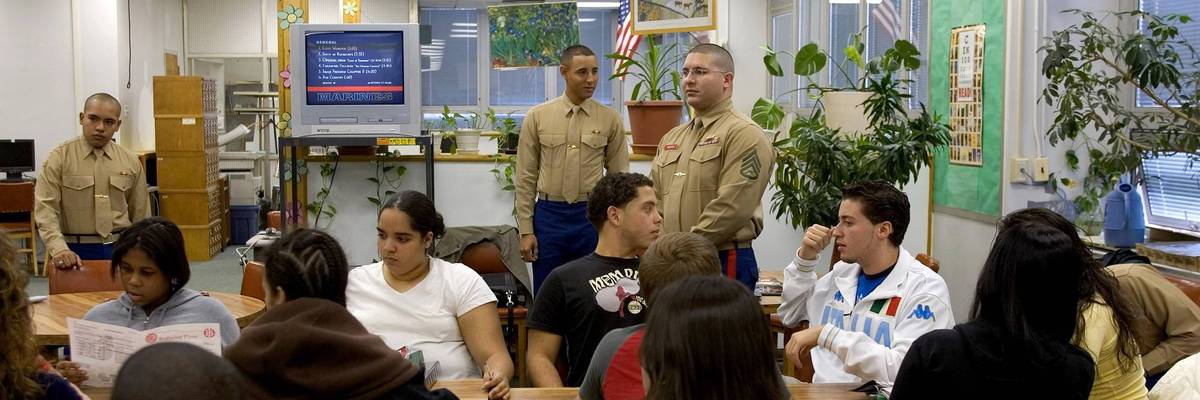
US Marine Staff Sergeant Erick Bruno (right) speaks to a group of senior Hoboken High School students during a Marine recruitment presentation on November 22, 2005 in Hoboken, New Jersey.
Thus far we’ve lost six service members. That number will almost certainly increase as this drags on. And the hard truth is the majority of those casualties will be kids recruited out of high schools in marginalized communities.
When the powers that be talk about sending kids to war, they aren’t talking about their kids. So, whose kids are they talking about, and where do those kids come from?
I teach senior English at an urban high school in upstate New York. The poverty rate here is high. There are no Fortunate Sons (or daughters) on my roster. And several have signed up to join the military after graduation. While I have nothing but reverence and respect for anyone willing to serve our great nation, I’m not sure 18 is old enough–or mature enough–to make such a seismic decision, especially now that a protracted conflict with Iran is a real possibility.
On Monday, Sen. Markwayne Mullin (R-Okla.) said, “If anybody has ever been there and been able to smell the war that's happening around you and taste it, and feel it in your nostrils, and hear it, it's something that you'll never forget.” Of course, Mr. Mullin himself has never been anywhere near a war.
Trust me when I tell you: 18 year olds are still children. They say dumb things. They do dumb things. They act on impulse. And a high school like mine is fruitful ground for the military. Most days, there’s a recruiter in the cafeteria when the kids come for lunch. He brings pamphlets and a pull-up bar. He dangles a signing bonus. And once someone commits, the military has them. A contract with any branch of the armed services is the only bona-fide lifelong contract in our culture.
“Kids aren’t supposed to be hurt or used by adults, or sent to potentially die in the sand, when only a few months prior they had to ask permission for a bathroom pass.”
According to the US Department of “War,” the military is seeing its highest recruiting numbers in over a decade. By June 2025, the Army, Navy, Air Force, and Space Force had already met their annual benchmarks. Perhaps this uptick is attributed to a sudden surge of patriotism. More likely, it’s because of a tightening job market for high school grads, or the rising costs of a college education.
Retired Staff Sergeant Tony Buchanan, who joined the Army in 2001 after high school, and served tours in Iraq and Afghanistan, said, “While I believe the military does a good job evaluating these young men and women before enlisting them, legally, a recruiter does not need to speak with a parent.”
I have no doubt the military teaches hard work, respect, and humility, plus the opportunity to embark on some pretty cool careers. But the reality is, at some point, these young men and women could be called to a war front, regardless of their individual goals or beliefs. Because of that, we must hope that our leadership sees war as a last resort.
To justify the mission, Secretary of State Marco Rubio said, “The imminent threat was that we knew that if Iran was attacked, and we believed they would be attacked, they would immediately come after us. If we waited for them to hit us first after they were attacked by someone else, we would suffer more casualties and more deaths.”
As a public educator, when I build a unit of study, the first thing I determine is where I want the content to take my students. The defined endgame drives all planning. I don’t just make it up as I go along and hope everything works out. Students always know what we’re doing, why we’re doing it, and where it’ll lead. They might not like it, and they may not agree with it, but they recognize the rationale.
Regarding our attack on Iran, I fear the endgame hasn’t been defined, and if it has, this administration has done a poor job articulating that. On Monday, Mark Warner, the top Democrat on the Senate Intel Committee, said he’s heard the administration verbalize “at least four different goals in the last eight or nine days.”
Every winter I teach Tim O’Brien’s The Things They Carried, a collection of short stories that explore the experiences of American soldiers in the Vietnam War. In it, O’Brien writes: “You don't make war without knowing why. Knowledge, of course, is always imperfect, but it seemed to me that when a nation goes to war it must have reasonable confidence in the justice and imperative of its cause. You can't fix your mistakes. Once people are dead, you can't make them undead.”
A CNN poll found that 59% of Americans disapprove of the Iran strikes and think a long-term conflict is likely.
Thus far we’ve lost six service members. That number will almost certainly increase as this drags on. And the hard truth is the majority of those casualties will be kids recruited out of high schools in marginalized communities.
“I’m a parent and teacher, so I see it as my job to protect kids,” said Derek Shuttleworth, a veteran educator who’s taught in Alaska, Oregon, California, and New York. “Kids aren’t supposed to be hurt or used by adults, or sent to potentially die in the sand, when only a few months prior they had to ask permission for a bathroom pass.”
This past January, I sat with a senior who’d just signed with the Army. He was excited about the cash bonus, enough to put a down payment on a “sick-ass truck.” Yesterday, he came back to see me. He’s now worried about the war. He doesn’t want to “catch a bullet in Iran.” He said, “I might’ve made a mistake."
Dear Common Dreams reader, It’s been nearly 30 years since I co-founded Common Dreams with my late wife, Lina Newhouser. We had the radical notion that journalism should serve the public good, not corporate profits. It was clear to us from the outset what it would take to build such a project. No paid advertisements. No corporate sponsors. No millionaire publisher telling us what to think or do. Many people said we wouldn't last a year, but we proved those doubters wrong. Together with a tremendous team of journalists and dedicated staff, we built an independent media outlet free from the constraints of profits and corporate control. Our mission has always been simple: To inform. To inspire. To ignite change for the common good. Building Common Dreams was not easy. Our survival was never guaranteed. When you take on the most powerful forces—Wall Street greed, fossil fuel industry destruction, Big Tech lobbyists, and uber-rich oligarchs who have spent billions upon billions rigging the economy and democracy in their favor—the only bulwark you have is supporters who believe in your work. But here’s the urgent message from me today. It's never been this bad out there. And it's never been this hard to keep us going. At the very moment Common Dreams is most needed, the threats we face are intensifying. We need your support now more than ever. We don't accept corporate advertising and never will. We don't have a paywall because we don't think people should be blocked from critical news based on their ability to pay. Everything we do is funded by the donations of readers like you. When everyone does the little they can afford, we are strong. But if that support retreats or dries up, so do we. Will you donate now to make sure Common Dreams not only survives but thrives? —Craig Brown, Co-founder |
When the powers that be talk about sending kids to war, they aren’t talking about their kids. So, whose kids are they talking about, and where do those kids come from?
I teach senior English at an urban high school in upstate New York. The poverty rate here is high. There are no Fortunate Sons (or daughters) on my roster. And several have signed up to join the military after graduation. While I have nothing but reverence and respect for anyone willing to serve our great nation, I’m not sure 18 is old enough–or mature enough–to make such a seismic decision, especially now that a protracted conflict with Iran is a real possibility.
On Monday, Sen. Markwayne Mullin (R-Okla.) said, “If anybody has ever been there and been able to smell the war that's happening around you and taste it, and feel it in your nostrils, and hear it, it's something that you'll never forget.” Of course, Mr. Mullin himself has never been anywhere near a war.
Trust me when I tell you: 18 year olds are still children. They say dumb things. They do dumb things. They act on impulse. And a high school like mine is fruitful ground for the military. Most days, there’s a recruiter in the cafeteria when the kids come for lunch. He brings pamphlets and a pull-up bar. He dangles a signing bonus. And once someone commits, the military has them. A contract with any branch of the armed services is the only bona-fide lifelong contract in our culture.
“Kids aren’t supposed to be hurt or used by adults, or sent to potentially die in the sand, when only a few months prior they had to ask permission for a bathroom pass.”
According to the US Department of “War,” the military is seeing its highest recruiting numbers in over a decade. By June 2025, the Army, Navy, Air Force, and Space Force had already met their annual benchmarks. Perhaps this uptick is attributed to a sudden surge of patriotism. More likely, it’s because of a tightening job market for high school grads, or the rising costs of a college education.
Retired Staff Sergeant Tony Buchanan, who joined the Army in 2001 after high school, and served tours in Iraq and Afghanistan, said, “While I believe the military does a good job evaluating these young men and women before enlisting them, legally, a recruiter does not need to speak with a parent.”
I have no doubt the military teaches hard work, respect, and humility, plus the opportunity to embark on some pretty cool careers. But the reality is, at some point, these young men and women could be called to a war front, regardless of their individual goals or beliefs. Because of that, we must hope that our leadership sees war as a last resort.
To justify the mission, Secretary of State Marco Rubio said, “The imminent threat was that we knew that if Iran was attacked, and we believed they would be attacked, they would immediately come after us. If we waited for them to hit us first after they were attacked by someone else, we would suffer more casualties and more deaths.”
As a public educator, when I build a unit of study, the first thing I determine is where I want the content to take my students. The defined endgame drives all planning. I don’t just make it up as I go along and hope everything works out. Students always know what we’re doing, why we’re doing it, and where it’ll lead. They might not like it, and they may not agree with it, but they recognize the rationale.
Regarding our attack on Iran, I fear the endgame hasn’t been defined, and if it has, this administration has done a poor job articulating that. On Monday, Mark Warner, the top Democrat on the Senate Intel Committee, said he’s heard the administration verbalize “at least four different goals in the last eight or nine days.”
Every winter I teach Tim O’Brien’s The Things They Carried, a collection of short stories that explore the experiences of American soldiers in the Vietnam War. In it, O’Brien writes: “You don't make war without knowing why. Knowledge, of course, is always imperfect, but it seemed to me that when a nation goes to war it must have reasonable confidence in the justice and imperative of its cause. You can't fix your mistakes. Once people are dead, you can't make them undead.”
A CNN poll found that 59% of Americans disapprove of the Iran strikes and think a long-term conflict is likely.
Thus far we’ve lost six service members. That number will almost certainly increase as this drags on. And the hard truth is the majority of those casualties will be kids recruited out of high schools in marginalized communities.
“I’m a parent and teacher, so I see it as my job to protect kids,” said Derek Shuttleworth, a veteran educator who’s taught in Alaska, Oregon, California, and New York. “Kids aren’t supposed to be hurt or used by adults, or sent to potentially die in the sand, when only a few months prior they had to ask permission for a bathroom pass.”
This past January, I sat with a senior who’d just signed with the Army. He was excited about the cash bonus, enough to put a down payment on a “sick-ass truck.” Yesterday, he came back to see me. He’s now worried about the war. He doesn’t want to “catch a bullet in Iran.” He said, “I might’ve made a mistake."
When the powers that be talk about sending kids to war, they aren’t talking about their kids. So, whose kids are they talking about, and where do those kids come from?
I teach senior English at an urban high school in upstate New York. The poverty rate here is high. There are no Fortunate Sons (or daughters) on my roster. And several have signed up to join the military after graduation. While I have nothing but reverence and respect for anyone willing to serve our great nation, I’m not sure 18 is old enough–or mature enough–to make such a seismic decision, especially now that a protracted conflict with Iran is a real possibility.
On Monday, Sen. Markwayne Mullin (R-Okla.) said, “If anybody has ever been there and been able to smell the war that's happening around you and taste it, and feel it in your nostrils, and hear it, it's something that you'll never forget.” Of course, Mr. Mullin himself has never been anywhere near a war.
Trust me when I tell you: 18 year olds are still children. They say dumb things. They do dumb things. They act on impulse. And a high school like mine is fruitful ground for the military. Most days, there’s a recruiter in the cafeteria when the kids come for lunch. He brings pamphlets and a pull-up bar. He dangles a signing bonus. And once someone commits, the military has them. A contract with any branch of the armed services is the only bona-fide lifelong contract in our culture.
“Kids aren’t supposed to be hurt or used by adults, or sent to potentially die in the sand, when only a few months prior they had to ask permission for a bathroom pass.”
According to the US Department of “War,” the military is seeing its highest recruiting numbers in over a decade. By June 2025, the Army, Navy, Air Force, and Space Force had already met their annual benchmarks. Perhaps this uptick is attributed to a sudden surge of patriotism. More likely, it’s because of a tightening job market for high school grads, or the rising costs of a college education.
Retired Staff Sergeant Tony Buchanan, who joined the Army in 2001 after high school, and served tours in Iraq and Afghanistan, said, “While I believe the military does a good job evaluating these young men and women before enlisting them, legally, a recruiter does not need to speak with a parent.”
I have no doubt the military teaches hard work, respect, and humility, plus the opportunity to embark on some pretty cool careers. But the reality is, at some point, these young men and women could be called to a war front, regardless of their individual goals or beliefs. Because of that, we must hope that our leadership sees war as a last resort.
To justify the mission, Secretary of State Marco Rubio said, “The imminent threat was that we knew that if Iran was attacked, and we believed they would be attacked, they would immediately come after us. If we waited for them to hit us first after they were attacked by someone else, we would suffer more casualties and more deaths.”
As a public educator, when I build a unit of study, the first thing I determine is where I want the content to take my students. The defined endgame drives all planning. I don’t just make it up as I go along and hope everything works out. Students always know what we’re doing, why we’re doing it, and where it’ll lead. They might not like it, and they may not agree with it, but they recognize the rationale.
Regarding our attack on Iran, I fear the endgame hasn’t been defined, and if it has, this administration has done a poor job articulating that. On Monday, Mark Warner, the top Democrat on the Senate Intel Committee, said he’s heard the administration verbalize “at least four different goals in the last eight or nine days.”
Every winter I teach Tim O’Brien’s The Things They Carried, a collection of short stories that explore the experiences of American soldiers in the Vietnam War. In it, O’Brien writes: “You don't make war without knowing why. Knowledge, of course, is always imperfect, but it seemed to me that when a nation goes to war it must have reasonable confidence in the justice and imperative of its cause. You can't fix your mistakes. Once people are dead, you can't make them undead.”
A CNN poll found that 59% of Americans disapprove of the Iran strikes and think a long-term conflict is likely.
Thus far we’ve lost six service members. That number will almost certainly increase as this drags on. And the hard truth is the majority of those casualties will be kids recruited out of high schools in marginalized communities.
“I’m a parent and teacher, so I see it as my job to protect kids,” said Derek Shuttleworth, a veteran educator who’s taught in Alaska, Oregon, California, and New York. “Kids aren’t supposed to be hurt or used by adults, or sent to potentially die in the sand, when only a few months prior they had to ask permission for a bathroom pass.”
This past January, I sat with a senior who’d just signed with the Army. He was excited about the cash bonus, enough to put a down payment on a “sick-ass truck.” Yesterday, he came back to see me. He’s now worried about the war. He doesn’t want to “catch a bullet in Iran.” He said, “I might’ve made a mistake."

