SUBSCRIBE TO OUR FREE NEWSLETTER
Daily news & progressive opinion—funded by the people, not the corporations—delivered straight to your inbox.
5
#000000
#FFFFFF
To donate by check, phone, or other method, see our More Ways to Give page.
Daily news & progressive opinion—funded by the people, not the corporations—delivered straight to your inbox.
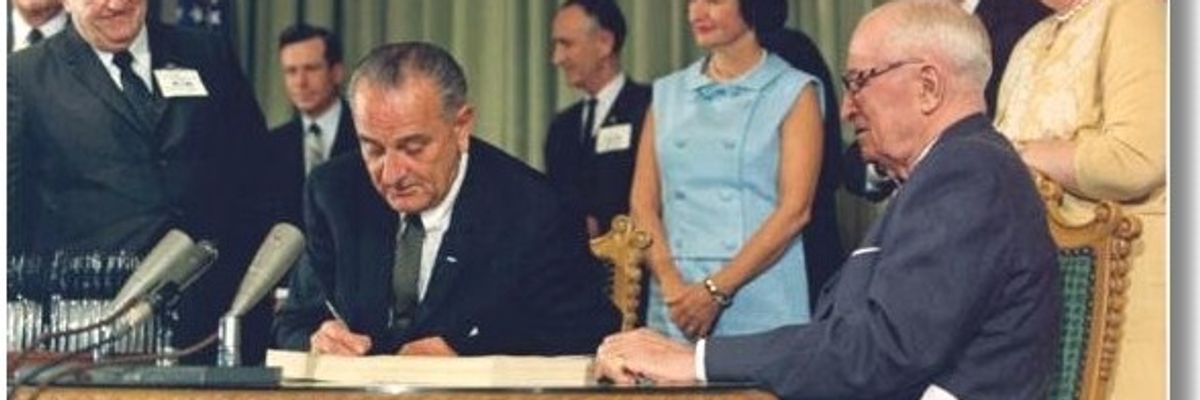
President Johnson signs the Medicare program into law on July 30, 1965.
Even after nearly six decades of Medicare’s overall success, we must continually protect it from conservatives’ attempts to cut and privatize the program.
Before Medicare was
signed into law by President Lyndon Johnson 59 years ago today, nearly half of American seniors had no hospital insurance. Private insurance companies were reluctant to cover anyone over 65. Even fewer seniors had coverage for non-hospital services like doctor’s visits. Many of the elderly were forced to exhaust their retirement savings to pay for medical care; some fell into poverty because of it. All of that changed with Medicare.
In Medicare’s first year of coverage, poverty decreased by 66% among the senior population. From 1965, when Medicare was enacted, to 1994, life expectancy at age 65 increased nearly three full years. This was no coincidence. Access to Medicare coverage for those who were previously uninsured helped lift seniors out of poverty and extend their lives.
As with Social Security, workers would contribute with each paycheck toward their future Medicare benefits. Upon putting his signature on this new program, a keystone of the Great Society, President Johnson declared, “Every citizen will be able, in their productive years when they are earning, to insure themselves against the ravages of illness in old age.”
Project 2025, the right-wing blueprint for a second Trump presidency, would gut traditional Medicare by accelerating privatization and repealing drug price negotiation.
Medicare has been improved several times over the decades. In 1972, Americans with disabilities (under 65 years of age) became eligible for Medicare coverage—along with people suffering from chronic kidney disease needing dialysis or transplants. In 2003, prescription drug coverage was added to Medicare (though the program was prohibited from negotiating prices with drugmakers). The Inflation Reduction Act of 2022 finally empowered Medicare to negotiate prices with Big Pharma—and lowered seniors’ costs by capping their out-of-pocket expenses for prescription drugs and insulin.
Nearly 60 years after it was enacted, Medicare is one of the most popular and efficient federal programs. Ninety-four percent of beneficiaries say they are “satisfied” or “very satisfied” with their quality of care. Unlike many other federal programs, Medicare spends less than 2% of its budget on administrative costs.
Medicare isn’t perfect. It should be expanded to cover dental, hearing, and vision care. More urgently, though, the privatized version of the program, Medicare Advantage (MA), is gobbling up a larger share of the program despite myriad problems, including MA insurers overbilling the government and denying care that’s always offered by traditional Medicare. The Biden-Harris administration has been working to hold those private plans more accountable, but much remains to be done to protect traditional Medicare from efforts toward privatization.
Even after 59 years of Medicare’s overall success, we must continually defend Medicare against conservatives’ attempts to cut and privatize the program. Our founder, Rep. James Roosevelt, Sr. (D-Calif.), son of President Franklin D. Roosevelt, knew that Medicare (along with Social Security) would need continuous advocacy to withstand assaults from antagonistic political forces. That’s why the word “preserve” is in our organization’s name.
Many conservatives opposed Medicare from the start, labeling it “socialism” and “socialized medicine.” In 1962, Ronald Reagan warned that if Medicare were to be enacted, “One of these days you and I are going to spend our sunset years telling our children, and our children’s children, what it once was like in America when men were free.”
Today, the onslaught continues. The House Republican Study Committee’s (RSC) 2025 budget proposes to cut Medicare by an estimated $1 trillion over the next decade. The RSC would replace Medicare’s current system with vouchers, and push seniors into private plans that can and do deny coverage. Project 2025, the right-wing blueprint for a second Trump presidency, would gut traditional Medicare by accelerating privatization and repealing drug price negotiation.
Democrats by and large support protecting and even expanding Medicare. President Joe Biden tried to add dental, vision, and hearing coverage in his Build Back Better Act, but encountered resistance from Republicans and centrist Democrats. It’s still a laudable goal.
Republicans, for the most part, advocate cutting Medicare benefits and privatization. We endorsed Vice President Kamala Harris for president, because she knows the importance of Medicare to America’s seniors and people with disabilities—and has vowed to protect them. Former President Donald Trump, on the other hand, has been rhetorically all over the map on this topic, telling CNBC he is “open” to “cutting entitlements” but claiming to support Medicare. (His budgets as president called for billions of dollars in Medicare cuts.)
The 59th anniversary of Medicare is both an occasion for celebrating the program’s enormous successes over the past six decades—and a time to defend Medicare in the marbled halls of Washington, D.C., and at the ballot box this November.
Dear Common Dreams reader, It’s been nearly 30 years since I co-founded Common Dreams with my late wife, Lina Newhouser. We had the radical notion that journalism should serve the public good, not corporate profits. It was clear to us from the outset what it would take to build such a project. No paid advertisements. No corporate sponsors. No millionaire publisher telling us what to think or do. Many people said we wouldn't last a year, but we proved those doubters wrong. Together with a tremendous team of journalists and dedicated staff, we built an independent media outlet free from the constraints of profits and corporate control. Our mission has always been simple: To inform. To inspire. To ignite change for the common good. Building Common Dreams was not easy. Our survival was never guaranteed. When you take on the most powerful forces—Wall Street greed, fossil fuel industry destruction, Big Tech lobbyists, and uber-rich oligarchs who have spent billions upon billions rigging the economy and democracy in their favor—the only bulwark you have is supporters who believe in your work. But here’s the urgent message from me today. It's never been this bad out there. And it's never been this hard to keep us going. At the very moment Common Dreams is most needed, the threats we face are intensifying. We need your support now more than ever. We don't accept corporate advertising and never will. We don't have a paywall because we don't think people should be blocked from critical news based on their ability to pay. Everything we do is funded by the donations of readers like you. When everyone does the little they can afford, we are strong. But if that support retreats or dries up, so do we. Will you donate now to make sure Common Dreams not only survives but thrives? —Craig Brown, Co-founder |
Before Medicare was
signed into law by President Lyndon Johnson 59 years ago today, nearly half of American seniors had no hospital insurance. Private insurance companies were reluctant to cover anyone over 65. Even fewer seniors had coverage for non-hospital services like doctor’s visits. Many of the elderly were forced to exhaust their retirement savings to pay for medical care; some fell into poverty because of it. All of that changed with Medicare.
In Medicare’s first year of coverage, poverty decreased by 66% among the senior population. From 1965, when Medicare was enacted, to 1994, life expectancy at age 65 increased nearly three full years. This was no coincidence. Access to Medicare coverage for those who were previously uninsured helped lift seniors out of poverty and extend their lives.
As with Social Security, workers would contribute with each paycheck toward their future Medicare benefits. Upon putting his signature on this new program, a keystone of the Great Society, President Johnson declared, “Every citizen will be able, in their productive years when they are earning, to insure themselves against the ravages of illness in old age.”
Project 2025, the right-wing blueprint for a second Trump presidency, would gut traditional Medicare by accelerating privatization and repealing drug price negotiation.
Medicare has been improved several times over the decades. In 1972, Americans with disabilities (under 65 years of age) became eligible for Medicare coverage—along with people suffering from chronic kidney disease needing dialysis or transplants. In 2003, prescription drug coverage was added to Medicare (though the program was prohibited from negotiating prices with drugmakers). The Inflation Reduction Act of 2022 finally empowered Medicare to negotiate prices with Big Pharma—and lowered seniors’ costs by capping their out-of-pocket expenses for prescription drugs and insulin.
Nearly 60 years after it was enacted, Medicare is one of the most popular and efficient federal programs. Ninety-four percent of beneficiaries say they are “satisfied” or “very satisfied” with their quality of care. Unlike many other federal programs, Medicare spends less than 2% of its budget on administrative costs.
Medicare isn’t perfect. It should be expanded to cover dental, hearing, and vision care. More urgently, though, the privatized version of the program, Medicare Advantage (MA), is gobbling up a larger share of the program despite myriad problems, including MA insurers overbilling the government and denying care that’s always offered by traditional Medicare. The Biden-Harris administration has been working to hold those private plans more accountable, but much remains to be done to protect traditional Medicare from efforts toward privatization.
Even after 59 years of Medicare’s overall success, we must continually defend Medicare against conservatives’ attempts to cut and privatize the program. Our founder, Rep. James Roosevelt, Sr. (D-Calif.), son of President Franklin D. Roosevelt, knew that Medicare (along with Social Security) would need continuous advocacy to withstand assaults from antagonistic political forces. That’s why the word “preserve” is in our organization’s name.
Many conservatives opposed Medicare from the start, labeling it “socialism” and “socialized medicine.” In 1962, Ronald Reagan warned that if Medicare were to be enacted, “One of these days you and I are going to spend our sunset years telling our children, and our children’s children, what it once was like in America when men were free.”
Today, the onslaught continues. The House Republican Study Committee’s (RSC) 2025 budget proposes to cut Medicare by an estimated $1 trillion over the next decade. The RSC would replace Medicare’s current system with vouchers, and push seniors into private plans that can and do deny coverage. Project 2025, the right-wing blueprint for a second Trump presidency, would gut traditional Medicare by accelerating privatization and repealing drug price negotiation.
Democrats by and large support protecting and even expanding Medicare. President Joe Biden tried to add dental, vision, and hearing coverage in his Build Back Better Act, but encountered resistance from Republicans and centrist Democrats. It’s still a laudable goal.
Republicans, for the most part, advocate cutting Medicare benefits and privatization. We endorsed Vice President Kamala Harris for president, because she knows the importance of Medicare to America’s seniors and people with disabilities—and has vowed to protect them. Former President Donald Trump, on the other hand, has been rhetorically all over the map on this topic, telling CNBC he is “open” to “cutting entitlements” but claiming to support Medicare. (His budgets as president called for billions of dollars in Medicare cuts.)
The 59th anniversary of Medicare is both an occasion for celebrating the program’s enormous successes over the past six decades—and a time to defend Medicare in the marbled halls of Washington, D.C., and at the ballot box this November.
Before Medicare was
signed into law by President Lyndon Johnson 59 years ago today, nearly half of American seniors had no hospital insurance. Private insurance companies were reluctant to cover anyone over 65. Even fewer seniors had coverage for non-hospital services like doctor’s visits. Many of the elderly were forced to exhaust their retirement savings to pay for medical care; some fell into poverty because of it. All of that changed with Medicare.
In Medicare’s first year of coverage, poverty decreased by 66% among the senior population. From 1965, when Medicare was enacted, to 1994, life expectancy at age 65 increased nearly three full years. This was no coincidence. Access to Medicare coverage for those who were previously uninsured helped lift seniors out of poverty and extend their lives.
As with Social Security, workers would contribute with each paycheck toward their future Medicare benefits. Upon putting his signature on this new program, a keystone of the Great Society, President Johnson declared, “Every citizen will be able, in their productive years when they are earning, to insure themselves against the ravages of illness in old age.”
Project 2025, the right-wing blueprint for a second Trump presidency, would gut traditional Medicare by accelerating privatization and repealing drug price negotiation.
Medicare has been improved several times over the decades. In 1972, Americans with disabilities (under 65 years of age) became eligible for Medicare coverage—along with people suffering from chronic kidney disease needing dialysis or transplants. In 2003, prescription drug coverage was added to Medicare (though the program was prohibited from negotiating prices with drugmakers). The Inflation Reduction Act of 2022 finally empowered Medicare to negotiate prices with Big Pharma—and lowered seniors’ costs by capping their out-of-pocket expenses for prescription drugs and insulin.
Nearly 60 years after it was enacted, Medicare is one of the most popular and efficient federal programs. Ninety-four percent of beneficiaries say they are “satisfied” or “very satisfied” with their quality of care. Unlike many other federal programs, Medicare spends less than 2% of its budget on administrative costs.
Medicare isn’t perfect. It should be expanded to cover dental, hearing, and vision care. More urgently, though, the privatized version of the program, Medicare Advantage (MA), is gobbling up a larger share of the program despite myriad problems, including MA insurers overbilling the government and denying care that’s always offered by traditional Medicare. The Biden-Harris administration has been working to hold those private plans more accountable, but much remains to be done to protect traditional Medicare from efforts toward privatization.
Even after 59 years of Medicare’s overall success, we must continually defend Medicare against conservatives’ attempts to cut and privatize the program. Our founder, Rep. James Roosevelt, Sr. (D-Calif.), son of President Franklin D. Roosevelt, knew that Medicare (along with Social Security) would need continuous advocacy to withstand assaults from antagonistic political forces. That’s why the word “preserve” is in our organization’s name.
Many conservatives opposed Medicare from the start, labeling it “socialism” and “socialized medicine.” In 1962, Ronald Reagan warned that if Medicare were to be enacted, “One of these days you and I are going to spend our sunset years telling our children, and our children’s children, what it once was like in America when men were free.”
Today, the onslaught continues. The House Republican Study Committee’s (RSC) 2025 budget proposes to cut Medicare by an estimated $1 trillion over the next decade. The RSC would replace Medicare’s current system with vouchers, and push seniors into private plans that can and do deny coverage. Project 2025, the right-wing blueprint for a second Trump presidency, would gut traditional Medicare by accelerating privatization and repealing drug price negotiation.
Democrats by and large support protecting and even expanding Medicare. President Joe Biden tried to add dental, vision, and hearing coverage in his Build Back Better Act, but encountered resistance from Republicans and centrist Democrats. It’s still a laudable goal.
Republicans, for the most part, advocate cutting Medicare benefits and privatization. We endorsed Vice President Kamala Harris for president, because she knows the importance of Medicare to America’s seniors and people with disabilities—and has vowed to protect them. Former President Donald Trump, on the other hand, has been rhetorically all over the map on this topic, telling CNBC he is “open” to “cutting entitlements” but claiming to support Medicare. (His budgets as president called for billions of dollars in Medicare cuts.)
The 59th anniversary of Medicare is both an occasion for celebrating the program’s enormous successes over the past six decades—and a time to defend Medicare in the marbled halls of Washington, D.C., and at the ballot box this November.