SUBSCRIBE TO OUR FREE NEWSLETTER
Daily news & progressive opinion—funded by the people, not the corporations—delivered straight to your inbox.
5
#000000
#FFFFFF
To donate by check, phone, or other method, see our More Ways to Give page.
Daily news & progressive opinion—funded by the people, not the corporations—delivered straight to your inbox.
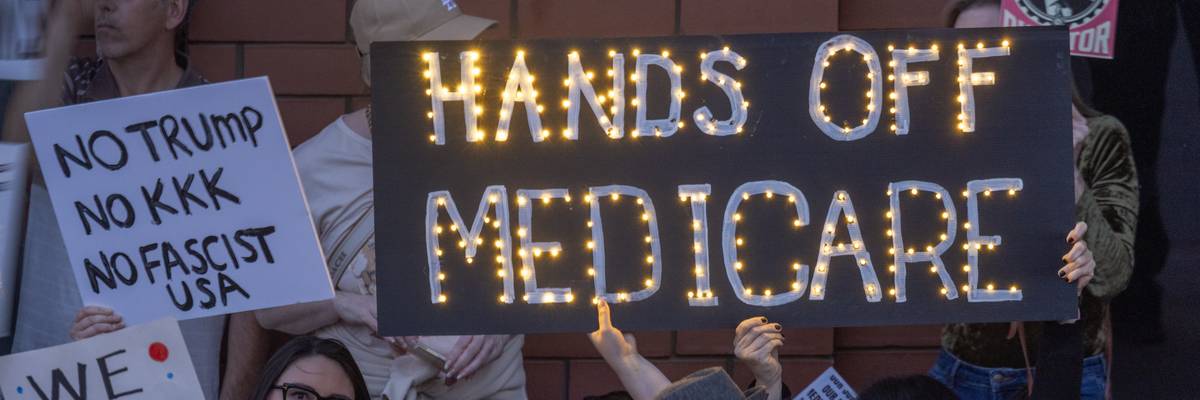
People join in a "Hands Off!" protest against the Trump administration on April 5, 2025 in Riverside, California. Protests against Trump administration policies and Elon Musk's Department of Government Efficiency (DOGE) are being held nationwide in what organizers are calling a National Day of Action.
Let's not allow President Trump and congressional Republicans to shred one of the greatest legacies of LBJ's Great Society.
Medicare turns 60 years old today. Former U.S. President Lyndon B. Johnson signed it into law on July 30, 1965, giving seniors a guarantee of health coverage that never existed before. Prior to Medicare's enactment, it was nearly impossible for older people to obtain health insurance, as they were considered a "bad risk."
Medicare provides universal coverage to Americans over 65 years of age. The law created Medicare Part A as a national hospital insurance program. Part B is a voluntary program for doctor visits and other medical services. Medicare Part C is another name for the privatized, for-profit version of the program called "Medicare Advantage." And Part D is the prescription drug program enacted in 2003.
The Hospital Insurance portion is funded through workers' payroll contributions. At the signing ceremony in Independence, Missouri, LBJ said, "Through this new law, every citizen will be able, in their productive years when they are earning, to insure themselves against the ravages of illness in his old age."
Lyndon Johnson paid tribute to former President Harry S. Truman, presenting him with the very first Medicare card. It was Truman who, 20 years earlier, had proposed a form of universal medical coverage for the American people.
LBJ quoted Truman's remarks from the 1940s:
Millions of our citizens do not now have a full measure of opportunity to achieve and to enjoy good health. Millions do not now have protection or security against the economic effects of sickness. And the time has now arrived for action to help them attain that opportunity and to help them get that protection.
It turned out that the time had not yet arrived. Truman's proposal failed to gain traction during a time of retrenchment from the expansions of the New Deal, and a Republican majority on Capitol Hill which he famously labeled the "Do-Nothing Congress."
President Johnson's determination to enact his Great Society agenda (of which Medicare was a large part) and sheer political muscle—not to mention solid Democratic control of Congress—pushed Medicare (and its sister program, Medicaid) into being.
Naturally, Medicare faced strong opposition from conservatives. None other than Ronald Reagan made the ludicrous prediction that if Medicare were enacted, "You and I are going to spend our sunset years telling our children and our children's children what it once was like in America when men were free." Sixty years later, we are no less "free" because of Medicare. In fact, having guaranteed healthcare makes seniors and people with disabilities (and their families) much more free—from disease, from worry, and financial ruin.
Today, 68 million people rely on Medicare for health coverage, including 12 million who are dually eligible for Medicare and Medicaid. Medicare isn't perfect: The for-profit Medicare Advantage (Part C) program is extremely problematic (see below). The Medicare Part A trust fund will become depleted in 2033 if Congress fails to take action to strengthen it. Traditional Medicare still doesn't cover basic hearing, vision, and dental care—which we have been pushing for many years. But most concerning of all—President Donald Trump and his party have spent this 60th anniversary year actively undermining both Medicare and Medicaid.
The "Unfair, Ugly" bill that Trump signed earlier this month slashed nearly $1 trillion from Medicaid, which will strip health coverage from an estimated 10 to 16 million lower-income Americans. The new law—projected to add some $4 trillion to the national debt—could trigger cuts to Medicare down the road.
Meanwhile, the Trump administration is recklessly taking steps to privatize the entire Medicare program. It has announced a pilot project to involve private companies in conducting prior authorizations for care in traditional Medicare. The administration, under Health and Human Services Secretary Robert F. Kennedy, Jr. and Centers for Medicare and Medicaid Services Director Mehmet Oz, also has announced a plan to automatically enroll new Medicare beneficiaries in the for-profit Medicare Advantage (MA) program—a huge gift to the multibillion dollar insurance industry at the expense of patients.
The problems with Medicare Advantage (MA) have become legendary. Enrollees are basically put into health maintenance organizations run by insurance giants, with limited networks of providers. Unreasonable denials of care are rampant. Patients who become disenchanted with MA plans often find it nearly impossible to switch to traditional Medicare. Meanwhile, some MA Insurers have been overcharging the government for their services and ripping off taxpayers. (Several of these companies are currently under investigation.)
We are watching to see if the Trump administration, which talks a good game about lowering prescription medication costs while simultaneously doing favors for Big Pharma, will honor the provisions of President Joe Biden's Inflation Reduction Act, which made myriad patient-friendly reforms to the Part D drug program—including out of pocket caps for beneficiaries and empowering Medicare to negotiate prices with the industry.
The bottom line is: Let's not allow President Trump and congressional Republicans to shred one of the greatest legacies of LBJ's Great Society. We and our fellow advocacy groups are pushing back—and so is the grassroots "Hands Off" movement. But we don't want to be fighting this same battle every time Medicare (and Medicaid) mark an anniversary when we should be purely celebrating.
Dear Common Dreams reader, It’s been nearly 30 years since I co-founded Common Dreams with my late wife, Lina Newhouser. We had the radical notion that journalism should serve the public good, not corporate profits. It was clear to us from the outset what it would take to build such a project. No paid advertisements. No corporate sponsors. No millionaire publisher telling us what to think or do. Many people said we wouldn't last a year, but we proved those doubters wrong. Together with a tremendous team of journalists and dedicated staff, we built an independent media outlet free from the constraints of profits and corporate control. Our mission has always been simple: To inform. To inspire. To ignite change for the common good. Building Common Dreams was not easy. Our survival was never guaranteed. When you take on the most powerful forces—Wall Street greed, fossil fuel industry destruction, Big Tech lobbyists, and uber-rich oligarchs who have spent billions upon billions rigging the economy and democracy in their favor—the only bulwark you have is supporters who believe in your work. But here’s the urgent message from me today. It's never been this bad out there. And it's never been this hard to keep us going. At the very moment Common Dreams is most needed, the threats we face are intensifying. We need your support now more than ever. We don't accept corporate advertising and never will. We don't have a paywall because we don't think people should be blocked from critical news based on their ability to pay. Everything we do is funded by the donations of readers like you. When everyone does the little they can afford, we are strong. But if that support retreats or dries up, so do we. Will you donate now to make sure Common Dreams not only survives but thrives? —Craig Brown, Co-founder |
Medicare turns 60 years old today. Former U.S. President Lyndon B. Johnson signed it into law on July 30, 1965, giving seniors a guarantee of health coverage that never existed before. Prior to Medicare's enactment, it was nearly impossible for older people to obtain health insurance, as they were considered a "bad risk."
Medicare provides universal coverage to Americans over 65 years of age. The law created Medicare Part A as a national hospital insurance program. Part B is a voluntary program for doctor visits and other medical services. Medicare Part C is another name for the privatized, for-profit version of the program called "Medicare Advantage." And Part D is the prescription drug program enacted in 2003.
The Hospital Insurance portion is funded through workers' payroll contributions. At the signing ceremony in Independence, Missouri, LBJ said, "Through this new law, every citizen will be able, in their productive years when they are earning, to insure themselves against the ravages of illness in his old age."
Lyndon Johnson paid tribute to former President Harry S. Truman, presenting him with the very first Medicare card. It was Truman who, 20 years earlier, had proposed a form of universal medical coverage for the American people.
LBJ quoted Truman's remarks from the 1940s:
Millions of our citizens do not now have a full measure of opportunity to achieve and to enjoy good health. Millions do not now have protection or security against the economic effects of sickness. And the time has now arrived for action to help them attain that opportunity and to help them get that protection.
It turned out that the time had not yet arrived. Truman's proposal failed to gain traction during a time of retrenchment from the expansions of the New Deal, and a Republican majority on Capitol Hill which he famously labeled the "Do-Nothing Congress."
President Johnson's determination to enact his Great Society agenda (of which Medicare was a large part) and sheer political muscle—not to mention solid Democratic control of Congress—pushed Medicare (and its sister program, Medicaid) into being.
Naturally, Medicare faced strong opposition from conservatives. None other than Ronald Reagan made the ludicrous prediction that if Medicare were enacted, "You and I are going to spend our sunset years telling our children and our children's children what it once was like in America when men were free." Sixty years later, we are no less "free" because of Medicare. In fact, having guaranteed healthcare makes seniors and people with disabilities (and their families) much more free—from disease, from worry, and financial ruin.
Today, 68 million people rely on Medicare for health coverage, including 12 million who are dually eligible for Medicare and Medicaid. Medicare isn't perfect: The for-profit Medicare Advantage (Part C) program is extremely problematic (see below). The Medicare Part A trust fund will become depleted in 2033 if Congress fails to take action to strengthen it. Traditional Medicare still doesn't cover basic hearing, vision, and dental care—which we have been pushing for many years. But most concerning of all—President Donald Trump and his party have spent this 60th anniversary year actively undermining both Medicare and Medicaid.
The "Unfair, Ugly" bill that Trump signed earlier this month slashed nearly $1 trillion from Medicaid, which will strip health coverage from an estimated 10 to 16 million lower-income Americans. The new law—projected to add some $4 trillion to the national debt—could trigger cuts to Medicare down the road.
Meanwhile, the Trump administration is recklessly taking steps to privatize the entire Medicare program. It has announced a pilot project to involve private companies in conducting prior authorizations for care in traditional Medicare. The administration, under Health and Human Services Secretary Robert F. Kennedy, Jr. and Centers for Medicare and Medicaid Services Director Mehmet Oz, also has announced a plan to automatically enroll new Medicare beneficiaries in the for-profit Medicare Advantage (MA) program—a huge gift to the multibillion dollar insurance industry at the expense of patients.
The problems with Medicare Advantage (MA) have become legendary. Enrollees are basically put into health maintenance organizations run by insurance giants, with limited networks of providers. Unreasonable denials of care are rampant. Patients who become disenchanted with MA plans often find it nearly impossible to switch to traditional Medicare. Meanwhile, some MA Insurers have been overcharging the government for their services and ripping off taxpayers. (Several of these companies are currently under investigation.)
We are watching to see if the Trump administration, which talks a good game about lowering prescription medication costs while simultaneously doing favors for Big Pharma, will honor the provisions of President Joe Biden's Inflation Reduction Act, which made myriad patient-friendly reforms to the Part D drug program—including out of pocket caps for beneficiaries and empowering Medicare to negotiate prices with the industry.
The bottom line is: Let's not allow President Trump and congressional Republicans to shred one of the greatest legacies of LBJ's Great Society. We and our fellow advocacy groups are pushing back—and so is the grassroots "Hands Off" movement. But we don't want to be fighting this same battle every time Medicare (and Medicaid) mark an anniversary when we should be purely celebrating.
Medicare turns 60 years old today. Former U.S. President Lyndon B. Johnson signed it into law on July 30, 1965, giving seniors a guarantee of health coverage that never existed before. Prior to Medicare's enactment, it was nearly impossible for older people to obtain health insurance, as they were considered a "bad risk."
Medicare provides universal coverage to Americans over 65 years of age. The law created Medicare Part A as a national hospital insurance program. Part B is a voluntary program for doctor visits and other medical services. Medicare Part C is another name for the privatized, for-profit version of the program called "Medicare Advantage." And Part D is the prescription drug program enacted in 2003.
The Hospital Insurance portion is funded through workers' payroll contributions. At the signing ceremony in Independence, Missouri, LBJ said, "Through this new law, every citizen will be able, in their productive years when they are earning, to insure themselves against the ravages of illness in his old age."
Lyndon Johnson paid tribute to former President Harry S. Truman, presenting him with the very first Medicare card. It was Truman who, 20 years earlier, had proposed a form of universal medical coverage for the American people.
LBJ quoted Truman's remarks from the 1940s:
Millions of our citizens do not now have a full measure of opportunity to achieve and to enjoy good health. Millions do not now have protection or security against the economic effects of sickness. And the time has now arrived for action to help them attain that opportunity and to help them get that protection.
It turned out that the time had not yet arrived. Truman's proposal failed to gain traction during a time of retrenchment from the expansions of the New Deal, and a Republican majority on Capitol Hill which he famously labeled the "Do-Nothing Congress."
President Johnson's determination to enact his Great Society agenda (of which Medicare was a large part) and sheer political muscle—not to mention solid Democratic control of Congress—pushed Medicare (and its sister program, Medicaid) into being.
Naturally, Medicare faced strong opposition from conservatives. None other than Ronald Reagan made the ludicrous prediction that if Medicare were enacted, "You and I are going to spend our sunset years telling our children and our children's children what it once was like in America when men were free." Sixty years later, we are no less "free" because of Medicare. In fact, having guaranteed healthcare makes seniors and people with disabilities (and their families) much more free—from disease, from worry, and financial ruin.
Today, 68 million people rely on Medicare for health coverage, including 12 million who are dually eligible for Medicare and Medicaid. Medicare isn't perfect: The for-profit Medicare Advantage (Part C) program is extremely problematic (see below). The Medicare Part A trust fund will become depleted in 2033 if Congress fails to take action to strengthen it. Traditional Medicare still doesn't cover basic hearing, vision, and dental care—which we have been pushing for many years. But most concerning of all—President Donald Trump and his party have spent this 60th anniversary year actively undermining both Medicare and Medicaid.
The "Unfair, Ugly" bill that Trump signed earlier this month slashed nearly $1 trillion from Medicaid, which will strip health coverage from an estimated 10 to 16 million lower-income Americans. The new law—projected to add some $4 trillion to the national debt—could trigger cuts to Medicare down the road.
Meanwhile, the Trump administration is recklessly taking steps to privatize the entire Medicare program. It has announced a pilot project to involve private companies in conducting prior authorizations for care in traditional Medicare. The administration, under Health and Human Services Secretary Robert F. Kennedy, Jr. and Centers for Medicare and Medicaid Services Director Mehmet Oz, also has announced a plan to automatically enroll new Medicare beneficiaries in the for-profit Medicare Advantage (MA) program—a huge gift to the multibillion dollar insurance industry at the expense of patients.
The problems with Medicare Advantage (MA) have become legendary. Enrollees are basically put into health maintenance organizations run by insurance giants, with limited networks of providers. Unreasonable denials of care are rampant. Patients who become disenchanted with MA plans often find it nearly impossible to switch to traditional Medicare. Meanwhile, some MA Insurers have been overcharging the government for their services and ripping off taxpayers. (Several of these companies are currently under investigation.)
We are watching to see if the Trump administration, which talks a good game about lowering prescription medication costs while simultaneously doing favors for Big Pharma, will honor the provisions of President Joe Biden's Inflation Reduction Act, which made myriad patient-friendly reforms to the Part D drug program—including out of pocket caps for beneficiaries and empowering Medicare to negotiate prices with the industry.
The bottom line is: Let's not allow President Trump and congressional Republicans to shred one of the greatest legacies of LBJ's Great Society. We and our fellow advocacy groups are pushing back—and so is the grassroots "Hands Off" movement. But we don't want to be fighting this same battle every time Medicare (and Medicaid) mark an anniversary when we should be purely celebrating.