

SUBSCRIBE TO OUR FREE NEWSLETTER
Daily news & progressive opinion—funded by the people, not the corporations—delivered straight to your inbox.
5
#000000
#FFFFFF
To donate by check, phone, or other method, see our More Ways to Give page.
Daily news & progressive opinion—funded by the people, not the corporations—delivered straight to your inbox.
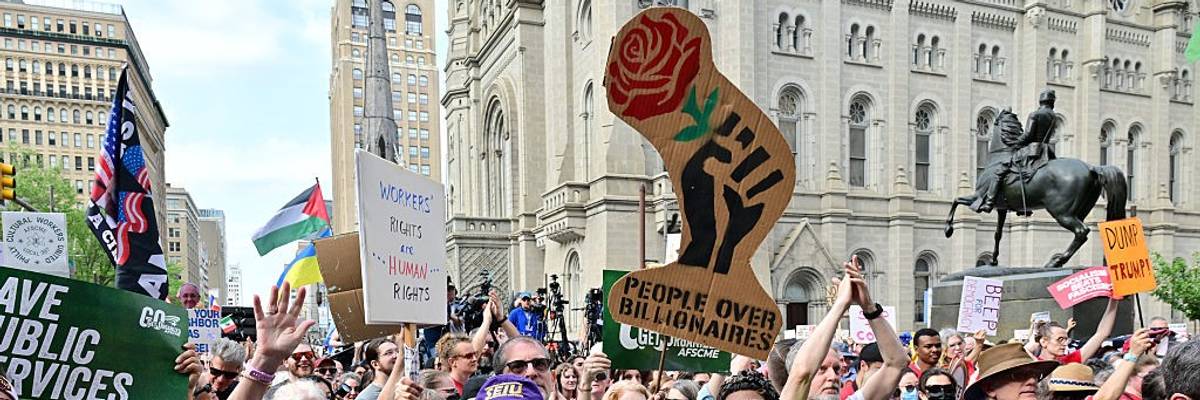
Protesters hold signs during the Nationwide May Day Strong Rally, "Workers Stand Up to Billionaires," on May 1, 2025 in Philadelphia, Pennsylvania.
Action isn't only about pressuring institutions anymore. It's increasingly about jamming the system, slowing it down, or breaking its rhythm. In plain terms, we've shifted from representative politics toward something more like direct pressure.
For decades, American politics rested on one big, mostly unquestioned idea: Real change happens through the system. You vote, you lobby, you go to court, you work the parties. Even the biggest protest movements eventually tried to plug themselves back into those official channels. But lately—especially since Donald Trump burst onto the scene—that old assumption has been crumbling fast.
What we're seeing now, in things like the “May Day Strong” actions, isn't just more people protesting. It's a deeper change in how politics actually works. Action isn't only about pressuring institutions anymore. It's increasingly about jamming the system, slowing it down, or breaking its rhythm. In plain terms, we've shifted from representative politics toward something more like direct pressure.
The key driver here is the collapse of trust in institutions. One of the most striking things about Trumpism isn't any single policy—it's the relentless way it attacked the legitimacy of the middlemen: the media as “the enemy of the people,” judges as biased, elections as rigged. These weren't just throwaway lines. Over time, they sank in and reshaped how a lot of people view the system's ability to actually deliver.
When folks stop believing the formal channels can handle their grievances, they start looking for other levers. That's when direct action, civil disobedience, and economic disruption stop looking fringe and start feeling logical.
“May Day Strong” feels like a live experiment. It's testing how well networked groups can mobilize and whether hitting the economy where it hurts can deliver lasting political leverage. The answers will matter a lot for where democracy goes next.
“May Day Strong” sits right at that crossroads. The call for “No Work, No Shopping” isn't subtle. It says: If real power flows through the economy, then choking those flows becomes a form of politics. On the surface it seems straightforward, but it quietly rewrites the textbook definition of power.
In the old model, power lived in government buildings and political offices. You tried to influence them. In the emerging one, power is scattered across economic networks and social connections. So the game moves from representation to targeted disruption—from institutional politics to what you might call infrastructural politics.
This isn't purely ideological. It also grows out of how people actually experience daily life now: gig work, shaky jobs, disappearing benefits, and costs that keep climbing. When the ground under your feet feels unstable, waiting for institutions to fix things starts to feel naive.
So where does Trumpism fit? It didn't invent this distrust, but it poured gasoline on it. By hammering institutional norms, torching media credibility, and sharpening polarization, it helped create an environment where formal mechanisms look increasingly broken. In that kind of atmosphere, taking it to the streets—or to the supply chains—doesn't feel radical. It feels like common sense.
Still, there's real tension. Disrupting people's everyday lives is a double-edged sword. If folks see it as standing up for justice, it can build wide support. If it just looks like chaos that hurts regular people trying to get by, it can spark a strong backlash.
That tension defines politics in this post-trust era. Legitimacy no longer comes neatly from institutions. It gets fought over in public opinion—and more and more, the street has become the arena where that fight happens.
In that light, “May Day Strong” feels like a live experiment. It's testing how well networked groups can mobilize and whether hitting the economy where it hurts can deliver lasting political leverage. The answers will matter a lot for where democracy goes next.
If direct disruption keeps replacing traditional institutional routes, the line between protest and actual governance starts to blur. Suddenly, the power to halt things becomes its own kind of authority. That opens doors for groups that felt shut out—but it also raises the odds of deeper instability.
At the end of the day, this isn't simply politics getting more extreme. It's politics changing its fundamental shape. It's no longer just a contest to control the institutions. It's becoming a struggle to control the flows—of information, money, goods, and attention.
Trumpism didn't create this shift, but it accelerated it. By eroding trust and heating up divisions, it helped make direct action feel less like an outlier and more like a normal part of how politics gets done.
The big question now isn't how institutions can manage protest. It's whether institutions can hold onto their central role at all.
Dear Common Dreams reader, It’s been nearly 30 years since I co-founded Common Dreams with my late wife, Lina Newhouser. We had the radical notion that journalism should serve the public good, not corporate profits. It was clear to us from the outset what it would take to build such a project. No paid advertisements. No corporate sponsors. No millionaire publisher telling us what to think or do. Many people said we wouldn't last a year, but we proved those doubters wrong. Together with a tremendous team of journalists and dedicated staff, we built an independent media outlet free from the constraints of profits and corporate control. Our mission has always been simple: To inform. To inspire. To ignite change for the common good. Building Common Dreams was not easy. Our survival was never guaranteed. When you take on the most powerful forces—Wall Street greed, fossil fuel industry destruction, Big Tech lobbyists, and uber-rich oligarchs who have spent billions upon billions rigging the economy and democracy in their favor—the only bulwark you have is supporters who believe in your work. But here’s the urgent message from me today. It's never been this bad out there. And it's never been this hard to keep us going. At the very moment Common Dreams is most needed, the threats we face are intensifying. We need your support now more than ever. We don't accept corporate advertising and never will. We don't have a paywall because we don't think people should be blocked from critical news based on their ability to pay. Everything we do is funded by the donations of readers like you. When everyone does the little they can afford, we are strong. But if that support retreats or dries up, so do we. Will you donate now to make sure Common Dreams not only survives but thrives? —Craig Brown, Co-founder |
For decades, American politics rested on one big, mostly unquestioned idea: Real change happens through the system. You vote, you lobby, you go to court, you work the parties. Even the biggest protest movements eventually tried to plug themselves back into those official channels. But lately—especially since Donald Trump burst onto the scene—that old assumption has been crumbling fast.
What we're seeing now, in things like the “May Day Strong” actions, isn't just more people protesting. It's a deeper change in how politics actually works. Action isn't only about pressuring institutions anymore. It's increasingly about jamming the system, slowing it down, or breaking its rhythm. In plain terms, we've shifted from representative politics toward something more like direct pressure.
The key driver here is the collapse of trust in institutions. One of the most striking things about Trumpism isn't any single policy—it's the relentless way it attacked the legitimacy of the middlemen: the media as “the enemy of the people,” judges as biased, elections as rigged. These weren't just throwaway lines. Over time, they sank in and reshaped how a lot of people view the system's ability to actually deliver.
When folks stop believing the formal channels can handle their grievances, they start looking for other levers. That's when direct action, civil disobedience, and economic disruption stop looking fringe and start feeling logical.
“May Day Strong” feels like a live experiment. It's testing how well networked groups can mobilize and whether hitting the economy where it hurts can deliver lasting political leverage. The answers will matter a lot for where democracy goes next.
“May Day Strong” sits right at that crossroads. The call for “No Work, No Shopping” isn't subtle. It says: If real power flows through the economy, then choking those flows becomes a form of politics. On the surface it seems straightforward, but it quietly rewrites the textbook definition of power.
In the old model, power lived in government buildings and political offices. You tried to influence them. In the emerging one, power is scattered across economic networks and social connections. So the game moves from representation to targeted disruption—from institutional politics to what you might call infrastructural politics.
This isn't purely ideological. It also grows out of how people actually experience daily life now: gig work, shaky jobs, disappearing benefits, and costs that keep climbing. When the ground under your feet feels unstable, waiting for institutions to fix things starts to feel naive.
So where does Trumpism fit? It didn't invent this distrust, but it poured gasoline on it. By hammering institutional norms, torching media credibility, and sharpening polarization, it helped create an environment where formal mechanisms look increasingly broken. In that kind of atmosphere, taking it to the streets—or to the supply chains—doesn't feel radical. It feels like common sense.
Still, there's real tension. Disrupting people's everyday lives is a double-edged sword. If folks see it as standing up for justice, it can build wide support. If it just looks like chaos that hurts regular people trying to get by, it can spark a strong backlash.
That tension defines politics in this post-trust era. Legitimacy no longer comes neatly from institutions. It gets fought over in public opinion—and more and more, the street has become the arena where that fight happens.
In that light, “May Day Strong” feels like a live experiment. It's testing how well networked groups can mobilize and whether hitting the economy where it hurts can deliver lasting political leverage. The answers will matter a lot for where democracy goes next.
If direct disruption keeps replacing traditional institutional routes, the line between protest and actual governance starts to blur. Suddenly, the power to halt things becomes its own kind of authority. That opens doors for groups that felt shut out—but it also raises the odds of deeper instability.
At the end of the day, this isn't simply politics getting more extreme. It's politics changing its fundamental shape. It's no longer just a contest to control the institutions. It's becoming a struggle to control the flows—of information, money, goods, and attention.
Trumpism didn't create this shift, but it accelerated it. By eroding trust and heating up divisions, it helped make direct action feel less like an outlier and more like a normal part of how politics gets done.
The big question now isn't how institutions can manage protest. It's whether institutions can hold onto their central role at all.
For decades, American politics rested on one big, mostly unquestioned idea: Real change happens through the system. You vote, you lobby, you go to court, you work the parties. Even the biggest protest movements eventually tried to plug themselves back into those official channels. But lately—especially since Donald Trump burst onto the scene—that old assumption has been crumbling fast.
What we're seeing now, in things like the “May Day Strong” actions, isn't just more people protesting. It's a deeper change in how politics actually works. Action isn't only about pressuring institutions anymore. It's increasingly about jamming the system, slowing it down, or breaking its rhythm. In plain terms, we've shifted from representative politics toward something more like direct pressure.
The key driver here is the collapse of trust in institutions. One of the most striking things about Trumpism isn't any single policy—it's the relentless way it attacked the legitimacy of the middlemen: the media as “the enemy of the people,” judges as biased, elections as rigged. These weren't just throwaway lines. Over time, they sank in and reshaped how a lot of people view the system's ability to actually deliver.
When folks stop believing the formal channels can handle their grievances, they start looking for other levers. That's when direct action, civil disobedience, and economic disruption stop looking fringe and start feeling logical.
“May Day Strong” feels like a live experiment. It's testing how well networked groups can mobilize and whether hitting the economy where it hurts can deliver lasting political leverage. The answers will matter a lot for where democracy goes next.
“May Day Strong” sits right at that crossroads. The call for “No Work, No Shopping” isn't subtle. It says: If real power flows through the economy, then choking those flows becomes a form of politics. On the surface it seems straightforward, but it quietly rewrites the textbook definition of power.
In the old model, power lived in government buildings and political offices. You tried to influence them. In the emerging one, power is scattered across economic networks and social connections. So the game moves from representation to targeted disruption—from institutional politics to what you might call infrastructural politics.
This isn't purely ideological. It also grows out of how people actually experience daily life now: gig work, shaky jobs, disappearing benefits, and costs that keep climbing. When the ground under your feet feels unstable, waiting for institutions to fix things starts to feel naive.
So where does Trumpism fit? It didn't invent this distrust, but it poured gasoline on it. By hammering institutional norms, torching media credibility, and sharpening polarization, it helped create an environment where formal mechanisms look increasingly broken. In that kind of atmosphere, taking it to the streets—or to the supply chains—doesn't feel radical. It feels like common sense.
Still, there's real tension. Disrupting people's everyday lives is a double-edged sword. If folks see it as standing up for justice, it can build wide support. If it just looks like chaos that hurts regular people trying to get by, it can spark a strong backlash.
That tension defines politics in this post-trust era. Legitimacy no longer comes neatly from institutions. It gets fought over in public opinion—and more and more, the street has become the arena where that fight happens.
In that light, “May Day Strong” feels like a live experiment. It's testing how well networked groups can mobilize and whether hitting the economy where it hurts can deliver lasting political leverage. The answers will matter a lot for where democracy goes next.
If direct disruption keeps replacing traditional institutional routes, the line between protest and actual governance starts to blur. Suddenly, the power to halt things becomes its own kind of authority. That opens doors for groups that felt shut out—but it also raises the odds of deeper instability.
At the end of the day, this isn't simply politics getting more extreme. It's politics changing its fundamental shape. It's no longer just a contest to control the institutions. It's becoming a struggle to control the flows—of information, money, goods, and attention.
Trumpism didn't create this shift, but it accelerated it. By eroding trust and heating up divisions, it helped make direct action feel less like an outlier and more like a normal part of how politics gets done.
The big question now isn't how institutions can manage protest. It's whether institutions can hold onto their central role at all.

