

SUBSCRIBE TO OUR FREE NEWSLETTER
Daily news & progressive opinion—funded by the people, not the corporations—delivered straight to your inbox.
5
#000000
#FFFFFF
To donate by check, phone, or other method, see our More Ways to Give page.
Daily news & progressive opinion—funded by the people, not the corporations—delivered straight to your inbox.
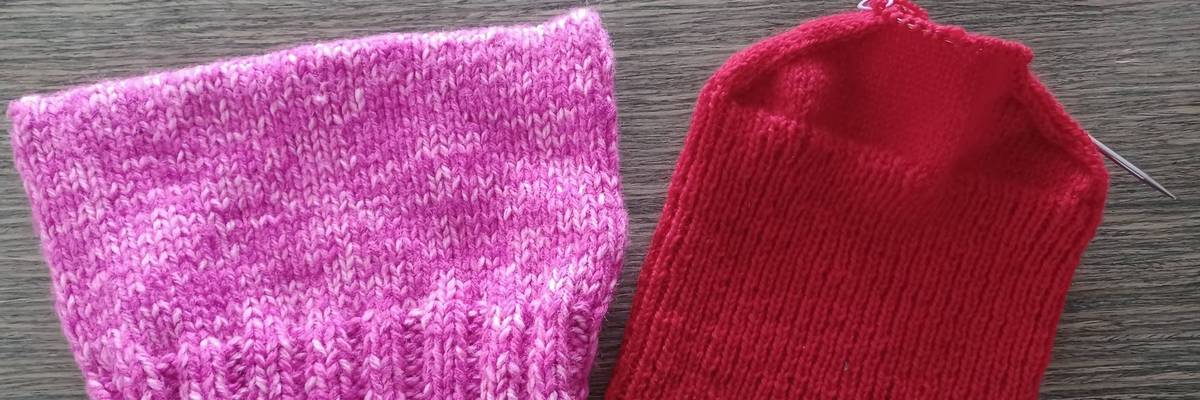
A pussyhat and melt-the-ICE hat knitted by Giamila Fantuzzi are seen side by side.
The color of the hats might have changed over these years, but what has not changed is the core message: the symbolism of knitting as the slow work required to build a movement, and the need to take the time to plan before acting.
The pattern for a bright red melt the ICE hat popped up in my news feed the other day, and I immediately knew I had to knit one. That the pattern for the freshly renamed hat reproduces the pointed, tasseled hats Norwegians wore in the 1940s as a symbol of protest against Nazi occupation; that it comes from a small woman-owned yarn store in Minnesota at a time when it feels we are not far away from the catastrophe of Fascism and Nazism; that the proceeds from buying the pattern go to organizations that protect immigrant rights. All of this made it even more urgent that I get hold of some red yarn and start casting my stitches without delay.
I learned to knit as a young child from a woman who had herself learned from a woman who had herself learned from a woman. In Italy, where I was born and grew up, this was the norm for girls, though boys were never taught the craft.
As a teen, I enjoyed the meditative quality of the repetitive work of making something grow, one knot at a time. I marveled at the magic of my hands transforming linear yarn into a multidimensional artifact. I learned the patience needed to make and unmake and remake something until I could get it not perfect but good enough. I absorbed the anti-consumerist message of frogging, or unraveling, an old sweater that no longer fits and reusing the yarn to make a new one. I grasped the necessity to create plans before jumping into action.
Then life got in the way, and I let it all fall to the side while I concentrated on becoming a scientist and relocating to the United States to work in biomedical research. My hands turned to handling pipettes and tubes rather than yarn and needles.
But symbols are important. They speak through history, they tell us we are not alone, they let us say things that words often cannot express.
But without my consciously knowing it, it became clear that the same skills were needed in the lab as in putting together a knitting project. There it was, the need to slow down and plan ahead, to repeat the same gesture over and over again, to reuse old concepts for new discoveries, to build step by step until a complex theory emerges from the simplicity of a single experiment. During those years, my brain might have forgotten the practicalities of knitting, but the underlying lessons were all there.
In early 2016, after more than 20 years in the US, I applied for citizenship, hoping to contribute my vote against what would become President Donald Trump’s first term. Bureaucracy was too slow to allow me the privilege to cast my vote that year, but it did not stifle my willingness to protest what I saw as a dangerous development.
The pussyhat, which became a symbol of the protest movement against President Trump, brought me back to knitting. I got hold of some bright pink yarn and needles at my local women-owned yarn store and discovered that my hands still had the muscle memory of what I had learned decades earlier on the other side of the world. I knit a bunch of pussyhats for myself and my friends, which we sported at the Chicago’s women’s march on the gorgeous, hopeful day that was January 21, 2017.
It’s now almost 10 years later, and here we are again, knitting hats against the dangers to our democracy. The hat’s color has changed, from the pink that represented women’s rights to the red now pointing to the defense of immigrants’ rights. As a woman immigrant, I need both and I am sure I will need more in the future.
The color of the hats might have changed over these years, but what has not changed is the core message: the symbolism of knitting as the slow work required to build activism and resistance, and the need to take the time to plan before acting. Knitting as the symbol of the patience it takes to build something meaningful and complex, one knot at a time. As the symbol of the need to constantly make and remake, to reuse what we built in the past to create something that fits the moment. And of knitting, just like quilting, embroidery, and other textile crafts, as reclaiming the role of women in history.
Yes, I know, a handmade hat will not determine the success of our resistance. Just like the pussyhats did not prevent a second Trump term, the melt the ICE hats by themselves will not stop the violence perpetrated against immigrants and those who try to protect them. But symbols are important. They speak through history, they tell us we are not alone, they let us say things that words often cannot express.
When I went to get my skein of yarn the other day, a young man wearing the same bright red hat I was planning to make was at the store, chatting with the owner, who had set aside a basket of skeins of red yarn. The young man told me, matter-of-factly, that he had just finished knitting the hat he was wearing and was there to buy some yarn to make a few more hats for his friends.
And there it was, the symbolism personified. A male knitter, unthinkable when I was a young girl, who let me know, without needing to explain it, that women’s history should not only be reclaimed but also shared with those who can treasure it. A red hat and a basket of red yarn that signaled, “You have nothing to fear here.” That told me that the accent that inflects my English was welcome, not despised. That I did not need the copy of the US passport I have started to take with me wherever I go. That we can do this, together, one knot at a time.
Dear Common Dreams reader, It’s been nearly 30 years since I co-founded Common Dreams with my late wife, Lina Newhouser. We had the radical notion that journalism should serve the public good, not corporate profits. It was clear to us from the outset what it would take to build such a project. No paid advertisements. No corporate sponsors. No millionaire publisher telling us what to think or do. Many people said we wouldn't last a year, but we proved those doubters wrong. Together with a tremendous team of journalists and dedicated staff, we built an independent media outlet free from the constraints of profits and corporate control. Our mission has always been simple: To inform. To inspire. To ignite change for the common good. Building Common Dreams was not easy. Our survival was never guaranteed. When you take on the most powerful forces—Wall Street greed, fossil fuel industry destruction, Big Tech lobbyists, and uber-rich oligarchs who have spent billions upon billions rigging the economy and democracy in their favor—the only bulwark you have is supporters who believe in your work. But here’s the urgent message from me today. It's never been this bad out there. And it's never been this hard to keep us going. At the very moment Common Dreams is most needed, the threats we face are intensifying. We need your support now more than ever. We don't accept corporate advertising and never will. We don't have a paywall because we don't think people should be blocked from critical news based on their ability to pay. Everything we do is funded by the donations of readers like you. When everyone does the little they can afford, we are strong. But if that support retreats or dries up, so do we. Will you donate now to make sure Common Dreams not only survives but thrives? —Craig Brown, Co-founder |
The pattern for a bright red melt the ICE hat popped up in my news feed the other day, and I immediately knew I had to knit one. That the pattern for the freshly renamed hat reproduces the pointed, tasseled hats Norwegians wore in the 1940s as a symbol of protest against Nazi occupation; that it comes from a small woman-owned yarn store in Minnesota at a time when it feels we are not far away from the catastrophe of Fascism and Nazism; that the proceeds from buying the pattern go to organizations that protect immigrant rights. All of this made it even more urgent that I get hold of some red yarn and start casting my stitches without delay.
I learned to knit as a young child from a woman who had herself learned from a woman who had herself learned from a woman. In Italy, where I was born and grew up, this was the norm for girls, though boys were never taught the craft.
As a teen, I enjoyed the meditative quality of the repetitive work of making something grow, one knot at a time. I marveled at the magic of my hands transforming linear yarn into a multidimensional artifact. I learned the patience needed to make and unmake and remake something until I could get it not perfect but good enough. I absorbed the anti-consumerist message of frogging, or unraveling, an old sweater that no longer fits and reusing the yarn to make a new one. I grasped the necessity to create plans before jumping into action.
Then life got in the way, and I let it all fall to the side while I concentrated on becoming a scientist and relocating to the United States to work in biomedical research. My hands turned to handling pipettes and tubes rather than yarn and needles.
But symbols are important. They speak through history, they tell us we are not alone, they let us say things that words often cannot express.
But without my consciously knowing it, it became clear that the same skills were needed in the lab as in putting together a knitting project. There it was, the need to slow down and plan ahead, to repeat the same gesture over and over again, to reuse old concepts for new discoveries, to build step by step until a complex theory emerges from the simplicity of a single experiment. During those years, my brain might have forgotten the practicalities of knitting, but the underlying lessons were all there.
In early 2016, after more than 20 years in the US, I applied for citizenship, hoping to contribute my vote against what would become President Donald Trump’s first term. Bureaucracy was too slow to allow me the privilege to cast my vote that year, but it did not stifle my willingness to protest what I saw as a dangerous development.
The pussyhat, which became a symbol of the protest movement against President Trump, brought me back to knitting. I got hold of some bright pink yarn and needles at my local women-owned yarn store and discovered that my hands still had the muscle memory of what I had learned decades earlier on the other side of the world. I knit a bunch of pussyhats for myself and my friends, which we sported at the Chicago’s women’s march on the gorgeous, hopeful day that was January 21, 2017.
It’s now almost 10 years later, and here we are again, knitting hats against the dangers to our democracy. The hat’s color has changed, from the pink that represented women’s rights to the red now pointing to the defense of immigrants’ rights. As a woman immigrant, I need both and I am sure I will need more in the future.
The color of the hats might have changed over these years, but what has not changed is the core message: the symbolism of knitting as the slow work required to build activism and resistance, and the need to take the time to plan before acting. Knitting as the symbol of the patience it takes to build something meaningful and complex, one knot at a time. As the symbol of the need to constantly make and remake, to reuse what we built in the past to create something that fits the moment. And of knitting, just like quilting, embroidery, and other textile crafts, as reclaiming the role of women in history.
Yes, I know, a handmade hat will not determine the success of our resistance. Just like the pussyhats did not prevent a second Trump term, the melt the ICE hats by themselves will not stop the violence perpetrated against immigrants and those who try to protect them. But symbols are important. They speak through history, they tell us we are not alone, they let us say things that words often cannot express.
When I went to get my skein of yarn the other day, a young man wearing the same bright red hat I was planning to make was at the store, chatting with the owner, who had set aside a basket of skeins of red yarn. The young man told me, matter-of-factly, that he had just finished knitting the hat he was wearing and was there to buy some yarn to make a few more hats for his friends.
And there it was, the symbolism personified. A male knitter, unthinkable when I was a young girl, who let me know, without needing to explain it, that women’s history should not only be reclaimed but also shared with those who can treasure it. A red hat and a basket of red yarn that signaled, “You have nothing to fear here.” That told me that the accent that inflects my English was welcome, not despised. That I did not need the copy of the US passport I have started to take with me wherever I go. That we can do this, together, one knot at a time.
The pattern for a bright red melt the ICE hat popped up in my news feed the other day, and I immediately knew I had to knit one. That the pattern for the freshly renamed hat reproduces the pointed, tasseled hats Norwegians wore in the 1940s as a symbol of protest against Nazi occupation; that it comes from a small woman-owned yarn store in Minnesota at a time when it feels we are not far away from the catastrophe of Fascism and Nazism; that the proceeds from buying the pattern go to organizations that protect immigrant rights. All of this made it even more urgent that I get hold of some red yarn and start casting my stitches without delay.
I learned to knit as a young child from a woman who had herself learned from a woman who had herself learned from a woman. In Italy, where I was born and grew up, this was the norm for girls, though boys were never taught the craft.
As a teen, I enjoyed the meditative quality of the repetitive work of making something grow, one knot at a time. I marveled at the magic of my hands transforming linear yarn into a multidimensional artifact. I learned the patience needed to make and unmake and remake something until I could get it not perfect but good enough. I absorbed the anti-consumerist message of frogging, or unraveling, an old sweater that no longer fits and reusing the yarn to make a new one. I grasped the necessity to create plans before jumping into action.
Then life got in the way, and I let it all fall to the side while I concentrated on becoming a scientist and relocating to the United States to work in biomedical research. My hands turned to handling pipettes and tubes rather than yarn and needles.
But symbols are important. They speak through history, they tell us we are not alone, they let us say things that words often cannot express.
But without my consciously knowing it, it became clear that the same skills were needed in the lab as in putting together a knitting project. There it was, the need to slow down and plan ahead, to repeat the same gesture over and over again, to reuse old concepts for new discoveries, to build step by step until a complex theory emerges from the simplicity of a single experiment. During those years, my brain might have forgotten the practicalities of knitting, but the underlying lessons were all there.
In early 2016, after more than 20 years in the US, I applied for citizenship, hoping to contribute my vote against what would become President Donald Trump’s first term. Bureaucracy was too slow to allow me the privilege to cast my vote that year, but it did not stifle my willingness to protest what I saw as a dangerous development.
The pussyhat, which became a symbol of the protest movement against President Trump, brought me back to knitting. I got hold of some bright pink yarn and needles at my local women-owned yarn store and discovered that my hands still had the muscle memory of what I had learned decades earlier on the other side of the world. I knit a bunch of pussyhats for myself and my friends, which we sported at the Chicago’s women’s march on the gorgeous, hopeful day that was January 21, 2017.
It’s now almost 10 years later, and here we are again, knitting hats against the dangers to our democracy. The hat’s color has changed, from the pink that represented women’s rights to the red now pointing to the defense of immigrants’ rights. As a woman immigrant, I need both and I am sure I will need more in the future.
The color of the hats might have changed over these years, but what has not changed is the core message: the symbolism of knitting as the slow work required to build activism and resistance, and the need to take the time to plan before acting. Knitting as the symbol of the patience it takes to build something meaningful and complex, one knot at a time. As the symbol of the need to constantly make and remake, to reuse what we built in the past to create something that fits the moment. And of knitting, just like quilting, embroidery, and other textile crafts, as reclaiming the role of women in history.
Yes, I know, a handmade hat will not determine the success of our resistance. Just like the pussyhats did not prevent a second Trump term, the melt the ICE hats by themselves will not stop the violence perpetrated against immigrants and those who try to protect them. But symbols are important. They speak through history, they tell us we are not alone, they let us say things that words often cannot express.
When I went to get my skein of yarn the other day, a young man wearing the same bright red hat I was planning to make was at the store, chatting with the owner, who had set aside a basket of skeins of red yarn. The young man told me, matter-of-factly, that he had just finished knitting the hat he was wearing and was there to buy some yarn to make a few more hats for his friends.
And there it was, the symbolism personified. A male knitter, unthinkable when I was a young girl, who let me know, without needing to explain it, that women’s history should not only be reclaimed but also shared with those who can treasure it. A red hat and a basket of red yarn that signaled, “You have nothing to fear here.” That told me that the accent that inflects my English was welcome, not despised. That I did not need the copy of the US passport I have started to take with me wherever I go. That we can do this, together, one knot at a time.

