SUBSCRIBE TO OUR FREE NEWSLETTER
Daily news & progressive opinion—funded by the people, not the corporations—delivered straight to your inbox.
5
#000000
#FFFFFF
To donate by check, phone, or other method, see our More Ways to Give page.
Daily news & progressive opinion—funded by the people, not the corporations—delivered straight to your inbox.
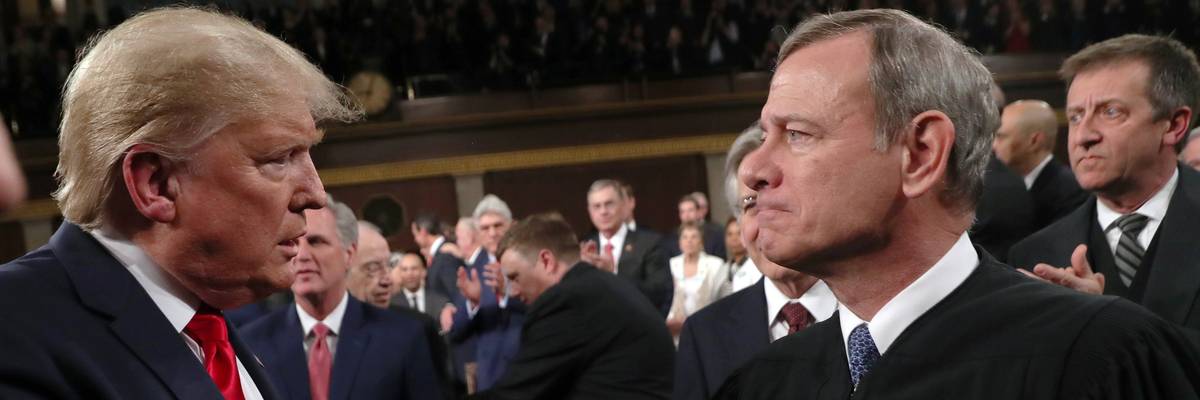
President Donald Trump shakes hands with Supreme Court Chief Justice John Roberts before the State of the Union address in the House chamber on February 4, 2020 in Washington, DC.
It's obvious to a majority of ordinary Americans that partisan gerrymandering undermines fundamental democratic principles. If only the Chief Justice of the US Supreme Court would have the courage to admit it.
In the short run, Democrats' victory in gerrymandering Virginia to create four new blue Congressional districts is a good thing. It will restore balance to the critical 2026 House elections to offset Republicans' Texas gerrymandering which created four new red districts.
President Donald Trump was technically right when the night before the Virginia vote he told a conference of supporters, “I don’t know if you know what gerrymandering is but it’s not good.” Of course what Trump really meant is that gerrymandering is bad when it disenfranchises Republicans but good when it disenfranchises Democrats.
Here's what we do know: partisan gerrymandering is an affront to democracy by letting politicians pick their voters instead of voters picking their politicians. Given Republicans' successful gerrymandering, the Virginia gerrymander was the least bad immediate option. As House Minority Leader Hakeem Jeffries said in a sharp reversal of recent establishment Democrats' attitude, "When they go low, we strike back."
But looking forward, partisan gerrymandering should be illegal. As Supreme Court Justice Elena Kagan wrote in her dissent to Chief Justice John Roberts' 2019 majority ruling that partisan gerrymandering is non-judiciable, “partisan gerrymanders here debased and dishonored our democracy, turning upside-down the core American idea that all governmental power derives from the people. If left unchecked, gerrymanders like the ones here may irreparably damage our system of government.”
You can blame John Roberts for debasing and dishonoring our democracy and irreparably damaging our system of government.
In his 5-4 majority decision in Rucho v. Common Cause in 2019, Roberts ruled that challenges to partisan gerrymandering are "political questions" that courts may not interfere with. Roberts may have disingenuously claimed in his confirmation hearings that he is nothing but an umpire calling balls and strikes, but in reality he changes the strike zone to favor Republicans.
Partisan gerrymandering blatantly violates the Equal Protection clause of the 14th Amendment of the Constitution. Partisan gerrymandering treats voters of the then minority party in a state unequally to voters of the then majority party and gives the then majority party an unequal advantage in securing their future electoral control regardless of the will of the voters. Voters from different parties do not have an equal chance to affect the outcome of elections. As Justice Kagan wrote in her dissent to Rucho a voter's constitutional equal protections rights“can be denied by a debasement or dilution of the weight of a citizen’s vote just as effectively as by wholly prohibiting the free exercise of the franchise.”
It's obvious to a majority of ordinary Americans that partisan gerrymandering undermines fundamental democratic principles. An August 2025 Reuters poll found that 55% of respondents, including 71% of Democrats and 46% of Republicans, thought that the partisan gerrymandering taking place in Texas and California are "bad for democracy." Regular Americans understand the dangers of partisan gerrymandering better than John Roberts in his lengthy "legal" opinion that courts can't do anything to prevent it.
Since Rucho was decided in 2019, advances in computer algorithms have enabled the majority party in a state to construct voting districts to virtually guarantee with surgical precision their own electoral victory.
If Roberts and his Republican cohorts on the Court were honest, they would consider revisiting and overturning Rucho and giving lower courts the power to devise standards for deciding if a partisan gerrymander is too much. But given the partisanship of the Republican Justices, that's unlikely to happen.
If, despite the disadvantages of partisan gerrymandering, Democrats regain control of Congress, they should enact legislation term limiting SCOTUS justices (after which they may keep their lifetime judicial tenure by taking senior status) and increasing the number of Justices from 9 to at least 12. This can be done by legislation and does not need to overcome the nearly impossible bar of a Constitutional Amendment. To protect democracy, Court reform should be a key part of Democrats' political platform.
Dear Common Dreams reader, It’s been nearly 30 years since I co-founded Common Dreams with my late wife, Lina Newhouser. We had the radical notion that journalism should serve the public good, not corporate profits. It was clear to us from the outset what it would take to build such a project. No paid advertisements. No corporate sponsors. No millionaire publisher telling us what to think or do. Many people said we wouldn't last a year, but we proved those doubters wrong. Together with a tremendous team of journalists and dedicated staff, we built an independent media outlet free from the constraints of profits and corporate control. Our mission has always been simple: To inform. To inspire. To ignite change for the common good. Building Common Dreams was not easy. Our survival was never guaranteed. When you take on the most powerful forces—Wall Street greed, fossil fuel industry destruction, Big Tech lobbyists, and uber-rich oligarchs who have spent billions upon billions rigging the economy and democracy in their favor—the only bulwark you have is supporters who believe in your work. But here’s the urgent message from me today. It's never been this bad out there. And it's never been this hard to keep us going. At the very moment Common Dreams is most needed, the threats we face are intensifying. We need your support now more than ever. We don't accept corporate advertising and never will. We don't have a paywall because we don't think people should be blocked from critical news based on their ability to pay. Everything we do is funded by the donations of readers like you. When everyone does the little they can afford, we are strong. But if that support retreats or dries up, so do we. Will you donate now to make sure Common Dreams not only survives but thrives? —Craig Brown, Co-founder |
In the short run, Democrats' victory in gerrymandering Virginia to create four new blue Congressional districts is a good thing. It will restore balance to the critical 2026 House elections to offset Republicans' Texas gerrymandering which created four new red districts.
President Donald Trump was technically right when the night before the Virginia vote he told a conference of supporters, “I don’t know if you know what gerrymandering is but it’s not good.” Of course what Trump really meant is that gerrymandering is bad when it disenfranchises Republicans but good when it disenfranchises Democrats.
Here's what we do know: partisan gerrymandering is an affront to democracy by letting politicians pick their voters instead of voters picking their politicians. Given Republicans' successful gerrymandering, the Virginia gerrymander was the least bad immediate option. As House Minority Leader Hakeem Jeffries said in a sharp reversal of recent establishment Democrats' attitude, "When they go low, we strike back."
But looking forward, partisan gerrymandering should be illegal. As Supreme Court Justice Elena Kagan wrote in her dissent to Chief Justice John Roberts' 2019 majority ruling that partisan gerrymandering is non-judiciable, “partisan gerrymanders here debased and dishonored our democracy, turning upside-down the core American idea that all governmental power derives from the people. If left unchecked, gerrymanders like the ones here may irreparably damage our system of government.”
You can blame John Roberts for debasing and dishonoring our democracy and irreparably damaging our system of government.
In his 5-4 majority decision in Rucho v. Common Cause in 2019, Roberts ruled that challenges to partisan gerrymandering are "political questions" that courts may not interfere with. Roberts may have disingenuously claimed in his confirmation hearings that he is nothing but an umpire calling balls and strikes, but in reality he changes the strike zone to favor Republicans.
Partisan gerrymandering blatantly violates the Equal Protection clause of the 14th Amendment of the Constitution. Partisan gerrymandering treats voters of the then minority party in a state unequally to voters of the then majority party and gives the then majority party an unequal advantage in securing their future electoral control regardless of the will of the voters. Voters from different parties do not have an equal chance to affect the outcome of elections. As Justice Kagan wrote in her dissent to Rucho a voter's constitutional equal protections rights“can be denied by a debasement or dilution of the weight of a citizen’s vote just as effectively as by wholly prohibiting the free exercise of the franchise.”
It's obvious to a majority of ordinary Americans that partisan gerrymandering undermines fundamental democratic principles. An August 2025 Reuters poll found that 55% of respondents, including 71% of Democrats and 46% of Republicans, thought that the partisan gerrymandering taking place in Texas and California are "bad for democracy." Regular Americans understand the dangers of partisan gerrymandering better than John Roberts in his lengthy "legal" opinion that courts can't do anything to prevent it.
Since Rucho was decided in 2019, advances in computer algorithms have enabled the majority party in a state to construct voting districts to virtually guarantee with surgical precision their own electoral victory.
If Roberts and his Republican cohorts on the Court were honest, they would consider revisiting and overturning Rucho and giving lower courts the power to devise standards for deciding if a partisan gerrymander is too much. But given the partisanship of the Republican Justices, that's unlikely to happen.
If, despite the disadvantages of partisan gerrymandering, Democrats regain control of Congress, they should enact legislation term limiting SCOTUS justices (after which they may keep their lifetime judicial tenure by taking senior status) and increasing the number of Justices from 9 to at least 12. This can be done by legislation and does not need to overcome the nearly impossible bar of a Constitutional Amendment. To protect democracy, Court reform should be a key part of Democrats' political platform.
In the short run, Democrats' victory in gerrymandering Virginia to create four new blue Congressional districts is a good thing. It will restore balance to the critical 2026 House elections to offset Republicans' Texas gerrymandering which created four new red districts.
President Donald Trump was technically right when the night before the Virginia vote he told a conference of supporters, “I don’t know if you know what gerrymandering is but it’s not good.” Of course what Trump really meant is that gerrymandering is bad when it disenfranchises Republicans but good when it disenfranchises Democrats.
Here's what we do know: partisan gerrymandering is an affront to democracy by letting politicians pick their voters instead of voters picking their politicians. Given Republicans' successful gerrymandering, the Virginia gerrymander was the least bad immediate option. As House Minority Leader Hakeem Jeffries said in a sharp reversal of recent establishment Democrats' attitude, "When they go low, we strike back."
But looking forward, partisan gerrymandering should be illegal. As Supreme Court Justice Elena Kagan wrote in her dissent to Chief Justice John Roberts' 2019 majority ruling that partisan gerrymandering is non-judiciable, “partisan gerrymanders here debased and dishonored our democracy, turning upside-down the core American idea that all governmental power derives from the people. If left unchecked, gerrymanders like the ones here may irreparably damage our system of government.”
You can blame John Roberts for debasing and dishonoring our democracy and irreparably damaging our system of government.
In his 5-4 majority decision in Rucho v. Common Cause in 2019, Roberts ruled that challenges to partisan gerrymandering are "political questions" that courts may not interfere with. Roberts may have disingenuously claimed in his confirmation hearings that he is nothing but an umpire calling balls and strikes, but in reality he changes the strike zone to favor Republicans.
Partisan gerrymandering blatantly violates the Equal Protection clause of the 14th Amendment of the Constitution. Partisan gerrymandering treats voters of the then minority party in a state unequally to voters of the then majority party and gives the then majority party an unequal advantage in securing their future electoral control regardless of the will of the voters. Voters from different parties do not have an equal chance to affect the outcome of elections. As Justice Kagan wrote in her dissent to Rucho a voter's constitutional equal protections rights“can be denied by a debasement or dilution of the weight of a citizen’s vote just as effectively as by wholly prohibiting the free exercise of the franchise.”
It's obvious to a majority of ordinary Americans that partisan gerrymandering undermines fundamental democratic principles. An August 2025 Reuters poll found that 55% of respondents, including 71% of Democrats and 46% of Republicans, thought that the partisan gerrymandering taking place in Texas and California are "bad for democracy." Regular Americans understand the dangers of partisan gerrymandering better than John Roberts in his lengthy "legal" opinion that courts can't do anything to prevent it.
Since Rucho was decided in 2019, advances in computer algorithms have enabled the majority party in a state to construct voting districts to virtually guarantee with surgical precision their own electoral victory.
If Roberts and his Republican cohorts on the Court were honest, they would consider revisiting and overturning Rucho and giving lower courts the power to devise standards for deciding if a partisan gerrymander is too much. But given the partisanship of the Republican Justices, that's unlikely to happen.
If, despite the disadvantages of partisan gerrymandering, Democrats regain control of Congress, they should enact legislation term limiting SCOTUS justices (after which they may keep their lifetime judicial tenure by taking senior status) and increasing the number of Justices from 9 to at least 12. This can be done by legislation and does not need to overcome the nearly impossible bar of a Constitutional Amendment. To protect democracy, Court reform should be a key part of Democrats' political platform.