

On Yom Kippur, two British Jews were killed at the Heaton Park Hebrew Congregation synagogue in Manchester, during a cruel, antisemitic act of violence. One of them was accidentally shot by police.
Later that week, while discussing antisemitism at the dinner table, my teenage son, who frequents a high school in Hackney, London, took out his phone and displayed scores of antisemitic Instagram reels.
Numerous AI-generated clips depicted Orthodox Jews in different settings, appearing to be obsessed with money, while other reels denied the Holocaust—questioning, for example, the possibility of preparing 6 million pizzas in 20 ovens. A few of his school friends liked the reels, thinking they were funny.
Antisemitism is alive and well in the UK and across Europe. This must be vigorously clamped down on. But, instead of focusing on this very real problem, major Jewish groups have instead followed the Israeli government by instrumentalizing antisemitism in an effort to criminalize and silence Palestinians and their supporters in the struggle for liberation and self-determination.
On the Chronicle’s pages, Corbyn appears to be much more threatening to Jews than Hitler.
The cruel irony is that, in effect, these organisations are dramatically weakening the real fight against antisemitism.
A case in point is the Jewish Chronicle, the world’s oldest Jewish newspaper. In December 2024, the Chronicle published an article by commentator Melanie Phillips, who wrote: “Deranged fear and hatred of Jews and the aim of exterminating them define the Palestinian cause… Left-wing governments that ideologically support the Palestinian cause and also kowtow to Muslim constituencies in which Jew-hatred is rife, shockingly recycle the lies about Israel.”
Claiming that the worst offenders have been “the governments in Britain, Australia and Canada,” Phillips concluded by casting all supporters of the Palestinian cause as “facilitating deranged and murderous Jew-hatred.”
Stripped of Meaning
Three weeks later, the Chronicle published an article entitled, “Did Elon Musk really perform a Nazi salute at Trump rally?” The subtitle assured readers that “Jewish charities deny it was a Nazi reference,” while the Anti-Defamation League was quoted as saying that Musk’s gesture was “awkward” but not a Nazi salute.
The juxtaposition of these articles—one conflating pro-Palestinian activism with murderous antisemitism, and the other downplaying the concrete dangers of antisemitism, as manifested in a nefarious salute by one of the world’s most powerful people—provides a gateway into the Chronicle’s universe, and its aggressive campaign against any demonstration of solidarity with Palestinians.
Antisemitism is often stripped of its original meaning—namely, discrimination against Jews as Jews—and used instead as an “iron dome” to defend Israel from its critics. Articles like these led me to look more closely at how the newspaper has historically understood and employed antisemitism on its own pages—a research project whose findings were recently published.
Examining the appearance of the term “antisemitism” over a period of 100 years—from 1925 to 2024—I assumed that its occurrence would be most pronounced during the Holocaust, when antisemitism led to the extermination of 6 million Jews.
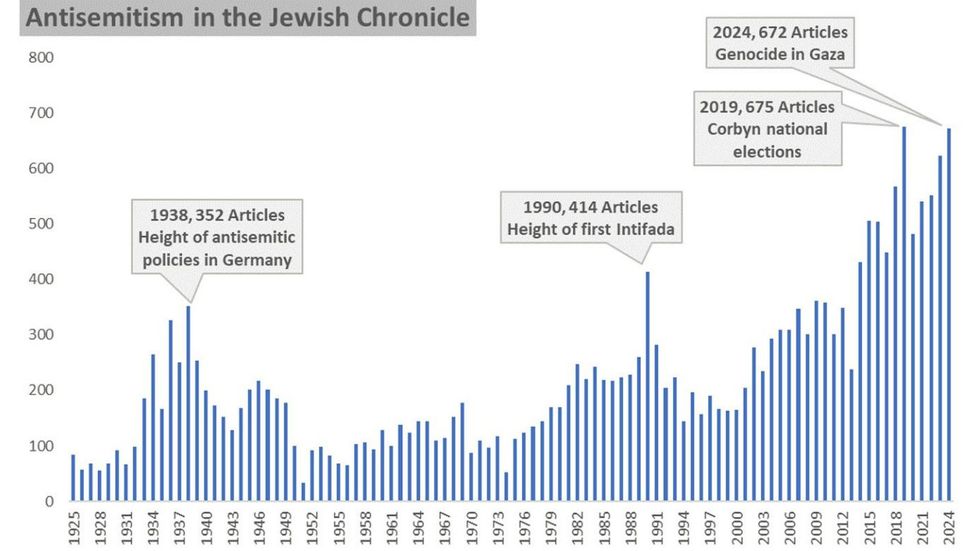 This graph shows the number of articles in the Jewish Chronicle that included the word "antisemitism," from January 1, 1925 to December 31, 2024. (Courtesy Neve Gordon)
The results, however, revealed that in 1938, at the height of the Nazi clampdown on Jews in Germany (which, unlike the “final solution,” was not shrouded in secrecy), antisemitism was mentioned in 352 articles. While this was substantially higher than its average appearance, it was substantially less than the term’s appearance during Jeremy Corbyn’s 2019 national election bid and Israel’s latest war on Gaza, where the number of articles invoking antisemitism was nearly double that.
Even though the term has become more common in recent decades, shockingly, in the Chronicle’s apparent view, the antisemitism threat is perceived as greater now than it was in the late 1930s and early 1940s.
Whipping up Fear
Between January 2023 and June 2024—a period covering nine months before the 7 October attack and nine months after—the term antisemitism, almost always denoting anti-Zionism and criticism of Israel, appeared in roughly every fifth article. This suggests that the UK’s primary Jewish newspaper has been weaponizing a Zionist notion of antisemitism to produce moral panic among its readers.
The Jewish weekly, in other words, has played a role in whipping up fear and anxiety by falsely conflating antisemitism with anti-Zionism or criticism of Israel. This false and dangerous conflation explains the dramatic increase in the term’s frequency, and why on the Chronicle’s pages, Corbyn appears to be much more threatening to Jews than Hitler.
But for such spurious allegations to gain credibility, anti-Zionism and criticism of Israel must be constructed as posing an imminent threat to individual Jews around the world. This is accomplished, in part, by introducing another false conflation—this time between a person’s sense of “feeling uncomfortable” and “being unsafe.”
Given the fact that genuine antisemitism remains an all-too-present reality, the way the Chronicle has spouted the term risks displacing the threat of actual existing antisemitism.
Obviously, the claim that Israel is carrying out genocide, or that it constitutes a settler-colonial regime and an apartheid state, might make Jews who identify emotionally with Israel and Zionism “feel uncomfortable.”
But the Chronicle positions their discomfort as itself injurious, or as “being unsafe.” Ultimately, then, a fallacious notion of antisemitism is cast as a safety hazard to conjure up fears of Jewish annihilation—and this is then used as a counterinsurgency tool to silence Palestinian and pro-Palestinian activists who criticize Israel’s apartheid and, more recently, its genocidal war in Gaza.
Given the fact that genuine antisemitism remains an all-too-present reality, the way the Chronicle has spouted the term risks displacing the threat of actual existing antisemitism.
Indeed, the oldest surviving Jewish newspaper seems dead set on using antisemitism not so much to fight racism, but to defend a racist regime and cover up horrific violations. By abusing the term antisemitism, the newspaper is harming the very Jews it claims to represent—myself included.
© 2023 Middle East Eye
On Yom Kippur, two British Jews were killed at the Heaton Park Hebrew Congregation synagogue in Manchester, during a cruel, antisemitic act of violence. One of them was accidentally shot by police.
Later that week, while discussing antisemitism at the dinner table, my teenage son, who frequents a high school in Hackney, London, took out his phone and displayed scores of antisemitic Instagram reels.
Numerous AI-generated clips depicted Orthodox Jews in different settings, appearing to be obsessed with money, while other reels denied the Holocaust—questioning, for example, the possibility of preparing 6 million pizzas in 20 ovens. A few of his school friends liked the reels, thinking they were funny.
Antisemitism is alive and well in the UK and across Europe. This must be vigorously clamped down on. But, instead of focusing on this very real problem, major Jewish groups have instead followed the Israeli government by instrumentalizing antisemitism in an effort to criminalize and silence Palestinians and their supporters in the struggle for liberation and self-determination.
On the Chronicle’s pages, Corbyn appears to be much more threatening to Jews than Hitler.
The cruel irony is that, in effect, these organisations are dramatically weakening the real fight against antisemitism.
A case in point is the Jewish Chronicle, the world’s oldest Jewish newspaper. In December 2024, the Chronicle published an article by commentator Melanie Phillips, who wrote: “Deranged fear and hatred of Jews and the aim of exterminating them define the Palestinian cause… Left-wing governments that ideologically support the Palestinian cause and also kowtow to Muslim constituencies in which Jew-hatred is rife, shockingly recycle the lies about Israel.”
Claiming that the worst offenders have been “the governments in Britain, Australia and Canada,” Phillips concluded by casting all supporters of the Palestinian cause as “facilitating deranged and murderous Jew-hatred.”
Stripped of Meaning
Three weeks later, the Chronicle published an article entitled, “Did Elon Musk really perform a Nazi salute at Trump rally?” The subtitle assured readers that “Jewish charities deny it was a Nazi reference,” while the Anti-Defamation League was quoted as saying that Musk’s gesture was “awkward” but not a Nazi salute.
The juxtaposition of these articles—one conflating pro-Palestinian activism with murderous antisemitism, and the other downplaying the concrete dangers of antisemitism, as manifested in a nefarious salute by one of the world’s most powerful people—provides a gateway into the Chronicle’s universe, and its aggressive campaign against any demonstration of solidarity with Palestinians.
Antisemitism is often stripped of its original meaning—namely, discrimination against Jews as Jews—and used instead as an “iron dome” to defend Israel from its critics. Articles like these led me to look more closely at how the newspaper has historically understood and employed antisemitism on its own pages—a research project whose findings were recently published.
Examining the appearance of the term “antisemitism” over a period of 100 years—from 1925 to 2024—I assumed that its occurrence would be most pronounced during the Holocaust, when antisemitism led to the extermination of 6 million Jews.
This graph shows the number of articles in the Jewish Chronicle that included the word "antisemitism," from January 1, 1925 to December 31, 2024. (Courtesy Neve Gordon)
The results, however, revealed that in 1938, at the height of the Nazi clampdown on Jews in Germany (which, unlike the “final solution,” was not shrouded in secrecy), antisemitism was mentioned in 352 articles. While this was substantially higher than its average appearance, it was substantially less than the term’s appearance during Jeremy Corbyn’s 2019 national election bid and Israel’s latest war on Gaza, where the number of articles invoking antisemitism was nearly double that.
Even though the term has become more common in recent decades, shockingly, in the Chronicle’s apparent view, the antisemitism threat is perceived as greater now than it was in the late 1930s and early 1940s.
Whipping up Fear
Between January 2023 and June 2024—a period covering nine months before the 7 October attack and nine months after—the term antisemitism, almost always denoting anti-Zionism and criticism of Israel, appeared in roughly every fifth article. This suggests that the UK’s primary Jewish newspaper has been weaponizing a Zionist notion of antisemitism to produce moral panic among its readers.
The Jewish weekly, in other words, has played a role in whipping up fear and anxiety by falsely conflating antisemitism with anti-Zionism or criticism of Israel. This false and dangerous conflation explains the dramatic increase in the term’s frequency, and why on the Chronicle’s pages, Corbyn appears to be much more threatening to Jews than Hitler.
But for such spurious allegations to gain credibility, anti-Zionism and criticism of Israel must be constructed as posing an imminent threat to individual Jews around the world. This is accomplished, in part, by introducing another false conflation—this time between a person’s sense of “feeling uncomfortable” and “being unsafe.”
Given the fact that genuine antisemitism remains an all-too-present reality, the way the Chronicle has spouted the term risks displacing the threat of actual existing antisemitism.
Obviously, the claim that Israel is carrying out genocide, or that it constitutes a settler-colonial regime and an apartheid state, might make Jews who identify emotionally with Israel and Zionism “feel uncomfortable.”
But the Chronicle positions their discomfort as itself injurious, or as “being unsafe.” Ultimately, then, a fallacious notion of antisemitism is cast as a safety hazard to conjure up fears of Jewish annihilation—and this is then used as a counterinsurgency tool to silence Palestinian and pro-Palestinian activists who criticize Israel’s apartheid and, more recently, its genocidal war in Gaza.
Given the fact that genuine antisemitism remains an all-too-present reality, the way the Chronicle has spouted the term risks displacing the threat of actual existing antisemitism.
Indeed, the oldest surviving Jewish newspaper seems dead set on using antisemitism not so much to fight racism, but to defend a racist regime and cover up horrific violations. By abusing the term antisemitism, the newspaper is harming the very Jews it claims to represent—myself included.
From Your Site Articles
- Ex-Harvard Hillel Leader: 'Stop Weaponizing Antisemitism' ›
- Why I Oppose Anti-Semitism ›
- Over 30 Scholars of Antisemitism, Holocaust Studies, and Jewish History Challenge Trump’s Attack on Free Speech ›
- Jewish Safety and the Weaponization of Antisemitism ›
- Understanding the Difference Between Anti-Semitism and Pro-Palestinian Activism ›
On Yom Kippur, two British Jews were killed at the Heaton Park Hebrew Congregation synagogue in Manchester, during a cruel, antisemitic act of violence. One of them was accidentally shot by police.
Later that week, while discussing antisemitism at the dinner table, my teenage son, who frequents a high school in Hackney, London, took out his phone and displayed scores of antisemitic Instagram reels.
Numerous AI-generated clips depicted Orthodox Jews in different settings, appearing to be obsessed with money, while other reels denied the Holocaust—questioning, for example, the possibility of preparing 6 million pizzas in 20 ovens. A few of his school friends liked the reels, thinking they were funny.
Antisemitism is alive and well in the UK and across Europe. This must be vigorously clamped down on. But, instead of focusing on this very real problem, major Jewish groups have instead followed the Israeli government by instrumentalizing antisemitism in an effort to criminalize and silence Palestinians and their supporters in the struggle for liberation and self-determination.
On the Chronicle’s pages, Corbyn appears to be much more threatening to Jews than Hitler.
The cruel irony is that, in effect, these organisations are dramatically weakening the real fight against antisemitism.
A case in point is the Jewish Chronicle, the world’s oldest Jewish newspaper. In December 2024, the Chronicle published an article by commentator Melanie Phillips, who wrote: “Deranged fear and hatred of Jews and the aim of exterminating them define the Palestinian cause… Left-wing governments that ideologically support the Palestinian cause and also kowtow to Muslim constituencies in which Jew-hatred is rife, shockingly recycle the lies about Israel.”
Claiming that the worst offenders have been “the governments in Britain, Australia and Canada,” Phillips concluded by casting all supporters of the Palestinian cause as “facilitating deranged and murderous Jew-hatred.”
Stripped of Meaning
Three weeks later, the Chronicle published an article entitled, “Did Elon Musk really perform a Nazi salute at Trump rally?” The subtitle assured readers that “Jewish charities deny it was a Nazi reference,” while the Anti-Defamation League was quoted as saying that Musk’s gesture was “awkward” but not a Nazi salute.
The juxtaposition of these articles—one conflating pro-Palestinian activism with murderous antisemitism, and the other downplaying the concrete dangers of antisemitism, as manifested in a nefarious salute by one of the world’s most powerful people—provides a gateway into the Chronicle’s universe, and its aggressive campaign against any demonstration of solidarity with Palestinians.
Antisemitism is often stripped of its original meaning—namely, discrimination against Jews as Jews—and used instead as an “iron dome” to defend Israel from its critics. Articles like these led me to look more closely at how the newspaper has historically understood and employed antisemitism on its own pages—a research project whose findings were recently published.
Examining the appearance of the term “antisemitism” over a period of 100 years—from 1925 to 2024—I assumed that its occurrence would be most pronounced during the Holocaust, when antisemitism led to the extermination of 6 million Jews.
This graph shows the number of articles in the Jewish Chronicle that included the word "antisemitism," from January 1, 1925 to December 31, 2024. (Courtesy Neve Gordon)
The results, however, revealed that in 1938, at the height of the Nazi clampdown on Jews in Germany (which, unlike the “final solution,” was not shrouded in secrecy), antisemitism was mentioned in 352 articles. While this was substantially higher than its average appearance, it was substantially less than the term’s appearance during Jeremy Corbyn’s 2019 national election bid and Israel’s latest war on Gaza, where the number of articles invoking antisemitism was nearly double that.
Even though the term has become more common in recent decades, shockingly, in the Chronicle’s apparent view, the antisemitism threat is perceived as greater now than it was in the late 1930s and early 1940s.
Whipping up Fear
Between January 2023 and June 2024—a period covering nine months before the 7 October attack and nine months after—the term antisemitism, almost always denoting anti-Zionism and criticism of Israel, appeared in roughly every fifth article. This suggests that the UK’s primary Jewish newspaper has been weaponizing a Zionist notion of antisemitism to produce moral panic among its readers.
The Jewish weekly, in other words, has played a role in whipping up fear and anxiety by falsely conflating antisemitism with anti-Zionism or criticism of Israel. This false and dangerous conflation explains the dramatic increase in the term’s frequency, and why on the Chronicle’s pages, Corbyn appears to be much more threatening to Jews than Hitler.
But for such spurious allegations to gain credibility, anti-Zionism and criticism of Israel must be constructed as posing an imminent threat to individual Jews around the world. This is accomplished, in part, by introducing another false conflation—this time between a person’s sense of “feeling uncomfortable” and “being unsafe.”
Given the fact that genuine antisemitism remains an all-too-present reality, the way the Chronicle has spouted the term risks displacing the threat of actual existing antisemitism.
Obviously, the claim that Israel is carrying out genocide, or that it constitutes a settler-colonial regime and an apartheid state, might make Jews who identify emotionally with Israel and Zionism “feel uncomfortable.”
But the Chronicle positions their discomfort as itself injurious, or as “being unsafe.” Ultimately, then, a fallacious notion of antisemitism is cast as a safety hazard to conjure up fears of Jewish annihilation—and this is then used as a counterinsurgency tool to silence Palestinian and pro-Palestinian activists who criticize Israel’s apartheid and, more recently, its genocidal war in Gaza.
Given the fact that genuine antisemitism remains an all-too-present reality, the way the Chronicle has spouted the term risks displacing the threat of actual existing antisemitism.
Indeed, the oldest surviving Jewish newspaper seems dead set on using antisemitism not so much to fight racism, but to defend a racist regime and cover up horrific violations. By abusing the term antisemitism, the newspaper is harming the very Jews it claims to represent—myself included.
From Your Site Articles
- Ex-Harvard Hillel Leader: 'Stop Weaponizing Antisemitism' ›
- Why I Oppose Anti-Semitism ›
- Over 30 Scholars of Antisemitism, Holocaust Studies, and Jewish History Challenge Trump’s Attack on Free Speech ›
- Jewish Safety and the Weaponization of Antisemitism ›
- Understanding the Difference Between Anti-Semitism and Pro-Palestinian Activism ›