SUBSCRIBE TO OUR FREE NEWSLETTER
Daily news & progressive opinion—funded by the people, not the corporations—delivered straight to your inbox.
5
#000000
#FFFFFF
To donate by check, phone, or other method, see our More Ways to Give page.
Daily news & progressive opinion—funded by the people, not the corporations—delivered straight to your inbox.
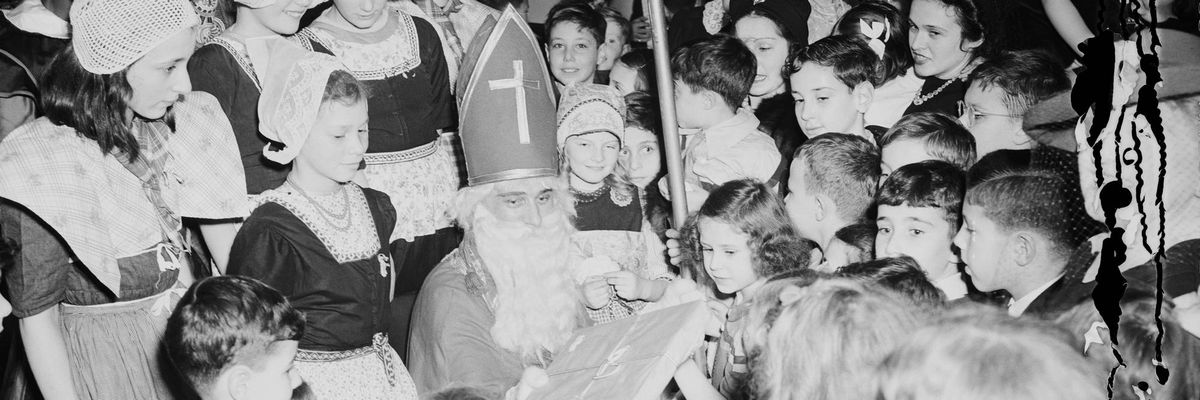
Dutch refugees celebrating St. Nicholas Day in New York City in 1941.
This holiday season, let us embrace the art of ambiguity as a form of resistance.
As Donald Trump declares in his recent address that he has achieved "more than anyone could have imagined" with "zero illegal aliens" allowed into the country and "100 percent of all jobs" going to American-born citizens, I'm thinking about what my Hungarian mother, my édi, taught me about surviving authoritarianism: the radical necessity of making room for what we cannot fully explain or control.
I'm an academic. I derive great comfort from empirical evidence and investigating every question with a critical, researcher's eye. I teach my students to do the same. I want them to confidently read the world with care and curiosity. This is more important than ever. As a group of students in my research methods class discovered this semester, 54% of adults in the U.S. read below a sixth-grade level. Authoritarians depend on this. They depend on a population that cannot parse complexity, that craves simple answers to complicated questions, that mistakes certainty for strength. In this recent ostensibly economic address, Trump declared he has "settled eight wars in 10 months" and brought "for the first time in 3,000 years peace to the Middle East." No nuance. No acknowledgment of ongoing negotiations or fragile ceasefires. Just absolute, unquestionable victory. This is the language of someone who cannot tolerate ambiguity, everything must be either 'worst ever' or 'best ever,' with no room for the messy reality in between.
I teach at CUNY, the largest urban university in the United States, which makes me one of the luckiest people alive. My students are remarkable worldbuilders, often the first in their families to earn degrees. Much like I experienced as an immigrant navigating college, they have no one opening doors for them, no family footsteps to guide their decision-making. They are celebrations of all their ancestors, all their family members and their legacies. When we get to be together, it is sacred.
While I'm deeply invested in helping refine their critical thinking brilliance and their literacy of complex information, these are essential democratic tools after all, I also focus on something autocrats fear even more: our tolerance for ambiguity. This isn't new wisdom. Simone de Beauvoir argued seventy years ago that embracing uncertainty is an ethical necessity, that rigid certainty is a form of bad faith. But knowing this intellectually isn't enough. We must practice it, build the muscle of sitting with what we cannot control. We aren't necessarily born with a tolerance for ambiguity, no, we have to develop it.
This is what ordinary people do when they refuse authoritarian thinking: they risk themselves for something beyond certainty, for the magic of collective care, for keeping possibility alive in impossible circumstances.
Authoritarianism offers the seductive comfort of certainty. It promises that complex problems have simple solutions, that there are clear enemies and obvious heroes, that strength means never wavering or admitting uncertainty. It means launching missiles at boats in international waters and, when survivors cling to debris, firing again and then claiming moral clarity where there is only extrajudicial killing. But meaningful civic engagement requires the opposite. Meaningful civic engagement requires the capacity to sit with complex questions, to accept unknowns, to trust processes we cannot fully control.
In my research methods course, I ask students to create "visual citations" to introduce themselves. For this assignment they are invited to use any medium their imaginations can conjure. When these are due, we create a gallery around the classroom and marvel at our luck to build community with each person. Students have brought in playlists, five items of clothing representing their life journeys, stunning collages, paintings, sculptures. One created an entire puzzle of her family's migration story. As we complete our visual analysis, we ask: What gifts does our community bring? That is where we root ourselves, in the joys uncovered through a deceptively ambiguous and uncertain process.
But to reach this revelation, we first have to get past the discomfort of the unfamiliar. Students sometimes want to resist. Who can blame them? Why can't I just give them an exam to cram for, definitions to memorize? But then, most of the time, the classroom comes to trust me. I always explain my pedagogical reasons. And these risks pay off tremendously. We come to see each other as complex, dynamic, wonderful human beings. We come to see ourselves as capable of things we could not have imagined.
I developed a high tolerance for ambiguity early, as a child in Ceaușescu's Romania. My father escaped before I could hold onto memories of him. My childhood was my single mother and my two siblings. But Christmas—wow, my mom made Christmas magical!
In our region, it's not Santa who comes on Christmas. On St. Nicholas Day early in the month, he leaves goodies (and handwritten notes giving tips about how we can behave in the coming year—Santa is such a critic) in our boots. On Christmas, angels arrive and bring surprises and the Christmas tree. We lived on the fifth floor of a communist tenement, and somehow my mom arranged for angels to arrive once while we were home. We had no other explanation. The angels must have flown in through the balcony door and left the same way. We knew that the angels were, in fact, real. Peering through the crack at the bottom of the door, we could see black boots moving in the living room.
Meaningful civic engagement requires the capacity to sit with complex questions, to accept unknowns, to trust processes we cannot fully control.
Decades later, on a rare visit to my village, I learned that our neighbor had been in cahoots with my mom that year and literally risked his life climbing over from his balcony to ours, to make sure we would not give up on the magic of Christmas. Angels do wear black boots, but some climb instead of fly.
This is what ordinary people do when they refuse authoritarian thinking: they risk themselves for something beyond certainty, for the magic of collective care, for keeping possibility alive in impossible circumstances.
We live in a complex world. How lucky we are to share it with people who hold different perspectives, different experiences, different skills from us. To fully appreciate the gift of diversity, we have to tolerate ambiguity.
As the Trump administration moves to consolidate power through the false comfort of absolute certainty—declaring "our border is secure, inflation has stopped, wages are up, prices are down," a world with no room for the millions of Americans whose lived reality tells a different story—we must practice the opposite. We must hold space for what we cannot fully explain: for the neighbor who climbs across balconies in the dark, for the angels who somehow bring trees to the fifth floor, for the students whose brilliance catches us by surprise, for neighbors organizing to protect community members from ICE raids, for the ways collective care outsmarts surveillance states.
This holiday season, let us embrace the art of ambiguity as a resistance to authoritarianism. Let us choose the discomfort of complexity over the seductive ease of autocratic certainty. Let us trust in processes we cannot fully control—like democratic deliberation, like community care, like the slow work of building understanding across difference.
That's how my mom taught me to survive authoritarianism with my soul intact. We did not match the rigid certainty of Ceaușescu's policies. Instead we kept alive our capacity for wonder, for trust in what we cannot see, for believing that angels wear black boots and fly through balcony doors.
Dear Common Dreams reader, It’s been nearly 30 years since I co-founded Common Dreams with my late wife, Lina Newhouser. We had the radical notion that journalism should serve the public good, not corporate profits. It was clear to us from the outset what it would take to build such a project. No paid advertisements. No corporate sponsors. No millionaire publisher telling us what to think or do. Many people said we wouldn't last a year, but we proved those doubters wrong. Together with a tremendous team of journalists and dedicated staff, we built an independent media outlet free from the constraints of profits and corporate control. Our mission has always been simple: To inform. To inspire. To ignite change for the common good. Building Common Dreams was not easy. Our survival was never guaranteed. When you take on the most powerful forces—Wall Street greed, fossil fuel industry destruction, Big Tech lobbyists, and uber-rich oligarchs who have spent billions upon billions rigging the economy and democracy in their favor—the only bulwark you have is supporters who believe in your work. But here’s the urgent message from me today. It's never been this bad out there. And it's never been this hard to keep us going. At the very moment Common Dreams is most needed, the threats we face are intensifying. We need your support now more than ever. We don't accept corporate advertising and never will. We don't have a paywall because we don't think people should be blocked from critical news based on their ability to pay. Everything we do is funded by the donations of readers like you. When everyone does the little they can afford, we are strong. But if that support retreats or dries up, so do we. Will you donate now to make sure Common Dreams not only survives but thrives? —Craig Brown, Co-founder |
As Donald Trump declares in his recent address that he has achieved "more than anyone could have imagined" with "zero illegal aliens" allowed into the country and "100 percent of all jobs" going to American-born citizens, I'm thinking about what my Hungarian mother, my édi, taught me about surviving authoritarianism: the radical necessity of making room for what we cannot fully explain or control.
I'm an academic. I derive great comfort from empirical evidence and investigating every question with a critical, researcher's eye. I teach my students to do the same. I want them to confidently read the world with care and curiosity. This is more important than ever. As a group of students in my research methods class discovered this semester, 54% of adults in the U.S. read below a sixth-grade level. Authoritarians depend on this. They depend on a population that cannot parse complexity, that craves simple answers to complicated questions, that mistakes certainty for strength. In this recent ostensibly economic address, Trump declared he has "settled eight wars in 10 months" and brought "for the first time in 3,000 years peace to the Middle East." No nuance. No acknowledgment of ongoing negotiations or fragile ceasefires. Just absolute, unquestionable victory. This is the language of someone who cannot tolerate ambiguity, everything must be either 'worst ever' or 'best ever,' with no room for the messy reality in between.
I teach at CUNY, the largest urban university in the United States, which makes me one of the luckiest people alive. My students are remarkable worldbuilders, often the first in their families to earn degrees. Much like I experienced as an immigrant navigating college, they have no one opening doors for them, no family footsteps to guide their decision-making. They are celebrations of all their ancestors, all their family members and their legacies. When we get to be together, it is sacred.
While I'm deeply invested in helping refine their critical thinking brilliance and their literacy of complex information, these are essential democratic tools after all, I also focus on something autocrats fear even more: our tolerance for ambiguity. This isn't new wisdom. Simone de Beauvoir argued seventy years ago that embracing uncertainty is an ethical necessity, that rigid certainty is a form of bad faith. But knowing this intellectually isn't enough. We must practice it, build the muscle of sitting with what we cannot control. We aren't necessarily born with a tolerance for ambiguity, no, we have to develop it.
This is what ordinary people do when they refuse authoritarian thinking: they risk themselves for something beyond certainty, for the magic of collective care, for keeping possibility alive in impossible circumstances.
Authoritarianism offers the seductive comfort of certainty. It promises that complex problems have simple solutions, that there are clear enemies and obvious heroes, that strength means never wavering or admitting uncertainty. It means launching missiles at boats in international waters and, when survivors cling to debris, firing again and then claiming moral clarity where there is only extrajudicial killing. But meaningful civic engagement requires the opposite. Meaningful civic engagement requires the capacity to sit with complex questions, to accept unknowns, to trust processes we cannot fully control.
In my research methods course, I ask students to create "visual citations" to introduce themselves. For this assignment they are invited to use any medium their imaginations can conjure. When these are due, we create a gallery around the classroom and marvel at our luck to build community with each person. Students have brought in playlists, five items of clothing representing their life journeys, stunning collages, paintings, sculptures. One created an entire puzzle of her family's migration story. As we complete our visual analysis, we ask: What gifts does our community bring? That is where we root ourselves, in the joys uncovered through a deceptively ambiguous and uncertain process.
But to reach this revelation, we first have to get past the discomfort of the unfamiliar. Students sometimes want to resist. Who can blame them? Why can't I just give them an exam to cram for, definitions to memorize? But then, most of the time, the classroom comes to trust me. I always explain my pedagogical reasons. And these risks pay off tremendously. We come to see each other as complex, dynamic, wonderful human beings. We come to see ourselves as capable of things we could not have imagined.
I developed a high tolerance for ambiguity early, as a child in Ceaușescu's Romania. My father escaped before I could hold onto memories of him. My childhood was my single mother and my two siblings. But Christmas—wow, my mom made Christmas magical!
In our region, it's not Santa who comes on Christmas. On St. Nicholas Day early in the month, he leaves goodies (and handwritten notes giving tips about how we can behave in the coming year—Santa is such a critic) in our boots. On Christmas, angels arrive and bring surprises and the Christmas tree. We lived on the fifth floor of a communist tenement, and somehow my mom arranged for angels to arrive once while we were home. We had no other explanation. The angels must have flown in through the balcony door and left the same way. We knew that the angels were, in fact, real. Peering through the crack at the bottom of the door, we could see black boots moving in the living room.
Meaningful civic engagement requires the capacity to sit with complex questions, to accept unknowns, to trust processes we cannot fully control.
Decades later, on a rare visit to my village, I learned that our neighbor had been in cahoots with my mom that year and literally risked his life climbing over from his balcony to ours, to make sure we would not give up on the magic of Christmas. Angels do wear black boots, but some climb instead of fly.
This is what ordinary people do when they refuse authoritarian thinking: they risk themselves for something beyond certainty, for the magic of collective care, for keeping possibility alive in impossible circumstances.
We live in a complex world. How lucky we are to share it with people who hold different perspectives, different experiences, different skills from us. To fully appreciate the gift of diversity, we have to tolerate ambiguity.
As the Trump administration moves to consolidate power through the false comfort of absolute certainty—declaring "our border is secure, inflation has stopped, wages are up, prices are down," a world with no room for the millions of Americans whose lived reality tells a different story—we must practice the opposite. We must hold space for what we cannot fully explain: for the neighbor who climbs across balconies in the dark, for the angels who somehow bring trees to the fifth floor, for the students whose brilliance catches us by surprise, for neighbors organizing to protect community members from ICE raids, for the ways collective care outsmarts surveillance states.
This holiday season, let us embrace the art of ambiguity as a resistance to authoritarianism. Let us choose the discomfort of complexity over the seductive ease of autocratic certainty. Let us trust in processes we cannot fully control—like democratic deliberation, like community care, like the slow work of building understanding across difference.
That's how my mom taught me to survive authoritarianism with my soul intact. We did not match the rigid certainty of Ceaușescu's policies. Instead we kept alive our capacity for wonder, for trust in what we cannot see, for believing that angels wear black boots and fly through balcony doors.
As Donald Trump declares in his recent address that he has achieved "more than anyone could have imagined" with "zero illegal aliens" allowed into the country and "100 percent of all jobs" going to American-born citizens, I'm thinking about what my Hungarian mother, my édi, taught me about surviving authoritarianism: the radical necessity of making room for what we cannot fully explain or control.
I'm an academic. I derive great comfort from empirical evidence and investigating every question with a critical, researcher's eye. I teach my students to do the same. I want them to confidently read the world with care and curiosity. This is more important than ever. As a group of students in my research methods class discovered this semester, 54% of adults in the U.S. read below a sixth-grade level. Authoritarians depend on this. They depend on a population that cannot parse complexity, that craves simple answers to complicated questions, that mistakes certainty for strength. In this recent ostensibly economic address, Trump declared he has "settled eight wars in 10 months" and brought "for the first time in 3,000 years peace to the Middle East." No nuance. No acknowledgment of ongoing negotiations or fragile ceasefires. Just absolute, unquestionable victory. This is the language of someone who cannot tolerate ambiguity, everything must be either 'worst ever' or 'best ever,' with no room for the messy reality in between.
I teach at CUNY, the largest urban university in the United States, which makes me one of the luckiest people alive. My students are remarkable worldbuilders, often the first in their families to earn degrees. Much like I experienced as an immigrant navigating college, they have no one opening doors for them, no family footsteps to guide their decision-making. They are celebrations of all their ancestors, all their family members and their legacies. When we get to be together, it is sacred.
While I'm deeply invested in helping refine their critical thinking brilliance and their literacy of complex information, these are essential democratic tools after all, I also focus on something autocrats fear even more: our tolerance for ambiguity. This isn't new wisdom. Simone de Beauvoir argued seventy years ago that embracing uncertainty is an ethical necessity, that rigid certainty is a form of bad faith. But knowing this intellectually isn't enough. We must practice it, build the muscle of sitting with what we cannot control. We aren't necessarily born with a tolerance for ambiguity, no, we have to develop it.
This is what ordinary people do when they refuse authoritarian thinking: they risk themselves for something beyond certainty, for the magic of collective care, for keeping possibility alive in impossible circumstances.
Authoritarianism offers the seductive comfort of certainty. It promises that complex problems have simple solutions, that there are clear enemies and obvious heroes, that strength means never wavering or admitting uncertainty. It means launching missiles at boats in international waters and, when survivors cling to debris, firing again and then claiming moral clarity where there is only extrajudicial killing. But meaningful civic engagement requires the opposite. Meaningful civic engagement requires the capacity to sit with complex questions, to accept unknowns, to trust processes we cannot fully control.
In my research methods course, I ask students to create "visual citations" to introduce themselves. For this assignment they are invited to use any medium their imaginations can conjure. When these are due, we create a gallery around the classroom and marvel at our luck to build community with each person. Students have brought in playlists, five items of clothing representing their life journeys, stunning collages, paintings, sculptures. One created an entire puzzle of her family's migration story. As we complete our visual analysis, we ask: What gifts does our community bring? That is where we root ourselves, in the joys uncovered through a deceptively ambiguous and uncertain process.
But to reach this revelation, we first have to get past the discomfort of the unfamiliar. Students sometimes want to resist. Who can blame them? Why can't I just give them an exam to cram for, definitions to memorize? But then, most of the time, the classroom comes to trust me. I always explain my pedagogical reasons. And these risks pay off tremendously. We come to see each other as complex, dynamic, wonderful human beings. We come to see ourselves as capable of things we could not have imagined.
I developed a high tolerance for ambiguity early, as a child in Ceaușescu's Romania. My father escaped before I could hold onto memories of him. My childhood was my single mother and my two siblings. But Christmas—wow, my mom made Christmas magical!
In our region, it's not Santa who comes on Christmas. On St. Nicholas Day early in the month, he leaves goodies (and handwritten notes giving tips about how we can behave in the coming year—Santa is such a critic) in our boots. On Christmas, angels arrive and bring surprises and the Christmas tree. We lived on the fifth floor of a communist tenement, and somehow my mom arranged for angels to arrive once while we were home. We had no other explanation. The angels must have flown in through the balcony door and left the same way. We knew that the angels were, in fact, real. Peering through the crack at the bottom of the door, we could see black boots moving in the living room.
Meaningful civic engagement requires the capacity to sit with complex questions, to accept unknowns, to trust processes we cannot fully control.
Decades later, on a rare visit to my village, I learned that our neighbor had been in cahoots with my mom that year and literally risked his life climbing over from his balcony to ours, to make sure we would not give up on the magic of Christmas. Angels do wear black boots, but some climb instead of fly.
This is what ordinary people do when they refuse authoritarian thinking: they risk themselves for something beyond certainty, for the magic of collective care, for keeping possibility alive in impossible circumstances.
We live in a complex world. How lucky we are to share it with people who hold different perspectives, different experiences, different skills from us. To fully appreciate the gift of diversity, we have to tolerate ambiguity.
As the Trump administration moves to consolidate power through the false comfort of absolute certainty—declaring "our border is secure, inflation has stopped, wages are up, prices are down," a world with no room for the millions of Americans whose lived reality tells a different story—we must practice the opposite. We must hold space for what we cannot fully explain: for the neighbor who climbs across balconies in the dark, for the angels who somehow bring trees to the fifth floor, for the students whose brilliance catches us by surprise, for neighbors organizing to protect community members from ICE raids, for the ways collective care outsmarts surveillance states.
This holiday season, let us embrace the art of ambiguity as a resistance to authoritarianism. Let us choose the discomfort of complexity over the seductive ease of autocratic certainty. Let us trust in processes we cannot fully control—like democratic deliberation, like community care, like the slow work of building understanding across difference.
That's how my mom taught me to survive authoritarianism with my soul intact. We did not match the rigid certainty of Ceaușescu's policies. Instead we kept alive our capacity for wonder, for trust in what we cannot see, for believing that angels wear black boots and fly through balcony doors.