SUBSCRIBE TO OUR FREE NEWSLETTER
Daily news & progressive opinion—funded by the people, not the corporations—delivered straight to your inbox.
5
#000000
#FFFFFF
To donate by check, phone, or other method, see our More Ways to Give page.
Daily news & progressive opinion—funded by the people, not the corporations—delivered straight to your inbox.
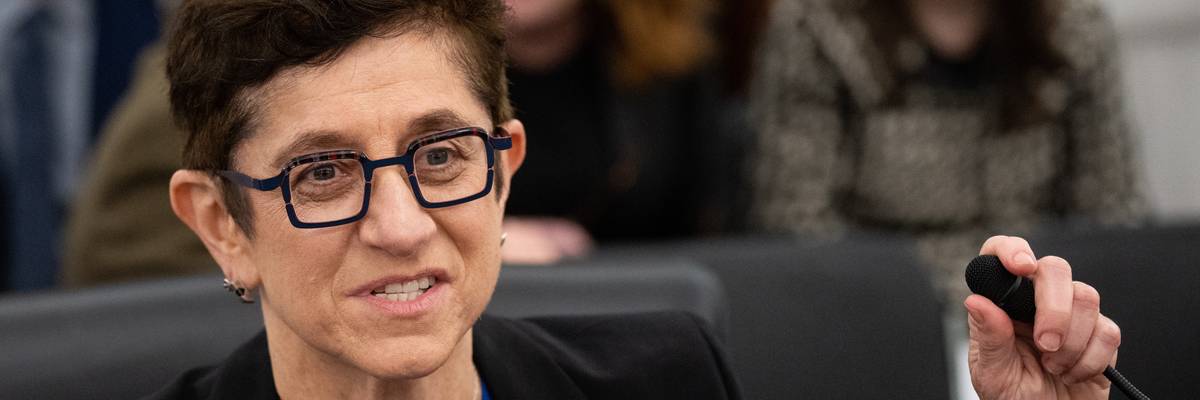
Gigi Sohn, nominated to be a Commissioner of the Federal Communications Commission, takes her seat to testify during her confirmation hearing in the Senate Commerce, Science and Transportation Committee on Tuesday, February 14, 2023. Sohn withdrew her name for consideration on Tuesday, March 7, following a relentless series of attacks by the telecom industry and its allies.
The failure of Democratic senators to advocate for their own nominee means that companies like Comcast and Fox will likely only double-down in the future on the kinds of deceitful tactics they deployed against a nominee who would have been an incredible addition to the FCC.
On Tuesday, Gigi Sohn withdrew her nomination to the Federal Communications Commission.
This ends a two-year fight to put an accomplished public servant in the important fifth seat on the FCC. In the —after nearly 500 days, multiple confirmation hearings, and a relentless industry-orchestrated campaign against her—Sohn didn't have enough votes in the Senate to move forward.
I'm furious—and determined to make sure this doesn't happen again.
They're celebrating today at Comcast and Fox, where their lobbyists deserve most of the credit for concocting lies to derail Sohn's nomination. They falsely portrayed her as radical and divisive, even though her years of experience tell a different story—about a highly regarded expert who has reached across political divides to support communications policies that help people.
Republicans who willfully spread those lies are thrilled, too. Their campaign of vile dog whistles, homophobic innuendo and false outrage worked. In fact, it was too easy.
But they're not the only ones to blame: The failure of Democratic leaders to defend their nominee cost the agency—and the nation—a true public servant. Their missteps and unforced errors were many.
From the start, infighting in the Biden administration delayed the nomination of a new FCC chair and commissioner for months—meaning Sohn wasn't nominated until late October 2021 and then got little time during debates around the infrastructure bills. Instead of moving on this nomination right away when the Biden team had the most political capital—they did it when they had the least.
While the GOP ganged up on her, most Democrats sat back, either using their time on the dais to ask questions about their home states or repeat industry-written talking points.
Then Senate leaders made Sohn endure an unprecedented three confirmation hearings, giving the right-wing noise machine numerous opportunities to badger her while extracting zero concessions from the other side. Despite her composure in the hot seat, this stage let Sohn's opponents test out numerous lines of attack. Sen. Ted Cruz (R-Texas) got endless opportunities to fulminate about her random retweets, while Sen. J.D. Vance (R-Ohio) cosplayed as a culture warrior from his new perch on the Commerce Committee.
While the GOP ganged up on her, most Democrats sat back, either using their time on the dais to ask questions about their home states or repeat industry-written talking points. (Notable and laudable exceptions who came to Sohn's defense include Sens. Ed Markey and Tammy Baldwin.)
Unfortunately, the failure of more Democratic senators to advocate for their own nominee means that companies like Comcast and Fox will likely only double-down in the future on the kinds of deceitful and dirty tactics they deployed against Sohn. What other lessons could they draw from how easily senators folded in the face of easily fact-checked lies and slanders? And what potential FCC nominee would want to subject themselves to this kind of character assassination?
Neither the White House nor Senate Majority Leader Chuck Schumer succeeded in getting the votes Sohn needed when she got through committee and to the verge of a floor vote last year. They didn't put enough pressure on holdout senators or create any real political costs for the holdouts' refusal to back the administration's nominees. Worse still, President Biden and Vice President Harris actually feted ISP execs in the Rose Garden—even as those same companies were sabotaging Sohn.
It says a lot about who they're willing to fight for—and who they won't.
Without real pressure from the top, rank-and-file Democrats invented excuses for why they couldn't vote before the midterms—and, once those were over, immediately recycled the same rationalizations about the 2024 election. As much as I might wish the FCC were a top-tier election issue, exactly zero swing voters are going to the polls thinking about Gigi Sohn. Yet multiple senators acted like a vote for their own party's nominee could sink their reelection chances.
Politicians who should know better all of a sudden took seriously the disingenuous pay-to-slay attacks by sock-puppet front groups (including one led by former North Dakota Sen. Heidi Heitkamp, now on the corporate payroll). I'm not sure what's worse: If they just made these excuses to placate corporate donors, or if they actually believed them.
What does it say when Democratic senators—like Sens. Cortez-Masto, Kelly, Rosen, and Tester, who all failed publicly support Sohn—take the specious claims of a disreputable group like the Fraternal Order of Police more seriously than they do the support of 400 of the nation's largest civil-rights, civil-liberties, labor and public-interest groups? What does it mean when they don't just let the lies fester but actually promote them? It says a lot about who they're willing to fight for—and who they won't.
This defeat has implications that go far beyond the FCC. The Republicans and their Democratic enablers are setting out markers for who's allowed to serve in government. They made clear that public servants will be pilloried while ex-corporate lobbyists sail through. Women and LGBTQIA+ folks—Sohn would have been the first lesbian to serve as an FCC commissioner—will be slandered. Tweeting about police violence can be disqualifying (in the Senate, retweets do equal endorsements). Questioning the propriety of Fox News—even as it's being exposed for aiding and abetting election lies and insurrection—is unacceptable. A basic understanding of U.S. history and racism may be disqualifying.
Of course, this is bad news for the FCC, too.
At a moment when media and tech are intertwined with every facet of our lives, our politics and the very state of our democracy, this vital agency cannot fully do its job. Which is just how the industry wants it.
One of the best things the Biden administration has done since 2021 is securing $65 billion for broadband expansion. FCC Chairwoman Jessica Rosenworcel has been making the most of the hand she was dealt, but a deadlocked FCC makes it harder to implement and maintain those programs and spend those funds in the best way possible. Net Neutrality and the restoration of Title II will remain in limbo without a fifth vote at the agency. As Sohn herself wrote in the statement announcing her withdrawal: "It means that the FCC will not have a majority to adopt strong rules which ensure that everyone has nondiscriminatory access to broadband, regardless of who they are or where they live."
At a moment when media and tech are intertwined with every facet of our lives, our politics and the very state of our democracy, this vital agency cannot fully do its job. Which is just how the industry wants it.
The next test is already here. The Biden administration needs to come up with a new nominee to the FCC, and it may be tempted to nominate an industry-friendly choice—someone who can "get through" and avoid a larger political fight. We must oppose and reject any return to business as usual that furthers industry capture of the FCC.
Instead, we need to demand an independent candidate with public-interest bona fides and a clear commitment to racial justice and civil rights. They must show they're willing to stand up to lies. They must be unequivocal in their support for restoring the FCC's authority, and making sure that the internet is open, affordable, available, and reliable for everyone. They must demonstrate a commitment to engaging the public, not just meeting with lobbyists.
This loss stings. Gigi Sohn deserved better. But we cannot let the industry pick its own regulators ever again.
Dear Common Dreams reader, It’s been nearly 30 years since I co-founded Common Dreams with my late wife, Lina Newhouser. We had the radical notion that journalism should serve the public good, not corporate profits. It was clear to us from the outset what it would take to build such a project. No paid advertisements. No corporate sponsors. No millionaire publisher telling us what to think or do. Many people said we wouldn't last a year, but we proved those doubters wrong. Together with a tremendous team of journalists and dedicated staff, we built an independent media outlet free from the constraints of profits and corporate control. Our mission has always been simple: To inform. To inspire. To ignite change for the common good. Building Common Dreams was not easy. Our survival was never guaranteed. When you take on the most powerful forces—Wall Street greed, fossil fuel industry destruction, Big Tech lobbyists, and uber-rich oligarchs who have spent billions upon billions rigging the economy and democracy in their favor—the only bulwark you have is supporters who believe in your work. But here’s the urgent message from me today. It's never been this bad out there. And it's never been this hard to keep us going. At the very moment Common Dreams is most needed, the threats we face are intensifying. We need your support now more than ever. We don't accept corporate advertising and never will. We don't have a paywall because we don't think people should be blocked from critical news based on their ability to pay. Everything we do is funded by the donations of readers like you. When everyone does the little they can afford, we are strong. But if that support retreats or dries up, so do we. Will you donate now to make sure Common Dreams not only survives but thrives? —Craig Brown, Co-founder |
On Tuesday, Gigi Sohn withdrew her nomination to the Federal Communications Commission.
This ends a two-year fight to put an accomplished public servant in the important fifth seat on the FCC. In the —after nearly 500 days, multiple confirmation hearings, and a relentless industry-orchestrated campaign against her—Sohn didn't have enough votes in the Senate to move forward.
I'm furious—and determined to make sure this doesn't happen again.
They're celebrating today at Comcast and Fox, where their lobbyists deserve most of the credit for concocting lies to derail Sohn's nomination. They falsely portrayed her as radical and divisive, even though her years of experience tell a different story—about a highly regarded expert who has reached across political divides to support communications policies that help people.
Republicans who willfully spread those lies are thrilled, too. Their campaign of vile dog whistles, homophobic innuendo and false outrage worked. In fact, it was too easy.
But they're not the only ones to blame: The failure of Democratic leaders to defend their nominee cost the agency—and the nation—a true public servant. Their missteps and unforced errors were many.
From the start, infighting in the Biden administration delayed the nomination of a new FCC chair and commissioner for months—meaning Sohn wasn't nominated until late October 2021 and then got little time during debates around the infrastructure bills. Instead of moving on this nomination right away when the Biden team had the most political capital—they did it when they had the least.
While the GOP ganged up on her, most Democrats sat back, either using their time on the dais to ask questions about their home states or repeat industry-written talking points.
Then Senate leaders made Sohn endure an unprecedented three confirmation hearings, giving the right-wing noise machine numerous opportunities to badger her while extracting zero concessions from the other side. Despite her composure in the hot seat, this stage let Sohn's opponents test out numerous lines of attack. Sen. Ted Cruz (R-Texas) got endless opportunities to fulminate about her random retweets, while Sen. J.D. Vance (R-Ohio) cosplayed as a culture warrior from his new perch on the Commerce Committee.
While the GOP ganged up on her, most Democrats sat back, either using their time on the dais to ask questions about their home states or repeat industry-written talking points. (Notable and laudable exceptions who came to Sohn's defense include Sens. Ed Markey and Tammy Baldwin.)
Unfortunately, the failure of more Democratic senators to advocate for their own nominee means that companies like Comcast and Fox will likely only double-down in the future on the kinds of deceitful and dirty tactics they deployed against Sohn. What other lessons could they draw from how easily senators folded in the face of easily fact-checked lies and slanders? And what potential FCC nominee would want to subject themselves to this kind of character assassination?
Neither the White House nor Senate Majority Leader Chuck Schumer succeeded in getting the votes Sohn needed when she got through committee and to the verge of a floor vote last year. They didn't put enough pressure on holdout senators or create any real political costs for the holdouts' refusal to back the administration's nominees. Worse still, President Biden and Vice President Harris actually feted ISP execs in the Rose Garden—even as those same companies were sabotaging Sohn.
It says a lot about who they're willing to fight for—and who they won't.
Without real pressure from the top, rank-and-file Democrats invented excuses for why they couldn't vote before the midterms—and, once those were over, immediately recycled the same rationalizations about the 2024 election. As much as I might wish the FCC were a top-tier election issue, exactly zero swing voters are going to the polls thinking about Gigi Sohn. Yet multiple senators acted like a vote for their own party's nominee could sink their reelection chances.
Politicians who should know better all of a sudden took seriously the disingenuous pay-to-slay attacks by sock-puppet front groups (including one led by former North Dakota Sen. Heidi Heitkamp, now on the corporate payroll). I'm not sure what's worse: If they just made these excuses to placate corporate donors, or if they actually believed them.
What does it say when Democratic senators—like Sens. Cortez-Masto, Kelly, Rosen, and Tester, who all failed publicly support Sohn—take the specious claims of a disreputable group like the Fraternal Order of Police more seriously than they do the support of 400 of the nation's largest civil-rights, civil-liberties, labor and public-interest groups? What does it mean when they don't just let the lies fester but actually promote them? It says a lot about who they're willing to fight for—and who they won't.
This defeat has implications that go far beyond the FCC. The Republicans and their Democratic enablers are setting out markers for who's allowed to serve in government. They made clear that public servants will be pilloried while ex-corporate lobbyists sail through. Women and LGBTQIA+ folks—Sohn would have been the first lesbian to serve as an FCC commissioner—will be slandered. Tweeting about police violence can be disqualifying (in the Senate, retweets do equal endorsements). Questioning the propriety of Fox News—even as it's being exposed for aiding and abetting election lies and insurrection—is unacceptable. A basic understanding of U.S. history and racism may be disqualifying.
Of course, this is bad news for the FCC, too.
At a moment when media and tech are intertwined with every facet of our lives, our politics and the very state of our democracy, this vital agency cannot fully do its job. Which is just how the industry wants it.
One of the best things the Biden administration has done since 2021 is securing $65 billion for broadband expansion. FCC Chairwoman Jessica Rosenworcel has been making the most of the hand she was dealt, but a deadlocked FCC makes it harder to implement and maintain those programs and spend those funds in the best way possible. Net Neutrality and the restoration of Title II will remain in limbo without a fifth vote at the agency. As Sohn herself wrote in the statement announcing her withdrawal: "It means that the FCC will not have a majority to adopt strong rules which ensure that everyone has nondiscriminatory access to broadband, regardless of who they are or where they live."
At a moment when media and tech are intertwined with every facet of our lives, our politics and the very state of our democracy, this vital agency cannot fully do its job. Which is just how the industry wants it.
The next test is already here. The Biden administration needs to come up with a new nominee to the FCC, and it may be tempted to nominate an industry-friendly choice—someone who can "get through" and avoid a larger political fight. We must oppose and reject any return to business as usual that furthers industry capture of the FCC.
Instead, we need to demand an independent candidate with public-interest bona fides and a clear commitment to racial justice and civil rights. They must show they're willing to stand up to lies. They must be unequivocal in their support for restoring the FCC's authority, and making sure that the internet is open, affordable, available, and reliable for everyone. They must demonstrate a commitment to engaging the public, not just meeting with lobbyists.
This loss stings. Gigi Sohn deserved better. But we cannot let the industry pick its own regulators ever again.
On Tuesday, Gigi Sohn withdrew her nomination to the Federal Communications Commission.
This ends a two-year fight to put an accomplished public servant in the important fifth seat on the FCC. In the —after nearly 500 days, multiple confirmation hearings, and a relentless industry-orchestrated campaign against her—Sohn didn't have enough votes in the Senate to move forward.
I'm furious—and determined to make sure this doesn't happen again.
They're celebrating today at Comcast and Fox, where their lobbyists deserve most of the credit for concocting lies to derail Sohn's nomination. They falsely portrayed her as radical and divisive, even though her years of experience tell a different story—about a highly regarded expert who has reached across political divides to support communications policies that help people.
Republicans who willfully spread those lies are thrilled, too. Their campaign of vile dog whistles, homophobic innuendo and false outrage worked. In fact, it was too easy.
But they're not the only ones to blame: The failure of Democratic leaders to defend their nominee cost the agency—and the nation—a true public servant. Their missteps and unforced errors were many.
From the start, infighting in the Biden administration delayed the nomination of a new FCC chair and commissioner for months—meaning Sohn wasn't nominated until late October 2021 and then got little time during debates around the infrastructure bills. Instead of moving on this nomination right away when the Biden team had the most political capital—they did it when they had the least.
While the GOP ganged up on her, most Democrats sat back, either using their time on the dais to ask questions about their home states or repeat industry-written talking points.
Then Senate leaders made Sohn endure an unprecedented three confirmation hearings, giving the right-wing noise machine numerous opportunities to badger her while extracting zero concessions from the other side. Despite her composure in the hot seat, this stage let Sohn's opponents test out numerous lines of attack. Sen. Ted Cruz (R-Texas) got endless opportunities to fulminate about her random retweets, while Sen. J.D. Vance (R-Ohio) cosplayed as a culture warrior from his new perch on the Commerce Committee.
While the GOP ganged up on her, most Democrats sat back, either using their time on the dais to ask questions about their home states or repeat industry-written talking points. (Notable and laudable exceptions who came to Sohn's defense include Sens. Ed Markey and Tammy Baldwin.)
Unfortunately, the failure of more Democratic senators to advocate for their own nominee means that companies like Comcast and Fox will likely only double-down in the future on the kinds of deceitful and dirty tactics they deployed against Sohn. What other lessons could they draw from how easily senators folded in the face of easily fact-checked lies and slanders? And what potential FCC nominee would want to subject themselves to this kind of character assassination?
Neither the White House nor Senate Majority Leader Chuck Schumer succeeded in getting the votes Sohn needed when she got through committee and to the verge of a floor vote last year. They didn't put enough pressure on holdout senators or create any real political costs for the holdouts' refusal to back the administration's nominees. Worse still, President Biden and Vice President Harris actually feted ISP execs in the Rose Garden—even as those same companies were sabotaging Sohn.
It says a lot about who they're willing to fight for—and who they won't.
Without real pressure from the top, rank-and-file Democrats invented excuses for why they couldn't vote before the midterms—and, once those were over, immediately recycled the same rationalizations about the 2024 election. As much as I might wish the FCC were a top-tier election issue, exactly zero swing voters are going to the polls thinking about Gigi Sohn. Yet multiple senators acted like a vote for their own party's nominee could sink their reelection chances.
Politicians who should know better all of a sudden took seriously the disingenuous pay-to-slay attacks by sock-puppet front groups (including one led by former North Dakota Sen. Heidi Heitkamp, now on the corporate payroll). I'm not sure what's worse: If they just made these excuses to placate corporate donors, or if they actually believed them.
What does it say when Democratic senators—like Sens. Cortez-Masto, Kelly, Rosen, and Tester, who all failed publicly support Sohn—take the specious claims of a disreputable group like the Fraternal Order of Police more seriously than they do the support of 400 of the nation's largest civil-rights, civil-liberties, labor and public-interest groups? What does it mean when they don't just let the lies fester but actually promote them? It says a lot about who they're willing to fight for—and who they won't.
This defeat has implications that go far beyond the FCC. The Republicans and their Democratic enablers are setting out markers for who's allowed to serve in government. They made clear that public servants will be pilloried while ex-corporate lobbyists sail through. Women and LGBTQIA+ folks—Sohn would have been the first lesbian to serve as an FCC commissioner—will be slandered. Tweeting about police violence can be disqualifying (in the Senate, retweets do equal endorsements). Questioning the propriety of Fox News—even as it's being exposed for aiding and abetting election lies and insurrection—is unacceptable. A basic understanding of U.S. history and racism may be disqualifying.
Of course, this is bad news for the FCC, too.
At a moment when media and tech are intertwined with every facet of our lives, our politics and the very state of our democracy, this vital agency cannot fully do its job. Which is just how the industry wants it.
One of the best things the Biden administration has done since 2021 is securing $65 billion for broadband expansion. FCC Chairwoman Jessica Rosenworcel has been making the most of the hand she was dealt, but a deadlocked FCC makes it harder to implement and maintain those programs and spend those funds in the best way possible. Net Neutrality and the restoration of Title II will remain in limbo without a fifth vote at the agency. As Sohn herself wrote in the statement announcing her withdrawal: "It means that the FCC will not have a majority to adopt strong rules which ensure that everyone has nondiscriminatory access to broadband, regardless of who they are or where they live."
At a moment when media and tech are intertwined with every facet of our lives, our politics and the very state of our democracy, this vital agency cannot fully do its job. Which is just how the industry wants it.
The next test is already here. The Biden administration needs to come up with a new nominee to the FCC, and it may be tempted to nominate an industry-friendly choice—someone who can "get through" and avoid a larger political fight. We must oppose and reject any return to business as usual that furthers industry capture of the FCC.
Instead, we need to demand an independent candidate with public-interest bona fides and a clear commitment to racial justice and civil rights. They must show they're willing to stand up to lies. They must be unequivocal in their support for restoring the FCC's authority, and making sure that the internet is open, affordable, available, and reliable for everyone. They must demonstrate a commitment to engaging the public, not just meeting with lobbyists.
This loss stings. Gigi Sohn deserved better. But we cannot let the industry pick its own regulators ever again.