
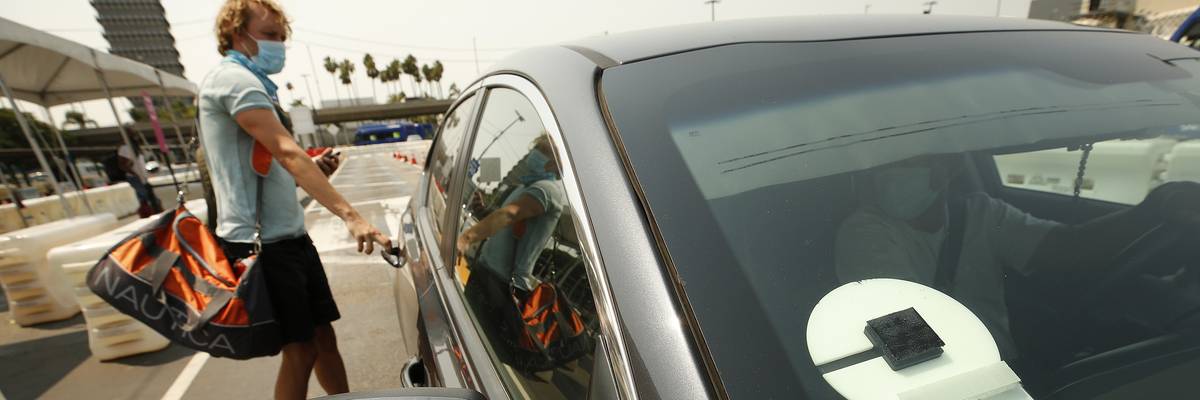
Kasey St. John connects with a driver at the Rideshare Lot at LAX as Uber and Lyft drivers held a moving rally as part of a statewide day of action to demand that both ride-hailing companies follow California law and grant drivers basic employee rights and to denounce the corporations efforts to avoid their responsibilities to workers.
Workers Built the Platform Economy, But They’re Not Seeing Its Rewards
By classifying workers as contractors, platform companies avoid paying core employment obligations while retaining tight control over how the work is done.
Alejandro G. thought that driving full-time for Uber in Houston offered freedom—flexible hours, quick cash, and time to care for his young son. But that promise faded fast.
“There are hours when I make $20,” he told me. “And there are hours when I make $2.” As his pay dropped, he pawned his computer and camera, began rationing the insulin he takes to manage his diabetes—putting his health at risk—and started driving seven days a week, often late into the night, just to break even.
Alejandro, whose real name is withheld for his privacy, is one of millions of workers powering a billion-dollar labor model built on legal loopholes. Companies like Uber insist they are tech platforms, not employers, and that their workers are independent contractors. This sleight of hand allows them to sidestep minimum wage laws, paid sick leave, and other workplace protections, while shifting the financial risks and responsibilities of employment onto the workers. It also lets them avoid employer taxes, draining funds from public coffers.
If gig workers were properly classified, public companies would have to disclose pay data, showing just how far below the median these workers earn, and how high executive compensation soars above them.
A new Human Rights Watch report looks at seven major platform companies operating in the U.S.—Amazon Flex, DoorDash, Favor, Instacart, Lyft, Shipt, and Uber—and finds that their labor model violates international human rights standards. These companies promise flexibility and opportunity, but the reality for many workers is far more precarious. In a survey of 127 platform workers in Texas, we found that after subtracting expenses and benefits, the median hourly pay was just $5.12, including tips. This is nearly 30% below the federal minimum wage, and about 70% below a living wage in Texas.
Seventy-five percent of workers we surveyed said they had struggled to pay for housing in the past year. Thirty-five percent said they couldn’t cover a $400 emergency expense. Over a third had been in a work-related car accident. Many said they sold possessions, relied on food stamps, or borrowed from family and friends to get by. Their labor keeps the system running—but the system isn’t built to work for them.
By classifying workers as contractors, platform companies avoid paying core employment obligations while retaining tight control over how the work is done. The platforms often use algorithms and automated systems to assign jobs, set pay rates, monitor performance, and deactivate workers without warning. In our survey, 65 workers said they feared being cut off from a platform, and 40 had already experienced it. Nearly half were later cleared of wrongdoing.
Companies use incentives that feel like rewards but function more like traps. Uber, Lyft, and DoorDash dangle “quests,” “challenges,” and “surges” to push workers to stay on a shift for longer or hit quotas. These schemes lure workers into chasing bonuses that rarely reflect the true cost of the work. One Uber driver in Houston said, “They are like puppet masters. They psychologically manipulate you.”
Access to higher-paying gigs is also conditioned on behavior. Platforms use customer ratings and performance scores to shape who gets the best jobs. One Shipt worker in Michigan said her pay plummeted immediately after she received two four-star reviews, down from her usual five. Ratings are hard to challenge, and recovering from a low score can take weeks. Workers feel forced to accept every job and appease every customer, reinforcing a system that rewards compliance over fairness.
These aren’t the conditions of self-employment. They’re the conditions of control.
This labor model also drains public resources. In Texas alone, Human Rights Watch estimates that misclassification of platform workers in ride share, food delivery, and in-home services cost the state over $111 million in unemployment insurance contributions between 2020 and 2022. These are public funds that could have strengthened social protection or public services. Instead, they’re absorbed into corporate profits—a quiet transfer of public wealth into private hands.
In 2024, Uber reported $43.9 billion in revenue and nearly $10 billion in net income, calling the fourth quarter its “strongest ever.” DoorDash pulled in $10.72 billion, up 24% from the previous year. Combined, their market valuation exceeds $250 billion.
But workers are pushing back, and policymakers are starting to listen. From June 2 to 13, the 113th session of the International Labour Conference—the United Nations-backed forum where global labor standards are negotiated—will convene to debate a binding treaty on decent work in the platform economy. The message is clear: Workers are demanding rules that protect their rights.
The U.S. can start by updating employment classification standards and adopting clear criteria to determine whether a platform worker is truly independent. We also need greater transparency. If gig workers were properly classified, public companies would have to disclose pay data, showing just how far below the median these workers earn, and how high executive compensation soars above them.
This isn’t about rejecting technology. It’s about making sure new forms of work don’t replicate old forms of exploitation or create new ones, by hiding them behind an app.
Alejandro doesn’t need an algorithm to tell him when to work harder. He has a right to a wage he can live on, protections he can count on, and a system that doesn’t punish him for getting sick, injured, or speaking up.
He and millions like him built the platform economy. It’s time they shared more than the burden.
We are at a crossroads
This country and this world are at a monumental crossroads. US voters have an opportunity to beat back the forces of fascism and confront the billionaires who are rigging the economy, our media system, and our democracy, making it increasingly impossible for ordinary people to get by. We’re not just talking about the election. We’re talking about what must be done once these fascist elements are vanquished from power. We need a bolder set of solutions than what either major party has so far been willing to offer and a working-class movement ready to fight like hell for it. Trump didn't emerge from nowhere. The conditions that fueled MAGA authoritarianism were created by decades of radical neoliberal economic policies and a corrupt political system dominated by corporate interests. They slashed taxes on the super-rich, promising that the benefits would trickle down. They said giveaways to the corporate titans would make life more affordable for the rest of us. It was all bullshit. And when a bitter, betrayed populace searches for someone to blame, right-wing demagogues have little trouble finding scapegoats. People know when they're being lied to, but you won't hear any of this from the corporate media. Only independent journalism—powered and funded by people who believe in building a better world—can deliver truly trustworthy daily news. Our Fall Campaign is underway, and we need your help. To power our newsroom through the rest of the year, we need to raise $125,000 by midnight on October 31. So if you share our vision, please contribute whatever you can to sustain our work. |
Alejandro G. thought that driving full-time for Uber in Houston offered freedom—flexible hours, quick cash, and time to care for his young son. But that promise faded fast.
“There are hours when I make $20,” he told me. “And there are hours when I make $2.” As his pay dropped, he pawned his computer and camera, began rationing the insulin he takes to manage his diabetes—putting his health at risk—and started driving seven days a week, often late into the night, just to break even.
Alejandro, whose real name is withheld for his privacy, is one of millions of workers powering a billion-dollar labor model built on legal loopholes. Companies like Uber insist they are tech platforms, not employers, and that their workers are independent contractors. This sleight of hand allows them to sidestep minimum wage laws, paid sick leave, and other workplace protections, while shifting the financial risks and responsibilities of employment onto the workers. It also lets them avoid employer taxes, draining funds from public coffers.
If gig workers were properly classified, public companies would have to disclose pay data, showing just how far below the median these workers earn, and how high executive compensation soars above them.
A new Human Rights Watch report looks at seven major platform companies operating in the U.S.—Amazon Flex, DoorDash, Favor, Instacart, Lyft, Shipt, and Uber—and finds that their labor model violates international human rights standards. These companies promise flexibility and opportunity, but the reality for many workers is far more precarious. In a survey of 127 platform workers in Texas, we found that after subtracting expenses and benefits, the median hourly pay was just $5.12, including tips. This is nearly 30% below the federal minimum wage, and about 70% below a living wage in Texas.
Seventy-five percent of workers we surveyed said they had struggled to pay for housing in the past year. Thirty-five percent said they couldn’t cover a $400 emergency expense. Over a third had been in a work-related car accident. Many said they sold possessions, relied on food stamps, or borrowed from family and friends to get by. Their labor keeps the system running—but the system isn’t built to work for them.
By classifying workers as contractors, platform companies avoid paying core employment obligations while retaining tight control over how the work is done. The platforms often use algorithms and automated systems to assign jobs, set pay rates, monitor performance, and deactivate workers without warning. In our survey, 65 workers said they feared being cut off from a platform, and 40 had already experienced it. Nearly half were later cleared of wrongdoing.
Companies use incentives that feel like rewards but function more like traps. Uber, Lyft, and DoorDash dangle “quests,” “challenges,” and “surges” to push workers to stay on a shift for longer or hit quotas. These schemes lure workers into chasing bonuses that rarely reflect the true cost of the work. One Uber driver in Houston said, “They are like puppet masters. They psychologically manipulate you.”
Access to higher-paying gigs is also conditioned on behavior. Platforms use customer ratings and performance scores to shape who gets the best jobs. One Shipt worker in Michigan said her pay plummeted immediately after she received two four-star reviews, down from her usual five. Ratings are hard to challenge, and recovering from a low score can take weeks. Workers feel forced to accept every job and appease every customer, reinforcing a system that rewards compliance over fairness.
These aren’t the conditions of self-employment. They’re the conditions of control.
This labor model also drains public resources. In Texas alone, Human Rights Watch estimates that misclassification of platform workers in ride share, food delivery, and in-home services cost the state over $111 million in unemployment insurance contributions between 2020 and 2022. These are public funds that could have strengthened social protection or public services. Instead, they’re absorbed into corporate profits—a quiet transfer of public wealth into private hands.
In 2024, Uber reported $43.9 billion in revenue and nearly $10 billion in net income, calling the fourth quarter its “strongest ever.” DoorDash pulled in $10.72 billion, up 24% from the previous year. Combined, their market valuation exceeds $250 billion.
But workers are pushing back, and policymakers are starting to listen. From June 2 to 13, the 113th session of the International Labour Conference—the United Nations-backed forum where global labor standards are negotiated—will convene to debate a binding treaty on decent work in the platform economy. The message is clear: Workers are demanding rules that protect their rights.
The U.S. can start by updating employment classification standards and adopting clear criteria to determine whether a platform worker is truly independent. We also need greater transparency. If gig workers were properly classified, public companies would have to disclose pay data, showing just how far below the median these workers earn, and how high executive compensation soars above them.
This isn’t about rejecting technology. It’s about making sure new forms of work don’t replicate old forms of exploitation or create new ones, by hiding them behind an app.
Alejandro doesn’t need an algorithm to tell him when to work harder. He has a right to a wage he can live on, protections he can count on, and a system that doesn’t punish him for getting sick, injured, or speaking up.
He and millions like him built the platform economy. It’s time they shared more than the burden.