5
#000000
#FFFFFF
To donate by check, phone, or other method, see our More Ways to Give page.
Daily news & progressive opinion—funded by the people, not the corporations—delivered straight to your inbox.
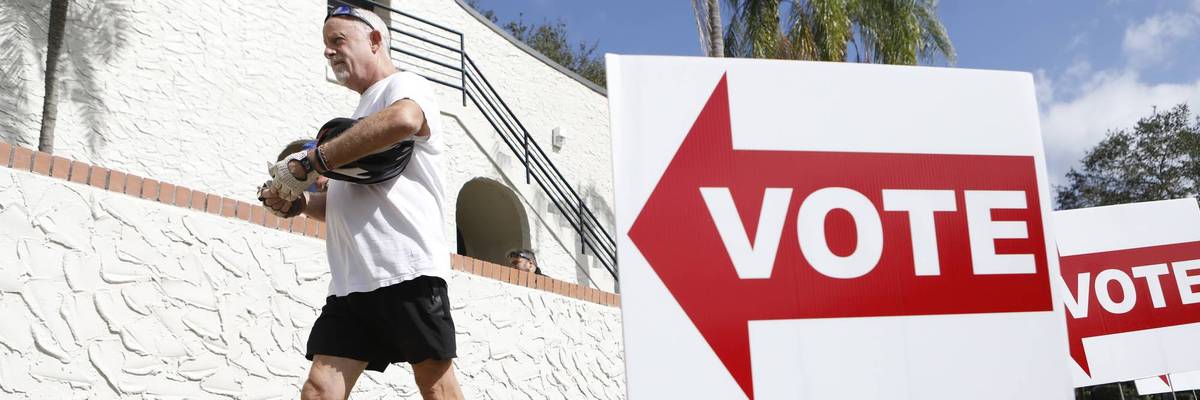
Pinellas County residents go to cast their voting ballots at the Coliseum polling precinct on November 8, 2022 in St. Petersburg, Florida.
If and when other states replicate Florida’s hardball tactics against ballot measures, it would represent the greatest threat to direct democracy in years.
In February, the Florida Department of State determined that no citizen-initiated measures qualified for the Florida 2026 general election ballot. This was not an accident. This outcome is the culmination of a multi-year, multi-pronged attack on the ballot measure process in Florida, with the most draconian blow coming last May.
On May 2, 2025, the Florida legislature passed House Bill 1205, a law that restricts, criminalizes, and penalizes ballot initiative efforts in Florida. HB 1205 is a direct assault on Florida’s citizen-led constitutional amendment process—imposing vague, burdensome, and punitive restrictions that threaten to chill core political speech and discourage civic participation. Although there are several insidious provisions in this law—severe petition-related fines and penalties, restrictive circulation periods, and burdensome petition circulation training obligations, including for volunteers—one of the most damaging provisions only revealed its true nature weeks after the law went into effect.
Unique to the Florida ballot measure process, statewide initiative proponents are obligated to pay a verification fee for each petition they submit. Prior to HB 1205, the cost averaged about 87 cents per petition. On its face, this obligation was already unconstitutional. However, HB 1205 went even further, redefining the “actual cost” of signature verification and authorizing county supervisors to calculate the new per-petition cost, and begin collecting it from statewide ballot initiatives.
Starting on June 30, 2025, the county supervisors began posting their increased signature verification rates. Many newly posted fees are dramatically higher. For example, Lee County raised fees from $0.95 to $4.40 per petition, a 363% increase, while Gilchrist County raised fees from $0.10 to $2.77 per petition, a 2,670% increase. On average, Florida’s three largest counties increased fees to more than $3.77 per signature. As a result, it will now cost sponsors millions of dollars to verify enough petitions to qualify for the ballot. By comparison, no other state even comes close—the largest filing fee we are aware of is Montana’s fee of $3,700, which a court promptly struck down as unconstitutional under state law.
If the regressive policies of HB 1205 are left unchecked, other states will immediately adopt the same types of policies.
There is no question that Florida has been a breeding ground for bad legislation in recent years. Just to name a few—in 2005, Florida passed the first “stand your ground” law. Florida was one of the first states to ban “critical race theory” from its classrooms and was the first state to ban the AP African American studies course. Attacks on the ballot measure process have escalated in recent years, and there is no question that state legislatures look to one another for novel ideas to make the ballot measure process more restrictive. Once a restrictive policy is seen as permissible in one state, other states move quickly to adopt it for themselves. For instance, several states have tried to increase their ballot measure passage thresholds after Florida increased its threshold to 60%. Likewise, geographic circulation requirements, circulator registration and reporting obligations, and circulator payment restrictions have spread like wildfire across Republican-controlled states. Without a doubt, if the regressive policies of HB 1205 are left unchecked, other states will immediately adopt the same types of policies.
And yet, there is still hope. After HB 1205 passed last year, Florida Decides Healthcare, the Medicaid expansion initiative campaign, immediately filed a lawsuit in federal court arguing that HB 1205 is a direct assault on Florida’s citizen-led ballot measure process. That case went to trial on February 9, where the State attempted to defend its restrictions. If HB 1205 is allowed to stand, it will be prohibitively expensive for any initiative to get on the ballot in Florida. If and when other states replicate Florida’s hardball tactics against ballot measures, it would represent the greatest threat to direct democracy in years. Democracy advocates around the country should watch this trial closely, and we should all applaud Florida Decides Healthcare for standing up for their direct democracy rights.
Dear Common Dreams reader, The U.S. is on a fast track to authoritarianism like nothing I've ever seen. Meanwhile, corporate news outlets are utterly capitulating to Trump, twisting their coverage to avoid drawing his ire while lining up to stuff cash in his pockets. That's why I believe that Common Dreams is doing the best and most consequential reporting that we've ever done. Our small but mighty team is a progressive reporting powerhouse, covering the news every day that the corporate media never will. Our mission has always been simple: To inform. To inspire. And to ignite change for the common good. Now here's the key piece that I want all our readers to understand: None of this would be possible without your financial support. That's not just some fundraising cliche. It's the absolute and literal truth. We don't accept corporate advertising and never will. We don't have a paywall because we don't think people should be blocked from critical news based on their ability to pay. Everything we do is funded by the donations of readers like you. Will you donate now to help power the nonprofit, independent reporting of Common Dreams? Thank you for being a vital member of our community. Together, we can keep independent journalism alive when it’s needed most. - Craig Brown, Co-founder |
In February, the Florida Department of State determined that no citizen-initiated measures qualified for the Florida 2026 general election ballot. This was not an accident. This outcome is the culmination of a multi-year, multi-pronged attack on the ballot measure process in Florida, with the most draconian blow coming last May.
On May 2, 2025, the Florida legislature passed House Bill 1205, a law that restricts, criminalizes, and penalizes ballot initiative efforts in Florida. HB 1205 is a direct assault on Florida’s citizen-led constitutional amendment process—imposing vague, burdensome, and punitive restrictions that threaten to chill core political speech and discourage civic participation. Although there are several insidious provisions in this law—severe petition-related fines and penalties, restrictive circulation periods, and burdensome petition circulation training obligations, including for volunteers—one of the most damaging provisions only revealed its true nature weeks after the law went into effect.
Unique to the Florida ballot measure process, statewide initiative proponents are obligated to pay a verification fee for each petition they submit. Prior to HB 1205, the cost averaged about 87 cents per petition. On its face, this obligation was already unconstitutional. However, HB 1205 went even further, redefining the “actual cost” of signature verification and authorizing county supervisors to calculate the new per-petition cost, and begin collecting it from statewide ballot initiatives.
Starting on June 30, 2025, the county supervisors began posting their increased signature verification rates. Many newly posted fees are dramatically higher. For example, Lee County raised fees from $0.95 to $4.40 per petition, a 363% increase, while Gilchrist County raised fees from $0.10 to $2.77 per petition, a 2,670% increase. On average, Florida’s three largest counties increased fees to more than $3.77 per signature. As a result, it will now cost sponsors millions of dollars to verify enough petitions to qualify for the ballot. By comparison, no other state even comes close—the largest filing fee we are aware of is Montana’s fee of $3,700, which a court promptly struck down as unconstitutional under state law.
If the regressive policies of HB 1205 are left unchecked, other states will immediately adopt the same types of policies.
There is no question that Florida has been a breeding ground for bad legislation in recent years. Just to name a few—in 2005, Florida passed the first “stand your ground” law. Florida was one of the first states to ban “critical race theory” from its classrooms and was the first state to ban the AP African American studies course. Attacks on the ballot measure process have escalated in recent years, and there is no question that state legislatures look to one another for novel ideas to make the ballot measure process more restrictive. Once a restrictive policy is seen as permissible in one state, other states move quickly to adopt it for themselves. For instance, several states have tried to increase their ballot measure passage thresholds after Florida increased its threshold to 60%. Likewise, geographic circulation requirements, circulator registration and reporting obligations, and circulator payment restrictions have spread like wildfire across Republican-controlled states. Without a doubt, if the regressive policies of HB 1205 are left unchecked, other states will immediately adopt the same types of policies.
And yet, there is still hope. After HB 1205 passed last year, Florida Decides Healthcare, the Medicaid expansion initiative campaign, immediately filed a lawsuit in federal court arguing that HB 1205 is a direct assault on Florida’s citizen-led ballot measure process. That case went to trial on February 9, where the State attempted to defend its restrictions. If HB 1205 is allowed to stand, it will be prohibitively expensive for any initiative to get on the ballot in Florida. If and when other states replicate Florida’s hardball tactics against ballot measures, it would represent the greatest threat to direct democracy in years. Democracy advocates around the country should watch this trial closely, and we should all applaud Florida Decides Healthcare for standing up for their direct democracy rights.
In February, the Florida Department of State determined that no citizen-initiated measures qualified for the Florida 2026 general election ballot. This was not an accident. This outcome is the culmination of a multi-year, multi-pronged attack on the ballot measure process in Florida, with the most draconian blow coming last May.
On May 2, 2025, the Florida legislature passed House Bill 1205, a law that restricts, criminalizes, and penalizes ballot initiative efforts in Florida. HB 1205 is a direct assault on Florida’s citizen-led constitutional amendment process—imposing vague, burdensome, and punitive restrictions that threaten to chill core political speech and discourage civic participation. Although there are several insidious provisions in this law—severe petition-related fines and penalties, restrictive circulation periods, and burdensome petition circulation training obligations, including for volunteers—one of the most damaging provisions only revealed its true nature weeks after the law went into effect.
Unique to the Florida ballot measure process, statewide initiative proponents are obligated to pay a verification fee for each petition they submit. Prior to HB 1205, the cost averaged about 87 cents per petition. On its face, this obligation was already unconstitutional. However, HB 1205 went even further, redefining the “actual cost” of signature verification and authorizing county supervisors to calculate the new per-petition cost, and begin collecting it from statewide ballot initiatives.
Starting on June 30, 2025, the county supervisors began posting their increased signature verification rates. Many newly posted fees are dramatically higher. For example, Lee County raised fees from $0.95 to $4.40 per petition, a 363% increase, while Gilchrist County raised fees from $0.10 to $2.77 per petition, a 2,670% increase. On average, Florida’s three largest counties increased fees to more than $3.77 per signature. As a result, it will now cost sponsors millions of dollars to verify enough petitions to qualify for the ballot. By comparison, no other state even comes close—the largest filing fee we are aware of is Montana’s fee of $3,700, which a court promptly struck down as unconstitutional under state law.
If the regressive policies of HB 1205 are left unchecked, other states will immediately adopt the same types of policies.
There is no question that Florida has been a breeding ground for bad legislation in recent years. Just to name a few—in 2005, Florida passed the first “stand your ground” law. Florida was one of the first states to ban “critical race theory” from its classrooms and was the first state to ban the AP African American studies course. Attacks on the ballot measure process have escalated in recent years, and there is no question that state legislatures look to one another for novel ideas to make the ballot measure process more restrictive. Once a restrictive policy is seen as permissible in one state, other states move quickly to adopt it for themselves. For instance, several states have tried to increase their ballot measure passage thresholds after Florida increased its threshold to 60%. Likewise, geographic circulation requirements, circulator registration and reporting obligations, and circulator payment restrictions have spread like wildfire across Republican-controlled states. Without a doubt, if the regressive policies of HB 1205 are left unchecked, other states will immediately adopt the same types of policies.
And yet, there is still hope. After HB 1205 passed last year, Florida Decides Healthcare, the Medicaid expansion initiative campaign, immediately filed a lawsuit in federal court arguing that HB 1205 is a direct assault on Florida’s citizen-led ballot measure process. That case went to trial on February 9, where the State attempted to defend its restrictions. If HB 1205 is allowed to stand, it will be prohibitively expensive for any initiative to get on the ballot in Florida. If and when other states replicate Florida’s hardball tactics against ballot measures, it would represent the greatest threat to direct democracy in years. Democracy advocates around the country should watch this trial closely, and we should all applaud Florida Decides Healthcare for standing up for their direct democracy rights.