SUBSCRIBE TO OUR FREE NEWSLETTER
Daily news & progressive opinion—funded by the people, not the corporations—delivered straight to your inbox.
5
#000000
#FFFFFF
To donate by check, phone, or other method, see our More Ways to Give page.
Daily news & progressive opinion—funded by the people, not the corporations—delivered straight to your inbox.
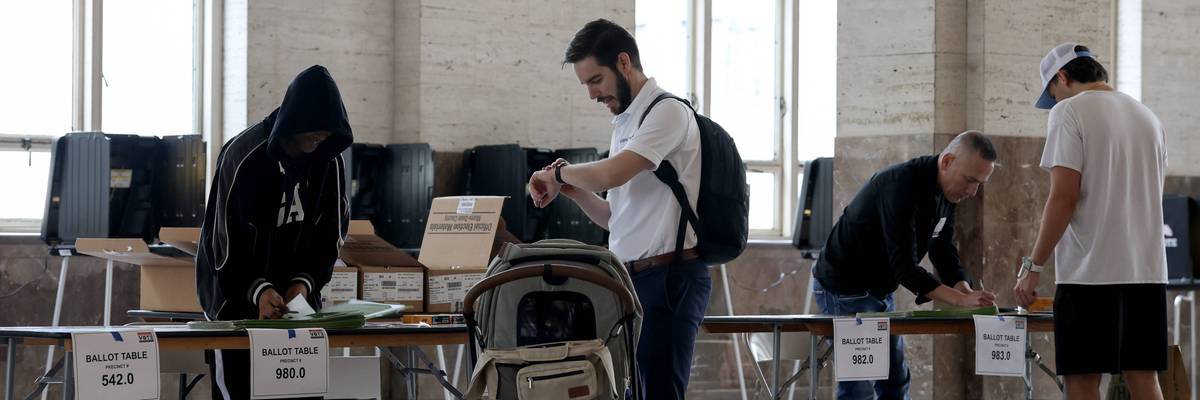
Poll workers help voters as they prepare to cast their ballots on December 09, 2025 in Miami, Florida.
"This wave of anti-voter legislation is advancing amid ongoing abuses of power that pose unprecedented threats to American democracy," said the ACLU of Florida's executive director.
With 251 days until the US general election, Florida Republicans on Wednesday passed a show-me-your-papers bill that opponents warn could prevent thousands of eligible state voters from registering if they don't have a valid birth certificate or passport, or their documents don't reflect a name change.
"Midterm elections are coming later this year—and they're a crucial test of our democracy," ACLU of Florida executive director Bacardi Jackson said in a Wednesday statement. "Moments like this bring new voters into the process and give communities the power to hold leaders accountable—exactly what a healthy democracy demands. But right now, some lawmakers are pushing an anti-voter bill that could shut thousands of eligible people out of our elections and discourage the enrollment of new eligible voters."
The Florida House of Representatives on Wednesday voted 83-31 on HB 991, sponsored by Rep. Jenna Persons-Mulicka (R-78).
"The Florida House version of the bill would only go into effect in January 2027. But under a similar bill set for consideration in the Florida Senate, the new rules would take effect this July, before the November midterm elections," Democracy Docket detailed. "A House committee already gave preliminary approval to the bill earlier this month."
Jackson highlighted that "many eligible voters don't have ready access to an unexpired passport or an original or certified copy of their birth certificate because of logistical and financial barriers. More than 8 million Floridians do not have a valid passport, and because many women legally change their name upon marriage, more than 4.7 million women in Florida do not have a birth certificate reflecting their current legal name—documents this bill would require."
"At the same time, this proposal would eliminate current, valid forms of ID proving eligibility at the polls, including student IDs, retirement center IDs, and public assistance IDs," she warned. "Taken together, these changes are not neutral or harmless—they would fall hardest on low-income voters, students, seniors, women, and Black and brown Floridians."
The ACLU leader also argued that "context matters. This wave of anti-voter legislation is advancing amid ongoing abuses of power that pose unprecedented threats to American democracy." She specifically pointed to the Safeguard American Voter Eligibility (SAVE) America Act that the GOP-controlled US House of Representatives passed earlier this month.
"We're seeing parallel efforts nationally to make it harder for eligible voters to cast their ballots—including the SAVE Act being debated in Congress right now—and Florida is leading the way down this authoritarian path," she said. The federal bill is less likely to get through the US Senate, whose filibuster rule requires the GOP to get some Democratic support to advance most legislation.
"What makes this even more galling is that lawmakers don't have to do any of this at all—they are choosing to," said Jackson. "They could enact reforms making it easier for eligible Floridians to vote and have their voices be heard, like the Harry T. and Harriette V. Moore Florida Voting Rights Act, HB 1419/SB 1598. Instead, they are fast-tracking legislation that would make voting harder for eligible Floridians and silence communities that deserve to be heard."
"We will not stand by while politicians in power seek to entrench their power at the expense of the people's rights," she vowed. "We will keep organizing and fighting to reclaim and defend our democracy—because every eligible Floridian deserves to vote."
Meanwhile, at the federal level, Senate Majority Leader John Thune (R-SD) plans to hold a vote on the SAVE America Act this week. President Donald Trump used his State of the Union address on Tuesday night to increase pressure on Congress to send the bill to his desk.
"I'm asking you to approve the SAVE America Act to stop illegal aliens and others who are unpermitted persons from voting in our sacred American elections—that cheating is rampant in our elections," Trump said. "It's very simple: All voters must show voter ID. All voters must show proof of citizenship in order to vote. And no more crooked mail-in ballots except for illness, disability, military, or travel. None."
Experts have long countered such GOP claims by emphasizing that, as the Brennan Center for Justice put it in a pair of blog posts, "noncitizen voting is already illegal" and "extensive research reveals that fraud is very rare."
Michelle Kanter Cohen, policy director and senior counsel for the national voting rights group Fair Elections Center, told Democracy Docket on Wednesday that Florida's voter suppression bill "would do a lot of the same things," as the SAVE America Act, "in terms of preventing American citizens from voting who don't have access to documentary proof of citizenship documents."
"The last thing someone who is on a path to citizenship would want to do is to jeopardize their naturalization by voting illegally," Kanter Cohen said. "And so people don't do that. That's not something that's happening because it has such dire consequences."
Dear Common Dreams reader, It’s been nearly 30 years since I co-founded Common Dreams with my late wife, Lina Newhouser. We had the radical notion that journalism should serve the public good, not corporate profits. It was clear to us from the outset what it would take to build such a project. No paid advertisements. No corporate sponsors. No millionaire publisher telling us what to think or do. Many people said we wouldn't last a year, but we proved those doubters wrong. Together with a tremendous team of journalists and dedicated staff, we built an independent media outlet free from the constraints of profits and corporate control. Our mission has always been simple: To inform. To inspire. To ignite change for the common good. Building Common Dreams was not easy. Our survival was never guaranteed. When you take on the most powerful forces—Wall Street greed, fossil fuel industry destruction, Big Tech lobbyists, and uber-rich oligarchs who have spent billions upon billions rigging the economy and democracy in their favor—the only bulwark you have is supporters who believe in your work. But here’s the urgent message from me today. It's never been this bad out there. And it's never been this hard to keep us going. At the very moment Common Dreams is most needed, the threats we face are intensifying. We need your support now more than ever. We don't accept corporate advertising and never will. We don't have a paywall because we don't think people should be blocked from critical news based on their ability to pay. Everything we do is funded by the donations of readers like you. When everyone does the little they can afford, we are strong. But if that support retreats or dries up, so do we. Will you donate now to make sure Common Dreams not only survives but thrives? —Craig Brown, Co-founder |
With 251 days until the US general election, Florida Republicans on Wednesday passed a show-me-your-papers bill that opponents warn could prevent thousands of eligible state voters from registering if they don't have a valid birth certificate or passport, or their documents don't reflect a name change.
"Midterm elections are coming later this year—and they're a crucial test of our democracy," ACLU of Florida executive director Bacardi Jackson said in a Wednesday statement. "Moments like this bring new voters into the process and give communities the power to hold leaders accountable—exactly what a healthy democracy demands. But right now, some lawmakers are pushing an anti-voter bill that could shut thousands of eligible people out of our elections and discourage the enrollment of new eligible voters."
The Florida House of Representatives on Wednesday voted 83-31 on HB 991, sponsored by Rep. Jenna Persons-Mulicka (R-78).
"The Florida House version of the bill would only go into effect in January 2027. But under a similar bill set for consideration in the Florida Senate, the new rules would take effect this July, before the November midterm elections," Democracy Docket detailed. "A House committee already gave preliminary approval to the bill earlier this month."
Jackson highlighted that "many eligible voters don't have ready access to an unexpired passport or an original or certified copy of their birth certificate because of logistical and financial barriers. More than 8 million Floridians do not have a valid passport, and because many women legally change their name upon marriage, more than 4.7 million women in Florida do not have a birth certificate reflecting their current legal name—documents this bill would require."
"At the same time, this proposal would eliminate current, valid forms of ID proving eligibility at the polls, including student IDs, retirement center IDs, and public assistance IDs," she warned. "Taken together, these changes are not neutral or harmless—they would fall hardest on low-income voters, students, seniors, women, and Black and brown Floridians."
The ACLU leader also argued that "context matters. This wave of anti-voter legislation is advancing amid ongoing abuses of power that pose unprecedented threats to American democracy." She specifically pointed to the Safeguard American Voter Eligibility (SAVE) America Act that the GOP-controlled US House of Representatives passed earlier this month.
"We're seeing parallel efforts nationally to make it harder for eligible voters to cast their ballots—including the SAVE Act being debated in Congress right now—and Florida is leading the way down this authoritarian path," she said. The federal bill is less likely to get through the US Senate, whose filibuster rule requires the GOP to get some Democratic support to advance most legislation.
"What makes this even more galling is that lawmakers don't have to do any of this at all—they are choosing to," said Jackson. "They could enact reforms making it easier for eligible Floridians to vote and have their voices be heard, like the Harry T. and Harriette V. Moore Florida Voting Rights Act, HB 1419/SB 1598. Instead, they are fast-tracking legislation that would make voting harder for eligible Floridians and silence communities that deserve to be heard."
"We will not stand by while politicians in power seek to entrench their power at the expense of the people's rights," she vowed. "We will keep organizing and fighting to reclaim and defend our democracy—because every eligible Floridian deserves to vote."
Meanwhile, at the federal level, Senate Majority Leader John Thune (R-SD) plans to hold a vote on the SAVE America Act this week. President Donald Trump used his State of the Union address on Tuesday night to increase pressure on Congress to send the bill to his desk.
"I'm asking you to approve the SAVE America Act to stop illegal aliens and others who are unpermitted persons from voting in our sacred American elections—that cheating is rampant in our elections," Trump said. "It's very simple: All voters must show voter ID. All voters must show proof of citizenship in order to vote. And no more crooked mail-in ballots except for illness, disability, military, or travel. None."
Experts have long countered such GOP claims by emphasizing that, as the Brennan Center for Justice put it in a pair of blog posts, "noncitizen voting is already illegal" and "extensive research reveals that fraud is very rare."
Michelle Kanter Cohen, policy director and senior counsel for the national voting rights group Fair Elections Center, told Democracy Docket on Wednesday that Florida's voter suppression bill "would do a lot of the same things," as the SAVE America Act, "in terms of preventing American citizens from voting who don't have access to documentary proof of citizenship documents."
"The last thing someone who is on a path to citizenship would want to do is to jeopardize their naturalization by voting illegally," Kanter Cohen said. "And so people don't do that. That's not something that's happening because it has such dire consequences."
With 251 days until the US general election, Florida Republicans on Wednesday passed a show-me-your-papers bill that opponents warn could prevent thousands of eligible state voters from registering if they don't have a valid birth certificate or passport, or their documents don't reflect a name change.
"Midterm elections are coming later this year—and they're a crucial test of our democracy," ACLU of Florida executive director Bacardi Jackson said in a Wednesday statement. "Moments like this bring new voters into the process and give communities the power to hold leaders accountable—exactly what a healthy democracy demands. But right now, some lawmakers are pushing an anti-voter bill that could shut thousands of eligible people out of our elections and discourage the enrollment of new eligible voters."
The Florida House of Representatives on Wednesday voted 83-31 on HB 991, sponsored by Rep. Jenna Persons-Mulicka (R-78).
"The Florida House version of the bill would only go into effect in January 2027. But under a similar bill set for consideration in the Florida Senate, the new rules would take effect this July, before the November midterm elections," Democracy Docket detailed. "A House committee already gave preliminary approval to the bill earlier this month."
Jackson highlighted that "many eligible voters don't have ready access to an unexpired passport or an original or certified copy of their birth certificate because of logistical and financial barriers. More than 8 million Floridians do not have a valid passport, and because many women legally change their name upon marriage, more than 4.7 million women in Florida do not have a birth certificate reflecting their current legal name—documents this bill would require."
"At the same time, this proposal would eliminate current, valid forms of ID proving eligibility at the polls, including student IDs, retirement center IDs, and public assistance IDs," she warned. "Taken together, these changes are not neutral or harmless—they would fall hardest on low-income voters, students, seniors, women, and Black and brown Floridians."
The ACLU leader also argued that "context matters. This wave of anti-voter legislation is advancing amid ongoing abuses of power that pose unprecedented threats to American democracy." She specifically pointed to the Safeguard American Voter Eligibility (SAVE) America Act that the GOP-controlled US House of Representatives passed earlier this month.
"We're seeing parallel efforts nationally to make it harder for eligible voters to cast their ballots—including the SAVE Act being debated in Congress right now—and Florida is leading the way down this authoritarian path," she said. The federal bill is less likely to get through the US Senate, whose filibuster rule requires the GOP to get some Democratic support to advance most legislation.
"What makes this even more galling is that lawmakers don't have to do any of this at all—they are choosing to," said Jackson. "They could enact reforms making it easier for eligible Floridians to vote and have their voices be heard, like the Harry T. and Harriette V. Moore Florida Voting Rights Act, HB 1419/SB 1598. Instead, they are fast-tracking legislation that would make voting harder for eligible Floridians and silence communities that deserve to be heard."
"We will not stand by while politicians in power seek to entrench their power at the expense of the people's rights," she vowed. "We will keep organizing and fighting to reclaim and defend our democracy—because every eligible Floridian deserves to vote."
Meanwhile, at the federal level, Senate Majority Leader John Thune (R-SD) plans to hold a vote on the SAVE America Act this week. President Donald Trump used his State of the Union address on Tuesday night to increase pressure on Congress to send the bill to his desk.
"I'm asking you to approve the SAVE America Act to stop illegal aliens and others who are unpermitted persons from voting in our sacred American elections—that cheating is rampant in our elections," Trump said. "It's very simple: All voters must show voter ID. All voters must show proof of citizenship in order to vote. And no more crooked mail-in ballots except for illness, disability, military, or travel. None."
Experts have long countered such GOP claims by emphasizing that, as the Brennan Center for Justice put it in a pair of blog posts, "noncitizen voting is already illegal" and "extensive research reveals that fraud is very rare."
Michelle Kanter Cohen, policy director and senior counsel for the national voting rights group Fair Elections Center, told Democracy Docket on Wednesday that Florida's voter suppression bill "would do a lot of the same things," as the SAVE America Act, "in terms of preventing American citizens from voting who don't have access to documentary proof of citizenship documents."
"The last thing someone who is on a path to citizenship would want to do is to jeopardize their naturalization by voting illegally," Kanter Cohen said. "And so people don't do that. That's not something that's happening because it has such dire consequences."