SUBSCRIBE TO OUR FREE NEWSLETTER
Daily news & progressive opinion—funded by the people, not the corporations—delivered straight to your inbox.
5
#000000
#FFFFFF
To donate by check, phone, or other method, see our More Ways to Give page.
Daily news & progressive opinion—funded by the people, not the corporations—delivered straight to your inbox.
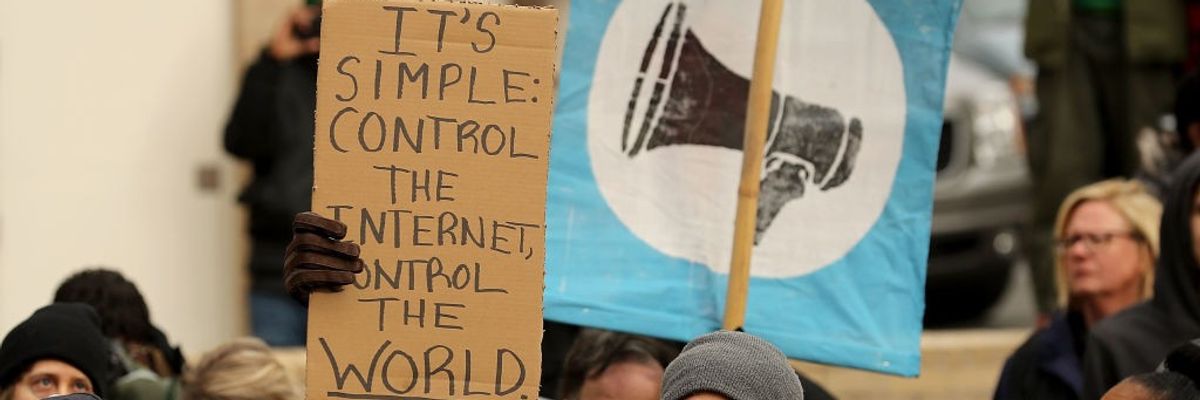
Demonstrators rally outside the Federal Communication Commission building to protest against the end of net neutrality rules December 14, 2017 in Washington, DC.
The powerful telecom industry did what they always do when the FCC does anything good or important on behalf of consumer: They sued to overturn the rules.
Happy New Year to everyone but the U.S. Court of Appeals for the 6th Circuit.
On Thursday, this federal court in Cincinnati threw out the Federal Communication Commission’s Net Neutrality rules, rejecting the agency’s authority to protect broadband consumers and handing phone and cable companies a major victory just weeks before the Trump administration returns to power.
The ruling against the FCC by three Republican judges isn’t shocking, but their reasoning is shoddy, a mish-mash of tired industry claims paired with a willful misrepresentation of how the internet actually works.
As Matt Wood, an experienced telecommunications attorney and my colleague at Free Press, explains: “Beyond being a disappointing outcome, the 6th Circuit’s opinion is just plainly wrong at every level of analysis. The decision missed the point on everything from its granular textual analysis and understanding of the broader statutory context, to the court’s view of the legislative and agency history, all the way to its conception of Congress’s overarching policy concerns.”
Our job now is to channel the growing outrage over this appalling decision into the long-term changes we need to keep the internet safe, reliable, accessible, affordable and free from unlawful discrimination.
Under the leadership of Chairwoman Jessica Rosenworcel, the FCC moved in April 2024 to restore Net Neutrality and the essential consumer protections that rest under Title II of the Communications Act, which had been gutted under the first Trump administration. This was an all-too-rare example in Washington of a government agency doing what it’s supposed to do: Listening to the public and taking their side against the powerful companies that for far too long have captured and called the shots in D.C.
And the phone and cable industry did what they always do when the FCC does anything good or important: They sued to overturn the rules.
This time, however, the lawyers for the biggest phone and cable companies had two things working in their favor. First, they got lucky: They won the forum-shopping lottery and got their case moved outside of Washington, D.C., where previous rounds of the Net Neutrality fight had been decided.
Second, the Supreme Court handed down a ruling in June in the Loper Bright Enterprises vs. Raimondo case that overturned the so-called Chevron doctrine that gave deference to expert agencies in complex matters like environmental and telecommunications regulations.
Unfortunately, the lawyers representing massive companies like AT&T, Comcast and Verizon found an eager audience in Cincinnati for their debunked arguments.
Despite extensive legal and economic analysis provided by Free Press and our allies in the case and at oral arguments in October, the court ruled against the FCC and deemed internet access to be an “information service” largely free from FCC oversight.
In a post-Chevron world where courts no longer have to defer to expert agencies, we’ve replaced years of evidence and argument with revelations like this from Judge Griffin: “The existence of a fact or thought in one’s mind is not ‘information’ like 0s and 1s used by computers.”
In the short term, this decision will let the incoming Trump FCC abdicate its responsibility to protect internet users so it can focus on its new priority of threatening TV broadcasters and social-media sites to carry more pro-Trump views.
I’ll spare you the rest. This court’s warped decision scraps the common-sense rules the FCC restored in April. The result is that throughout most of the country, the most essential communications service of this century will be operating without any real government oversight, with no one to step in when companies rip you off or slow down your service.
This ruling is far out of step with the views of the American public, who overwhelmingly support real Net Neutrality and despise the cable companies. They’re tired of paying too much, and they hate being spied on when they surf (or talk, thanks Siri). Now they’ll have even less recourse to deal with unscrupulous and abusive business practices.
Incoming FCC Chair Brendan Carr and his old boss Ajit Pai, who’s part of the Trump transition team, are crowing everywhere about the decision and cheering this strike against “regulatory overreach.” Of course, Carr and his ilk have never been interested in protecting the public interest, only private profits.
In the short term, this decision will let the incoming Trump FCC abdicate its responsibility to protect internet users so it can focus on its new priority of threatening TV broadcasters and social-media sites to carry more pro-Trump views. The hypocrisy of crushing light-touch regulations while aggressively pursuing government censorship is something to behold.
In the weeks ahead, the FCC, as well as Free Press and the other parties who intervened in the case, will consider our legal options and decide whether to appeal the case to the Supreme Court. In Congress, we’ll start laying the groundwork for a future bill that restores Net Neutrality and FCC authority. Meanwhile, we’ll look to the states to hold the line, with laws like California’s strong Net Neutrality regulations thankfully still on the books.
Our job now is to channel the growing outrage over this appalling decision into the long-term changes we need to keep the internet safe, reliable, accessible, affordable and free from unlawful discrimination.
It may have gotten harder, but the fight for the free and open internet is far from over.
Dear Common Dreams reader, It’s been nearly 30 years since I co-founded Common Dreams with my late wife, Lina Newhouser. We had the radical notion that journalism should serve the public good, not corporate profits. It was clear to us from the outset what it would take to build such a project. No paid advertisements. No corporate sponsors. No millionaire publisher telling us what to think or do. Many people said we wouldn't last a year, but we proved those doubters wrong. Together with a tremendous team of journalists and dedicated staff, we built an independent media outlet free from the constraints of profits and corporate control. Our mission has always been simple: To inform. To inspire. To ignite change for the common good. Building Common Dreams was not easy. Our survival was never guaranteed. When you take on the most powerful forces—Wall Street greed, fossil fuel industry destruction, Big Tech lobbyists, and uber-rich oligarchs who have spent billions upon billions rigging the economy and democracy in their favor—the only bulwark you have is supporters who believe in your work. But here’s the urgent message from me today. It's never been this bad out there. And it's never been this hard to keep us going. At the very moment Common Dreams is most needed, the threats we face are intensifying. We need your support now more than ever. We don't accept corporate advertising and never will. We don't have a paywall because we don't think people should be blocked from critical news based on their ability to pay. Everything we do is funded by the donations of readers like you. When everyone does the little they can afford, we are strong. But if that support retreats or dries up, so do we. Will you donate now to make sure Common Dreams not only survives but thrives? —Craig Brown, Co-founder |
Happy New Year to everyone but the U.S. Court of Appeals for the 6th Circuit.
On Thursday, this federal court in Cincinnati threw out the Federal Communication Commission’s Net Neutrality rules, rejecting the agency’s authority to protect broadband consumers and handing phone and cable companies a major victory just weeks before the Trump administration returns to power.
The ruling against the FCC by three Republican judges isn’t shocking, but their reasoning is shoddy, a mish-mash of tired industry claims paired with a willful misrepresentation of how the internet actually works.
As Matt Wood, an experienced telecommunications attorney and my colleague at Free Press, explains: “Beyond being a disappointing outcome, the 6th Circuit’s opinion is just plainly wrong at every level of analysis. The decision missed the point on everything from its granular textual analysis and understanding of the broader statutory context, to the court’s view of the legislative and agency history, all the way to its conception of Congress’s overarching policy concerns.”
Our job now is to channel the growing outrage over this appalling decision into the long-term changes we need to keep the internet safe, reliable, accessible, affordable and free from unlawful discrimination.
Under the leadership of Chairwoman Jessica Rosenworcel, the FCC moved in April 2024 to restore Net Neutrality and the essential consumer protections that rest under Title II of the Communications Act, which had been gutted under the first Trump administration. This was an all-too-rare example in Washington of a government agency doing what it’s supposed to do: Listening to the public and taking their side against the powerful companies that for far too long have captured and called the shots in D.C.
And the phone and cable industry did what they always do when the FCC does anything good or important: They sued to overturn the rules.
This time, however, the lawyers for the biggest phone and cable companies had two things working in their favor. First, they got lucky: They won the forum-shopping lottery and got their case moved outside of Washington, D.C., where previous rounds of the Net Neutrality fight had been decided.
Second, the Supreme Court handed down a ruling in June in the Loper Bright Enterprises vs. Raimondo case that overturned the so-called Chevron doctrine that gave deference to expert agencies in complex matters like environmental and telecommunications regulations.
Unfortunately, the lawyers representing massive companies like AT&T, Comcast and Verizon found an eager audience in Cincinnati for their debunked arguments.
Despite extensive legal and economic analysis provided by Free Press and our allies in the case and at oral arguments in October, the court ruled against the FCC and deemed internet access to be an “information service” largely free from FCC oversight.
In a post-Chevron world where courts no longer have to defer to expert agencies, we’ve replaced years of evidence and argument with revelations like this from Judge Griffin: “The existence of a fact or thought in one’s mind is not ‘information’ like 0s and 1s used by computers.”
In the short term, this decision will let the incoming Trump FCC abdicate its responsibility to protect internet users so it can focus on its new priority of threatening TV broadcasters and social-media sites to carry more pro-Trump views.
I’ll spare you the rest. This court’s warped decision scraps the common-sense rules the FCC restored in April. The result is that throughout most of the country, the most essential communications service of this century will be operating without any real government oversight, with no one to step in when companies rip you off or slow down your service.
This ruling is far out of step with the views of the American public, who overwhelmingly support real Net Neutrality and despise the cable companies. They’re tired of paying too much, and they hate being spied on when they surf (or talk, thanks Siri). Now they’ll have even less recourse to deal with unscrupulous and abusive business practices.
Incoming FCC Chair Brendan Carr and his old boss Ajit Pai, who’s part of the Trump transition team, are crowing everywhere about the decision and cheering this strike against “regulatory overreach.” Of course, Carr and his ilk have never been interested in protecting the public interest, only private profits.
In the short term, this decision will let the incoming Trump FCC abdicate its responsibility to protect internet users so it can focus on its new priority of threatening TV broadcasters and social-media sites to carry more pro-Trump views. The hypocrisy of crushing light-touch regulations while aggressively pursuing government censorship is something to behold.
In the weeks ahead, the FCC, as well as Free Press and the other parties who intervened in the case, will consider our legal options and decide whether to appeal the case to the Supreme Court. In Congress, we’ll start laying the groundwork for a future bill that restores Net Neutrality and FCC authority. Meanwhile, we’ll look to the states to hold the line, with laws like California’s strong Net Neutrality regulations thankfully still on the books.
Our job now is to channel the growing outrage over this appalling decision into the long-term changes we need to keep the internet safe, reliable, accessible, affordable and free from unlawful discrimination.
It may have gotten harder, but the fight for the free and open internet is far from over.
Happy New Year to everyone but the U.S. Court of Appeals for the 6th Circuit.
On Thursday, this federal court in Cincinnati threw out the Federal Communication Commission’s Net Neutrality rules, rejecting the agency’s authority to protect broadband consumers and handing phone and cable companies a major victory just weeks before the Trump administration returns to power.
The ruling against the FCC by three Republican judges isn’t shocking, but their reasoning is shoddy, a mish-mash of tired industry claims paired with a willful misrepresentation of how the internet actually works.
As Matt Wood, an experienced telecommunications attorney and my colleague at Free Press, explains: “Beyond being a disappointing outcome, the 6th Circuit’s opinion is just plainly wrong at every level of analysis. The decision missed the point on everything from its granular textual analysis and understanding of the broader statutory context, to the court’s view of the legislative and agency history, all the way to its conception of Congress’s overarching policy concerns.”
Our job now is to channel the growing outrage over this appalling decision into the long-term changes we need to keep the internet safe, reliable, accessible, affordable and free from unlawful discrimination.
Under the leadership of Chairwoman Jessica Rosenworcel, the FCC moved in April 2024 to restore Net Neutrality and the essential consumer protections that rest under Title II of the Communications Act, which had been gutted under the first Trump administration. This was an all-too-rare example in Washington of a government agency doing what it’s supposed to do: Listening to the public and taking their side against the powerful companies that for far too long have captured and called the shots in D.C.
And the phone and cable industry did what they always do when the FCC does anything good or important: They sued to overturn the rules.
This time, however, the lawyers for the biggest phone and cable companies had two things working in their favor. First, they got lucky: They won the forum-shopping lottery and got their case moved outside of Washington, D.C., where previous rounds of the Net Neutrality fight had been decided.
Second, the Supreme Court handed down a ruling in June in the Loper Bright Enterprises vs. Raimondo case that overturned the so-called Chevron doctrine that gave deference to expert agencies in complex matters like environmental and telecommunications regulations.
Unfortunately, the lawyers representing massive companies like AT&T, Comcast and Verizon found an eager audience in Cincinnati for their debunked arguments.
Despite extensive legal and economic analysis provided by Free Press and our allies in the case and at oral arguments in October, the court ruled against the FCC and deemed internet access to be an “information service” largely free from FCC oversight.
In a post-Chevron world where courts no longer have to defer to expert agencies, we’ve replaced years of evidence and argument with revelations like this from Judge Griffin: “The existence of a fact or thought in one’s mind is not ‘information’ like 0s and 1s used by computers.”
In the short term, this decision will let the incoming Trump FCC abdicate its responsibility to protect internet users so it can focus on its new priority of threatening TV broadcasters and social-media sites to carry more pro-Trump views.
I’ll spare you the rest. This court’s warped decision scraps the common-sense rules the FCC restored in April. The result is that throughout most of the country, the most essential communications service of this century will be operating without any real government oversight, with no one to step in when companies rip you off or slow down your service.
This ruling is far out of step with the views of the American public, who overwhelmingly support real Net Neutrality and despise the cable companies. They’re tired of paying too much, and they hate being spied on when they surf (or talk, thanks Siri). Now they’ll have even less recourse to deal with unscrupulous and abusive business practices.
Incoming FCC Chair Brendan Carr and his old boss Ajit Pai, who’s part of the Trump transition team, are crowing everywhere about the decision and cheering this strike against “regulatory overreach.” Of course, Carr and his ilk have never been interested in protecting the public interest, only private profits.
In the short term, this decision will let the incoming Trump FCC abdicate its responsibility to protect internet users so it can focus on its new priority of threatening TV broadcasters and social-media sites to carry more pro-Trump views. The hypocrisy of crushing light-touch regulations while aggressively pursuing government censorship is something to behold.
In the weeks ahead, the FCC, as well as Free Press and the other parties who intervened in the case, will consider our legal options and decide whether to appeal the case to the Supreme Court. In Congress, we’ll start laying the groundwork for a future bill that restores Net Neutrality and FCC authority. Meanwhile, we’ll look to the states to hold the line, with laws like California’s strong Net Neutrality regulations thankfully still on the books.
Our job now is to channel the growing outrage over this appalling decision into the long-term changes we need to keep the internet safe, reliable, accessible, affordable and free from unlawful discrimination.
It may have gotten harder, but the fight for the free and open internet is far from over.