SUBSCRIBE TO OUR FREE NEWSLETTER
Daily news & progressive opinion—funded by the people, not the corporations—delivered straight to your inbox.
5
#000000
#FFFFFF
To donate by check, phone, or other method, see our More Ways to Give page.
Daily news & progressive opinion—funded by the people, not the corporations—delivered straight to your inbox.
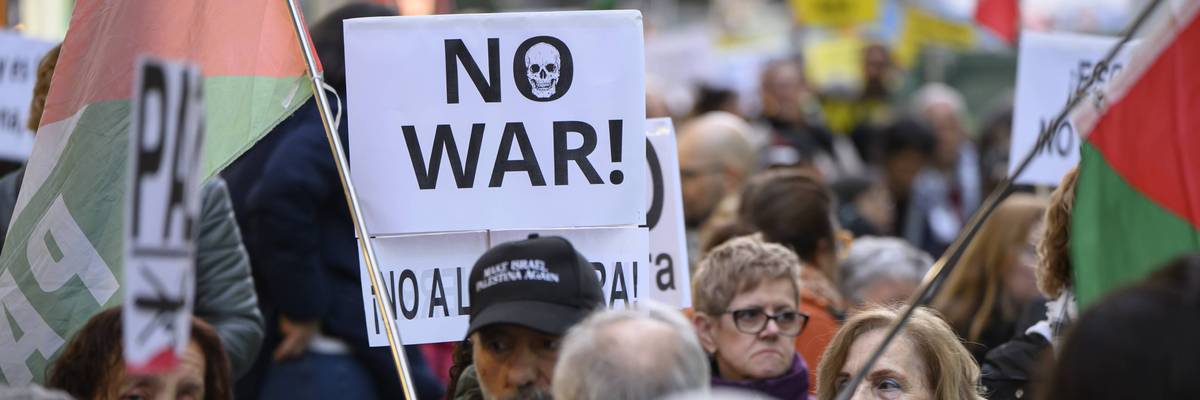
Europe is no longer prepared to be drawn, by default, into an open-ended military operation in the Middle East.
What is unfolding across European capitals is not merely dissent over a particular conflict; it is the quiet reconfiguration of alliance behavior under conditions of escalating risk. The refusal voiced in Madrid—most starkly articulated by Spain’s Transport Minister, Óscar Puente, who declared that his country would not go “even around the corner” with Israeli Prime Minister Benjamin Netanyahu—signals something more consequential than diplomatic disagreement.
Delivered in unusually blunt terms, his remark crystallized a broader political reality: Europe is no longer prepared to be drawn, by default, into an open-ended military escalation against Iran. It marks, in effect, the visible boundary of a strategic threshold the continent is no longer willing to cross.
For decades, transatlantic alignment functioned on the presumption of convergence: that when Washington moved, Europe would calibrate—but ultimately align. That presumption is now under strain. The prospect of a US-Israeli military aggression against Iran has exposed a widening gap between American strategic impulses and European risk tolerance.
The divergence is not ideological. It is structural. European governments are confronting a scenario in which escalation offers limited strategic clarity but immediate systemic exposure. They are being asked, in effect, to underwrite a conflict defined by uncertain objectives, fluid escalation dynamics, and a disproportionate economic burden—without corresponding influence over its conduct or conclusion.
The era of automatic convergence is giving way to one of selective alignment, where interests are weighed more carefully, risks are more openly acknowledged, and participation in conflict is no longer the default expression of alliance.
Spain’s position, far from anomalous, crystallizes this dynamic. The refusal to facilitate or politically endorse escalation reflects a broader European instinct toward insulation. Berlin’s caution, Paris’s distance, and the European Union’s emphasis on deescalation all point in the same direction: a deliberate effort to decouple European stability from the volatility of a conflict it neither initiated nor controls.
At the center of this recalibration lies energy vulnerability. The Strait of Hormuz—through which between 17 and 20 million barrels of oil pass daily—remains the most immediate point of systemic exposure. Any disruption, even partial, would transmit shockwaves through European economies already navigating inflationary pressures and fragile growth trajectories. Oil prices hovering around $115 per barrel, with credible projections reaching $150-$175 under sustained disruption, are not abstract indicators; they are policy constraints.
This economic dimension has begun to reshape strategic language. Where earlier discourse emphasized deterrence and enforcement, current formulations increasingly prioritize stability, containment, and the avoidance of escalation spirals. The postponement of strikes on Iranian energy infrastructure, following what Washington described as “productive” engagement, underscores the extent to which strategic decisions are now bounded by economic risk.
Equally significant is the absence of decisive outcomes on the ground. The escalation has yet to produce the structural breakthroughs that would justify its expansion. Assertions of operational success coexist with the persistence of institutional continuity within Iran, where governing structures remain intact and operationally coherent. In strategic terms, the conflict has generated pressure without resolution—a condition that complicates both escalation and exit.
Under these circumstances, Europe’s posture begins to take on a different meaning. It is not hesitation, nor is it disengagement. It is a recalibration of agency. By declining automatic alignment, European states are asserting a form of strategic autonomy that had long been subordinated to alliance cohesion. The message is not framed in declarative terms, but its implications are unmistakable: Participation is no longer assumed; it is contingent.
This shift does not dissolve the transatlantic relationship, but it does redefine its operational boundaries. It introduces friction where there was once fluidity, and conditionality where there was once reflex. Most importantly, it signals that the costs of alignment—economic, political, and strategic—are now subject to explicit calculation rather than implicit acceptance.
The significance of Spain’s stance, therefore, lies not in its rhetoric, but in what it reveals about the evolving architecture of Western power. The era of automatic convergence is giving way to one of selective alignment, where interests are weighed more carefully, risks are more openly acknowledged, and participation in conflict is no longer the default expression of alliance.
In that sense, Europe’s refusal to go “even around the corner” is not a momentary divergence. It is an early indicator of a deeper transformation—one in which the boundaries of Western cohesion are being redrawn in real time.
Dear Common Dreams reader, It’s been nearly 30 years since I co-founded Common Dreams with my late wife, Lina Newhouser. We had the radical notion that journalism should serve the public good, not corporate profits. It was clear to us from the outset what it would take to build such a project. No paid advertisements. No corporate sponsors. No millionaire publisher telling us what to think or do. Many people said we wouldn't last a year, but we proved those doubters wrong. Together with a tremendous team of journalists and dedicated staff, we built an independent media outlet free from the constraints of profits and corporate control. Our mission has always been simple: To inform. To inspire. To ignite change for the common good. Building Common Dreams was not easy. Our survival was never guaranteed. When you take on the most powerful forces—Wall Street greed, fossil fuel industry destruction, Big Tech lobbyists, and uber-rich oligarchs who have spent billions upon billions rigging the economy and democracy in their favor—the only bulwark you have is supporters who believe in your work. But here’s the urgent message from me today. It's never been this bad out there. And it's never been this hard to keep us going. At the very moment Common Dreams is most needed, the threats we face are intensifying. We need your support now more than ever. We don't accept corporate advertising and never will. We don't have a paywall because we don't think people should be blocked from critical news based on their ability to pay. Everything we do is funded by the donations of readers like you. When everyone does the little they can afford, we are strong. But if that support retreats or dries up, so do we. Will you donate now to make sure Common Dreams not only survives but thrives? —Craig Brown, Co-founder |
What is unfolding across European capitals is not merely dissent over a particular conflict; it is the quiet reconfiguration of alliance behavior under conditions of escalating risk. The refusal voiced in Madrid—most starkly articulated by Spain’s Transport Minister, Óscar Puente, who declared that his country would not go “even around the corner” with Israeli Prime Minister Benjamin Netanyahu—signals something more consequential than diplomatic disagreement.
Delivered in unusually blunt terms, his remark crystallized a broader political reality: Europe is no longer prepared to be drawn, by default, into an open-ended military escalation against Iran. It marks, in effect, the visible boundary of a strategic threshold the continent is no longer willing to cross.
For decades, transatlantic alignment functioned on the presumption of convergence: that when Washington moved, Europe would calibrate—but ultimately align. That presumption is now under strain. The prospect of a US-Israeli military aggression against Iran has exposed a widening gap between American strategic impulses and European risk tolerance.
The divergence is not ideological. It is structural. European governments are confronting a scenario in which escalation offers limited strategic clarity but immediate systemic exposure. They are being asked, in effect, to underwrite a conflict defined by uncertain objectives, fluid escalation dynamics, and a disproportionate economic burden—without corresponding influence over its conduct or conclusion.
The era of automatic convergence is giving way to one of selective alignment, where interests are weighed more carefully, risks are more openly acknowledged, and participation in conflict is no longer the default expression of alliance.
Spain’s position, far from anomalous, crystallizes this dynamic. The refusal to facilitate or politically endorse escalation reflects a broader European instinct toward insulation. Berlin’s caution, Paris’s distance, and the European Union’s emphasis on deescalation all point in the same direction: a deliberate effort to decouple European stability from the volatility of a conflict it neither initiated nor controls.
At the center of this recalibration lies energy vulnerability. The Strait of Hormuz—through which between 17 and 20 million barrels of oil pass daily—remains the most immediate point of systemic exposure. Any disruption, even partial, would transmit shockwaves through European economies already navigating inflationary pressures and fragile growth trajectories. Oil prices hovering around $115 per barrel, with credible projections reaching $150-$175 under sustained disruption, are not abstract indicators; they are policy constraints.
This economic dimension has begun to reshape strategic language. Where earlier discourse emphasized deterrence and enforcement, current formulations increasingly prioritize stability, containment, and the avoidance of escalation spirals. The postponement of strikes on Iranian energy infrastructure, following what Washington described as “productive” engagement, underscores the extent to which strategic decisions are now bounded by economic risk.
Equally significant is the absence of decisive outcomes on the ground. The escalation has yet to produce the structural breakthroughs that would justify its expansion. Assertions of operational success coexist with the persistence of institutional continuity within Iran, where governing structures remain intact and operationally coherent. In strategic terms, the conflict has generated pressure without resolution—a condition that complicates both escalation and exit.
Under these circumstances, Europe’s posture begins to take on a different meaning. It is not hesitation, nor is it disengagement. It is a recalibration of agency. By declining automatic alignment, European states are asserting a form of strategic autonomy that had long been subordinated to alliance cohesion. The message is not framed in declarative terms, but its implications are unmistakable: Participation is no longer assumed; it is contingent.
This shift does not dissolve the transatlantic relationship, but it does redefine its operational boundaries. It introduces friction where there was once fluidity, and conditionality where there was once reflex. Most importantly, it signals that the costs of alignment—economic, political, and strategic—are now subject to explicit calculation rather than implicit acceptance.
The significance of Spain’s stance, therefore, lies not in its rhetoric, but in what it reveals about the evolving architecture of Western power. The era of automatic convergence is giving way to one of selective alignment, where interests are weighed more carefully, risks are more openly acknowledged, and participation in conflict is no longer the default expression of alliance.
In that sense, Europe’s refusal to go “even around the corner” is not a momentary divergence. It is an early indicator of a deeper transformation—one in which the boundaries of Western cohesion are being redrawn in real time.
What is unfolding across European capitals is not merely dissent over a particular conflict; it is the quiet reconfiguration of alliance behavior under conditions of escalating risk. The refusal voiced in Madrid—most starkly articulated by Spain’s Transport Minister, Óscar Puente, who declared that his country would not go “even around the corner” with Israeli Prime Minister Benjamin Netanyahu—signals something more consequential than diplomatic disagreement.
Delivered in unusually blunt terms, his remark crystallized a broader political reality: Europe is no longer prepared to be drawn, by default, into an open-ended military escalation against Iran. It marks, in effect, the visible boundary of a strategic threshold the continent is no longer willing to cross.
For decades, transatlantic alignment functioned on the presumption of convergence: that when Washington moved, Europe would calibrate—but ultimately align. That presumption is now under strain. The prospect of a US-Israeli military aggression against Iran has exposed a widening gap between American strategic impulses and European risk tolerance.
The divergence is not ideological. It is structural. European governments are confronting a scenario in which escalation offers limited strategic clarity but immediate systemic exposure. They are being asked, in effect, to underwrite a conflict defined by uncertain objectives, fluid escalation dynamics, and a disproportionate economic burden—without corresponding influence over its conduct or conclusion.
The era of automatic convergence is giving way to one of selective alignment, where interests are weighed more carefully, risks are more openly acknowledged, and participation in conflict is no longer the default expression of alliance.
Spain’s position, far from anomalous, crystallizes this dynamic. The refusal to facilitate or politically endorse escalation reflects a broader European instinct toward insulation. Berlin’s caution, Paris’s distance, and the European Union’s emphasis on deescalation all point in the same direction: a deliberate effort to decouple European stability from the volatility of a conflict it neither initiated nor controls.
At the center of this recalibration lies energy vulnerability. The Strait of Hormuz—through which between 17 and 20 million barrels of oil pass daily—remains the most immediate point of systemic exposure. Any disruption, even partial, would transmit shockwaves through European economies already navigating inflationary pressures and fragile growth trajectories. Oil prices hovering around $115 per barrel, with credible projections reaching $150-$175 under sustained disruption, are not abstract indicators; they are policy constraints.
This economic dimension has begun to reshape strategic language. Where earlier discourse emphasized deterrence and enforcement, current formulations increasingly prioritize stability, containment, and the avoidance of escalation spirals. The postponement of strikes on Iranian energy infrastructure, following what Washington described as “productive” engagement, underscores the extent to which strategic decisions are now bounded by economic risk.
Equally significant is the absence of decisive outcomes on the ground. The escalation has yet to produce the structural breakthroughs that would justify its expansion. Assertions of operational success coexist with the persistence of institutional continuity within Iran, where governing structures remain intact and operationally coherent. In strategic terms, the conflict has generated pressure without resolution—a condition that complicates both escalation and exit.
Under these circumstances, Europe’s posture begins to take on a different meaning. It is not hesitation, nor is it disengagement. It is a recalibration of agency. By declining automatic alignment, European states are asserting a form of strategic autonomy that had long been subordinated to alliance cohesion. The message is not framed in declarative terms, but its implications are unmistakable: Participation is no longer assumed; it is contingent.
This shift does not dissolve the transatlantic relationship, but it does redefine its operational boundaries. It introduces friction where there was once fluidity, and conditionality where there was once reflex. Most importantly, it signals that the costs of alignment—economic, political, and strategic—are now subject to explicit calculation rather than implicit acceptance.
The significance of Spain’s stance, therefore, lies not in its rhetoric, but in what it reveals about the evolving architecture of Western power. The era of automatic convergence is giving way to one of selective alignment, where interests are weighed more carefully, risks are more openly acknowledged, and participation in conflict is no longer the default expression of alliance.
In that sense, Europe’s refusal to go “even around the corner” is not a momentary divergence. It is an early indicator of a deeper transformation—one in which the boundaries of Western cohesion are being redrawn in real time.