SUBSCRIBE TO OUR FREE NEWSLETTER
Daily news & progressive opinion—funded by the people, not the corporations—delivered straight to your inbox.
5
#000000
#FFFFFF
To donate by check, phone, or other method, see our More Ways to Give page.
Daily news & progressive opinion—funded by the people, not the corporations—delivered straight to your inbox.
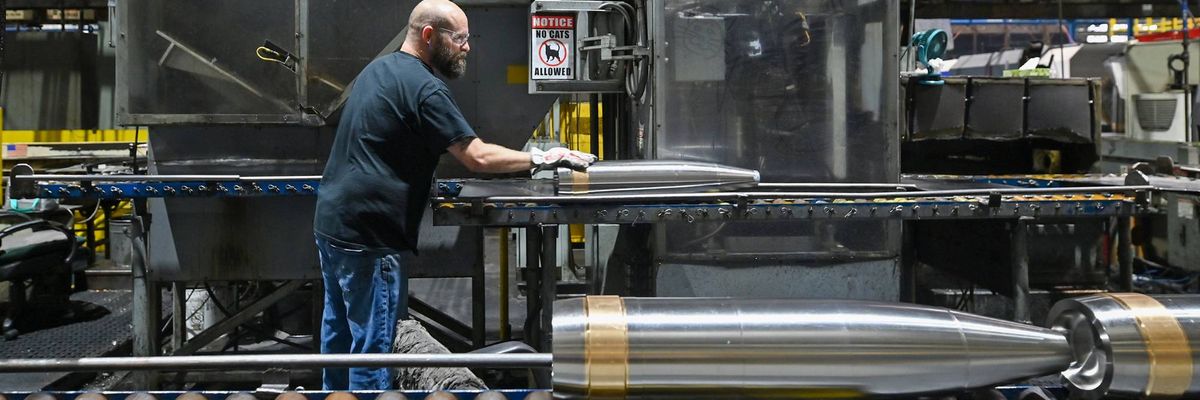
An employee at General Dynamics Scranton moves a mortar along the production line. The plant produces 155 mm shells.
The Democrats could push Trump—or go around him to make better inroads with working people—but will they dare to take that leap? One would hope so, but don’t hold your breath.
Trump has decided that the government should not give money to defense contractors who then reroute our tax dollars via stock buybacks to stockholders and executives.
A stock buyback, for those unfamiliar, is when a corporation repurchases its own shares, thus boosting the share’s price, a legalized form of stock manipulation. CEOs, who are paid mostly in stock incentives, and large investors directly benefit from stock buybacks, and unlike with dividends, don’t have to pay taxes until they sell their shares.
In the weapons industry, this isn’t news. Studies show that defense contractors spent three times more on dividends and stock buybacks than on capital investments needed to fulfill their contracts over the last decade. In Europe, it was the other way around with defense companies spending twice as much on capital investments compared to dividends. (They don’t do stock buybacks.)
The New York Times cited a Department of Defense study during the Biden administration that “found that top US defense contractors spent more on returning cash to shareholders in the form of dividends and stock buybacks between 2010 and 2019 compared to the previous decades, while spending on research and new or upgraded factories had declined.”
You’ve got to wonder why the Biden administration didn’t try to stop this scam. Maybe it feared looking anti-military. Or maybe it thought such an action would be too upsetting to their Wall Street donors who feast on stock buybacks?
Now we have Trump doing what the Democrats should have done long ago, announcing he will stop buybacks and cap executive salaries at profligate defense contractors:
How about Preventing Mass Layoffs?
If the Democrats wanted to show more concern for working people they would jump all over this executive order and push legislation to expand it to include a prohibition of compulsory layoffs at all defense contractors. If a contractor wants to change staffing levels, they should offer voluntary financial buyout packages. No one should be forced to leave.
This is an easy case to make. Why should taxpayers give money to corporations that then lay off taxpayers so that they can shovel more and more of our tax dollars to the wealthy? If the problem is that these defense contractors fail to deliver products on time they need more workers, not fewer.
Instead of wallowing in the Epstein files, the Democrats should declare again and again that mass layoffs are the weapon of choice to enrich executives and Wall Street. Fight for the damn jobs!
In April, the Labor Institute, in cooperation with the Center for Working Class Politics, produced a YouGov survey of 3,000 voters in Michigan, Ohio, Pennsylvania, and Wisconsin. In the survey, we asked voters to evaluate a state ballot initiative we invented that read:
“Corporations with more than 500 employees that receive taxpayer-funded federal contracts are prohibited from conducting involuntary layoffs of American workers. All layoffs during the life of a taxpayer-funded contract must be voluntary, based on employer financial incentives. No one shall be forced to leave.”
Overall, 42 percent supported the proposal, while 26 percent opposed it and 32 percent were not sure. The no-layoff proposal was brand new, unheard of by anyone before the survey was administered, yet it tied for fifth in popularity among 25 economic proposals. Furthermore, we reported that:
“Respondents from key demographic groups that Democrats have struggled to reach in recent electoral cycles showed robust support for the policy, which was tied for fifth among respondents without a four-year college degree and those whose family income was less than $50,000 per year, and tied for sixth among respondents who reported a declining standard of living and those who live in rural areas and small towns.”
This no-layoffs policy would be a big winner for the Democrats leading up to the mid-terms. But it would not be a winner for the financial backers of the party who cherish their stock buybacks.
So here we are again. Trump outflanking the Democrats on a populist economic proposal, like cancelling NAFTA, one that the Democrats failed to address while in power. In this case, the Democrats could push Trump even further by tying job stability to federal defense contracts, something that working people would greatly value but would be upsetting to Wall Street.
The Democrats could push Trump, but will they dare to take that leap? One would hope so, but don’t hold your breath.
The failure to rigorously defend working people over the last forty years against needless mass layoffs may be why so many voters right now are willing to consider a new political party, independent of the two billionaire parties.
Much more on that to come.
Dear Common Dreams reader, It’s been nearly 30 years since I co-founded Common Dreams with my late wife, Lina Newhouser. We had the radical notion that journalism should serve the public good, not corporate profits. It was clear to us from the outset what it would take to build such a project. No paid advertisements. No corporate sponsors. No millionaire publisher telling us what to think or do. Many people said we wouldn't last a year, but we proved those doubters wrong. Together with a tremendous team of journalists and dedicated staff, we built an independent media outlet free from the constraints of profits and corporate control. Our mission has always been simple: To inform. To inspire. To ignite change for the common good. Building Common Dreams was not easy. Our survival was never guaranteed. When you take on the most powerful forces—Wall Street greed, fossil fuel industry destruction, Big Tech lobbyists, and uber-rich oligarchs who have spent billions upon billions rigging the economy and democracy in their favor—the only bulwark you have is supporters who believe in your work. But here’s the urgent message from me today. It's never been this bad out there. And it's never been this hard to keep us going. At the very moment Common Dreams is most needed, the threats we face are intensifying. We need your support now more than ever. We don't accept corporate advertising and never will. We don't have a paywall because we don't think people should be blocked from critical news based on their ability to pay. Everything we do is funded by the donations of readers like you. When everyone does the little they can afford, we are strong. But if that support retreats or dries up, so do we. Will you donate now to make sure Common Dreams not only survives but thrives? —Craig Brown, Co-founder |
Les Leopold is the executive director of the Labor Institute and author of the new book, “The Billionaires Have Two Parties, We Need a Party of Our Own” (2026). His previous books include: “Wall Street’s War on Workers: How Mass Layoffs and Greed Are Destroying the Working Class and What to Do About It" (2024); "Runaway Inequality: An Activist's Guide to Economic Justice" (2015); and “The Man Who Hated Work and Loved Labor: The Life and Times of Tony Mazzocchi” (2007). Read more of his work on his substack here.
Trump has decided that the government should not give money to defense contractors who then reroute our tax dollars via stock buybacks to stockholders and executives.
A stock buyback, for those unfamiliar, is when a corporation repurchases its own shares, thus boosting the share’s price, a legalized form of stock manipulation. CEOs, who are paid mostly in stock incentives, and large investors directly benefit from stock buybacks, and unlike with dividends, don’t have to pay taxes until they sell their shares.
In the weapons industry, this isn’t news. Studies show that defense contractors spent three times more on dividends and stock buybacks than on capital investments needed to fulfill their contracts over the last decade. In Europe, it was the other way around with defense companies spending twice as much on capital investments compared to dividends. (They don’t do stock buybacks.)
The New York Times cited a Department of Defense study during the Biden administration that “found that top US defense contractors spent more on returning cash to shareholders in the form of dividends and stock buybacks between 2010 and 2019 compared to the previous decades, while spending on research and new or upgraded factories had declined.”
You’ve got to wonder why the Biden administration didn’t try to stop this scam. Maybe it feared looking anti-military. Or maybe it thought such an action would be too upsetting to their Wall Street donors who feast on stock buybacks?
Now we have Trump doing what the Democrats should have done long ago, announcing he will stop buybacks and cap executive salaries at profligate defense contractors:
How about Preventing Mass Layoffs?
If the Democrats wanted to show more concern for working people they would jump all over this executive order and push legislation to expand it to include a prohibition of compulsory layoffs at all defense contractors. If a contractor wants to change staffing levels, they should offer voluntary financial buyout packages. No one should be forced to leave.
This is an easy case to make. Why should taxpayers give money to corporations that then lay off taxpayers so that they can shovel more and more of our tax dollars to the wealthy? If the problem is that these defense contractors fail to deliver products on time they need more workers, not fewer.
Instead of wallowing in the Epstein files, the Democrats should declare again and again that mass layoffs are the weapon of choice to enrich executives and Wall Street. Fight for the damn jobs!
In April, the Labor Institute, in cooperation with the Center for Working Class Politics, produced a YouGov survey of 3,000 voters in Michigan, Ohio, Pennsylvania, and Wisconsin. In the survey, we asked voters to evaluate a state ballot initiative we invented that read:
“Corporations with more than 500 employees that receive taxpayer-funded federal contracts are prohibited from conducting involuntary layoffs of American workers. All layoffs during the life of a taxpayer-funded contract must be voluntary, based on employer financial incentives. No one shall be forced to leave.”
Overall, 42 percent supported the proposal, while 26 percent opposed it and 32 percent were not sure. The no-layoff proposal was brand new, unheard of by anyone before the survey was administered, yet it tied for fifth in popularity among 25 economic proposals. Furthermore, we reported that:
“Respondents from key demographic groups that Democrats have struggled to reach in recent electoral cycles showed robust support for the policy, which was tied for fifth among respondents without a four-year college degree and those whose family income was less than $50,000 per year, and tied for sixth among respondents who reported a declining standard of living and those who live in rural areas and small towns.”
This no-layoffs policy would be a big winner for the Democrats leading up to the mid-terms. But it would not be a winner for the financial backers of the party who cherish their stock buybacks.
So here we are again. Trump outflanking the Democrats on a populist economic proposal, like cancelling NAFTA, one that the Democrats failed to address while in power. In this case, the Democrats could push Trump even further by tying job stability to federal defense contracts, something that working people would greatly value but would be upsetting to Wall Street.
The Democrats could push Trump, but will they dare to take that leap? One would hope so, but don’t hold your breath.
The failure to rigorously defend working people over the last forty years against needless mass layoffs may be why so many voters right now are willing to consider a new political party, independent of the two billionaire parties.
Much more on that to come.
Les Leopold is the executive director of the Labor Institute and author of the new book, “The Billionaires Have Two Parties, We Need a Party of Our Own” (2026). His previous books include: “Wall Street’s War on Workers: How Mass Layoffs and Greed Are Destroying the Working Class and What to Do About It" (2024); "Runaway Inequality: An Activist's Guide to Economic Justice" (2015); and “The Man Who Hated Work and Loved Labor: The Life and Times of Tony Mazzocchi” (2007). Read more of his work on his substack here.
Trump has decided that the government should not give money to defense contractors who then reroute our tax dollars via stock buybacks to stockholders and executives.
A stock buyback, for those unfamiliar, is when a corporation repurchases its own shares, thus boosting the share’s price, a legalized form of stock manipulation. CEOs, who are paid mostly in stock incentives, and large investors directly benefit from stock buybacks, and unlike with dividends, don’t have to pay taxes until they sell their shares.
In the weapons industry, this isn’t news. Studies show that defense contractors spent three times more on dividends and stock buybacks than on capital investments needed to fulfill their contracts over the last decade. In Europe, it was the other way around with defense companies spending twice as much on capital investments compared to dividends. (They don’t do stock buybacks.)
The New York Times cited a Department of Defense study during the Biden administration that “found that top US defense contractors spent more on returning cash to shareholders in the form of dividends and stock buybacks between 2010 and 2019 compared to the previous decades, while spending on research and new or upgraded factories had declined.”
You’ve got to wonder why the Biden administration didn’t try to stop this scam. Maybe it feared looking anti-military. Or maybe it thought such an action would be too upsetting to their Wall Street donors who feast on stock buybacks?
Now we have Trump doing what the Democrats should have done long ago, announcing he will stop buybacks and cap executive salaries at profligate defense contractors:
How about Preventing Mass Layoffs?
If the Democrats wanted to show more concern for working people they would jump all over this executive order and push legislation to expand it to include a prohibition of compulsory layoffs at all defense contractors. If a contractor wants to change staffing levels, they should offer voluntary financial buyout packages. No one should be forced to leave.
This is an easy case to make. Why should taxpayers give money to corporations that then lay off taxpayers so that they can shovel more and more of our tax dollars to the wealthy? If the problem is that these defense contractors fail to deliver products on time they need more workers, not fewer.
Instead of wallowing in the Epstein files, the Democrats should declare again and again that mass layoffs are the weapon of choice to enrich executives and Wall Street. Fight for the damn jobs!
In April, the Labor Institute, in cooperation with the Center for Working Class Politics, produced a YouGov survey of 3,000 voters in Michigan, Ohio, Pennsylvania, and Wisconsin. In the survey, we asked voters to evaluate a state ballot initiative we invented that read:
“Corporations with more than 500 employees that receive taxpayer-funded federal contracts are prohibited from conducting involuntary layoffs of American workers. All layoffs during the life of a taxpayer-funded contract must be voluntary, based on employer financial incentives. No one shall be forced to leave.”
Overall, 42 percent supported the proposal, while 26 percent opposed it and 32 percent were not sure. The no-layoff proposal was brand new, unheard of by anyone before the survey was administered, yet it tied for fifth in popularity among 25 economic proposals. Furthermore, we reported that:
“Respondents from key demographic groups that Democrats have struggled to reach in recent electoral cycles showed robust support for the policy, which was tied for fifth among respondents without a four-year college degree and those whose family income was less than $50,000 per year, and tied for sixth among respondents who reported a declining standard of living and those who live in rural areas and small towns.”
This no-layoffs policy would be a big winner for the Democrats leading up to the mid-terms. But it would not be a winner for the financial backers of the party who cherish their stock buybacks.
So here we are again. Trump outflanking the Democrats on a populist economic proposal, like cancelling NAFTA, one that the Democrats failed to address while in power. In this case, the Democrats could push Trump even further by tying job stability to federal defense contracts, something that working people would greatly value but would be upsetting to Wall Street.
The Democrats could push Trump, but will they dare to take that leap? One would hope so, but don’t hold your breath.
The failure to rigorously defend working people over the last forty years against needless mass layoffs may be why so many voters right now are willing to consider a new political party, independent of the two billionaire parties.
Much more on that to come.