SUBSCRIBE TO OUR FREE NEWSLETTER
Daily news & progressive opinion—funded by the people, not the corporations—delivered straight to your inbox.
5
#000000
#FFFFFF
To donate by check, phone, or other method, see our More Ways to Give page.
Daily news & progressive opinion—funded by the people, not the corporations—delivered straight to your inbox.
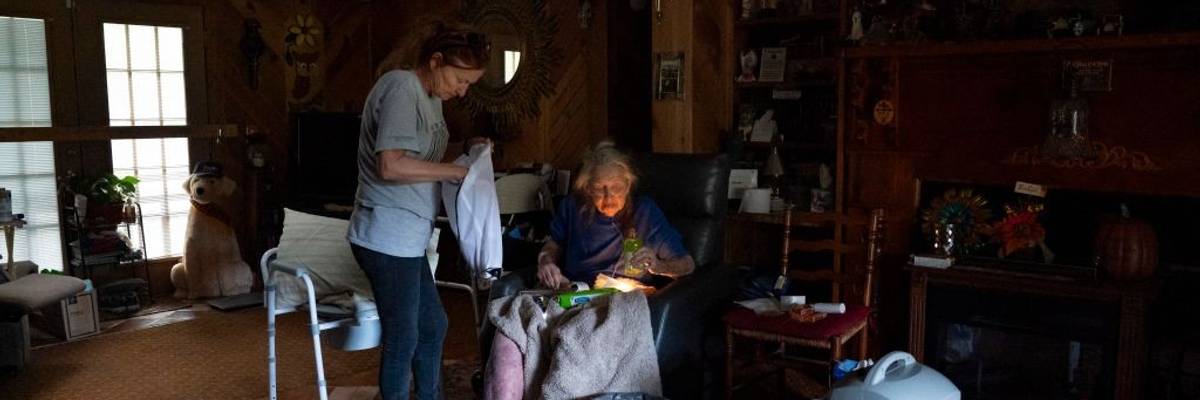
Teresa Rust (L) brings supplies to her neighbor, 94-year-old Barbara Sams, who is powering her oxygen supply with a generator, in Bills Creek, North Carolina, October 2, 2024, after the passage of Hurricane Helene.
And you don’t lower prices by giving giant tax cuts to billionaires and price gouging corporations.
Editor's note: The following is the prepared opening statement by the author as part of testimony for a hearing before the U.S. Senate Special Committee on Aging—titled “Making Washington Work for Seniors: Fighting to End Inflation and Achieve Fiscal Sanity”—on Wednesday, January 29, 2025 .
Good afternoon, Chairman Scott, Ranking Member Gillibrand, and distinguished members of the committee.
As executive director of Social Security Works, I travel across the country speaking with legions of primarily older Americans. Almost to a person, they are concerned about rising prices. These rising prices hurt older adults, endangering their ability to afford food, housing, and prescription drugs. They want Congress to take action.
Across the country, there is widespread bipartisan agreement on what people want: cracking down on corporate price gouging, improving Social Security’s annual cost-of-living adjustments, which keep up with rising prices and currently under-measure seniors’ cost of living, and reducing the price of prescription drugs by expanding Medicare’s power to negotiate. These are actionable policies that will help older adults adjust to inflation caused by global supply chain shocks and greedflation—which has contributed to rising costs over the past few years. In fact, Federal Reserve research found that corporate profits accounted for all the inflation in the first year of the pandemic recovery and 41 percent of inflation overall in the first two years of the post-pandemic recovery.
There is bipartisan agreement across this country about what people don’t want in response to rising prices: Republicans, Independents, and Democrats all agree that not one single penny of cuts to Social Security, Medicare, or Medicaid benefits should be made. There is absolute bipartisan agreement among people everywhere across the country.
Despite this, the House Republican majority announced proposals to slash trillions from Medicaid, our country’s largest provider of long-term care. Over 9 million Americans over 65 rely on Medicaid.
Cuts to Medicaid would force these seniors, and their families, to pay enormous out of pocket costs for long-term care—money they don’t have. It would also force millions of caregivers, most often women, out of the workforce. This would make it far harder for American families to pay their monthly bills. In addition, these proposals also include cuts to SNAP benefits, which 4.8 million older Americans rely on to put food on the table.
Just last week, the new Trump Administration repealed an Executive Order from President Biden that directed the federal government to find ways to lower drug prices. The Trump administration is already favoring Big Pharma at the expense of seniors and working families.
There have also been calls by Republicans to repeal the Inflation Reduction Act, which gives Medicare the power to negotiate lower prices on key prescription drugs. This could force many seniors to cut their life-sustaining medications in half due to higher costs. Many others would face a terrible choice between buying food, filling their prescriptions, and paying their heating bills.
Even Social Security, the most popular and effective program in America, is not safe. Last month, a Republican representative, who is a member of the DOGE Caucus, told me personally that “there will be some cuts” to Social Security and Medicare.
Let me be clear: these proposed cuts will do nothing to lower costs for average Americans or older adults; these cuts are being proposed to offset the cost of tax handouts for billionaires and corporations, who have already been shown to be responsible for rising costs. This Congress should value the interests of older adults above the wealthiest, and I hope that the Aging Committee will lead that charge.
Consider this: If an older adult can’t afford their drugs and groceries at the average Social Security benefit of $1900 a month, it is absolute fiscal insanity to think the solution is to cut their income! To take away their health care! To destroy Medicaid and force them to pay the average long-term care cost of around $100,000 per year! If they can’t afford the price of eggs, it is absolute fiscal insanity to believe they can afford them better without SNAP benefits.
I’m here to deliver a message to the members of this committee from older Americans across the country: You don’t lower prices by stealing health care. You don’t lower prices by giving giant tax cuts to billionaires and price gouging corporations. And you absolutely don’t lower prices by reducing the Social Security and other benefits that adults have worked their entire lives for.
Dear Common Dreams reader, It’s been nearly 30 years since I co-founded Common Dreams with my late wife, Lina Newhouser. We had the radical notion that journalism should serve the public good, not corporate profits. It was clear to us from the outset what it would take to build such a project. No paid advertisements. No corporate sponsors. No millionaire publisher telling us what to think or do. Many people said we wouldn't last a year, but we proved those doubters wrong. Together with a tremendous team of journalists and dedicated staff, we built an independent media outlet free from the constraints of profits and corporate control. Our mission has always been simple: To inform. To inspire. To ignite change for the common good. Building Common Dreams was not easy. Our survival was never guaranteed. When you take on the most powerful forces—Wall Street greed, fossil fuel industry destruction, Big Tech lobbyists, and uber-rich oligarchs who have spent billions upon billions rigging the economy and democracy in their favor—the only bulwark you have is supporters who believe in your work. But here’s the urgent message from me today. It's never been this bad out there. And it's never been this hard to keep us going. At the very moment Common Dreams is most needed, the threats we face are intensifying. We need your support now more than ever. We don't accept corporate advertising and never will. We don't have a paywall because we don't think people should be blocked from critical news based on their ability to pay. Everything we do is funded by the donations of readers like you. When everyone does the little they can afford, we are strong. But if that support retreats or dries up, so do we. Will you donate now to make sure Common Dreams not only survives but thrives? —Craig Brown, Co-founder |
Editor's note: The following is the prepared opening statement by the author as part of testimony for a hearing before the U.S. Senate Special Committee on Aging—titled “Making Washington Work for Seniors: Fighting to End Inflation and Achieve Fiscal Sanity”—on Wednesday, January 29, 2025 .
Good afternoon, Chairman Scott, Ranking Member Gillibrand, and distinguished members of the committee.
As executive director of Social Security Works, I travel across the country speaking with legions of primarily older Americans. Almost to a person, they are concerned about rising prices. These rising prices hurt older adults, endangering their ability to afford food, housing, and prescription drugs. They want Congress to take action.
Across the country, there is widespread bipartisan agreement on what people want: cracking down on corporate price gouging, improving Social Security’s annual cost-of-living adjustments, which keep up with rising prices and currently under-measure seniors’ cost of living, and reducing the price of prescription drugs by expanding Medicare’s power to negotiate. These are actionable policies that will help older adults adjust to inflation caused by global supply chain shocks and greedflation—which has contributed to rising costs over the past few years. In fact, Federal Reserve research found that corporate profits accounted for all the inflation in the first year of the pandemic recovery and 41 percent of inflation overall in the first two years of the post-pandemic recovery.
There is bipartisan agreement across this country about what people don’t want in response to rising prices: Republicans, Independents, and Democrats all agree that not one single penny of cuts to Social Security, Medicare, or Medicaid benefits should be made. There is absolute bipartisan agreement among people everywhere across the country.
Despite this, the House Republican majority announced proposals to slash trillions from Medicaid, our country’s largest provider of long-term care. Over 9 million Americans over 65 rely on Medicaid.
Cuts to Medicaid would force these seniors, and their families, to pay enormous out of pocket costs for long-term care—money they don’t have. It would also force millions of caregivers, most often women, out of the workforce. This would make it far harder for American families to pay their monthly bills. In addition, these proposals also include cuts to SNAP benefits, which 4.8 million older Americans rely on to put food on the table.
Just last week, the new Trump Administration repealed an Executive Order from President Biden that directed the federal government to find ways to lower drug prices. The Trump administration is already favoring Big Pharma at the expense of seniors and working families.
There have also been calls by Republicans to repeal the Inflation Reduction Act, which gives Medicare the power to negotiate lower prices on key prescription drugs. This could force many seniors to cut their life-sustaining medications in half due to higher costs. Many others would face a terrible choice between buying food, filling their prescriptions, and paying their heating bills.
Even Social Security, the most popular and effective program in America, is not safe. Last month, a Republican representative, who is a member of the DOGE Caucus, told me personally that “there will be some cuts” to Social Security and Medicare.
Let me be clear: these proposed cuts will do nothing to lower costs for average Americans or older adults; these cuts are being proposed to offset the cost of tax handouts for billionaires and corporations, who have already been shown to be responsible for rising costs. This Congress should value the interests of older adults above the wealthiest, and I hope that the Aging Committee will lead that charge.
Consider this: If an older adult can’t afford their drugs and groceries at the average Social Security benefit of $1900 a month, it is absolute fiscal insanity to think the solution is to cut their income! To take away their health care! To destroy Medicaid and force them to pay the average long-term care cost of around $100,000 per year! If they can’t afford the price of eggs, it is absolute fiscal insanity to believe they can afford them better without SNAP benefits.
I’m here to deliver a message to the members of this committee from older Americans across the country: You don’t lower prices by stealing health care. You don’t lower prices by giving giant tax cuts to billionaires and price gouging corporations. And you absolutely don’t lower prices by reducing the Social Security and other benefits that adults have worked their entire lives for.
Editor's note: The following is the prepared opening statement by the author as part of testimony for a hearing before the U.S. Senate Special Committee on Aging—titled “Making Washington Work for Seniors: Fighting to End Inflation and Achieve Fiscal Sanity”—on Wednesday, January 29, 2025 .
Good afternoon, Chairman Scott, Ranking Member Gillibrand, and distinguished members of the committee.
As executive director of Social Security Works, I travel across the country speaking with legions of primarily older Americans. Almost to a person, they are concerned about rising prices. These rising prices hurt older adults, endangering their ability to afford food, housing, and prescription drugs. They want Congress to take action.
Across the country, there is widespread bipartisan agreement on what people want: cracking down on corporate price gouging, improving Social Security’s annual cost-of-living adjustments, which keep up with rising prices and currently under-measure seniors’ cost of living, and reducing the price of prescription drugs by expanding Medicare’s power to negotiate. These are actionable policies that will help older adults adjust to inflation caused by global supply chain shocks and greedflation—which has contributed to rising costs over the past few years. In fact, Federal Reserve research found that corporate profits accounted for all the inflation in the first year of the pandemic recovery and 41 percent of inflation overall in the first two years of the post-pandemic recovery.
There is bipartisan agreement across this country about what people don’t want in response to rising prices: Republicans, Independents, and Democrats all agree that not one single penny of cuts to Social Security, Medicare, or Medicaid benefits should be made. There is absolute bipartisan agreement among people everywhere across the country.
Despite this, the House Republican majority announced proposals to slash trillions from Medicaid, our country’s largest provider of long-term care. Over 9 million Americans over 65 rely on Medicaid.
Cuts to Medicaid would force these seniors, and their families, to pay enormous out of pocket costs for long-term care—money they don’t have. It would also force millions of caregivers, most often women, out of the workforce. This would make it far harder for American families to pay their monthly bills. In addition, these proposals also include cuts to SNAP benefits, which 4.8 million older Americans rely on to put food on the table.
Just last week, the new Trump Administration repealed an Executive Order from President Biden that directed the federal government to find ways to lower drug prices. The Trump administration is already favoring Big Pharma at the expense of seniors and working families.
There have also been calls by Republicans to repeal the Inflation Reduction Act, which gives Medicare the power to negotiate lower prices on key prescription drugs. This could force many seniors to cut their life-sustaining medications in half due to higher costs. Many others would face a terrible choice between buying food, filling their prescriptions, and paying their heating bills.
Even Social Security, the most popular and effective program in America, is not safe. Last month, a Republican representative, who is a member of the DOGE Caucus, told me personally that “there will be some cuts” to Social Security and Medicare.
Let me be clear: these proposed cuts will do nothing to lower costs for average Americans or older adults; these cuts are being proposed to offset the cost of tax handouts for billionaires and corporations, who have already been shown to be responsible for rising costs. This Congress should value the interests of older adults above the wealthiest, and I hope that the Aging Committee will lead that charge.
Consider this: If an older adult can’t afford their drugs and groceries at the average Social Security benefit of $1900 a month, it is absolute fiscal insanity to think the solution is to cut their income! To take away their health care! To destroy Medicaid and force them to pay the average long-term care cost of around $100,000 per year! If they can’t afford the price of eggs, it is absolute fiscal insanity to believe they can afford them better without SNAP benefits.
I’m here to deliver a message to the members of this committee from older Americans across the country: You don’t lower prices by stealing health care. You don’t lower prices by giving giant tax cuts to billionaires and price gouging corporations. And you absolutely don’t lower prices by reducing the Social Security and other benefits that adults have worked their entire lives for.