SUBSCRIBE TO OUR FREE NEWSLETTER
Daily news & progressive opinion—funded by the people, not the corporations—delivered straight to your inbox.
5
#000000
#FFFFFF
To donate by check, phone, or other method, see our More Ways to Give page.
Daily news & progressive opinion—funded by the people, not the corporations—delivered straight to your inbox.
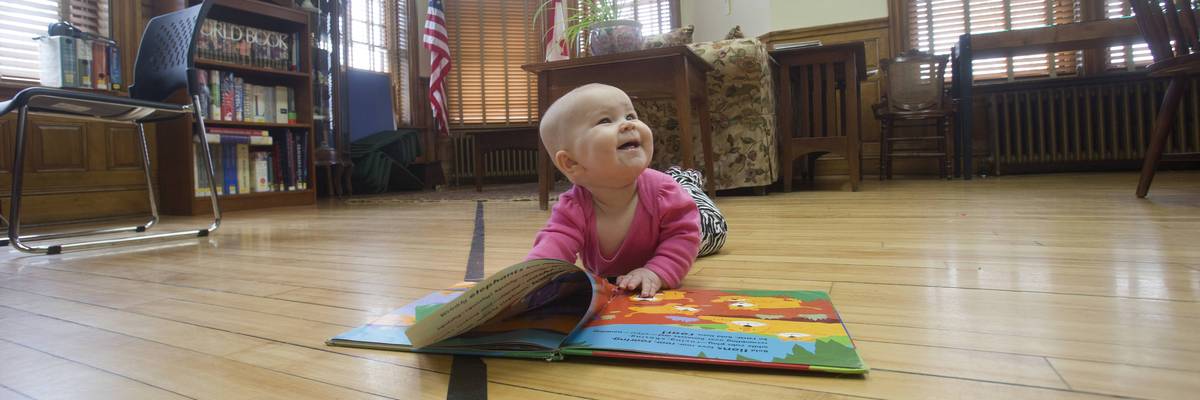
Rebel Sargent, 6-months-old, of Holland, Vermont, looks at her book on the Quebec side of the border line going through the Haskell Free library.
Back new bills now up for review to support libraries in providing passport application services, particularly in communities where it can be difficult or intimidating for people to use other federal offices.
Recent public announcements that many public libraries could no longer accept passport applications surprised many.
In a now unusual attempt at bicameral and bipartisan legislation, Rep. John Joyce (R-Pa.) and Sen. John Fetterman (D-Pa.), have put forth bills (H.R.6997 and S.3733) that would enable all public libraries, whether they are organized as units of government or nonprofit organizations, to serve as passport acceptance facilities designated by the State Department.
As a university educator in Library and Information Science, I was at first taken aback by the passport application ban attempt. Many others were surprised that libraries had been accepting passport applications. But then perhaps neither the service nor the attempt to shut it down are a surprise at all.
Public libraries across the nation are an integral piece of our social and civic infrastructure. Librarians see up close the needs for social services in their communities, and they step up to meet those needs.
Libraries are where people step from one world into another, sometimes by opening books and sometimes by sharing space with people very different from themselves.
Libraries provide internet access for people who do not have the resources to get online from home or may not have a home where they can get online. Libraries provide physical shelter, in times of climate emergency like extreme heatwaves or intense freezes. They provide shelter for people who need to get off the street for a few hours to find a safe place. Recently, they have begin offering telehealth booths to support medical care in remote communities.
Libraries promote literacy, a lynchpin of economic security for both individuals and the communities in which they live. Indeed, there is considerable research demonstrating that there are higher literacy rates in communities with access to a public library, particularly in low income and rural areas.
There are approximately 17,000 public libraries in the United States, a number that has remained remarkably stable in the past few decades. Despite funding difficulties, skepticism about the value of physical libraries in the digital era, and political and social challenges to library collections, libraries remain at the center, meeting many of those communities’ needs.
Of course, it is perfect that libraries were places to apply for passports as they are places of border crossing. Libraries are where people step from one world into another, sometimes by opening books and sometimes by sharing space with people very different from themselves.
There is a public library that famously straddles the Vermont-Canada border where you can literally step across a border. That quiet fame has grown louder now that it plays a key role in Louise Penny’s latest novel, The Black Wolf.
To step into the world of the library at most you’ll need a library card. Everyone is welcome.
To be sure, not every library looks like it welcomes all people with open arms. Legacy architecture and practices can perpetuate the perception of the library as hushed and exclusive.
The precarity of funding for public libraries often prevents libraries from addressing that perception. Many libraries aspire to renovating and modernizing their spaces in ways that they simply cannot afford. Public libraries rely upon local taxpayers for much of their funding, but they also rely upon federal grants to innovate and develop new initiatives.
Nearly one year ago, President Donald Trump issued an Executive Order intended to dismantle the only federal agency dedicated to funding library services, the Institute for Museum and Library Services. The agency awards almost $300,000,000 in grants every year, including more than $160 million that goes to states and largely supports the work of public libraries.
The executive order was successfully challenged in court by the attorneys general of 21 states, and on November 21 of last year, the US District Court for the District of Rhode Island struck down the Trump administration’s attempts to dismantle the Institute of Museum and Library Services (IMLS).
One result of this victory is that last month, IMLS awarded for eight projects “dedicated to building AI literacy.” Once again, libraries see a need and step up to meet it.
Many people voice public criticism and concern about the use of public libraries. Critics complain that they are overrun with noisy teens after school, socializing and playing video games. Some complain libraries are filled with sleeping, foul-smelling people who experience homelessness, or that they are opening the doors for children to step into obscenity.
But it is crucial to see the critical need for accessible public libraries in this country. It is important to support these bills now up for review to support libraries in providing passport application services, particularly in communities where it can be difficult or intimidating for people to use other federal offices.
More than that, it is essential for the country for policymakers, funders, and all Americans to support libraries through ensuring funding, community advocacy, and moral support. It is crucial to help libraries continue to be places where everyone can cross borders and step into new worlds.
Dear Common Dreams reader, It’s been nearly 30 years since I co-founded Common Dreams with my late wife, Lina Newhouser. We had the radical notion that journalism should serve the public good, not corporate profits. It was clear to us from the outset what it would take to build such a project. No paid advertisements. No corporate sponsors. No millionaire publisher telling us what to think or do. Many people said we wouldn't last a year, but we proved those doubters wrong. Together with a tremendous team of journalists and dedicated staff, we built an independent media outlet free from the constraints of profits and corporate control. Our mission has always been simple: To inform. To inspire. To ignite change for the common good. Building Common Dreams was not easy. Our survival was never guaranteed. When you take on the most powerful forces—Wall Street greed, fossil fuel industry destruction, Big Tech lobbyists, and uber-rich oligarchs who have spent billions upon billions rigging the economy and democracy in their favor—the only bulwark you have is supporters who believe in your work. But here’s the urgent message from me today. It's never been this bad out there. And it's never been this hard to keep us going. At the very moment Common Dreams is most needed, the threats we face are intensifying. We need your support now more than ever. We don't accept corporate advertising and never will. We don't have a paywall because we don't think people should be blocked from critical news based on their ability to pay. Everything we do is funded by the donations of readers like you. When everyone does the little they can afford, we are strong. But if that support retreats or dries up, so do we. Will you donate now to make sure Common Dreams not only survives but thrives? —Craig Brown, Co-founder |
Recent public announcements that many public libraries could no longer accept passport applications surprised many.
In a now unusual attempt at bicameral and bipartisan legislation, Rep. John Joyce (R-Pa.) and Sen. John Fetterman (D-Pa.), have put forth bills (H.R.6997 and S.3733) that would enable all public libraries, whether they are organized as units of government or nonprofit organizations, to serve as passport acceptance facilities designated by the State Department.
As a university educator in Library and Information Science, I was at first taken aback by the passport application ban attempt. Many others were surprised that libraries had been accepting passport applications. But then perhaps neither the service nor the attempt to shut it down are a surprise at all.
Public libraries across the nation are an integral piece of our social and civic infrastructure. Librarians see up close the needs for social services in their communities, and they step up to meet those needs.
Libraries are where people step from one world into another, sometimes by opening books and sometimes by sharing space with people very different from themselves.
Libraries provide internet access for people who do not have the resources to get online from home or may not have a home where they can get online. Libraries provide physical shelter, in times of climate emergency like extreme heatwaves or intense freezes. They provide shelter for people who need to get off the street for a few hours to find a safe place. Recently, they have begin offering telehealth booths to support medical care in remote communities.
Libraries promote literacy, a lynchpin of economic security for both individuals and the communities in which they live. Indeed, there is considerable research demonstrating that there are higher literacy rates in communities with access to a public library, particularly in low income and rural areas.
There are approximately 17,000 public libraries in the United States, a number that has remained remarkably stable in the past few decades. Despite funding difficulties, skepticism about the value of physical libraries in the digital era, and political and social challenges to library collections, libraries remain at the center, meeting many of those communities’ needs.
Of course, it is perfect that libraries were places to apply for passports as they are places of border crossing. Libraries are where people step from one world into another, sometimes by opening books and sometimes by sharing space with people very different from themselves.
There is a public library that famously straddles the Vermont-Canada border where you can literally step across a border. That quiet fame has grown louder now that it plays a key role in Louise Penny’s latest novel, The Black Wolf.
To step into the world of the library at most you’ll need a library card. Everyone is welcome.
To be sure, not every library looks like it welcomes all people with open arms. Legacy architecture and practices can perpetuate the perception of the library as hushed and exclusive.
The precarity of funding for public libraries often prevents libraries from addressing that perception. Many libraries aspire to renovating and modernizing their spaces in ways that they simply cannot afford. Public libraries rely upon local taxpayers for much of their funding, but they also rely upon federal grants to innovate and develop new initiatives.
Nearly one year ago, President Donald Trump issued an Executive Order intended to dismantle the only federal agency dedicated to funding library services, the Institute for Museum and Library Services. The agency awards almost $300,000,000 in grants every year, including more than $160 million that goes to states and largely supports the work of public libraries.
The executive order was successfully challenged in court by the attorneys general of 21 states, and on November 21 of last year, the US District Court for the District of Rhode Island struck down the Trump administration’s attempts to dismantle the Institute of Museum and Library Services (IMLS).
One result of this victory is that last month, IMLS awarded for eight projects “dedicated to building AI literacy.” Once again, libraries see a need and step up to meet it.
Many people voice public criticism and concern about the use of public libraries. Critics complain that they are overrun with noisy teens after school, socializing and playing video games. Some complain libraries are filled with sleeping, foul-smelling people who experience homelessness, or that they are opening the doors for children to step into obscenity.
But it is crucial to see the critical need for accessible public libraries in this country. It is important to support these bills now up for review to support libraries in providing passport application services, particularly in communities where it can be difficult or intimidating for people to use other federal offices.
More than that, it is essential for the country for policymakers, funders, and all Americans to support libraries through ensuring funding, community advocacy, and moral support. It is crucial to help libraries continue to be places where everyone can cross borders and step into new worlds.
Recent public announcements that many public libraries could no longer accept passport applications surprised many.
In a now unusual attempt at bicameral and bipartisan legislation, Rep. John Joyce (R-Pa.) and Sen. John Fetterman (D-Pa.), have put forth bills (H.R.6997 and S.3733) that would enable all public libraries, whether they are organized as units of government or nonprofit organizations, to serve as passport acceptance facilities designated by the State Department.
As a university educator in Library and Information Science, I was at first taken aback by the passport application ban attempt. Many others were surprised that libraries had been accepting passport applications. But then perhaps neither the service nor the attempt to shut it down are a surprise at all.
Public libraries across the nation are an integral piece of our social and civic infrastructure. Librarians see up close the needs for social services in their communities, and they step up to meet those needs.
Libraries are where people step from one world into another, sometimes by opening books and sometimes by sharing space with people very different from themselves.
Libraries provide internet access for people who do not have the resources to get online from home or may not have a home where they can get online. Libraries provide physical shelter, in times of climate emergency like extreme heatwaves or intense freezes. They provide shelter for people who need to get off the street for a few hours to find a safe place. Recently, they have begin offering telehealth booths to support medical care in remote communities.
Libraries promote literacy, a lynchpin of economic security for both individuals and the communities in which they live. Indeed, there is considerable research demonstrating that there are higher literacy rates in communities with access to a public library, particularly in low income and rural areas.
There are approximately 17,000 public libraries in the United States, a number that has remained remarkably stable in the past few decades. Despite funding difficulties, skepticism about the value of physical libraries in the digital era, and political and social challenges to library collections, libraries remain at the center, meeting many of those communities’ needs.
Of course, it is perfect that libraries were places to apply for passports as they are places of border crossing. Libraries are where people step from one world into another, sometimes by opening books and sometimes by sharing space with people very different from themselves.
There is a public library that famously straddles the Vermont-Canada border where you can literally step across a border. That quiet fame has grown louder now that it plays a key role in Louise Penny’s latest novel, The Black Wolf.
To step into the world of the library at most you’ll need a library card. Everyone is welcome.
To be sure, not every library looks like it welcomes all people with open arms. Legacy architecture and practices can perpetuate the perception of the library as hushed and exclusive.
The precarity of funding for public libraries often prevents libraries from addressing that perception. Many libraries aspire to renovating and modernizing their spaces in ways that they simply cannot afford. Public libraries rely upon local taxpayers for much of their funding, but they also rely upon federal grants to innovate and develop new initiatives.
Nearly one year ago, President Donald Trump issued an Executive Order intended to dismantle the only federal agency dedicated to funding library services, the Institute for Museum and Library Services. The agency awards almost $300,000,000 in grants every year, including more than $160 million that goes to states and largely supports the work of public libraries.
The executive order was successfully challenged in court by the attorneys general of 21 states, and on November 21 of last year, the US District Court for the District of Rhode Island struck down the Trump administration’s attempts to dismantle the Institute of Museum and Library Services (IMLS).
One result of this victory is that last month, IMLS awarded for eight projects “dedicated to building AI literacy.” Once again, libraries see a need and step up to meet it.
Many people voice public criticism and concern about the use of public libraries. Critics complain that they are overrun with noisy teens after school, socializing and playing video games. Some complain libraries are filled with sleeping, foul-smelling people who experience homelessness, or that they are opening the doors for children to step into obscenity.
But it is crucial to see the critical need for accessible public libraries in this country. It is important to support these bills now up for review to support libraries in providing passport application services, particularly in communities where it can be difficult or intimidating for people to use other federal offices.
More than that, it is essential for the country for policymakers, funders, and all Americans to support libraries through ensuring funding, community advocacy, and moral support. It is crucial to help libraries continue to be places where everyone can cross borders and step into new worlds.