
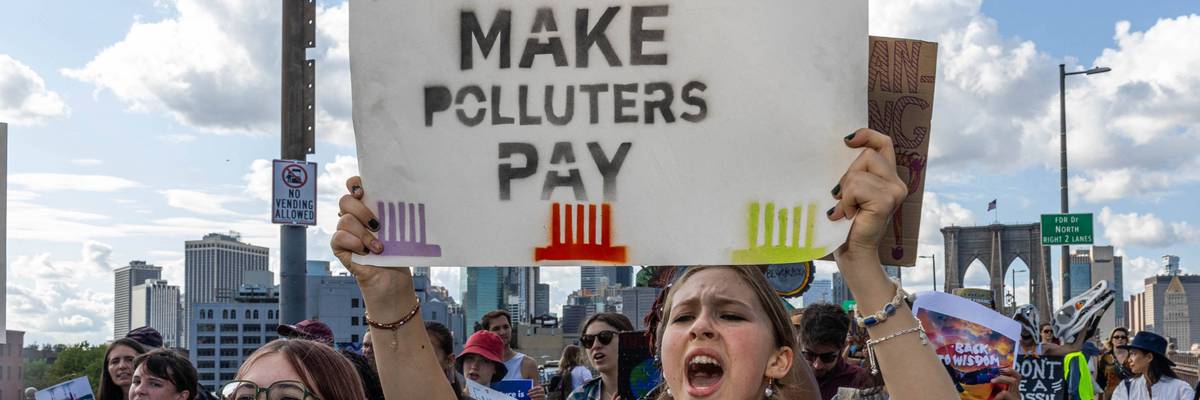
Activists hold signs reading, "Make Polluters Pay" as they cross the Brooklyn Bridge calling for leaders to "Tear down the pillars of fossil fuels" during a Youth Global Climate demonstration ahead of the United Nations Climate Week and General Assembly in New York City on September 20, 2024.
Don’t Let Congress Give Another Industry a Free Pass
Giving fossil fuel companies immunity is a dangerous move that should be strongly rejected.
One of Americans’ fundamental rights is under threat: the ability to hold bad actors accountable in court. Across the country, bills aiming to restrict communities from taking corporations and other parties to court over their environmental harm and pollution are moving through state legislatures. Utah became the first state to pass a law all but shutting down communities’ ability to hold gas-emitting polluters responsible for harms caused by their bad actions. Tennessee is poised to be next.
This is part of a familiar playbook. Last month, President Donad Trump signed an executive order that effectively shields pesticide manufacturers—including Bayer, the maker of Roundup—from billions in lawsuits alleging their products cause cancer. Overnight, pesticide producers gained legal immunity. Because the Environmental Protection Agency (EPA) does not classify glyphosate, Roundup’s main ingredient, as a carcinogen, the order now blocks dozens of lawsuits arguing that Bayer failed to warn consumers of the risks—lawsuits Bayer was considering spending more than $7 billion to settle out of court.
The fossil fuel industry wants that same legal carve out. For decades, fossil fuel companies misled the public about the risks of climate change, and are now fighting dozens of lawsuits that could expose decades of deception. Instead of answering in court, Big Oil is lobbying for its own blanket liability shield, backed by 16 Republican attorneys general. Not only has the oil and gas industry successfully convinced state legislators to move these protections forward, but a congressional House representative confirmed recently that federal lawmakers are also working on legislation that would block the fossil fuel industry from having to face any laws or lawsuits that aim to hold it accountable for its deception.
In other words, rather than defend itself in court, Big Oil is lobbying lawmakers to rewrite the rules.
If ExxonMobil believes it never misled the public, let it prove that in court.
The broader problem is clear: Powerful industries hide the dangers of their products, and once the truth emerges, they race to Congress to close the courthouse doors. If lawmakers hand out immunity, the victims are left with nothing. Supporters claim immunity is needed to prevent “frivolous” lawsuits or protect jobs. But that’s exactly what courts are for: to weigh evidence, reject weak claims, and hold wrongdoers accountable. If Bayer truly believes Roundup is safe, it should have no fear of a jury. And, for that matter, if ExxonMobil believes it never misled the public, let it prove that in court.
Immunity shields aren’t routine policy. They are radical interventions that strip away the rights of ordinary Americans while giving corporations extraordinary protection. That’s why only one industry, the gun lobby, has ever successfully won such a carve out, and its 2005 law remains widely condemned as a historic mistake. Even some conservatives are balking. The “Make America Healthy Again” movement, made up of Trump-aligned parents worried about pesticides in food, has erupted against the Bayer immunity provision, warning Republican lawmakers they’ll pay a political price. Their outrage reflects something deeper, which is that Americans across the spectrum believe no one should be above the law.
Congress should listen. Giving fossil fuel companies immunity is a dangerous move that should be strongly rejected. If these industries want to avoid liability, they should do it the same way everyone else does, by making their case in court. Anything else would betray a basic American principle: Justice should be decided by juries, not lobbyists.
We are at a crossroads
This country and this world are at a monumental crossroads. In a few short weeks, US voters will have an opportunity to beat back the forces of fascism and confront the billionaires who are rigging the economy, our media system, and our democracy, making it increasingly impossible for ordinary people to get by. We’re not just talking about the election. We’re talking about what must be done once these fascist elements are vanquished from power. We need a bolder set of solutions than what either major party has so far been willing to offer and a working-class movement ready to fight like hell for it. Trump didn't emerge from nowhere. The conditions that fueled MAGA authoritarianism were created by decades of radical neoliberal economic policies and a corrupt political system dominated by corporate interests. They slashed taxes on the super-rich, promising that the benefits would trickle down. They said giveaways to the corporate titans would make life more affordable for the rest of us. It was all bullshit. And when a bitter, betrayed populace searches for someone to blame, right-wing demagogues have little trouble finding scapegoats. People know when they're being lied to, but you won't hear any of this from the corporate media. Only independent journalism—powered and funded by people who believe in building a better world—can deliver truly trustworthy daily news. Our Fall Campaign is underway, and we need your help. To power our newsroom through the rest of the year, we need to raise $125,000 by midnight on October 31. So if you share our vision, please contribute whatever you can to sustain our work. |
One of Americans’ fundamental rights is under threat: the ability to hold bad actors accountable in court. Across the country, bills aiming to restrict communities from taking corporations and other parties to court over their environmental harm and pollution are moving through state legislatures. Utah became the first state to pass a law all but shutting down communities’ ability to hold gas-emitting polluters responsible for harms caused by their bad actions. Tennessee is poised to be next.
This is part of a familiar playbook. Last month, President Donad Trump signed an executive order that effectively shields pesticide manufacturers—including Bayer, the maker of Roundup—from billions in lawsuits alleging their products cause cancer. Overnight, pesticide producers gained legal immunity. Because the Environmental Protection Agency (EPA) does not classify glyphosate, Roundup’s main ingredient, as a carcinogen, the order now blocks dozens of lawsuits arguing that Bayer failed to warn consumers of the risks—lawsuits Bayer was considering spending more than $7 billion to settle out of court.
The fossil fuel industry wants that same legal carve out. For decades, fossil fuel companies misled the public about the risks of climate change, and are now fighting dozens of lawsuits that could expose decades of deception. Instead of answering in court, Big Oil is lobbying for its own blanket liability shield, backed by 16 Republican attorneys general. Not only has the oil and gas industry successfully convinced state legislators to move these protections forward, but a congressional House representative confirmed recently that federal lawmakers are also working on legislation that would block the fossil fuel industry from having to face any laws or lawsuits that aim to hold it accountable for its deception.
In other words, rather than defend itself in court, Big Oil is lobbying lawmakers to rewrite the rules.
If ExxonMobil believes it never misled the public, let it prove that in court.
The broader problem is clear: Powerful industries hide the dangers of their products, and once the truth emerges, they race to Congress to close the courthouse doors. If lawmakers hand out immunity, the victims are left with nothing. Supporters claim immunity is needed to prevent “frivolous” lawsuits or protect jobs. But that’s exactly what courts are for: to weigh evidence, reject weak claims, and hold wrongdoers accountable. If Bayer truly believes Roundup is safe, it should have no fear of a jury. And, for that matter, if ExxonMobil believes it never misled the public, let it prove that in court.
Immunity shields aren’t routine policy. They are radical interventions that strip away the rights of ordinary Americans while giving corporations extraordinary protection. That’s why only one industry, the gun lobby, has ever successfully won such a carve out, and its 2005 law remains widely condemned as a historic mistake. Even some conservatives are balking. The “Make America Healthy Again” movement, made up of Trump-aligned parents worried about pesticides in food, has erupted against the Bayer immunity provision, warning Republican lawmakers they’ll pay a political price. Their outrage reflects something deeper, which is that Americans across the spectrum believe no one should be above the law.
Congress should listen. Giving fossil fuel companies immunity is a dangerous move that should be strongly rejected. If these industries want to avoid liability, they should do it the same way everyone else does, by making their case in court. Anything else would betray a basic American principle: Justice should be decided by juries, not lobbyists.
- Trump Executive Order Another Handout to Fossil Fuel Industry ›
- Make the Polluters Pay! Ellison and Sanders Call on Congress to End Fossil Fuel Subsidies ›
- "Break Free From Fossil Fuels": Worldwide Escalated Mobilisations to End the Fossil Fuel Era ›
- With Support of 70 Climate Groups, Lawmakers Unveil Bill to Ban US Fossil Fuel Exports ›
- Senate Permitting Reform Bill Slammed as 'Biggest Giveaway' to Fossil Fuel Industry ›
One of Americans’ fundamental rights is under threat: the ability to hold bad actors accountable in court. Across the country, bills aiming to restrict communities from taking corporations and other parties to court over their environmental harm and pollution are moving through state legislatures. Utah became the first state to pass a law all but shutting down communities’ ability to hold gas-emitting polluters responsible for harms caused by their bad actions. Tennessee is poised to be next.
This is part of a familiar playbook. Last month, President Donad Trump signed an executive order that effectively shields pesticide manufacturers—including Bayer, the maker of Roundup—from billions in lawsuits alleging their products cause cancer. Overnight, pesticide producers gained legal immunity. Because the Environmental Protection Agency (EPA) does not classify glyphosate, Roundup’s main ingredient, as a carcinogen, the order now blocks dozens of lawsuits arguing that Bayer failed to warn consumers of the risks—lawsuits Bayer was considering spending more than $7 billion to settle out of court.
The fossil fuel industry wants that same legal carve out. For decades, fossil fuel companies misled the public about the risks of climate change, and are now fighting dozens of lawsuits that could expose decades of deception. Instead of answering in court, Big Oil is lobbying for its own blanket liability shield, backed by 16 Republican attorneys general. Not only has the oil and gas industry successfully convinced state legislators to move these protections forward, but a congressional House representative confirmed recently that federal lawmakers are also working on legislation that would block the fossil fuel industry from having to face any laws or lawsuits that aim to hold it accountable for its deception.
In other words, rather than defend itself in court, Big Oil is lobbying lawmakers to rewrite the rules.
If ExxonMobil believes it never misled the public, let it prove that in court.
The broader problem is clear: Powerful industries hide the dangers of their products, and once the truth emerges, they race to Congress to close the courthouse doors. If lawmakers hand out immunity, the victims are left with nothing. Supporters claim immunity is needed to prevent “frivolous” lawsuits or protect jobs. But that’s exactly what courts are for: to weigh evidence, reject weak claims, and hold wrongdoers accountable. If Bayer truly believes Roundup is safe, it should have no fear of a jury. And, for that matter, if ExxonMobil believes it never misled the public, let it prove that in court.
Immunity shields aren’t routine policy. They are radical interventions that strip away the rights of ordinary Americans while giving corporations extraordinary protection. That’s why only one industry, the gun lobby, has ever successfully won such a carve out, and its 2005 law remains widely condemned as a historic mistake. Even some conservatives are balking. The “Make America Healthy Again” movement, made up of Trump-aligned parents worried about pesticides in food, has erupted against the Bayer immunity provision, warning Republican lawmakers they’ll pay a political price. Their outrage reflects something deeper, which is that Americans across the spectrum believe no one should be above the law.
Congress should listen. Giving fossil fuel companies immunity is a dangerous move that should be strongly rejected. If these industries want to avoid liability, they should do it the same way everyone else does, by making their case in court. Anything else would betray a basic American principle: Justice should be decided by juries, not lobbyists.
- Trump Executive Order Another Handout to Fossil Fuel Industry ›
- Make the Polluters Pay! Ellison and Sanders Call on Congress to End Fossil Fuel Subsidies ›
- "Break Free From Fossil Fuels": Worldwide Escalated Mobilisations to End the Fossil Fuel Era ›
- With Support of 70 Climate Groups, Lawmakers Unveil Bill to Ban US Fossil Fuel Exports ›
- Senate Permitting Reform Bill Slammed as 'Biggest Giveaway' to Fossil Fuel Industry ›