SUBSCRIBE TO OUR FREE NEWSLETTER
Daily news & progressive opinion—funded by the people, not the corporations—delivered straight to your inbox.
5
#000000
#FFFFFF
To donate by check, phone, or other method, see our More Ways to Give page.
Daily news & progressive opinion—funded by the people, not the corporations—delivered straight to your inbox.
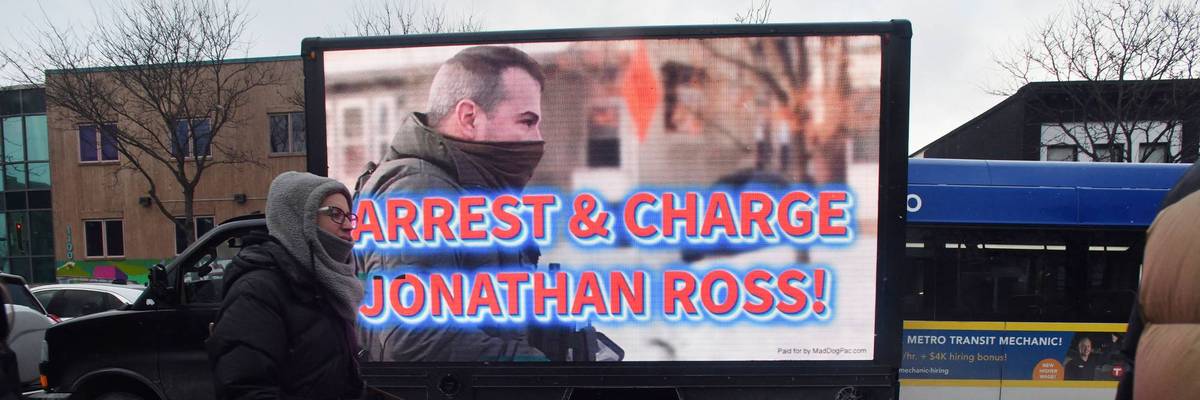
Protesters walk past a screen reading, "Arrest and charge Jonathan Ross," named in US media as the Immigration and Customs Enforcement (ICE) officer who fatally shot Renee Good, as they march from Powderhorn Park in Minneapolis against ICE and the fatal shooting of Good, calling on federal authorities to leave the city and demand accountability, in Minneapolis, Minnesota, on January 10, 2026.
A simple law could ensure that no federal agent is above the law.
The American public's patience with reckless federal agents has run out—but Congress has yet to act. While members of Congress debate funding for Immigration and Customs Enforcement and Border Patrol, communities across the country remain at risk of further harm from lawless policing.
For months, polling has shown cratering support for ICE and the agency’s aggressive tactics, including a 30 point collapse in a single year. Recent YouGov and American Civil Liberties Union (ACLU) polling shows that Americans don’t think federal law enforcement should be above the law: 93% of voters—including 89% of Trump voters—believe that agents who violate people's rights must be held accountable. Former MAGA influencers have criticized ICE and compared the agency’s tactics to the Gestapo. Even current Department of Homeland Security agents have told reporters that they’re troubled by the agency’s tactics. And in cities across the country, the response has been unmistakable: massive demonstrations in response to violent raids and multiple fatal shootings by federal agents.
Americans have been demanding accountability because when agents can violently attack and kill community members without consequence, everyone is less safe.
Consider what happened to one ACLU client in Maine earlier this year.
When federal agents face no consequences, that impunity invites more wrongdoing, turns our freedoms into empty promises, and leaves us all unprotected.
On the morning of January 22, Juan Sebastián Carvajal-Muñoz was abducted in broad daylight by federal agents. A civil engineer, Mr. Carvajal-Muñoz was driving to his job when a dark SUV cut in front of his car, forcing it to stop. Three people approached his window and demanded to see his papers. He showed his driver’s license through the window, and the agents ordered him to get out of his car. When he reached for his phone to call for help and to record the interaction, agents violently smashed his car window, forced his car open, and dragged him out. Mr. Carvajal-Muñoz’s car was left running with the door open, and his phone was left lying on the street.
Mr. Carvajal-Muñoz was racially profiled and targeted as part of an immigration crackdown in Maine callously called “Operation Catch of the Day.” Mr. Carvajal-Munoz was caught, but for what? He was legally working in the United States on an H1-B visa, was not breaking a single law, and was simply driving as a Latino man. Mr. Carvajal-Munoz was able to sue for these constitutional violations under Maine’s Civil Rights Act, but people in most states cannot.
That’s because there’s an alarming accountability gap between federal and state officers. For example, after Minneapolis Police Officer Derek Chauvin murdered George Floyd in 2020, Mr. Floyd’s family sued the City of Minneapolis and police officers for violating his constitutional rights, ultimately securing a $27 million settlement. Federal law, however, does not allow the families of Alex Pretti and Renee Good to file that type of lawsuit against the federal agents who shot and killed them just miles from where Mr. Floyd was murdered.
This illogical gap stems from a historical omission. After the Civil War, in response to pro-Confederate state and local officials’ widespread violations of the rights of Black people and Union sympathizers, the Reconstruction Congress passed a law allowing people to sue state and local officers for damages or other relief when their rights were violated. Unfortunately, that law, commonly known as Section 1983, did not cover federal officers.
In 1971, the Supreme Court filled that accountability gap, ruling in Bivens v. Six Unknown Federal Narcotics Agents that the logic of the Constitution demanded that federal officers could be sued for constitutional violations, too. For decades afterward, people sued federal agents over constitutional violations in what were known as Bivens actions. But in 2017, the Supreme Court severely limited when people can bring Bivens actions, and now it’s nearly impossible to sue federal officers for violating people’s rights. For example, in 2021, a federal court rejected Bivens claims against federal officers who were sued for attacking peaceful civil rights demonstrators with tear gas, rubber bullets, and a baton charge at Lafayette Square Park across the street from the White House. At the same time, the same court ruled that local officers could be sued for those same constitutional violations, which the court held “would have been clear to every reasonable officer.”
When federal agents face no consequences, that impunity invites more wrongdoing, turns our freedoms into empty promises, and leaves us all unprotected. US courts have long recognized the fundamental legal principle that where there is a right, there must be a remedy. In other words, a right that you can’t enforce is just a suggestion that government actors can ignore when it suits them. We are now seeing the very real results that follow when a right lacks remedies: Officers can terrorize and abuse people without repercussions.
Congress has the power to close this dangerous accountability gap and restore a basic promise: If a federal officer violates your rights, you can seek justice, just like you can when a state officer crosses the line. All Congress has to do is pass the Bivens Act, which would fix the historical omission by explicitly stating that, like state and local officials, federal officers can be sued when they violate our constitutional rights. As the Supreme Court pointed out in a 1980 case applying Bivens, “The ‘constitutional design’ would be stood on its head if federal officials did not face at least the same liability as state officials guilty of the same constitutional transgression.”
The weight of our constitutional rights is becoming clearer every day: None of us is safe when federal agents can harm people at will. Congress can and must pass the Bivens Act, a simple law that would restore accountability, compensate victims and their families, and deter the unchecked government violence that has become a hallmark of this administration.
Dear Common Dreams reader, It’s been nearly 30 years since I co-founded Common Dreams with my late wife, Lina Newhouser. We had the radical notion that journalism should serve the public good, not corporate profits. It was clear to us from the outset what it would take to build such a project. No paid advertisements. No corporate sponsors. No millionaire publisher telling us what to think or do. Many people said we wouldn't last a year, but we proved those doubters wrong. Together with a tremendous team of journalists and dedicated staff, we built an independent media outlet free from the constraints of profits and corporate control. Our mission has always been simple: To inform. To inspire. To ignite change for the common good. Building Common Dreams was not easy. Our survival was never guaranteed. When you take on the most powerful forces—Wall Street greed, fossil fuel industry destruction, Big Tech lobbyists, and uber-rich oligarchs who have spent billions upon billions rigging the economy and democracy in their favor—the only bulwark you have is supporters who believe in your work. But here’s the urgent message from me today. It's never been this bad out there. And it's never been this hard to keep us going. At the very moment Common Dreams is most needed, the threats we face are intensifying. We need your support now more than ever. We don't accept corporate advertising and never will. We don't have a paywall because we don't think people should be blocked from critical news based on their ability to pay. Everything we do is funded by the donations of readers like you. When everyone does the little they can afford, we are strong. But if that support retreats or dries up, so do we. Will you donate now to make sure Common Dreams not only survives but thrives? —Craig Brown, Co-founder |
The American public's patience with reckless federal agents has run out—but Congress has yet to act. While members of Congress debate funding for Immigration and Customs Enforcement and Border Patrol, communities across the country remain at risk of further harm from lawless policing.
For months, polling has shown cratering support for ICE and the agency’s aggressive tactics, including a 30 point collapse in a single year. Recent YouGov and American Civil Liberties Union (ACLU) polling shows that Americans don’t think federal law enforcement should be above the law: 93% of voters—including 89% of Trump voters—believe that agents who violate people's rights must be held accountable. Former MAGA influencers have criticized ICE and compared the agency’s tactics to the Gestapo. Even current Department of Homeland Security agents have told reporters that they’re troubled by the agency’s tactics. And in cities across the country, the response has been unmistakable: massive demonstrations in response to violent raids and multiple fatal shootings by federal agents.
Americans have been demanding accountability because when agents can violently attack and kill community members without consequence, everyone is less safe.
Consider what happened to one ACLU client in Maine earlier this year.
When federal agents face no consequences, that impunity invites more wrongdoing, turns our freedoms into empty promises, and leaves us all unprotected.
On the morning of January 22, Juan Sebastián Carvajal-Muñoz was abducted in broad daylight by federal agents. A civil engineer, Mr. Carvajal-Muñoz was driving to his job when a dark SUV cut in front of his car, forcing it to stop. Three people approached his window and demanded to see his papers. He showed his driver’s license through the window, and the agents ordered him to get out of his car. When he reached for his phone to call for help and to record the interaction, agents violently smashed his car window, forced his car open, and dragged him out. Mr. Carvajal-Muñoz’s car was left running with the door open, and his phone was left lying on the street.
Mr. Carvajal-Muñoz was racially profiled and targeted as part of an immigration crackdown in Maine callously called “Operation Catch of the Day.” Mr. Carvajal-Munoz was caught, but for what? He was legally working in the United States on an H1-B visa, was not breaking a single law, and was simply driving as a Latino man. Mr. Carvajal-Munoz was able to sue for these constitutional violations under Maine’s Civil Rights Act, but people in most states cannot.
That’s because there’s an alarming accountability gap between federal and state officers. For example, after Minneapolis Police Officer Derek Chauvin murdered George Floyd in 2020, Mr. Floyd’s family sued the City of Minneapolis and police officers for violating his constitutional rights, ultimately securing a $27 million settlement. Federal law, however, does not allow the families of Alex Pretti and Renee Good to file that type of lawsuit against the federal agents who shot and killed them just miles from where Mr. Floyd was murdered.
This illogical gap stems from a historical omission. After the Civil War, in response to pro-Confederate state and local officials’ widespread violations of the rights of Black people and Union sympathizers, the Reconstruction Congress passed a law allowing people to sue state and local officers for damages or other relief when their rights were violated. Unfortunately, that law, commonly known as Section 1983, did not cover federal officers.
In 1971, the Supreme Court filled that accountability gap, ruling in Bivens v. Six Unknown Federal Narcotics Agents that the logic of the Constitution demanded that federal officers could be sued for constitutional violations, too. For decades afterward, people sued federal agents over constitutional violations in what were known as Bivens actions. But in 2017, the Supreme Court severely limited when people can bring Bivens actions, and now it’s nearly impossible to sue federal officers for violating people’s rights. For example, in 2021, a federal court rejected Bivens claims against federal officers who were sued for attacking peaceful civil rights demonstrators with tear gas, rubber bullets, and a baton charge at Lafayette Square Park across the street from the White House. At the same time, the same court ruled that local officers could be sued for those same constitutional violations, which the court held “would have been clear to every reasonable officer.”
When federal agents face no consequences, that impunity invites more wrongdoing, turns our freedoms into empty promises, and leaves us all unprotected. US courts have long recognized the fundamental legal principle that where there is a right, there must be a remedy. In other words, a right that you can’t enforce is just a suggestion that government actors can ignore when it suits them. We are now seeing the very real results that follow when a right lacks remedies: Officers can terrorize and abuse people without repercussions.
Congress has the power to close this dangerous accountability gap and restore a basic promise: If a federal officer violates your rights, you can seek justice, just like you can when a state officer crosses the line. All Congress has to do is pass the Bivens Act, which would fix the historical omission by explicitly stating that, like state and local officials, federal officers can be sued when they violate our constitutional rights. As the Supreme Court pointed out in a 1980 case applying Bivens, “The ‘constitutional design’ would be stood on its head if federal officials did not face at least the same liability as state officials guilty of the same constitutional transgression.”
The weight of our constitutional rights is becoming clearer every day: None of us is safe when federal agents can harm people at will. Congress can and must pass the Bivens Act, a simple law that would restore accountability, compensate victims and their families, and deter the unchecked government violence that has become a hallmark of this administration.
The American public's patience with reckless federal agents has run out—but Congress has yet to act. While members of Congress debate funding for Immigration and Customs Enforcement and Border Patrol, communities across the country remain at risk of further harm from lawless policing.
For months, polling has shown cratering support for ICE and the agency’s aggressive tactics, including a 30 point collapse in a single year. Recent YouGov and American Civil Liberties Union (ACLU) polling shows that Americans don’t think federal law enforcement should be above the law: 93% of voters—including 89% of Trump voters—believe that agents who violate people's rights must be held accountable. Former MAGA influencers have criticized ICE and compared the agency’s tactics to the Gestapo. Even current Department of Homeland Security agents have told reporters that they’re troubled by the agency’s tactics. And in cities across the country, the response has been unmistakable: massive demonstrations in response to violent raids and multiple fatal shootings by federal agents.
Americans have been demanding accountability because when agents can violently attack and kill community members without consequence, everyone is less safe.
Consider what happened to one ACLU client in Maine earlier this year.
When federal agents face no consequences, that impunity invites more wrongdoing, turns our freedoms into empty promises, and leaves us all unprotected.
On the morning of January 22, Juan Sebastián Carvajal-Muñoz was abducted in broad daylight by federal agents. A civil engineer, Mr. Carvajal-Muñoz was driving to his job when a dark SUV cut in front of his car, forcing it to stop. Three people approached his window and demanded to see his papers. He showed his driver’s license through the window, and the agents ordered him to get out of his car. When he reached for his phone to call for help and to record the interaction, agents violently smashed his car window, forced his car open, and dragged him out. Mr. Carvajal-Muñoz’s car was left running with the door open, and his phone was left lying on the street.
Mr. Carvajal-Muñoz was racially profiled and targeted as part of an immigration crackdown in Maine callously called “Operation Catch of the Day.” Mr. Carvajal-Munoz was caught, but for what? He was legally working in the United States on an H1-B visa, was not breaking a single law, and was simply driving as a Latino man. Mr. Carvajal-Munoz was able to sue for these constitutional violations under Maine’s Civil Rights Act, but people in most states cannot.
That’s because there’s an alarming accountability gap between federal and state officers. For example, after Minneapolis Police Officer Derek Chauvin murdered George Floyd in 2020, Mr. Floyd’s family sued the City of Minneapolis and police officers for violating his constitutional rights, ultimately securing a $27 million settlement. Federal law, however, does not allow the families of Alex Pretti and Renee Good to file that type of lawsuit against the federal agents who shot and killed them just miles from where Mr. Floyd was murdered.
This illogical gap stems from a historical omission. After the Civil War, in response to pro-Confederate state and local officials’ widespread violations of the rights of Black people and Union sympathizers, the Reconstruction Congress passed a law allowing people to sue state and local officers for damages or other relief when their rights were violated. Unfortunately, that law, commonly known as Section 1983, did not cover federal officers.
In 1971, the Supreme Court filled that accountability gap, ruling in Bivens v. Six Unknown Federal Narcotics Agents that the logic of the Constitution demanded that federal officers could be sued for constitutional violations, too. For decades afterward, people sued federal agents over constitutional violations in what were known as Bivens actions. But in 2017, the Supreme Court severely limited when people can bring Bivens actions, and now it’s nearly impossible to sue federal officers for violating people’s rights. For example, in 2021, a federal court rejected Bivens claims against federal officers who were sued for attacking peaceful civil rights demonstrators with tear gas, rubber bullets, and a baton charge at Lafayette Square Park across the street from the White House. At the same time, the same court ruled that local officers could be sued for those same constitutional violations, which the court held “would have been clear to every reasonable officer.”
When federal agents face no consequences, that impunity invites more wrongdoing, turns our freedoms into empty promises, and leaves us all unprotected. US courts have long recognized the fundamental legal principle that where there is a right, there must be a remedy. In other words, a right that you can’t enforce is just a suggestion that government actors can ignore when it suits them. We are now seeing the very real results that follow when a right lacks remedies: Officers can terrorize and abuse people without repercussions.
Congress has the power to close this dangerous accountability gap and restore a basic promise: If a federal officer violates your rights, you can seek justice, just like you can when a state officer crosses the line. All Congress has to do is pass the Bivens Act, which would fix the historical omission by explicitly stating that, like state and local officials, federal officers can be sued when they violate our constitutional rights. As the Supreme Court pointed out in a 1980 case applying Bivens, “The ‘constitutional design’ would be stood on its head if federal officials did not face at least the same liability as state officials guilty of the same constitutional transgression.”
The weight of our constitutional rights is becoming clearer every day: None of us is safe when federal agents can harm people at will. Congress can and must pass the Bivens Act, a simple law that would restore accountability, compensate victims and their families, and deter the unchecked government violence that has become a hallmark of this administration.