SUBSCRIBE TO OUR FREE NEWSLETTER
Daily news & progressive opinion—funded by the people, not the corporations—delivered straight to your inbox.
5
#000000
#FFFFFF
To donate by check, phone, or other method, see our More Ways to Give page.
Daily news & progressive opinion—funded by the people, not the corporations—delivered straight to your inbox.
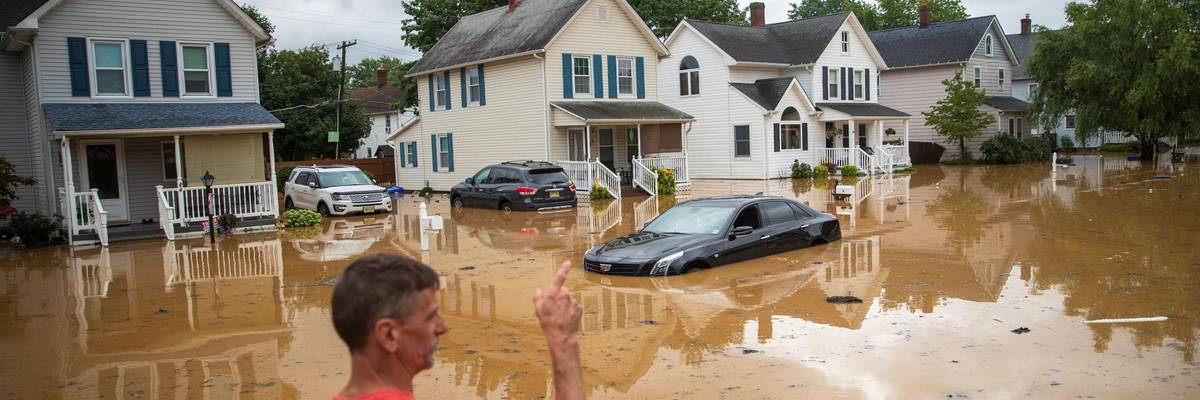
An evacuated resident points in the direction of his home following a flash flood, which came as Tropical Storm Henri made landfall, in Helmetta, New Jersey on August 22, 2021.
Areas previously affected by redlining are now also those prone to flooding and higher temperatures, a problem compounded by poor infrastructure that fails to mitigate these risks.
In an era of climate disasters, Americans in vulnerable regions will need to rely more than ever on their home insurance. But as floods, wildfires, and severe storms become more common, a troubling practice known as “bluelining” threatens to leave many communities unable to afford insurance—or obtain it at any price.
Bluelining is an insidious practice with similarities to redlining—the notorious government-sanctioned practice of financial institutions denying mortgages and credit to Black and brown communities, which were often marked by red lines on map.
These days, financial institutions are now drawing “blue lines” around many of these same communities, restricting services like insurance based on environmental risks. Even worse, many of those same institutions are bankrolling those risks by funding and insuring the fossil fuel industry.
This situation will demand a radical rethink of how we approach investing in our communities based on climate risks.
Originally, bluelining referred to blue-water flood risks, but it now includes other climate-related disasters like wildfires, hurricanes, and severe thunderstorms, all of which are driving private-sector decisions. (Severe thunderstorms, in fact, were responsible for about 61% of insured natural catastrophe losses in 2023.)
In the case of property insurance, we’re already seeing insurers pull out of entire states like California and Florida. The financial impacts of these decisions are considerable for everyone they affect—and often fall hardest on those in low-income and historically disadvantaged communities.
A Redfin study from 2021 illustrated that areas previously affected by redlining are now also those prone to flooding and higher temperatures, a problem compounded by poor infrastructure that fails to mitigate these risks. This overlap is not a coincidence but a further consequence of systemic discrimination and disinvestment.
This financial problem exists no matter where you live. In 2024, the national average home insurance cost rose about 23% above the cost of similar coverage last year. Homeowners across more and more states are left grappling with soaring premiums or no insurance options at all. And the lack of federal oversight means there is little uniformity or coordination in addressing these retreats.
This situation will demand a radical rethink of how we approach investing in our communities based on climate risks. For one thing, financial institutions must pivot from funding fossil fuel expansion to investing in renewable energy, natural climate solutions, and climate resilience, including infrastructure upgrades.
What about communities in especially vulnerable areas?
One strategy is community-driven relocation and managed retreat. By relocating communities to low-risk areas, we not only safeguard them against immediate physical dangers but also against ensuing financial hardships. Additionally, preventing development in known high-risk areas can significantly decrease financial instability and economic losses from future disasters.
As part of this strategic shift, financial policies must be realigned. We need regulations that compel financial institutions to manage and mitigate financial risk to the system and to consumers. We also need them to invest in affordable housing development that is energy-efficient, climate-resilient, and located in areas less susceptible to climate change in the mid- to long-term.
Meanwhile, green infrastructure and stricter energy efficiency and other resilience-related building codes can serve as bulwarks against extreme temperatures and weather events.
The challenge of bluelining offers us an opportunity to forge a path towards a more resilient and equitable society. We owe it to the future generations to do more than just adapt to climate change. We also need to confront and overhaul the systems that harm our climate. The communities most exposed to climate change deserve no less.
Dear Common Dreams reader, It’s been nearly 30 years since I co-founded Common Dreams with my late wife, Lina Newhouser. We had the radical notion that journalism should serve the public good, not corporate profits. It was clear to us from the outset what it would take to build such a project. No paid advertisements. No corporate sponsors. No millionaire publisher telling us what to think or do. Many people said we wouldn't last a year, but we proved those doubters wrong. Together with a tremendous team of journalists and dedicated staff, we built an independent media outlet free from the constraints of profits and corporate control. Our mission has always been simple: To inform. To inspire. To ignite change for the common good. Building Common Dreams was not easy. Our survival was never guaranteed. When you take on the most powerful forces—Wall Street greed, fossil fuel industry destruction, Big Tech lobbyists, and uber-rich oligarchs who have spent billions upon billions rigging the economy and democracy in their favor—the only bulwark you have is supporters who believe in your work. But here’s the urgent message from me today. It's never been this bad out there. And it's never been this hard to keep us going. At the very moment Common Dreams is most needed, the threats we face are intensifying. We need your support now more than ever. We don't accept corporate advertising and never will. We don't have a paywall because we don't think people should be blocked from critical news based on their ability to pay. Everything we do is funded by the donations of readers like you. When everyone does the little they can afford, we are strong. But if that support retreats or dries up, so do we. Will you donate now to make sure Common Dreams not only survives but thrives? —Craig Brown, Co-founder |
In an era of climate disasters, Americans in vulnerable regions will need to rely more than ever on their home insurance. But as floods, wildfires, and severe storms become more common, a troubling practice known as “bluelining” threatens to leave many communities unable to afford insurance—or obtain it at any price.
Bluelining is an insidious practice with similarities to redlining—the notorious government-sanctioned practice of financial institutions denying mortgages and credit to Black and brown communities, which were often marked by red lines on map.
These days, financial institutions are now drawing “blue lines” around many of these same communities, restricting services like insurance based on environmental risks. Even worse, many of those same institutions are bankrolling those risks by funding and insuring the fossil fuel industry.
This situation will demand a radical rethink of how we approach investing in our communities based on climate risks.
Originally, bluelining referred to blue-water flood risks, but it now includes other climate-related disasters like wildfires, hurricanes, and severe thunderstorms, all of which are driving private-sector decisions. (Severe thunderstorms, in fact, were responsible for about 61% of insured natural catastrophe losses in 2023.)
In the case of property insurance, we’re already seeing insurers pull out of entire states like California and Florida. The financial impacts of these decisions are considerable for everyone they affect—and often fall hardest on those in low-income and historically disadvantaged communities.
A Redfin study from 2021 illustrated that areas previously affected by redlining are now also those prone to flooding and higher temperatures, a problem compounded by poor infrastructure that fails to mitigate these risks. This overlap is not a coincidence but a further consequence of systemic discrimination and disinvestment.
This financial problem exists no matter where you live. In 2024, the national average home insurance cost rose about 23% above the cost of similar coverage last year. Homeowners across more and more states are left grappling with soaring premiums or no insurance options at all. And the lack of federal oversight means there is little uniformity or coordination in addressing these retreats.
This situation will demand a radical rethink of how we approach investing in our communities based on climate risks. For one thing, financial institutions must pivot from funding fossil fuel expansion to investing in renewable energy, natural climate solutions, and climate resilience, including infrastructure upgrades.
What about communities in especially vulnerable areas?
One strategy is community-driven relocation and managed retreat. By relocating communities to low-risk areas, we not only safeguard them against immediate physical dangers but also against ensuing financial hardships. Additionally, preventing development in known high-risk areas can significantly decrease financial instability and economic losses from future disasters.
As part of this strategic shift, financial policies must be realigned. We need regulations that compel financial institutions to manage and mitigate financial risk to the system and to consumers. We also need them to invest in affordable housing development that is energy-efficient, climate-resilient, and located in areas less susceptible to climate change in the mid- to long-term.
Meanwhile, green infrastructure and stricter energy efficiency and other resilience-related building codes can serve as bulwarks against extreme temperatures and weather events.
The challenge of bluelining offers us an opportunity to forge a path towards a more resilient and equitable society. We owe it to the future generations to do more than just adapt to climate change. We also need to confront and overhaul the systems that harm our climate. The communities most exposed to climate change deserve no less.
In an era of climate disasters, Americans in vulnerable regions will need to rely more than ever on their home insurance. But as floods, wildfires, and severe storms become more common, a troubling practice known as “bluelining” threatens to leave many communities unable to afford insurance—or obtain it at any price.
Bluelining is an insidious practice with similarities to redlining—the notorious government-sanctioned practice of financial institutions denying mortgages and credit to Black and brown communities, which were often marked by red lines on map.
These days, financial institutions are now drawing “blue lines” around many of these same communities, restricting services like insurance based on environmental risks. Even worse, many of those same institutions are bankrolling those risks by funding and insuring the fossil fuel industry.
This situation will demand a radical rethink of how we approach investing in our communities based on climate risks.
Originally, bluelining referred to blue-water flood risks, but it now includes other climate-related disasters like wildfires, hurricanes, and severe thunderstorms, all of which are driving private-sector decisions. (Severe thunderstorms, in fact, were responsible for about 61% of insured natural catastrophe losses in 2023.)
In the case of property insurance, we’re already seeing insurers pull out of entire states like California and Florida. The financial impacts of these decisions are considerable for everyone they affect—and often fall hardest on those in low-income and historically disadvantaged communities.
A Redfin study from 2021 illustrated that areas previously affected by redlining are now also those prone to flooding and higher temperatures, a problem compounded by poor infrastructure that fails to mitigate these risks. This overlap is not a coincidence but a further consequence of systemic discrimination and disinvestment.
This financial problem exists no matter where you live. In 2024, the national average home insurance cost rose about 23% above the cost of similar coverage last year. Homeowners across more and more states are left grappling with soaring premiums or no insurance options at all. And the lack of federal oversight means there is little uniformity or coordination in addressing these retreats.
This situation will demand a radical rethink of how we approach investing in our communities based on climate risks. For one thing, financial institutions must pivot from funding fossil fuel expansion to investing in renewable energy, natural climate solutions, and climate resilience, including infrastructure upgrades.
What about communities in especially vulnerable areas?
One strategy is community-driven relocation and managed retreat. By relocating communities to low-risk areas, we not only safeguard them against immediate physical dangers but also against ensuing financial hardships. Additionally, preventing development in known high-risk areas can significantly decrease financial instability and economic losses from future disasters.
As part of this strategic shift, financial policies must be realigned. We need regulations that compel financial institutions to manage and mitigate financial risk to the system and to consumers. We also need them to invest in affordable housing development that is energy-efficient, climate-resilient, and located in areas less susceptible to climate change in the mid- to long-term.
Meanwhile, green infrastructure and stricter energy efficiency and other resilience-related building codes can serve as bulwarks against extreme temperatures and weather events.
The challenge of bluelining offers us an opportunity to forge a path towards a more resilient and equitable society. We owe it to the future generations to do more than just adapt to climate change. We also need to confront and overhaul the systems that harm our climate. The communities most exposed to climate change deserve no less.