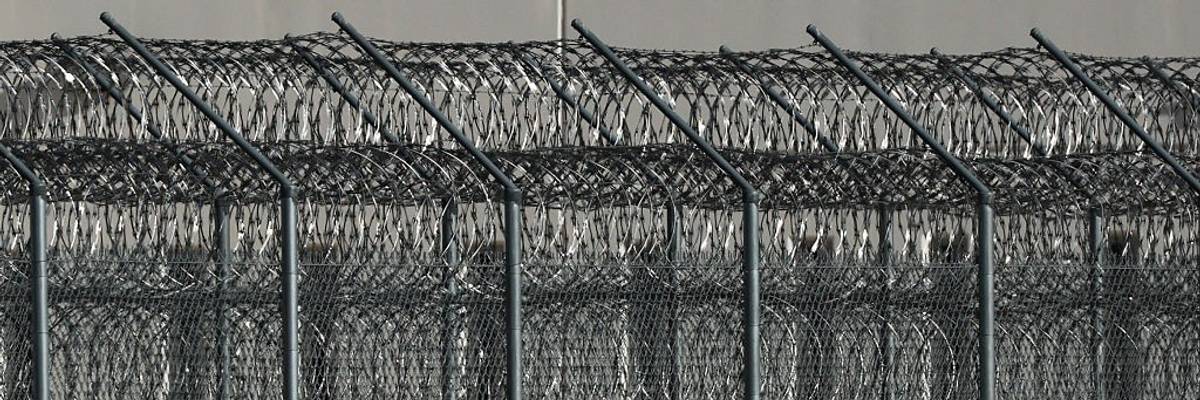
Security fencing surrounds the CoreCivic, Inc. California City Immigration Processing Center in the Kern County desert ahead of the facility reopening as a federal immigrant detention facility under contract with the US Immigration and Customs Enforcement (ICE) in California City, California on July 10, 2025.
Immigration Detention Is No Place for a Child
As I continue to heal from my own experience in a for-profit ICE prison, I can’t help but wonder if children detained will ever feel safe again.
Each day, I read more news about children as young as two years old who are detained in a for-profit Immigration and Customs Enforcement detention center in Dilley, Texas, away from their friends, schools, and communities. I see reports of handwritten letters from children asking to be released, as they describe the fear they experience day in and day out while in detention. As an applied developmental scientist who spent more than 13 years studying child and youth development, as well as someone who has firsthand experienced the horrors of encountering immigration enforcement and the inhumane treatment and conditions that follow, I am deeply concerned for children impacted by immigration enforcement surges.
There is no shortage of research that demonstrates the connection between family detention and deportation proceedings of children and negative educational outcomes, elevated levels of distress, mental and physical harm, trauma, and decline in multiple aspects of well-being. Currently, approximately 1 in 12 children in the US face risk of deportation of a loved one and the lasting negative impacts on their psychological and physical well-being. ICE has detained at least 3,800 children since mid-January 2025. Of those 3,800 kids, more than 600 unaccompanied children have been put in custody of the Department of Homeland Security (DHS) and were taken from their parents in many cases.
Regardless of my role as researcher, on a human level I am constantly thinking: What do children feel when they first encounter immigration enforcement, who are usually armed and masked? Do their little bodies tremble or freeze? What happens when federal agents take their parents away from them? What does it mean for a preschooler to be detained? What is their crime? Is it being born or, perhaps, seeking asylum? What sense of childhood remains when immigrant children are detained in inhumane conditions?
What I experienced as an adult paints enough of a bleak picture. As a 30-year-old, I was unlawfully abducted from the street by masked and armed agents for being a co-author in a school op-ed at Tufts Daily that advocated for Palestinian human rights. I was sent to a for-profit ICE prison thousands of miles away from school and the community I’d built in Boston, not to mention thousands of miles away from my family in Turkey. The experience has been profoundly harmful to me, even as an adult. Despite the immense care, love, and support from my community, there has still not been a single day when I have felt safe walking the streets again—not even on my way home or to school. It’s not just the moment of abduction that is terrifying, but also where one will go and the inhumane treatment they may face that cannot be considered developmentally appropriate for any single child. Research suggests that interacting with the immigration system poses harm to children’s long-term development. Previous personal accounts indicate that suffering continues throughout the lifetime.
We must all ask ourselves: Is this really the world we want for our children—one where they are afraid to go to school, home, hospitals, neighborhoods, playgrounds, museums, and libraries for fear of immigration detention?
As I continue to heal from my own experience in a for-profit ICE prison, I can’t help but wonder if children detained will ever feel safe again. I worry about how they will grow up and carry this adverse experience for a lifetime. Interacting with immigration enforcement not only poses developmental risk to children detained in those shameful places for longer periods of time, but also to children (including citizen children) whose parents are detained at the for-profit ICE prisons. In the for-profit prison where I was unlawfully detained, I met countless mothers who cried everyday longing for their children. I met mothers in the deportation process whose hearts were shattered when their children were taken into foster care. I listened as some mothers tried to speak with their children on tablets, only to have officers order them to close the tablets or take them away, leaving their children in tears. I met mothers whose babies were taken from them just weeks after birth. I met with a pregnant mom waiting for her deportation. Her children are American citizens.
But these cruel immigration raids aren’t only harming immigrant children or children with immigrant parents. The experience also affects classmates who are waiting for their detained peers to return. These same children are trying to make sense of what they see on news reports of kids being detained, of disappearing classmates, students, and adults on the street during ICE raids. Children and their teachers are being taken from their communities, leaving classrooms and communities in fear. There are accounts of BIPOC and immigrant children being bullied at school.
We must all ask ourselves: Is this really the world we want for our children—one where they are afraid to go to school, home, hospitals, neighborhoods, playgrounds, museums, and libraries for fear of immigration detention?
I hope there is an end to family detention so that these parents and young children can proceed with their cases while living in their communities, going to school, getting medical treatment, and playing with their friends. Too many children are facing detention because of ICE’s rampant operations. But detention is no place for a child. It’s cruel and unnecessary. We can all take action, whether that means raising our voices to demand an end to child detention, or simply educating ourselves on how current immigration policies are impacting children.
We are at a crossroads
This country and this world are at a monumental crossroads. In a few short weeks, US voters will have an opportunity to beat back the forces of fascism and confront the billionaires who are rigging the economy, our media system, and our democracy, making it increasingly impossible for ordinary people to get by. We’re not just talking about the election. We’re talking about what must be done once these fascist elements are vanquished from power. We need a bolder set of solutions than what either major party has so far been willing to offer and a working-class movement ready to fight like hell for it. Trump didn't emerge from nowhere. The conditions that fueled MAGA authoritarianism were created by decades of radical neoliberal economic policies and a corrupt political system dominated by corporate interests. They slashed taxes on the super-rich, promising that the benefits would trickle down. They said giveaways to the corporate titans would make life more affordable for the rest of us. It was all bullshit. And when a bitter, betrayed populace searches for someone to blame, right-wing demagogues have little trouble finding scapegoats. People know when they're being lied to, but you won't hear any of this from the corporate media. Only independent journalism—powered and funded by people who believe in building a better world—can deliver truly trustworthy daily news. Our Fall Campaign is underway, and we need your help. To power our newsroom through the rest of the year, we need to raise $125,000 by midnight on October 31. So if you share our vision, please contribute whatever you can to sustain our work. |
Each day, I read more news about children as young as two years old who are detained in a for-profit Immigration and Customs Enforcement detention center in Dilley, Texas, away from their friends, schools, and communities. I see reports of handwritten letters from children asking to be released, as they describe the fear they experience day in and day out while in detention. As an applied developmental scientist who spent more than 13 years studying child and youth development, as well as someone who has firsthand experienced the horrors of encountering immigration enforcement and the inhumane treatment and conditions that follow, I am deeply concerned for children impacted by immigration enforcement surges.
There is no shortage of research that demonstrates the connection between family detention and deportation proceedings of children and negative educational outcomes, elevated levels of distress, mental and physical harm, trauma, and decline in multiple aspects of well-being. Currently, approximately 1 in 12 children in the US face risk of deportation of a loved one and the lasting negative impacts on their psychological and physical well-being. ICE has detained at least 3,800 children since mid-January 2025. Of those 3,800 kids, more than 600 unaccompanied children have been put in custody of the Department of Homeland Security (DHS) and were taken from their parents in many cases.
Regardless of my role as researcher, on a human level I am constantly thinking: What do children feel when they first encounter immigration enforcement, who are usually armed and masked? Do their little bodies tremble or freeze? What happens when federal agents take their parents away from them? What does it mean for a preschooler to be detained? What is their crime? Is it being born or, perhaps, seeking asylum? What sense of childhood remains when immigrant children are detained in inhumane conditions?
What I experienced as an adult paints enough of a bleak picture. As a 30-year-old, I was unlawfully abducted from the street by masked and armed agents for being a co-author in a school op-ed at Tufts Daily that advocated for Palestinian human rights. I was sent to a for-profit ICE prison thousands of miles away from school and the community I’d built in Boston, not to mention thousands of miles away from my family in Turkey. The experience has been profoundly harmful to me, even as an adult. Despite the immense care, love, and support from my community, there has still not been a single day when I have felt safe walking the streets again—not even on my way home or to school. It’s not just the moment of abduction that is terrifying, but also where one will go and the inhumane treatment they may face that cannot be considered developmentally appropriate for any single child. Research suggests that interacting with the immigration system poses harm to children’s long-term development. Previous personal accounts indicate that suffering continues throughout the lifetime.
We must all ask ourselves: Is this really the world we want for our children—one where they are afraid to go to school, home, hospitals, neighborhoods, playgrounds, museums, and libraries for fear of immigration detention?
As I continue to heal from my own experience in a for-profit ICE prison, I can’t help but wonder if children detained will ever feel safe again. I worry about how they will grow up and carry this adverse experience for a lifetime. Interacting with immigration enforcement not only poses developmental risk to children detained in those shameful places for longer periods of time, but also to children (including citizen children) whose parents are detained at the for-profit ICE prisons. In the for-profit prison where I was unlawfully detained, I met countless mothers who cried everyday longing for their children. I met mothers in the deportation process whose hearts were shattered when their children were taken into foster care. I listened as some mothers tried to speak with their children on tablets, only to have officers order them to close the tablets or take them away, leaving their children in tears. I met mothers whose babies were taken from them just weeks after birth. I met with a pregnant mom waiting for her deportation. Her children are American citizens.
But these cruel immigration raids aren’t only harming immigrant children or children with immigrant parents. The experience also affects classmates who are waiting for their detained peers to return. These same children are trying to make sense of what they see on news reports of kids being detained, of disappearing classmates, students, and adults on the street during ICE raids. Children and their teachers are being taken from their communities, leaving classrooms and communities in fear. There are accounts of BIPOC and immigrant children being bullied at school.
We must all ask ourselves: Is this really the world we want for our children—one where they are afraid to go to school, home, hospitals, neighborhoods, playgrounds, museums, and libraries for fear of immigration detention?
I hope there is an end to family detention so that these parents and young children can proceed with their cases while living in their communities, going to school, getting medical treatment, and playing with their friends. Too many children are facing detention because of ICE’s rampant operations. But detention is no place for a child. It’s cruel and unnecessary. We can all take action, whether that means raising our voices to demand an end to child detention, or simply educating ourselves on how current immigration policies are impacting children.
- Migrant Children Imprisoned in Texas Detail Border Patrol's "Level of Inhumanity" ›
- Stop a Federal Budget That Betrays Millions of Children, Including Immigrant Children ›
- After Locking Migrant Children in Cages, DHS Chief Tells Congress, 'They're Not Cages' ›
- 5-Year-Old Abducted by ICE in Minneapolis Now Sick in ‘Abysmal’ Texas Detention Facility ›
- The Laken Riley Act Harms Immigrant Children, And It’s Only the Beginning ›
- 'Absolutely Vile': ICE Snatches Young Kids From Minnesota Schools, Sends Them to Texas ›
Each day, I read more news about children as young as two years old who are detained in a for-profit Immigration and Customs Enforcement detention center in Dilley, Texas, away from their friends, schools, and communities. I see reports of handwritten letters from children asking to be released, as they describe the fear they experience day in and day out while in detention. As an applied developmental scientist who spent more than 13 years studying child and youth development, as well as someone who has firsthand experienced the horrors of encountering immigration enforcement and the inhumane treatment and conditions that follow, I am deeply concerned for children impacted by immigration enforcement surges.
There is no shortage of research that demonstrates the connection between family detention and deportation proceedings of children and negative educational outcomes, elevated levels of distress, mental and physical harm, trauma, and decline in multiple aspects of well-being. Currently, approximately 1 in 12 children in the US face risk of deportation of a loved one and the lasting negative impacts on their psychological and physical well-being. ICE has detained at least 3,800 children since mid-January 2025. Of those 3,800 kids, more than 600 unaccompanied children have been put in custody of the Department of Homeland Security (DHS) and were taken from their parents in many cases.
Regardless of my role as researcher, on a human level I am constantly thinking: What do children feel when they first encounter immigration enforcement, who are usually armed and masked? Do their little bodies tremble or freeze? What happens when federal agents take their parents away from them? What does it mean for a preschooler to be detained? What is their crime? Is it being born or, perhaps, seeking asylum? What sense of childhood remains when immigrant children are detained in inhumane conditions?
What I experienced as an adult paints enough of a bleak picture. As a 30-year-old, I was unlawfully abducted from the street by masked and armed agents for being a co-author in a school op-ed at Tufts Daily that advocated for Palestinian human rights. I was sent to a for-profit ICE prison thousands of miles away from school and the community I’d built in Boston, not to mention thousands of miles away from my family in Turkey. The experience has been profoundly harmful to me, even as an adult. Despite the immense care, love, and support from my community, there has still not been a single day when I have felt safe walking the streets again—not even on my way home or to school. It’s not just the moment of abduction that is terrifying, but also where one will go and the inhumane treatment they may face that cannot be considered developmentally appropriate for any single child. Research suggests that interacting with the immigration system poses harm to children’s long-term development. Previous personal accounts indicate that suffering continues throughout the lifetime.
We must all ask ourselves: Is this really the world we want for our children—one where they are afraid to go to school, home, hospitals, neighborhoods, playgrounds, museums, and libraries for fear of immigration detention?
As I continue to heal from my own experience in a for-profit ICE prison, I can’t help but wonder if children detained will ever feel safe again. I worry about how they will grow up and carry this adverse experience for a lifetime. Interacting with immigration enforcement not only poses developmental risk to children detained in those shameful places for longer periods of time, but also to children (including citizen children) whose parents are detained at the for-profit ICE prisons. In the for-profit prison where I was unlawfully detained, I met countless mothers who cried everyday longing for their children. I met mothers in the deportation process whose hearts were shattered when their children were taken into foster care. I listened as some mothers tried to speak with their children on tablets, only to have officers order them to close the tablets or take them away, leaving their children in tears. I met mothers whose babies were taken from them just weeks after birth. I met with a pregnant mom waiting for her deportation. Her children are American citizens.
But these cruel immigration raids aren’t only harming immigrant children or children with immigrant parents. The experience also affects classmates who are waiting for their detained peers to return. These same children are trying to make sense of what they see on news reports of kids being detained, of disappearing classmates, students, and adults on the street during ICE raids. Children and their teachers are being taken from their communities, leaving classrooms and communities in fear. There are accounts of BIPOC and immigrant children being bullied at school.
We must all ask ourselves: Is this really the world we want for our children—one where they are afraid to go to school, home, hospitals, neighborhoods, playgrounds, museums, and libraries for fear of immigration detention?
I hope there is an end to family detention so that these parents and young children can proceed with their cases while living in their communities, going to school, getting medical treatment, and playing with their friends. Too many children are facing detention because of ICE’s rampant operations. But detention is no place for a child. It’s cruel and unnecessary. We can all take action, whether that means raising our voices to demand an end to child detention, or simply educating ourselves on how current immigration policies are impacting children.
- Migrant Children Imprisoned in Texas Detail Border Patrol's "Level of Inhumanity" ›
- Stop a Federal Budget That Betrays Millions of Children, Including Immigrant Children ›
- After Locking Migrant Children in Cages, DHS Chief Tells Congress, 'They're Not Cages' ›
- 5-Year-Old Abducted by ICE in Minneapolis Now Sick in ‘Abysmal’ Texas Detention Facility ›
- The Laken Riley Act Harms Immigrant Children, And It’s Only the Beginning ›
- 'Absolutely Vile': ICE Snatches Young Kids From Minnesota Schools, Sends Them to Texas ›