SUBSCRIBE TO OUR FREE NEWSLETTER
Daily news & progressive opinion—funded by the people, not the corporations—delivered straight to your inbox.
5
#000000
#FFFFFF
To donate by check, phone, or other method, see our More Ways to Give page.
Daily news & progressive opinion—funded by the people, not the corporations—delivered straight to your inbox.
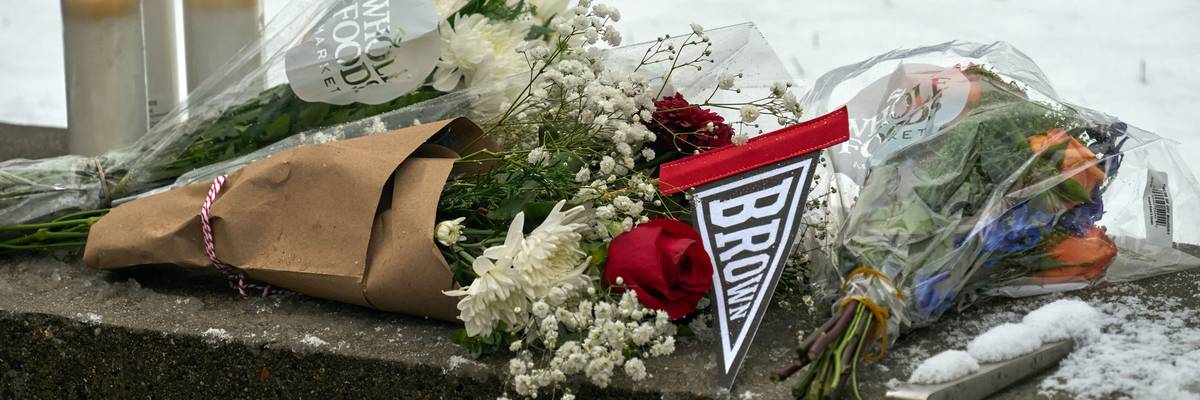
Flowers and candles are seen at a makeshift memorial outside the Barus & Holley engineering building on the campus of Brown University, in Providence, Rhode Island on December 14, 2025.
Australia’s response to a December 14 mass shooting reminds us that violence is not an inevitability to be endured; it is a problem to be confronted.
Days ago, two tragedies unfolded on opposite sides of the world—each marked by gun violence and grief, yet met with starkly different national responses.
On December 14, on the first night of Hanukkah, a gathering on Bondi Beach in Sydney turned into horror when a father and son opened fire during a “Hanukkah by the Sea” celebration, killing 15 people and wounding 40 in what Australian authorities called an antisemitic terrorist attack. The carnage would have been much worse were it not for the heroic act of Ahmed al-Ahmed, an Australian citizen who migrated from Syria two decades ago.
The day before in Providence, Rhode Island, a shooter opened fire at Brown University during finals, killing two students and wounding nine. As of this writing, authorities are actively searching for a suspect—and a motive.
These shootings—one at a beloved public beach, the other on an Ivy League campus—expose not only shared grief but radically different understandings of responsibility. In Australia, sorrow was quickly followed by collective resolve. The US followed a familiar ritual: shock, condolences, and political paralysis. If I had a dollar for every politician’s “thoughts and prayers,” I could join the billionaire class those officials so eagerly protect.
If we are serious about honoring the victims and survivors in Sydney, at Brown, and everywhere else touched by mass shootings, expressing grief is not enough.
Australian Prime Minister Anthony Albanese condemned the Bondi Beach massacre as an act of “evil beyond comprehension,” pledging solidarity with the Jewish community and signaling renewed efforts to strengthen gun laws: tougher licensing, tighter oversight, and renewed limits on gun ownership.
Australians remember what followed the 1996 Port Arthur massacre. Within days, the country banned rapid-fire weapons, bought back and destroyed nearly 1 million firearms, and created a national gun registry. The result? Decades with virtually no similar mass shootings.
In the US, by contrast, each new tragedy yields the same results: more guns, more shootings, more grief; this in a country with more guns than people! And once again, the gendered reality of this violence is almost entirely ignored. There's a reason we never hear the phrase, gunwoman.
The overwhelming majority of US mass shooters are male—frequently young, usually white, and commonly driven by grievance, isolation, and entitlement. This is not incidental. It’s a pattern demanding honest cultural reckoning. For decades, we’ve failed to challenge destructive norms of masculinity. No surprise that those norms keep finding their most lethal expression through guns.
Let’s be clear: This is not about demonizing men. It’s about telling the truth. We train boys to suppress vulnerability, to equate manhood with dominance, and to interpret frustration as humiliation. When that script collides with easy access to weapons designed to kill many people quickly, the outcome is predictable. Every time. Full stop.
Australia acted on that reality. After Port Arthur, it banned fully automatic weapons, semi-automatic rifles, and pump-action shotguns—and treated firearms not as sacred objects, but as regulated tools with enormous public risk. Rather than deny their grief, Australians transformed it into collective responsibility, identifying gun violence as a systemic problem requiring systemic solutions.
In the US, mass shootings are still framed as isolated incidents—acts of deranged individuals—or worse, as unavoidable features of national life: school shootings; movie theater shootings; grocery store shootings; church, mosque, and synagogue shootings. Together they form a normalized nightmare we refuse to confront honestly, ignoring the 393 mass shootings so far in 2025, according to the Gun Violence Archive.
At Brown University, students and families are now living with the trauma of a field of learning turned into a killing field. Final exams meant to test academic mastery became tests of life and death. The remainder of the semester was canceled, and students headed home to process a violent assault rather than celebrating the end of the semester.
And yet, even as Brown students grieve, politicians employ familiar distractions—talking about mental health or spiritual resilience—anything to avoid confronting easy access to weapons of mass destruction.
Australia’s response reminds us that violence is not an inevitability to be endured; it is a problem to be confronted. Their approach is not perfect; nor is their country. Their strategy reflects a fundamental belief: Government exists to protect lives, not to fetishize weapons. The US, trapped in a twisted love affair with the Second Amendment, continues to block meaningful reform.
Still, this country has a choice. We can center honest conversations about masculinity and how we raise boys. We can invest in early interventions for alienated youth. We can regulate weapons of mass killing. Or we can keep normalizing trauma and, laughably, calling it freedom.
When Brown students return to campus, many will have already spent weeks organizing for tougher gun laws. I predict students across the country will join them.
If we are serious about honoring the victims and survivors in Sydney, at Brown, and everywhere else touched by mass shootings, expressing grief is not enough. Action—the antidote to despair—is required. Now.
Dear Common Dreams reader, It’s been nearly 30 years since I co-founded Common Dreams with my late wife, Lina Newhouser. We had the radical notion that journalism should serve the public good, not corporate profits. It was clear to us from the outset what it would take to build such a project. No paid advertisements. No corporate sponsors. No millionaire publisher telling us what to think or do. Many people said we wouldn't last a year, but we proved those doubters wrong. Together with a tremendous team of journalists and dedicated staff, we built an independent media outlet free from the constraints of profits and corporate control. Our mission has always been simple: To inform. To inspire. To ignite change for the common good. Building Common Dreams was not easy. Our survival was never guaranteed. When you take on the most powerful forces—Wall Street greed, fossil fuel industry destruction, Big Tech lobbyists, and uber-rich oligarchs who have spent billions upon billions rigging the economy and democracy in their favor—the only bulwark you have is supporters who believe in your work. But here’s the urgent message from me today. It's never been this bad out there. And it's never been this hard to keep us going. At the very moment Common Dreams is most needed, the threats we face are intensifying. We need your support now more than ever. We don't accept corporate advertising and never will. We don't have a paywall because we don't think people should be blocked from critical news based on their ability to pay. Everything we do is funded by the donations of readers like you. When everyone does the little they can afford, we are strong. But if that support retreats or dries up, so do we. Will you donate now to make sure Common Dreams not only survives but thrives? —Craig Brown, Co-founder |
Days ago, two tragedies unfolded on opposite sides of the world—each marked by gun violence and grief, yet met with starkly different national responses.
On December 14, on the first night of Hanukkah, a gathering on Bondi Beach in Sydney turned into horror when a father and son opened fire during a “Hanukkah by the Sea” celebration, killing 15 people and wounding 40 in what Australian authorities called an antisemitic terrorist attack. The carnage would have been much worse were it not for the heroic act of Ahmed al-Ahmed, an Australian citizen who migrated from Syria two decades ago.
The day before in Providence, Rhode Island, a shooter opened fire at Brown University during finals, killing two students and wounding nine. As of this writing, authorities are actively searching for a suspect—and a motive.
These shootings—one at a beloved public beach, the other on an Ivy League campus—expose not only shared grief but radically different understandings of responsibility. In Australia, sorrow was quickly followed by collective resolve. The US followed a familiar ritual: shock, condolences, and political paralysis. If I had a dollar for every politician’s “thoughts and prayers,” I could join the billionaire class those officials so eagerly protect.
If we are serious about honoring the victims and survivors in Sydney, at Brown, and everywhere else touched by mass shootings, expressing grief is not enough.
Australian Prime Minister Anthony Albanese condemned the Bondi Beach massacre as an act of “evil beyond comprehension,” pledging solidarity with the Jewish community and signaling renewed efforts to strengthen gun laws: tougher licensing, tighter oversight, and renewed limits on gun ownership.
Australians remember what followed the 1996 Port Arthur massacre. Within days, the country banned rapid-fire weapons, bought back and destroyed nearly 1 million firearms, and created a national gun registry. The result? Decades with virtually no similar mass shootings.
In the US, by contrast, each new tragedy yields the same results: more guns, more shootings, more grief; this in a country with more guns than people! And once again, the gendered reality of this violence is almost entirely ignored. There's a reason we never hear the phrase, gunwoman.
The overwhelming majority of US mass shooters are male—frequently young, usually white, and commonly driven by grievance, isolation, and entitlement. This is not incidental. It’s a pattern demanding honest cultural reckoning. For decades, we’ve failed to challenge destructive norms of masculinity. No surprise that those norms keep finding their most lethal expression through guns.
Let’s be clear: This is not about demonizing men. It’s about telling the truth. We train boys to suppress vulnerability, to equate manhood with dominance, and to interpret frustration as humiliation. When that script collides with easy access to weapons designed to kill many people quickly, the outcome is predictable. Every time. Full stop.
Australia acted on that reality. After Port Arthur, it banned fully automatic weapons, semi-automatic rifles, and pump-action shotguns—and treated firearms not as sacred objects, but as regulated tools with enormous public risk. Rather than deny their grief, Australians transformed it into collective responsibility, identifying gun violence as a systemic problem requiring systemic solutions.
In the US, mass shootings are still framed as isolated incidents—acts of deranged individuals—or worse, as unavoidable features of national life: school shootings; movie theater shootings; grocery store shootings; church, mosque, and synagogue shootings. Together they form a normalized nightmare we refuse to confront honestly, ignoring the 393 mass shootings so far in 2025, according to the Gun Violence Archive.
At Brown University, students and families are now living with the trauma of a field of learning turned into a killing field. Final exams meant to test academic mastery became tests of life and death. The remainder of the semester was canceled, and students headed home to process a violent assault rather than celebrating the end of the semester.
And yet, even as Brown students grieve, politicians employ familiar distractions—talking about mental health or spiritual resilience—anything to avoid confronting easy access to weapons of mass destruction.
Australia’s response reminds us that violence is not an inevitability to be endured; it is a problem to be confronted. Their approach is not perfect; nor is their country. Their strategy reflects a fundamental belief: Government exists to protect lives, not to fetishize weapons. The US, trapped in a twisted love affair with the Second Amendment, continues to block meaningful reform.
Still, this country has a choice. We can center honest conversations about masculinity and how we raise boys. We can invest in early interventions for alienated youth. We can regulate weapons of mass killing. Or we can keep normalizing trauma and, laughably, calling it freedom.
When Brown students return to campus, many will have already spent weeks organizing for tougher gun laws. I predict students across the country will join them.
If we are serious about honoring the victims and survivors in Sydney, at Brown, and everywhere else touched by mass shootings, expressing grief is not enough. Action—the antidote to despair—is required. Now.
Days ago, two tragedies unfolded on opposite sides of the world—each marked by gun violence and grief, yet met with starkly different national responses.
On December 14, on the first night of Hanukkah, a gathering on Bondi Beach in Sydney turned into horror when a father and son opened fire during a “Hanukkah by the Sea” celebration, killing 15 people and wounding 40 in what Australian authorities called an antisemitic terrorist attack. The carnage would have been much worse were it not for the heroic act of Ahmed al-Ahmed, an Australian citizen who migrated from Syria two decades ago.
The day before in Providence, Rhode Island, a shooter opened fire at Brown University during finals, killing two students and wounding nine. As of this writing, authorities are actively searching for a suspect—and a motive.
These shootings—one at a beloved public beach, the other on an Ivy League campus—expose not only shared grief but radically different understandings of responsibility. In Australia, sorrow was quickly followed by collective resolve. The US followed a familiar ritual: shock, condolences, and political paralysis. If I had a dollar for every politician’s “thoughts and prayers,” I could join the billionaire class those officials so eagerly protect.
If we are serious about honoring the victims and survivors in Sydney, at Brown, and everywhere else touched by mass shootings, expressing grief is not enough.
Australian Prime Minister Anthony Albanese condemned the Bondi Beach massacre as an act of “evil beyond comprehension,” pledging solidarity with the Jewish community and signaling renewed efforts to strengthen gun laws: tougher licensing, tighter oversight, and renewed limits on gun ownership.
Australians remember what followed the 1996 Port Arthur massacre. Within days, the country banned rapid-fire weapons, bought back and destroyed nearly 1 million firearms, and created a national gun registry. The result? Decades with virtually no similar mass shootings.
In the US, by contrast, each new tragedy yields the same results: more guns, more shootings, more grief; this in a country with more guns than people! And once again, the gendered reality of this violence is almost entirely ignored. There's a reason we never hear the phrase, gunwoman.
The overwhelming majority of US mass shooters are male—frequently young, usually white, and commonly driven by grievance, isolation, and entitlement. This is not incidental. It’s a pattern demanding honest cultural reckoning. For decades, we’ve failed to challenge destructive norms of masculinity. No surprise that those norms keep finding their most lethal expression through guns.
Let’s be clear: This is not about demonizing men. It’s about telling the truth. We train boys to suppress vulnerability, to equate manhood with dominance, and to interpret frustration as humiliation. When that script collides with easy access to weapons designed to kill many people quickly, the outcome is predictable. Every time. Full stop.
Australia acted on that reality. After Port Arthur, it banned fully automatic weapons, semi-automatic rifles, and pump-action shotguns—and treated firearms not as sacred objects, but as regulated tools with enormous public risk. Rather than deny their grief, Australians transformed it into collective responsibility, identifying gun violence as a systemic problem requiring systemic solutions.
In the US, mass shootings are still framed as isolated incidents—acts of deranged individuals—or worse, as unavoidable features of national life: school shootings; movie theater shootings; grocery store shootings; church, mosque, and synagogue shootings. Together they form a normalized nightmare we refuse to confront honestly, ignoring the 393 mass shootings so far in 2025, according to the Gun Violence Archive.
At Brown University, students and families are now living with the trauma of a field of learning turned into a killing field. Final exams meant to test academic mastery became tests of life and death. The remainder of the semester was canceled, and students headed home to process a violent assault rather than celebrating the end of the semester.
And yet, even as Brown students grieve, politicians employ familiar distractions—talking about mental health or spiritual resilience—anything to avoid confronting easy access to weapons of mass destruction.
Australia’s response reminds us that violence is not an inevitability to be endured; it is a problem to be confronted. Their approach is not perfect; nor is their country. Their strategy reflects a fundamental belief: Government exists to protect lives, not to fetishize weapons. The US, trapped in a twisted love affair with the Second Amendment, continues to block meaningful reform.
Still, this country has a choice. We can center honest conversations about masculinity and how we raise boys. We can invest in early interventions for alienated youth. We can regulate weapons of mass killing. Or we can keep normalizing trauma and, laughably, calling it freedom.
When Brown students return to campus, many will have already spent weeks organizing for tougher gun laws. I predict students across the country will join them.
If we are serious about honoring the victims and survivors in Sydney, at Brown, and everywhere else touched by mass shootings, expressing grief is not enough. Action—the antidote to despair—is required. Now.