SUBSCRIBE TO OUR FREE NEWSLETTER
Daily news & progressive opinion—funded by the people, not the corporations—delivered straight to your inbox.
5
#000000
#FFFFFF
To donate by check, phone, or other method, see our More Ways to Give page.
Daily news & progressive opinion—funded by the people, not the corporations—delivered straight to your inbox.
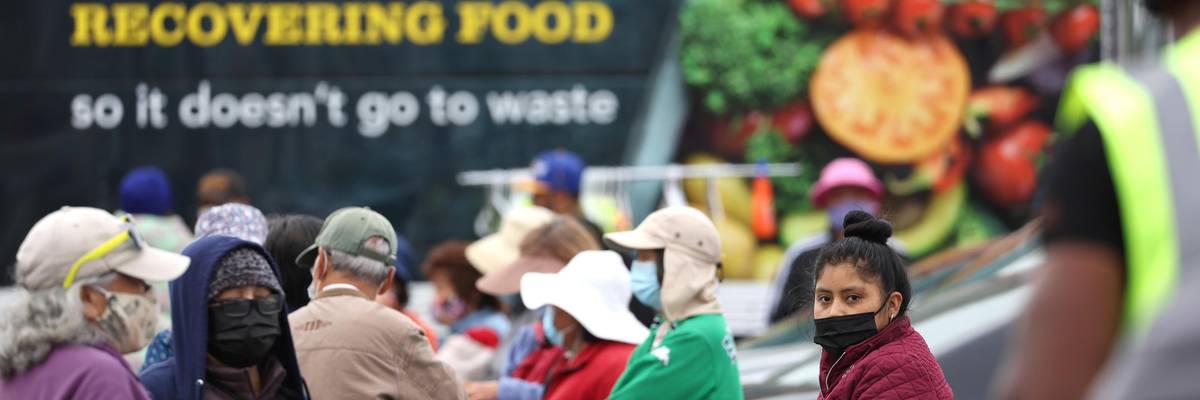
People wait in line to receive packages of food during an Alameda County Community Food Bank food giveaway at Acts Full Gospel Church on July 15, 2022 in Oakland, California amid record high inflation.
Biden has not condemned specific corporations publicly, or threatened them with specific actions unless they lower their prices.
I’ve analyzed every poll and survey over the last two months, and they all tell the same basic story:
Voters’ top issue is high prices and the cost of living—not jobs, not abortion, not immigration, not U.S. President Joe Biden’s or former President Donald Trump’s age, not even the survival of democracy.
Voters still don’t believe Biden will get prices down, but they believe Trump will. A significant number appear willing to vote for Trump and risk the future of democracy because they believe he will do better job lowering prices.
Consumers are getting shafted, as corporations tell Wall Street they expect to be able to keep their prices and profits in the stratosphere.
Which is why Biden’s approval rating on the economy is deeply underwater while perceptions of Trump’s handling of the economy when he was president (marked by low inflation but huge job losses from Covid-19) are positive.
What should Biden do?
Put blame for high prices squarely where it belongs: on big corporations with monopoly power to keep prices high.
And take those corporations on: Condemn them for price gouging. Threaten them with antitrust lawsuits, price-gouging lawsuits, even price controls. Criticize them for making huge profits and giving their top executives record pay while shafting consumers.
And name names: PepsiCo, Tyson's, Kroger and Albertsons, Exxon-Mobil, and others.
To be sure, the Biden administration has brought down the prices of prescription drugs like insulin and inhalers, reduced bank overdraft and credit card fees, and cracked down on “junk fees” levied by airlines, concert promoters, and more.
Its Department of Justice has launched a lawsuit to combat price-fixing in the meat industry. And the FTC is suing to block the Kroger/Albertsons grocery mega-merger that would send grocery bills even higher.
“We’re taking on corporate greed to bring down the price of gas, food, and rent, eliminating junk fees,” Biden told a crowd of 1,000 supporters in Philadelphia recently.
But Biden has not berated hugely profitable corporations for keeping their prices and profit margins sky high—unlike Sens. Bob Casey (D-Penn.) and Sherrod Brown (D-Ohio), who have made corporate price hikes central to their campaigns and are outrunning Biden in polls. Biden has not condemned specific corporations publicly, or threatened them with specific actions unless they lower their prices.
Brown, who represents a state that Trump won handily in 2020, has cut several web ads proclaiming he is “cracking down on the companies that rip off Ohio.”
Casey released a campaign ad showing corporate executives in suits sneaking into a grocery store under cover of night and switching out cereal boxes for smaller replacements. He has introduced a bill that would crack down on “shrinkflation”—a term for companies’ reducing the size of their goods but not cutting prices (Biden praised that legislation during his State of the Union address).
Senate Democrats in tight races, like Tammy Baldwin of Wisconsin and Jacky Rosen of Nevada, are making similar pitches.
Why isn’t Biden?
Partly, I think, because he’s uncomfortable attacking corporations directly.
It’s also because some economists close to his White House (such as Larry Summers) disagree that a major driver of inflation is corporations’ raising prices to juice profits. (Three years ago, Larry and I publicly debated a wealth tax on hugely profitable corporations. I was in favor; he against.)
But the fact is, corporate profits have surged to record levels. Shares are trading at record levels. Corporations are buying back their stock at record levels. CEO pay is at record levels. Corporate concentration—monopoly power—is higher than ever.
Concentration has increased in over 75% of U.S. industries since the late 1990s.
Consumers are getting shafted, as corporations tell Wall Street they expect to be able to keep their prices and profits in the stratosphere.
Is It Inflation? Or Is It Greedflation? | Robert Reichwww.youtube.com
Most voters agree that big corporations are largely responsible for inflation. Nearly 6 in 10 say corporations’ being “greedy” is a major cause of inflation, including a majority of independent voters, according to a poll by Navigator Research.
The Biden campaign’s internal polling has found similar results.
With less than five months to go—and the cost of living being the No. 1 issue on voters’ minds—Biden should let ‘er rip.
Dear Common Dreams reader, It’s been nearly 30 years since I co-founded Common Dreams with my late wife, Lina Newhouser. We had the radical notion that journalism should serve the public good, not corporate profits. It was clear to us from the outset what it would take to build such a project. No paid advertisements. No corporate sponsors. No millionaire publisher telling us what to think or do. Many people said we wouldn't last a year, but we proved those doubters wrong. Together with a tremendous team of journalists and dedicated staff, we built an independent media outlet free from the constraints of profits and corporate control. Our mission has always been simple: To inform. To inspire. To ignite change for the common good. Building Common Dreams was not easy. Our survival was never guaranteed. When you take on the most powerful forces—Wall Street greed, fossil fuel industry destruction, Big Tech lobbyists, and uber-rich oligarchs who have spent billions upon billions rigging the economy and democracy in their favor—the only bulwark you have is supporters who believe in your work. But here’s the urgent message from me today. It's never been this bad out there. And it's never been this hard to keep us going. At the very moment Common Dreams is most needed, the threats we face are intensifying. We need your support now more than ever. We don't accept corporate advertising and never will. We don't have a paywall because we don't think people should be blocked from critical news based on their ability to pay. Everything we do is funded by the donations of readers like you. When everyone does the little they can afford, we are strong. But if that support retreats or dries up, so do we. Will you donate now to make sure Common Dreams not only survives but thrives? —Craig Brown, Co-founder |
I’ve analyzed every poll and survey over the last two months, and they all tell the same basic story:
Voters’ top issue is high prices and the cost of living—not jobs, not abortion, not immigration, not U.S. President Joe Biden’s or former President Donald Trump’s age, not even the survival of democracy.
Voters still don’t believe Biden will get prices down, but they believe Trump will. A significant number appear willing to vote for Trump and risk the future of democracy because they believe he will do better job lowering prices.
Consumers are getting shafted, as corporations tell Wall Street they expect to be able to keep their prices and profits in the stratosphere.
Which is why Biden’s approval rating on the economy is deeply underwater while perceptions of Trump’s handling of the economy when he was president (marked by low inflation but huge job losses from Covid-19) are positive.
What should Biden do?
Put blame for high prices squarely where it belongs: on big corporations with monopoly power to keep prices high.
And take those corporations on: Condemn them for price gouging. Threaten them with antitrust lawsuits, price-gouging lawsuits, even price controls. Criticize them for making huge profits and giving their top executives record pay while shafting consumers.
And name names: PepsiCo, Tyson's, Kroger and Albertsons, Exxon-Mobil, and others.
To be sure, the Biden administration has brought down the prices of prescription drugs like insulin and inhalers, reduced bank overdraft and credit card fees, and cracked down on “junk fees” levied by airlines, concert promoters, and more.
Its Department of Justice has launched a lawsuit to combat price-fixing in the meat industry. And the FTC is suing to block the Kroger/Albertsons grocery mega-merger that would send grocery bills even higher.
“We’re taking on corporate greed to bring down the price of gas, food, and rent, eliminating junk fees,” Biden told a crowd of 1,000 supporters in Philadelphia recently.
But Biden has not berated hugely profitable corporations for keeping their prices and profit margins sky high—unlike Sens. Bob Casey (D-Penn.) and Sherrod Brown (D-Ohio), who have made corporate price hikes central to their campaigns and are outrunning Biden in polls. Biden has not condemned specific corporations publicly, or threatened them with specific actions unless they lower their prices.
Brown, who represents a state that Trump won handily in 2020, has cut several web ads proclaiming he is “cracking down on the companies that rip off Ohio.”
Casey released a campaign ad showing corporate executives in suits sneaking into a grocery store under cover of night and switching out cereal boxes for smaller replacements. He has introduced a bill that would crack down on “shrinkflation”—a term for companies’ reducing the size of their goods but not cutting prices (Biden praised that legislation during his State of the Union address).
Senate Democrats in tight races, like Tammy Baldwin of Wisconsin and Jacky Rosen of Nevada, are making similar pitches.
Why isn’t Biden?
Partly, I think, because he’s uncomfortable attacking corporations directly.
It’s also because some economists close to his White House (such as Larry Summers) disagree that a major driver of inflation is corporations’ raising prices to juice profits. (Three years ago, Larry and I publicly debated a wealth tax on hugely profitable corporations. I was in favor; he against.)
But the fact is, corporate profits have surged to record levels. Shares are trading at record levels. Corporations are buying back their stock at record levels. CEO pay is at record levels. Corporate concentration—monopoly power—is higher than ever.
Concentration has increased in over 75% of U.S. industries since the late 1990s.
Consumers are getting shafted, as corporations tell Wall Street they expect to be able to keep their prices and profits in the stratosphere.
Is It Inflation? Or Is It Greedflation? | Robert Reichwww.youtube.com
Most voters agree that big corporations are largely responsible for inflation. Nearly 6 in 10 say corporations’ being “greedy” is a major cause of inflation, including a majority of independent voters, according to a poll by Navigator Research.
The Biden campaign’s internal polling has found similar results.
With less than five months to go—and the cost of living being the No. 1 issue on voters’ minds—Biden should let ‘er rip.
I’ve analyzed every poll and survey over the last two months, and they all tell the same basic story:
Voters’ top issue is high prices and the cost of living—not jobs, not abortion, not immigration, not U.S. President Joe Biden’s or former President Donald Trump’s age, not even the survival of democracy.
Voters still don’t believe Biden will get prices down, but they believe Trump will. A significant number appear willing to vote for Trump and risk the future of democracy because they believe he will do better job lowering prices.
Consumers are getting shafted, as corporations tell Wall Street they expect to be able to keep their prices and profits in the stratosphere.
Which is why Biden’s approval rating on the economy is deeply underwater while perceptions of Trump’s handling of the economy when he was president (marked by low inflation but huge job losses from Covid-19) are positive.
What should Biden do?
Put blame for high prices squarely where it belongs: on big corporations with monopoly power to keep prices high.
And take those corporations on: Condemn them for price gouging. Threaten them with antitrust lawsuits, price-gouging lawsuits, even price controls. Criticize them for making huge profits and giving their top executives record pay while shafting consumers.
And name names: PepsiCo, Tyson's, Kroger and Albertsons, Exxon-Mobil, and others.
To be sure, the Biden administration has brought down the prices of prescription drugs like insulin and inhalers, reduced bank overdraft and credit card fees, and cracked down on “junk fees” levied by airlines, concert promoters, and more.
Its Department of Justice has launched a lawsuit to combat price-fixing in the meat industry. And the FTC is suing to block the Kroger/Albertsons grocery mega-merger that would send grocery bills even higher.
“We’re taking on corporate greed to bring down the price of gas, food, and rent, eliminating junk fees,” Biden told a crowd of 1,000 supporters in Philadelphia recently.
But Biden has not berated hugely profitable corporations for keeping their prices and profit margins sky high—unlike Sens. Bob Casey (D-Penn.) and Sherrod Brown (D-Ohio), who have made corporate price hikes central to their campaigns and are outrunning Biden in polls. Biden has not condemned specific corporations publicly, or threatened them with specific actions unless they lower their prices.
Brown, who represents a state that Trump won handily in 2020, has cut several web ads proclaiming he is “cracking down on the companies that rip off Ohio.”
Casey released a campaign ad showing corporate executives in suits sneaking into a grocery store under cover of night and switching out cereal boxes for smaller replacements. He has introduced a bill that would crack down on “shrinkflation”—a term for companies’ reducing the size of their goods but not cutting prices (Biden praised that legislation during his State of the Union address).
Senate Democrats in tight races, like Tammy Baldwin of Wisconsin and Jacky Rosen of Nevada, are making similar pitches.
Why isn’t Biden?
Partly, I think, because he’s uncomfortable attacking corporations directly.
It’s also because some economists close to his White House (such as Larry Summers) disagree that a major driver of inflation is corporations’ raising prices to juice profits. (Three years ago, Larry and I publicly debated a wealth tax on hugely profitable corporations. I was in favor; he against.)
But the fact is, corporate profits have surged to record levels. Shares are trading at record levels. Corporations are buying back their stock at record levels. CEO pay is at record levels. Corporate concentration—monopoly power—is higher than ever.
Concentration has increased in over 75% of U.S. industries since the late 1990s.
Consumers are getting shafted, as corporations tell Wall Street they expect to be able to keep their prices and profits in the stratosphere.
Is It Inflation? Or Is It Greedflation? | Robert Reichwww.youtube.com
Most voters agree that big corporations are largely responsible for inflation. Nearly 6 in 10 say corporations’ being “greedy” is a major cause of inflation, including a majority of independent voters, according to a poll by Navigator Research.
The Biden campaign’s internal polling has found similar results.
With less than five months to go—and the cost of living being the No. 1 issue on voters’ minds—Biden should let ‘er rip.