

SUBSCRIBE TO OUR FREE NEWSLETTER
Daily news & progressive opinion—funded by the people, not the corporations—delivered straight to your inbox.
5
#000000
#FFFFFF
To donate by check, phone, or other method, see our More Ways to Give page.
Daily news & progressive opinion—funded by the people, not the corporations—delivered straight to your inbox.
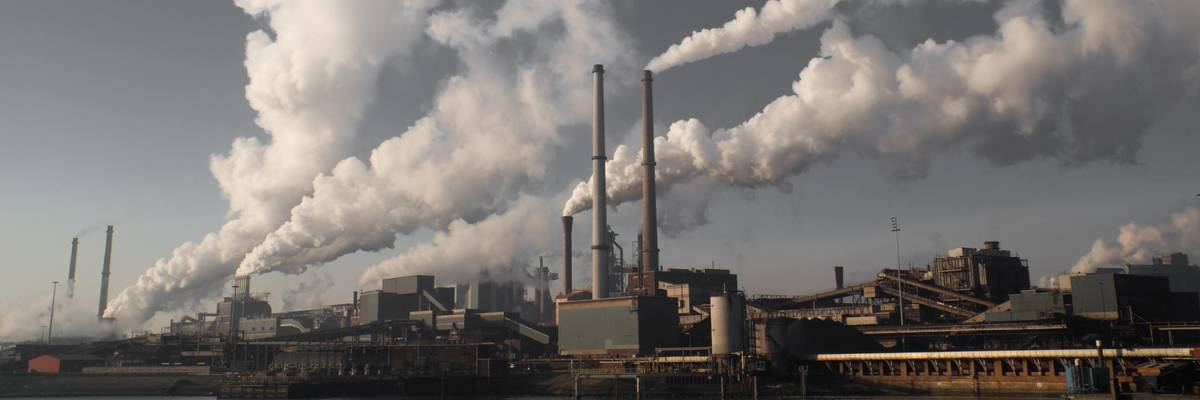
Two-thirds of U.S. voters surveyed by Data for Progress support making fossil fuel companies pay for the damage their products cause to the climate.
"Voters resoundingly endorse fossil fuel companies contributing their fair share to address a crisis they helped manufacture and still refuse to help fix," said one campaigner.
As yet another United Nations Climate Change Conference winds down without a meaningful agreement on phasing out fossil fuels, polling released Tuesday by Data for Progress revealed strong bipartisan support among U.S. voters for legislation forcing oil and gas companies to pay for their role in fueling the planetary emergency.
The survey of 1,279 U.S. voters, conducted November 3-6, found that around two-thirds of all likely voters support such legislation, a +40-point net margin. Among Democrats, support for the proposed bill is 88%, while 61% of Independent and 46% of Republicans either strongly or somewhat back the proposal.
"In a resounding call for accountability, two-thirds of the American people support legislation demanding industry titans like Exxon and Shell shoulder their fair share of the climate damages inflicted by fossil fuels."
Asked if they were more or less likely to support elected officials who prioritize making Big Oil pay for its climate pollution, 64% of overall respondents, 89% of Democrats, and 58% of Independents answered "more likely." Republicans were the only group whose members were less likely to back officials who would make oil and gas companies pay for their pollution.
"In a resounding call for accountability, two-thirds of the American people support legislation demanding industry titans like Exxon and Shell shoulder their fair share of the climate damages inflicted by fossil fuels," Fossil Free Media communications director Cassidy DiPaola said in a statement.
"With COP spotlighting the towering price tag of climate change, voters resoundingly endorse fossil fuel companies contributing their fair share to address a crisis they helped manufacture and still refuse to help fix," she added, referencing the U.N. summit.
The poll follows the September launch of the "Make Polluters Pay" campaign, a public relations blitz meant to drum up public support for suing fossil fuel corporations—which knew that their products caused climate change decades before publicly saying so.
That month, California joined dozens of states and municipalities that have targeted fossil fuel giants in court, suing five fossil fuel giants—ExxonMobil, Shell, BP, ConocoPhillips, and Chevron—over their decadeslong effort to deceive the public about their products' role in fueling global heating.
The new survey's findings also came as so-called "loss and damage"—the harm caused by anthropogenic climate change—features prominently at COP28. However, climate campaigners were once again disappointed as the United States and other top polluters failed to make meaningful contributions to the fund.
The rich nations most responsible for the climate catastrophe pledged just $700 million between them, the equivalent of under 0.2% of the irreversible losses Global South countries suffer each year during the worsening planetary crisis. The United States pledged a paltry $17.5 million.
"Every year, we travel across oceans to come to these negotiations and we continue to get only drops of ambition," Drue Slatter, a Fijian climate campaigner attending COP28, wrote in an opinion piece published Tuesday by Common Dreams.
"Facing the catastrophic effects of extreme weather at home and watching the slow progress of the negotiations, it was hard not to be pessimistic before we even arrived at COP28," Slatter added. "But the point is that we can't afford not to be here, we can't afford to stop fighting because what's at stake is our very survival."
Dear Common Dreams reader, It’s been nearly 30 years since I co-founded Common Dreams with my late wife, Lina Newhouser. We had the radical notion that journalism should serve the public good, not corporate profits. It was clear to us from the outset what it would take to build such a project. No paid advertisements. No corporate sponsors. No millionaire publisher telling us what to think or do. Many people said we wouldn't last a year, but we proved those doubters wrong. Together with a tremendous team of journalists and dedicated staff, we built an independent media outlet free from the constraints of profits and corporate control. Our mission has always been simple: To inform. To inspire. To ignite change for the common good. Building Common Dreams was not easy. Our survival was never guaranteed. When you take on the most powerful forces—Wall Street greed, fossil fuel industry destruction, Big Tech lobbyists, and uber-rich oligarchs who have spent billions upon billions rigging the economy and democracy in their favor—the only bulwark you have is supporters who believe in your work. But here’s the urgent message from me today. It's never been this bad out there. And it's never been this hard to keep us going. At the very moment Common Dreams is most needed, the threats we face are intensifying. We need your support now more than ever. We don't accept corporate advertising and never will. We don't have a paywall because we don't think people should be blocked from critical news based on their ability to pay. Everything we do is funded by the donations of readers like you. When everyone does the little they can afford, we are strong. But if that support retreats or dries up, so do we. Will you donate now to make sure Common Dreams not only survives but thrives? —Craig Brown, Co-founder |
As yet another United Nations Climate Change Conference winds down without a meaningful agreement on phasing out fossil fuels, polling released Tuesday by Data for Progress revealed strong bipartisan support among U.S. voters for legislation forcing oil and gas companies to pay for their role in fueling the planetary emergency.
The survey of 1,279 U.S. voters, conducted November 3-6, found that around two-thirds of all likely voters support such legislation, a +40-point net margin. Among Democrats, support for the proposed bill is 88%, while 61% of Independent and 46% of Republicans either strongly or somewhat back the proposal.
"In a resounding call for accountability, two-thirds of the American people support legislation demanding industry titans like Exxon and Shell shoulder their fair share of the climate damages inflicted by fossil fuels."
Asked if they were more or less likely to support elected officials who prioritize making Big Oil pay for its climate pollution, 64% of overall respondents, 89% of Democrats, and 58% of Independents answered "more likely." Republicans were the only group whose members were less likely to back officials who would make oil and gas companies pay for their pollution.
"In a resounding call for accountability, two-thirds of the American people support legislation demanding industry titans like Exxon and Shell shoulder their fair share of the climate damages inflicted by fossil fuels," Fossil Free Media communications director Cassidy DiPaola said in a statement.
"With COP spotlighting the towering price tag of climate change, voters resoundingly endorse fossil fuel companies contributing their fair share to address a crisis they helped manufacture and still refuse to help fix," she added, referencing the U.N. summit.
The poll follows the September launch of the "Make Polluters Pay" campaign, a public relations blitz meant to drum up public support for suing fossil fuel corporations—which knew that their products caused climate change decades before publicly saying so.
That month, California joined dozens of states and municipalities that have targeted fossil fuel giants in court, suing five fossil fuel giants—ExxonMobil, Shell, BP, ConocoPhillips, and Chevron—over their decadeslong effort to deceive the public about their products' role in fueling global heating.
The new survey's findings also came as so-called "loss and damage"—the harm caused by anthropogenic climate change—features prominently at COP28. However, climate campaigners were once again disappointed as the United States and other top polluters failed to make meaningful contributions to the fund.
The rich nations most responsible for the climate catastrophe pledged just $700 million between them, the equivalent of under 0.2% of the irreversible losses Global South countries suffer each year during the worsening planetary crisis. The United States pledged a paltry $17.5 million.
"Every year, we travel across oceans to come to these negotiations and we continue to get only drops of ambition," Drue Slatter, a Fijian climate campaigner attending COP28, wrote in an opinion piece published Tuesday by Common Dreams.
"Facing the catastrophic effects of extreme weather at home and watching the slow progress of the negotiations, it was hard not to be pessimistic before we even arrived at COP28," Slatter added. "But the point is that we can't afford not to be here, we can't afford to stop fighting because what's at stake is our very survival."
As yet another United Nations Climate Change Conference winds down without a meaningful agreement on phasing out fossil fuels, polling released Tuesday by Data for Progress revealed strong bipartisan support among U.S. voters for legislation forcing oil and gas companies to pay for their role in fueling the planetary emergency.
The survey of 1,279 U.S. voters, conducted November 3-6, found that around two-thirds of all likely voters support such legislation, a +40-point net margin. Among Democrats, support for the proposed bill is 88%, while 61% of Independent and 46% of Republicans either strongly or somewhat back the proposal.
"In a resounding call for accountability, two-thirds of the American people support legislation demanding industry titans like Exxon and Shell shoulder their fair share of the climate damages inflicted by fossil fuels."
Asked if they were more or less likely to support elected officials who prioritize making Big Oil pay for its climate pollution, 64% of overall respondents, 89% of Democrats, and 58% of Independents answered "more likely." Republicans were the only group whose members were less likely to back officials who would make oil and gas companies pay for their pollution.
"In a resounding call for accountability, two-thirds of the American people support legislation demanding industry titans like Exxon and Shell shoulder their fair share of the climate damages inflicted by fossil fuels," Fossil Free Media communications director Cassidy DiPaola said in a statement.
"With COP spotlighting the towering price tag of climate change, voters resoundingly endorse fossil fuel companies contributing their fair share to address a crisis they helped manufacture and still refuse to help fix," she added, referencing the U.N. summit.
The poll follows the September launch of the "Make Polluters Pay" campaign, a public relations blitz meant to drum up public support for suing fossil fuel corporations—which knew that their products caused climate change decades before publicly saying so.
That month, California joined dozens of states and municipalities that have targeted fossil fuel giants in court, suing five fossil fuel giants—ExxonMobil, Shell, BP, ConocoPhillips, and Chevron—over their decadeslong effort to deceive the public about their products' role in fueling global heating.
The new survey's findings also came as so-called "loss and damage"—the harm caused by anthropogenic climate change—features prominently at COP28. However, climate campaigners were once again disappointed as the United States and other top polluters failed to make meaningful contributions to the fund.
The rich nations most responsible for the climate catastrophe pledged just $700 million between them, the equivalent of under 0.2% of the irreversible losses Global South countries suffer each year during the worsening planetary crisis. The United States pledged a paltry $17.5 million.
"Every year, we travel across oceans to come to these negotiations and we continue to get only drops of ambition," Drue Slatter, a Fijian climate campaigner attending COP28, wrote in an opinion piece published Tuesday by Common Dreams.
"Facing the catastrophic effects of extreme weather at home and watching the slow progress of the negotiations, it was hard not to be pessimistic before we even arrived at COP28," Slatter added. "But the point is that we can't afford not to be here, we can't afford to stop fighting because what's at stake is our very survival."

