SUBSCRIBE TO OUR FREE NEWSLETTER
Daily news & progressive opinion—funded by the people, not the corporations—delivered straight to your inbox.
5
#000000
#FFFFFF
To donate by check, phone, or other method, see our More Ways to Give page.
Daily news & progressive opinion—funded by the people, not the corporations—delivered straight to your inbox.
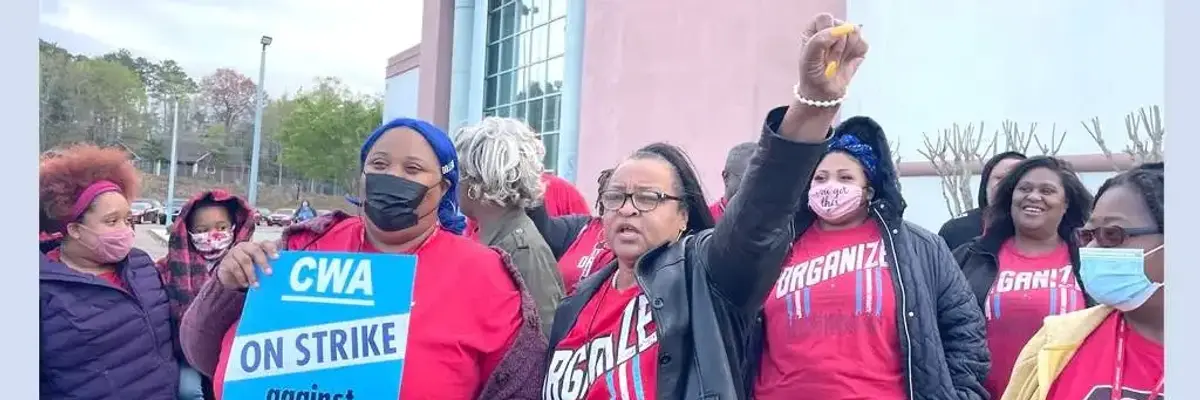
Maximus call center workers engage in a one-day strike.
The administration has the power to use public money to ensure contractors like Maximus pay living wages and engage in fair employment practices.
As a federal customer service representative, I help seniors access the healthcare they need through Medicare. I often handle hundreds of calls per day to sign people up, answer their questions, help them navigate billing, and more.
The hard truth is that despite working for the largest federal call center contractor, Maximus, I don’t have access to affordable health coverage for myself or children, and my pay is so low I’m struggling to stay afloat. That’s why I went on strike this November with hundreds of my co-workers who are experiencing similar struggles.
It’s not easy navigating our healthcare system, and I take pride in making sure the process is as painless as possible for seniors who feel frustrated by it. Sadly, I know that feeling all too well.
We need the administration to follow through on its commitment to use federal dollars to create good jobs and end the two-tier system in which we’re expected to do similar work to federal employees but aren’t paid enough to support our families.
Unlike workers directly employed by the government, who are paid living wages and receive good benefits, I make $16.20 per hour—the minimum allowed for federal contract workers. My children and I live in a home that’s owned by my children’s grandparents. If it wasn’t for their help, we’d likely be homeless.
While Maximus rakes in billions in federal dollars, I’ve had to go without meals to ensure my children have food on the table. Over a year ago, my son had an allergic reaction and had to go to the emergency room. I still have medical debt from that visit because my health insurance from Maximus doesn’t cover a lot of costs, and I can’t afford the bill.
Nobody should have to endure this kind of hardship, especially while working for a company with a $6.6 billion federal contract that’s spent $20 million on CEO pay and hundreds of millions of dollars on stock buybacks.
As our one-day strike showed, I’m not the only one struggling at Maximus. A new report shows that 9 in 10 surveyed workers at Maximus report having medical debt or having to avoid or postpone medical treatment due to cost. And 91% report earning significantly less than the living wage needed to sustain a household with children.
Our employer is well aware of these issues. In the call center where I work, Maximus announced a program that asks us to donate used clothing for co-workers who may not be able to afford new clothes. It would be better to simply pay us a living wage.
In our call centers in Mississippi, Florida, Arizona, Virginia, Texas, and Louisiana, many of my coworkers are Black and Latina women like myself. We make up close to a majority of the lowest-paid workers at the company. This is not a coincidence.
We’ve been sounding the alarm for years about this, and we’ve been disappointed by the failure of the Biden administration, which pays Maximus to run its Affordable Care Act and Medicare call centers, to make things better.
The administration has the power to use public money to ensure contractors like Maximus pay living wages and engage in fair employment practices.Yet they awarded Maximus another massive contract just last year—and haven’t taken any steps to address our demands for living wages and affordable healthcare.
We need the administration to follow through on its commitment to use federal dollars to create good jobs and end the two-tier system in which we’re expected to do similar work to federal employees but aren’t paid enough to support our families.
The Biden administration says they believe healthcare is a right not a privilege, that federal money should be used to create good jobs, and that Black women are the backbone of their coalition. I stand with hundreds of my co-workers to say: prove it.
Dear Common Dreams reader, It’s been nearly 30 years since I co-founded Common Dreams with my late wife, Lina Newhouser. We had the radical notion that journalism should serve the public good, not corporate profits. It was clear to us from the outset what it would take to build such a project. No paid advertisements. No corporate sponsors. No millionaire publisher telling us what to think or do. Many people said we wouldn't last a year, but we proved those doubters wrong. Together with a tremendous team of journalists and dedicated staff, we built an independent media outlet free from the constraints of profits and corporate control. Our mission has always been simple: To inform. To inspire. To ignite change for the common good. Building Common Dreams was not easy. Our survival was never guaranteed. When you take on the most powerful forces—Wall Street greed, fossil fuel industry destruction, Big Tech lobbyists, and uber-rich oligarchs who have spent billions upon billions rigging the economy and democracy in their favor—the only bulwark you have is supporters who believe in your work. But here’s the urgent message from me today. It's never been this bad out there. And it's never been this hard to keep us going. At the very moment Common Dreams is most needed, the threats we face are intensifying. We need your support now more than ever. We don't accept corporate advertising and never will. We don't have a paywall because we don't think people should be blocked from critical news based on their ability to pay. Everything we do is funded by the donations of readers like you. When everyone does the little they can afford, we are strong. But if that support retreats or dries up, so do we. Will you donate now to make sure Common Dreams not only survives but thrives? —Craig Brown, Co-founder |
As a federal customer service representative, I help seniors access the healthcare they need through Medicare. I often handle hundreds of calls per day to sign people up, answer their questions, help them navigate billing, and more.
The hard truth is that despite working for the largest federal call center contractor, Maximus, I don’t have access to affordable health coverage for myself or children, and my pay is so low I’m struggling to stay afloat. That’s why I went on strike this November with hundreds of my co-workers who are experiencing similar struggles.
It’s not easy navigating our healthcare system, and I take pride in making sure the process is as painless as possible for seniors who feel frustrated by it. Sadly, I know that feeling all too well.
We need the administration to follow through on its commitment to use federal dollars to create good jobs and end the two-tier system in which we’re expected to do similar work to federal employees but aren’t paid enough to support our families.
Unlike workers directly employed by the government, who are paid living wages and receive good benefits, I make $16.20 per hour—the minimum allowed for federal contract workers. My children and I live in a home that’s owned by my children’s grandparents. If it wasn’t for their help, we’d likely be homeless.
While Maximus rakes in billions in federal dollars, I’ve had to go without meals to ensure my children have food on the table. Over a year ago, my son had an allergic reaction and had to go to the emergency room. I still have medical debt from that visit because my health insurance from Maximus doesn’t cover a lot of costs, and I can’t afford the bill.
Nobody should have to endure this kind of hardship, especially while working for a company with a $6.6 billion federal contract that’s spent $20 million on CEO pay and hundreds of millions of dollars on stock buybacks.
As our one-day strike showed, I’m not the only one struggling at Maximus. A new report shows that 9 in 10 surveyed workers at Maximus report having medical debt or having to avoid or postpone medical treatment due to cost. And 91% report earning significantly less than the living wage needed to sustain a household with children.
Our employer is well aware of these issues. In the call center where I work, Maximus announced a program that asks us to donate used clothing for co-workers who may not be able to afford new clothes. It would be better to simply pay us a living wage.
In our call centers in Mississippi, Florida, Arizona, Virginia, Texas, and Louisiana, many of my coworkers are Black and Latina women like myself. We make up close to a majority of the lowest-paid workers at the company. This is not a coincidence.
We’ve been sounding the alarm for years about this, and we’ve been disappointed by the failure of the Biden administration, which pays Maximus to run its Affordable Care Act and Medicare call centers, to make things better.
The administration has the power to use public money to ensure contractors like Maximus pay living wages and engage in fair employment practices.Yet they awarded Maximus another massive contract just last year—and haven’t taken any steps to address our demands for living wages and affordable healthcare.
We need the administration to follow through on its commitment to use federal dollars to create good jobs and end the two-tier system in which we’re expected to do similar work to federal employees but aren’t paid enough to support our families.
The Biden administration says they believe healthcare is a right not a privilege, that federal money should be used to create good jobs, and that Black women are the backbone of their coalition. I stand with hundreds of my co-workers to say: prove it.
As a federal customer service representative, I help seniors access the healthcare they need through Medicare. I often handle hundreds of calls per day to sign people up, answer their questions, help them navigate billing, and more.
The hard truth is that despite working for the largest federal call center contractor, Maximus, I don’t have access to affordable health coverage for myself or children, and my pay is so low I’m struggling to stay afloat. That’s why I went on strike this November with hundreds of my co-workers who are experiencing similar struggles.
It’s not easy navigating our healthcare system, and I take pride in making sure the process is as painless as possible for seniors who feel frustrated by it. Sadly, I know that feeling all too well.
We need the administration to follow through on its commitment to use federal dollars to create good jobs and end the two-tier system in which we’re expected to do similar work to federal employees but aren’t paid enough to support our families.
Unlike workers directly employed by the government, who are paid living wages and receive good benefits, I make $16.20 per hour—the minimum allowed for federal contract workers. My children and I live in a home that’s owned by my children’s grandparents. If it wasn’t for their help, we’d likely be homeless.
While Maximus rakes in billions in federal dollars, I’ve had to go without meals to ensure my children have food on the table. Over a year ago, my son had an allergic reaction and had to go to the emergency room. I still have medical debt from that visit because my health insurance from Maximus doesn’t cover a lot of costs, and I can’t afford the bill.
Nobody should have to endure this kind of hardship, especially while working for a company with a $6.6 billion federal contract that’s spent $20 million on CEO pay and hundreds of millions of dollars on stock buybacks.
As our one-day strike showed, I’m not the only one struggling at Maximus. A new report shows that 9 in 10 surveyed workers at Maximus report having medical debt or having to avoid or postpone medical treatment due to cost. And 91% report earning significantly less than the living wage needed to sustain a household with children.
Our employer is well aware of these issues. In the call center where I work, Maximus announced a program that asks us to donate used clothing for co-workers who may not be able to afford new clothes. It would be better to simply pay us a living wage.
In our call centers in Mississippi, Florida, Arizona, Virginia, Texas, and Louisiana, many of my coworkers are Black and Latina women like myself. We make up close to a majority of the lowest-paid workers at the company. This is not a coincidence.
We’ve been sounding the alarm for years about this, and we’ve been disappointed by the failure of the Biden administration, which pays Maximus to run its Affordable Care Act and Medicare call centers, to make things better.
The administration has the power to use public money to ensure contractors like Maximus pay living wages and engage in fair employment practices.Yet they awarded Maximus another massive contract just last year—and haven’t taken any steps to address our demands for living wages and affordable healthcare.
We need the administration to follow through on its commitment to use federal dollars to create good jobs and end the two-tier system in which we’re expected to do similar work to federal employees but aren’t paid enough to support our families.
The Biden administration says they believe healthcare is a right not a privilege, that federal money should be used to create good jobs, and that Black women are the backbone of their coalition. I stand with hundreds of my co-workers to say: prove it.