SUBSCRIBE TO OUR FREE NEWSLETTER
Daily news & progressive opinion—funded by the people, not the corporations—delivered straight to your inbox.
5
#000000
#FFFFFF
To donate by check, phone, or other method, see our More Ways to Give page.
Daily news & progressive opinion—funded by the people, not the corporations—delivered straight to your inbox.

People protest the Moms for Liberty Joyful Warriors national summit outside the Philadelphia Marriott Downtown on July 1, 2023 in Philadelphia, Pennsylvania.
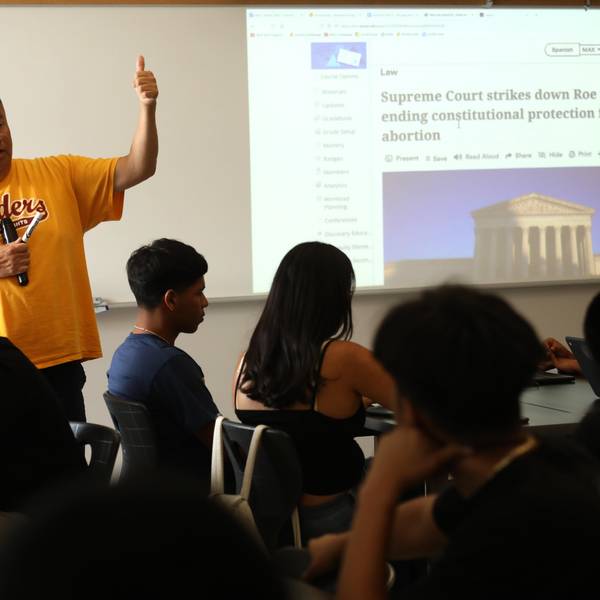
Even when faced with pressure and threats from almost all sides, the actual, individual people shaping the education of our children will not let themselves be cowed.
There is a looming threat to K-12 public education in America, but it is not only the substantial amount of laws restricting what can be taught in classrooms. The equally profound danger is that we are allowing a narrow political narrative to overshadow what is actually happening inside schools.
National pundits and scholars frame “the law” as a singular force indoctrinating students, obscuring the fact that we are dealing with a patchwork of rapidly evolving laws. While these legal shifts are detrimental, a more comprehensive understanding requires considering the lived experiences of educators, students, and the organizations that navigate them. The threat is not simply complacency to this “silent majority.” It is also the refusal to recognize that our schools are not homogeneous battlegrounds, but diverse communities experiencing these political pressures in very different ways.
The problem is not “the law,” it is the laws, plural, rushed through statehouses by politicians eager to score cultural points without any clarity on implementation or impact. Political influence on standards is nothing new, but recent controversies have reached a fever pitch as conservative lawmakers push divisive-concepts bills restricting topics such as race, gender, and LGBTQ+ rights.
In 2022, the South Carolina legislature debated bills banning The 1619 Project and any content feared to make white students “feel guilty.” Today, 35% of K-12 students attend school in states with anti-critical race theory laws. By 2023, 65% of history teachers reported limiting political discussions. As one Ohio teacher put it, “It’s tough for teachers to stick their neck out… you just see the attack on teachers increasing over and over again.”
While the legislators passing these laws attempt to rally popular support behind a narrative that they are the “silent majority,” we can’t let them obscure their genuine presence as simply a highly outspoken minority.
For example, New Hampshire is facing restrictive “divisive-concepts” laws, dwindling public school funding, and bounties on teachers that Moms for Liberty hopes to “catch.” As much as Moms for Liberty promotes its bounty as protection for children, the bounty serves one exclusive purpose. To instigate fear among educators, parents, and the broader public.
But this fear is largely baseless. Despite its efforts to intrude into the classroom and attack teachers, Moms for Liberty has remained unsuccessful. Even with a $500 cash prize on the line, not a single teacher was “caught” and fired for Moms for Liberty’s agenda. It’s as if, when investigated, teachers are not posing dangers to students. Rather, they are trained educators fighting for the strong democratic education of the nation's children.
While the legislators passing these laws attempt to rally popular support behind a narrative that they are the “silent majority,” we can’t let them obscure their genuine presence as simply a highly outspoken minority.
Legislative activity across the nation is also propagating fear among educators. But these bills are poorly crafted, vague, lacking expert input, and inconsistent with the First Amendment and academic freedom. While these threatening bills infiltrate news headlines, most of them have no real power. In 2024, 56 educational gag orders were filed, but only 8 were actually implemented. These are also new lows for proposed and implemented gag orders compared with the last few years.
Instead, we continue to see bipartisan opposition to politicized state lawmakers making choices about the content in K-12 schools. In 2024, we saw the first successful challenges to K-12 gag orders in court. Groups like Moms for Liberty remain unpopular among the public. Moms for Liberty and the 1776 Project continue to suffer electoral losses, with their publicly endorsed candidates losing about 70% of their races nationwide in 2023.
Bearing this in mind, we must continue to hold strong against these loud (but little) groups. Although they’ve mastered the art of amplifying their voices and distracting us with frightening news headlines, we cannot succumb to their scare tactics and must continue to make informed decisions based on our own investigation.
Furthermore, beyond the failures of these scare tactics, perhaps one of the most profound places to look for hope is in the actions of individual teachers across the United States. Here, we will draw on the testimonies of three different teachers, whom we interviewed as part of an Amherst College course on the polarization of social studies education. Although they cannot single-handedly represent the entire nation, their words have been echoed throughout the sources and interviews we have examined in our class.
What these teachers can show us is that, even when faced with pressure and threats from almost all sides, the actual, individual people shaping the education of our children will not let themselves be cowed.
Even as some parents threaten the livelihoods and lives of teachers, a teacher in Florida makes the effort to reach out to the parents of the children he teaches, creating a parent-teacher relationship based on trust and respect, not hatred and anger. Even as legislators try to write teachers out of their laws, a teacher from Ohio continues to demand that his voice be heard and has ensured that, over the past six years, not a single bill has been passed that was not approved by the coalition of Ohio teachers. Even as the politicians in Washington squabble like children, a teacher in Arkansas crafts a classroom where the children she teaches learn to engage in civil debate and learn to disagree on a topic while still remaining friends.
All three of these teachers—and thousands more across the country—continue, quietly, to educate the nation's children with kindness and nuance, even as the politicians in the Capitol do their best to sabotage the fundamental educational structures of the United States.
So don’t give up, don’t let them win. Don’t let them write a story that places teachers as the villains.
Don’t let them make you forget how hope endures and that the strength of the educational system lies maybe not in the laws that politicians apply to it, but instead in the individuals who dedicate their lives to ensuring children can learn and play and will grow to shape the future of this country.
Dear Common Dreams reader, It’s been nearly 30 years since I co-founded Common Dreams with my late wife, Lina Newhouser. We had the radical notion that journalism should serve the public good, not corporate profits. It was clear to us from the outset what it would take to build such a project. No paid advertisements. No corporate sponsors. No millionaire publisher telling us what to think or do. Many people said we wouldn't last a year, but we proved those doubters wrong. Together with a tremendous team of journalists and dedicated staff, we built an independent media outlet free from the constraints of profits and corporate control. Our mission has always been simple: To inform. To inspire. To ignite change for the common good. Building Common Dreams was not easy. Our survival was never guaranteed. When you take on the most powerful forces—Wall Street greed, fossil fuel industry destruction, Big Tech lobbyists, and uber-rich oligarchs who have spent billions upon billions rigging the economy and democracy in their favor—the only bulwark you have is supporters who believe in your work. But here’s the urgent message from me today. It's never been this bad out there. And it's never been this hard to keep us going. At the very moment Common Dreams is most needed, the threats we face are intensifying. We need your support now more than ever. We don't accept corporate advertising and never will. We don't have a paywall because we don't think people should be blocked from critical news based on their ability to pay. Everything we do is funded by the donations of readers like you. When everyone does the little they can afford, we are strong. But if that support retreats or dries up, so do we. Will you donate now to make sure Common Dreams not only survives but thrives? —Craig Brown, Co-founder |
There is a looming threat to K-12 public education in America, but it is not only the substantial amount of laws restricting what can be taught in classrooms. The equally profound danger is that we are allowing a narrow political narrative to overshadow what is actually happening inside schools.
National pundits and scholars frame “the law” as a singular force indoctrinating students, obscuring the fact that we are dealing with a patchwork of rapidly evolving laws. While these legal shifts are detrimental, a more comprehensive understanding requires considering the lived experiences of educators, students, and the organizations that navigate them. The threat is not simply complacency to this “silent majority.” It is also the refusal to recognize that our schools are not homogeneous battlegrounds, but diverse communities experiencing these political pressures in very different ways.
The problem is not “the law,” it is the laws, plural, rushed through statehouses by politicians eager to score cultural points without any clarity on implementation or impact. Political influence on standards is nothing new, but recent controversies have reached a fever pitch as conservative lawmakers push divisive-concepts bills restricting topics such as race, gender, and LGBTQ+ rights.
In 2022, the South Carolina legislature debated bills banning The 1619 Project and any content feared to make white students “feel guilty.” Today, 35% of K-12 students attend school in states with anti-critical race theory laws. By 2023, 65% of history teachers reported limiting political discussions. As one Ohio teacher put it, “It’s tough for teachers to stick their neck out… you just see the attack on teachers increasing over and over again.”
While the legislators passing these laws attempt to rally popular support behind a narrative that they are the “silent majority,” we can’t let them obscure their genuine presence as simply a highly outspoken minority.
For example, New Hampshire is facing restrictive “divisive-concepts” laws, dwindling public school funding, and bounties on teachers that Moms for Liberty hopes to “catch.” As much as Moms for Liberty promotes its bounty as protection for children, the bounty serves one exclusive purpose. To instigate fear among educators, parents, and the broader public.
But this fear is largely baseless. Despite its efforts to intrude into the classroom and attack teachers, Moms for Liberty has remained unsuccessful. Even with a $500 cash prize on the line, not a single teacher was “caught” and fired for Moms for Liberty’s agenda. It’s as if, when investigated, teachers are not posing dangers to students. Rather, they are trained educators fighting for the strong democratic education of the nation's children.
While the legislators passing these laws attempt to rally popular support behind a narrative that they are the “silent majority,” we can’t let them obscure their genuine presence as simply a highly outspoken minority.
Legislative activity across the nation is also propagating fear among educators. But these bills are poorly crafted, vague, lacking expert input, and inconsistent with the First Amendment and academic freedom. While these threatening bills infiltrate news headlines, most of them have no real power. In 2024, 56 educational gag orders were filed, but only 8 were actually implemented. These are also new lows for proposed and implemented gag orders compared with the last few years.
Instead, we continue to see bipartisan opposition to politicized state lawmakers making choices about the content in K-12 schools. In 2024, we saw the first successful challenges to K-12 gag orders in court. Groups like Moms for Liberty remain unpopular among the public. Moms for Liberty and the 1776 Project continue to suffer electoral losses, with their publicly endorsed candidates losing about 70% of their races nationwide in 2023.
Bearing this in mind, we must continue to hold strong against these loud (but little) groups. Although they’ve mastered the art of amplifying their voices and distracting us with frightening news headlines, we cannot succumb to their scare tactics and must continue to make informed decisions based on our own investigation.
Furthermore, beyond the failures of these scare tactics, perhaps one of the most profound places to look for hope is in the actions of individual teachers across the United States. Here, we will draw on the testimonies of three different teachers, whom we interviewed as part of an Amherst College course on the polarization of social studies education. Although they cannot single-handedly represent the entire nation, their words have been echoed throughout the sources and interviews we have examined in our class.
What these teachers can show us is that, even when faced with pressure and threats from almost all sides, the actual, individual people shaping the education of our children will not let themselves be cowed.
Even as some parents threaten the livelihoods and lives of teachers, a teacher in Florida makes the effort to reach out to the parents of the children he teaches, creating a parent-teacher relationship based on trust and respect, not hatred and anger. Even as legislators try to write teachers out of their laws, a teacher from Ohio continues to demand that his voice be heard and has ensured that, over the past six years, not a single bill has been passed that was not approved by the coalition of Ohio teachers. Even as the politicians in Washington squabble like children, a teacher in Arkansas crafts a classroom where the children she teaches learn to engage in civil debate and learn to disagree on a topic while still remaining friends.
All three of these teachers—and thousands more across the country—continue, quietly, to educate the nation's children with kindness and nuance, even as the politicians in the Capitol do their best to sabotage the fundamental educational structures of the United States.
So don’t give up, don’t let them win. Don’t let them write a story that places teachers as the villains.
Don’t let them make you forget how hope endures and that the strength of the educational system lies maybe not in the laws that politicians apply to it, but instead in the individuals who dedicate their lives to ensuring children can learn and play and will grow to shape the future of this country.
There is a looming threat to K-12 public education in America, but it is not only the substantial amount of laws restricting what can be taught in classrooms. The equally profound danger is that we are allowing a narrow political narrative to overshadow what is actually happening inside schools.
National pundits and scholars frame “the law” as a singular force indoctrinating students, obscuring the fact that we are dealing with a patchwork of rapidly evolving laws. While these legal shifts are detrimental, a more comprehensive understanding requires considering the lived experiences of educators, students, and the organizations that navigate them. The threat is not simply complacency to this “silent majority.” It is also the refusal to recognize that our schools are not homogeneous battlegrounds, but diverse communities experiencing these political pressures in very different ways.
The problem is not “the law,” it is the laws, plural, rushed through statehouses by politicians eager to score cultural points without any clarity on implementation or impact. Political influence on standards is nothing new, but recent controversies have reached a fever pitch as conservative lawmakers push divisive-concepts bills restricting topics such as race, gender, and LGBTQ+ rights.
In 2022, the South Carolina legislature debated bills banning The 1619 Project and any content feared to make white students “feel guilty.” Today, 35% of K-12 students attend school in states with anti-critical race theory laws. By 2023, 65% of history teachers reported limiting political discussions. As one Ohio teacher put it, “It’s tough for teachers to stick their neck out… you just see the attack on teachers increasing over and over again.”
While the legislators passing these laws attempt to rally popular support behind a narrative that they are the “silent majority,” we can’t let them obscure their genuine presence as simply a highly outspoken minority.
For example, New Hampshire is facing restrictive “divisive-concepts” laws, dwindling public school funding, and bounties on teachers that Moms for Liberty hopes to “catch.” As much as Moms for Liberty promotes its bounty as protection for children, the bounty serves one exclusive purpose. To instigate fear among educators, parents, and the broader public.
But this fear is largely baseless. Despite its efforts to intrude into the classroom and attack teachers, Moms for Liberty has remained unsuccessful. Even with a $500 cash prize on the line, not a single teacher was “caught” and fired for Moms for Liberty’s agenda. It’s as if, when investigated, teachers are not posing dangers to students. Rather, they are trained educators fighting for the strong democratic education of the nation's children.
While the legislators passing these laws attempt to rally popular support behind a narrative that they are the “silent majority,” we can’t let them obscure their genuine presence as simply a highly outspoken minority.
Legislative activity across the nation is also propagating fear among educators. But these bills are poorly crafted, vague, lacking expert input, and inconsistent with the First Amendment and academic freedom. While these threatening bills infiltrate news headlines, most of them have no real power. In 2024, 56 educational gag orders were filed, but only 8 were actually implemented. These are also new lows for proposed and implemented gag orders compared with the last few years.
Instead, we continue to see bipartisan opposition to politicized state lawmakers making choices about the content in K-12 schools. In 2024, we saw the first successful challenges to K-12 gag orders in court. Groups like Moms for Liberty remain unpopular among the public. Moms for Liberty and the 1776 Project continue to suffer electoral losses, with their publicly endorsed candidates losing about 70% of their races nationwide in 2023.
Bearing this in mind, we must continue to hold strong against these loud (but little) groups. Although they’ve mastered the art of amplifying their voices and distracting us with frightening news headlines, we cannot succumb to their scare tactics and must continue to make informed decisions based on our own investigation.
Furthermore, beyond the failures of these scare tactics, perhaps one of the most profound places to look for hope is in the actions of individual teachers across the United States. Here, we will draw on the testimonies of three different teachers, whom we interviewed as part of an Amherst College course on the polarization of social studies education. Although they cannot single-handedly represent the entire nation, their words have been echoed throughout the sources and interviews we have examined in our class.
What these teachers can show us is that, even when faced with pressure and threats from almost all sides, the actual, individual people shaping the education of our children will not let themselves be cowed.
Even as some parents threaten the livelihoods and lives of teachers, a teacher in Florida makes the effort to reach out to the parents of the children he teaches, creating a parent-teacher relationship based on trust and respect, not hatred and anger. Even as legislators try to write teachers out of their laws, a teacher from Ohio continues to demand that his voice be heard and has ensured that, over the past six years, not a single bill has been passed that was not approved by the coalition of Ohio teachers. Even as the politicians in Washington squabble like children, a teacher in Arkansas crafts a classroom where the children she teaches learn to engage in civil debate and learn to disagree on a topic while still remaining friends.
All three of these teachers—and thousands more across the country—continue, quietly, to educate the nation's children with kindness and nuance, even as the politicians in the Capitol do their best to sabotage the fundamental educational structures of the United States.
So don’t give up, don’t let them win. Don’t let them write a story that places teachers as the villains.
Don’t let them make you forget how hope endures and that the strength of the educational system lies maybe not in the laws that politicians apply to it, but instead in the individuals who dedicate their lives to ensuring children can learn and play and will grow to shape the future of this country.