SUBSCRIBE TO OUR FREE NEWSLETTER
Daily news & progressive opinion—funded by the people, not the corporations—delivered straight to your inbox.
5
#000000
#FFFFFF
To donate by check, phone, or other method, see our More Ways to Give page.
Daily news & progressive opinion—funded by the people, not the corporations—delivered straight to your inbox.
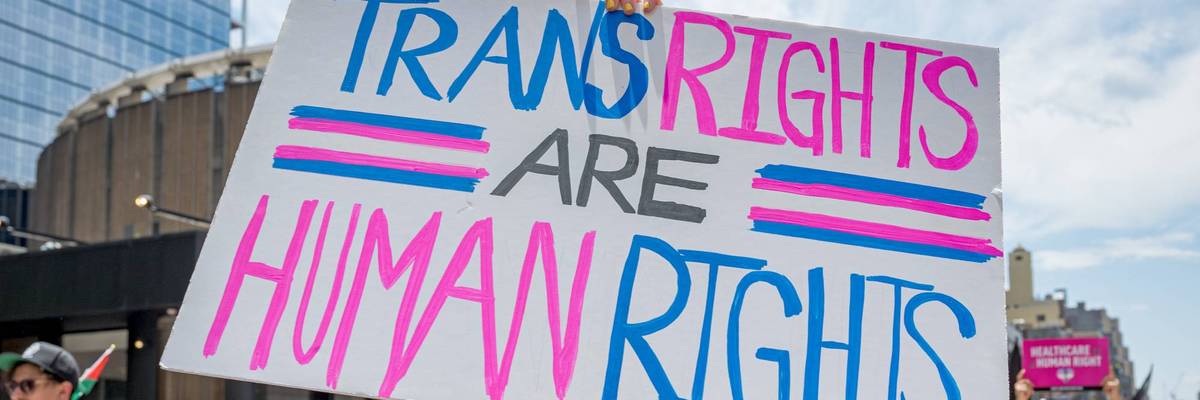
Participant seen holding a sign at the march. Thousands of New Yorkers took to the streets of Manhattan to participate on the Reclaim Pride Coalition's (RPC) seventh annual Queer Liberation March, where no police, politicians or corporations were allowed to participate.
This is not difficult: Gender-affirming care is health care, period, and decisions about that care belong to patients and their health care providers (and families in the case of minors), not politicians on an ideological crusade.
For some time now, right-wing forces have been attacking gender-affirming health care for transgender individuals, and especially for trans youth. Those attacks ratcheted up seriously in December, when the Trump administration proposed rules designed to ban gender-affirming care for young people, with HHS Secretary Robert F. Kennedy Jr. flatly calling such care “malpractice.”
The medical community promptly and unequivocally disagreed, with American Academy of Pediatrics President Dr. Susan J. Kressly telling NPR, "These policies and proposals misconstrue the current medical consensus and fail to reflect the realities of pediatric care and the needs of children and families." AAP’s view represents the overwhelming consensus among medical, nursing and psychiatric organizations, but that has had no impact on the crusade by the administration as well as right-wing state officials to erase trans people and eliminate and even criminalize their health care.
The Trump administration’s push to erase trans people began early last year with a presidential executive order titled “Defending Women from Gender Ideology Extremism and Restoring Biological Truth to the Federal Government.” The order declared, “Efforts to eradicate the biological reality of sex fundamentally attack women by depriving them of their dignity, safety, and well-being.” Trump’s order oddly failed to acknowledge the existence of transgender men but effectively declared all transgender humans to be nonpersons according to the U.S. government. “It is the policy of the United States,” it read, “to recognize two sexes, male and female. These sexes are not changeable and are grounded in fundamental and incontrovertible reality.”
That’s not a scientific statement but an ideological one. In fact, as Nathan Lents, a molecular evolutionary biologist at the John Jay College of Criminal Justice in New York City explained to a reporter after the executive order was issued, “Biology doesn’t operate in binaries very often … Reducing sex to a binary really doesn’t make a lot of sense for how we actually live.”
Many cultures around the world, particularly indigenous cultures, have long recognized gender diversity. In Hawaii, where I live, native Hawaiian culture understood and respected māhū, the Hawaiian word for a person of dual male and female spirit. What administration officials and other right-wingers dismiss as “radical gender ideology” is in fact a factual, science-based understanding of a facet of human diversity that has been recognized by different cultures around the globe for millennia, starting long before either modern science or modern politics entered the picture.
Nevertheless, the president’s order and subsequent messages from the Department of Health and Human Services put intense pressure on hospitals and health care providers, many of whom responded by curtailing gender-affirming care, especially for minors. Those pausing or such care included major hospital systems such as Kaiser Permanente with its 40 hospitals. By late August, news outlets had counted at least 17 major hospital systems in at least nine states and the District of Columbia that had paused, discontinued, canceled or ended gender-affirming care for pediatric patients.
States—generally Republican-leaning states—have also piled on restrictions. Late last year, KFF reported that 27 states had passed laws limiting access to gender-affirming care for minors. Roughly half of the nation’s trans or nonbinary youth are estimated to live in these states. Half a dozen states, including Florida, Alabama and Idaho, have made it a felony to provide gender-affirming care for young people under 18. Though the Supreme Court upheld such bans last year, some of these state laws face legal challenges in state courts based on individual state constitutions.
On the other hand, a number of states—generally “blue states,” including New York and California—have passed laws protecting gender-affirming care, while a few others have such policies via executive orders. Recently, New York Attorney General Letitia James informed a major Manhattan hospital that its actions to curb gender-affirming care under federal pressure violated New York State law. Hospitals and other providers may find themselves more and more caught between conflicting state and federal requirements.
It’s important to remember that for those under 18, gender-affirming care almost never involves surgery, but typically focuses on social and psychological support. Medical interventions such as puberty blockers are sometimes used after puberty begins. Puberty blockers, which are entirely reversible (and which a White House executive order has dishonestly branded as “chemical mutilation”) pause puberty in order to buy the young person time to mature and consider their options before major and complex-to-reverse physical changes set in.
Opponents of gender-affirming care sometimes focus on a handful of patients who later changed their minds and regretted having this care. Nearly any medical procedure results in a few patients wishing they hadn’t done it, but research consistently shows that regret rates for gender-affirming care are quite low. For example, a 2024 review of 55 articles that looked at regret rates after various types of plastic surgery found that gender-affirming surgery had far lower regret rates than other surgeries, including breast augmentation or reconstruction, not to mention other major life decisions such as having children or getting a tattoo.
A later study of 150 youthful individuals (median age 18.6 years) who had had gender-affirming hormone therapy and/or surgery found that the most common emotions associated with these treatments “were satisfaction (88.0%) and confidence (86.7%).” Only one of the 150 wished they hadn’t had the treatments, leading the authors to conclude, “Individuals who accessed [gender-affirming care] as adolescents are largely satisfied with this care. Care-related satisfaction and regret are more nuanced than sometimes portrayed and should not be used to limit access.”
State attacks on transgender residents don’t stop with medical care. Kansas, for example, just summarily invalidated all driver’s licenses in which the driver had legally changed their gender to match their lived identity. Such policies can impact the health of those affected, both by adding new layers of stress and by interfering with their ability to drive to obtain care or just make a living.
All of these policies are based on a myth: That transgender identity is the product of some new, “woke,” “radical gender ideology” and that trans people are simply confused and have been propagandized into believing that they can change their gender.
Trans people know better. Take “Perry” (a pseudonym), a young friend of mine whom I wrote about last October for Defend Public Health. Perry, 17 when I met him and now turning 21, knew something was amiss from early in his childhood. “I always felt uncomfortable,” he told me. “I rebelled against every single authority most of my childhood.” His feelings clarified when he was about twelve. As he explained it, “I always felt like I wasn’t myself, like I was playing a role” -- the role assigned to the female anatomy he was born with.
Despite some parental unease, he eventually began living as a boy and instantly felt more comfortable and like his authentic self. Trans people like Perry know who they are and don’t need politicians dictating what care they can and can’t obtain.
Happily for Perry, he lives in Hawaii, a state that has not restricted gender-affirming care and is unlikely to. But Hawaii doesn’t yet have a shield law to protect providers (such a bill is now up for consideration in the state legislature), and can certainly be impacted by misguided federal policies, so he’s not completely out of danger.
This is not difficult: Gender-affirming care is health care, period, and decisions about that care belong to patients and their health care providers (and families in the case of minors), not politicians on an ideological crusade. We must fight back against these attacks and push our politicians to defend the rights of all, including transgender people, to get the care they need.
Dear Common Dreams reader, It’s been nearly 30 years since I co-founded Common Dreams with my late wife, Lina Newhouser. We had the radical notion that journalism should serve the public good, not corporate profits. It was clear to us from the outset what it would take to build such a project. No paid advertisements. No corporate sponsors. No millionaire publisher telling us what to think or do. Many people said we wouldn't last a year, but we proved those doubters wrong. Together with a tremendous team of journalists and dedicated staff, we built an independent media outlet free from the constraints of profits and corporate control. Our mission has always been simple: To inform. To inspire. To ignite change for the common good. Building Common Dreams was not easy. Our survival was never guaranteed. When you take on the most powerful forces—Wall Street greed, fossil fuel industry destruction, Big Tech lobbyists, and uber-rich oligarchs who have spent billions upon billions rigging the economy and democracy in their favor—the only bulwark you have is supporters who believe in your work. But here’s the urgent message from me today. It's never been this bad out there. And it's never been this hard to keep us going. At the very moment Common Dreams is most needed, the threats we face are intensifying. We need your support now more than ever. We don't accept corporate advertising and never will. We don't have a paywall because we don't think people should be blocked from critical news based on their ability to pay. Everything we do is funded by the donations of readers like you. When everyone does the little they can afford, we are strong. But if that support retreats or dries up, so do we. Will you donate now to make sure Common Dreams not only survives but thrives? —Craig Brown, Co-founder |
Bruce Mirken is a longtime activist, journalist and communications professional. He now volunteers as Communications Co-Chair for Defend Public Health, a volunteer-driven network of public health researchers, healthcare workers, advocates and allies fighting to protect the health of all from the Trump administration's cruel attacks on proven, science-based public health policies.
For some time now, right-wing forces have been attacking gender-affirming health care for transgender individuals, and especially for trans youth. Those attacks ratcheted up seriously in December, when the Trump administration proposed rules designed to ban gender-affirming care for young people, with HHS Secretary Robert F. Kennedy Jr. flatly calling such care “malpractice.”
The medical community promptly and unequivocally disagreed, with American Academy of Pediatrics President Dr. Susan J. Kressly telling NPR, "These policies and proposals misconstrue the current medical consensus and fail to reflect the realities of pediatric care and the needs of children and families." AAP’s view represents the overwhelming consensus among medical, nursing and psychiatric organizations, but that has had no impact on the crusade by the administration as well as right-wing state officials to erase trans people and eliminate and even criminalize their health care.
The Trump administration’s push to erase trans people began early last year with a presidential executive order titled “Defending Women from Gender Ideology Extremism and Restoring Biological Truth to the Federal Government.” The order declared, “Efforts to eradicate the biological reality of sex fundamentally attack women by depriving them of their dignity, safety, and well-being.” Trump’s order oddly failed to acknowledge the existence of transgender men but effectively declared all transgender humans to be nonpersons according to the U.S. government. “It is the policy of the United States,” it read, “to recognize two sexes, male and female. These sexes are not changeable and are grounded in fundamental and incontrovertible reality.”
That’s not a scientific statement but an ideological one. In fact, as Nathan Lents, a molecular evolutionary biologist at the John Jay College of Criminal Justice in New York City explained to a reporter after the executive order was issued, “Biology doesn’t operate in binaries very often … Reducing sex to a binary really doesn’t make a lot of sense for how we actually live.”
Many cultures around the world, particularly indigenous cultures, have long recognized gender diversity. In Hawaii, where I live, native Hawaiian culture understood and respected māhū, the Hawaiian word for a person of dual male and female spirit. What administration officials and other right-wingers dismiss as “radical gender ideology” is in fact a factual, science-based understanding of a facet of human diversity that has been recognized by different cultures around the globe for millennia, starting long before either modern science or modern politics entered the picture.
Nevertheless, the president’s order and subsequent messages from the Department of Health and Human Services put intense pressure on hospitals and health care providers, many of whom responded by curtailing gender-affirming care, especially for minors. Those pausing or such care included major hospital systems such as Kaiser Permanente with its 40 hospitals. By late August, news outlets had counted at least 17 major hospital systems in at least nine states and the District of Columbia that had paused, discontinued, canceled or ended gender-affirming care for pediatric patients.
States—generally Republican-leaning states—have also piled on restrictions. Late last year, KFF reported that 27 states had passed laws limiting access to gender-affirming care for minors. Roughly half of the nation’s trans or nonbinary youth are estimated to live in these states. Half a dozen states, including Florida, Alabama and Idaho, have made it a felony to provide gender-affirming care for young people under 18. Though the Supreme Court upheld such bans last year, some of these state laws face legal challenges in state courts based on individual state constitutions.
On the other hand, a number of states—generally “blue states,” including New York and California—have passed laws protecting gender-affirming care, while a few others have such policies via executive orders. Recently, New York Attorney General Letitia James informed a major Manhattan hospital that its actions to curb gender-affirming care under federal pressure violated New York State law. Hospitals and other providers may find themselves more and more caught between conflicting state and federal requirements.
It’s important to remember that for those under 18, gender-affirming care almost never involves surgery, but typically focuses on social and psychological support. Medical interventions such as puberty blockers are sometimes used after puberty begins. Puberty blockers, which are entirely reversible (and which a White House executive order has dishonestly branded as “chemical mutilation”) pause puberty in order to buy the young person time to mature and consider their options before major and complex-to-reverse physical changes set in.
Opponents of gender-affirming care sometimes focus on a handful of patients who later changed their minds and regretted having this care. Nearly any medical procedure results in a few patients wishing they hadn’t done it, but research consistently shows that regret rates for gender-affirming care are quite low. For example, a 2024 review of 55 articles that looked at regret rates after various types of plastic surgery found that gender-affirming surgery had far lower regret rates than other surgeries, including breast augmentation or reconstruction, not to mention other major life decisions such as having children or getting a tattoo.
A later study of 150 youthful individuals (median age 18.6 years) who had had gender-affirming hormone therapy and/or surgery found that the most common emotions associated with these treatments “were satisfaction (88.0%) and confidence (86.7%).” Only one of the 150 wished they hadn’t had the treatments, leading the authors to conclude, “Individuals who accessed [gender-affirming care] as adolescents are largely satisfied with this care. Care-related satisfaction and regret are more nuanced than sometimes portrayed and should not be used to limit access.”
State attacks on transgender residents don’t stop with medical care. Kansas, for example, just summarily invalidated all driver’s licenses in which the driver had legally changed their gender to match their lived identity. Such policies can impact the health of those affected, both by adding new layers of stress and by interfering with their ability to drive to obtain care or just make a living.
All of these policies are based on a myth: That transgender identity is the product of some new, “woke,” “radical gender ideology” and that trans people are simply confused and have been propagandized into believing that they can change their gender.
Trans people know better. Take “Perry” (a pseudonym), a young friend of mine whom I wrote about last October for Defend Public Health. Perry, 17 when I met him and now turning 21, knew something was amiss from early in his childhood. “I always felt uncomfortable,” he told me. “I rebelled against every single authority most of my childhood.” His feelings clarified when he was about twelve. As he explained it, “I always felt like I wasn’t myself, like I was playing a role” -- the role assigned to the female anatomy he was born with.
Despite some parental unease, he eventually began living as a boy and instantly felt more comfortable and like his authentic self. Trans people like Perry know who they are and don’t need politicians dictating what care they can and can’t obtain.
Happily for Perry, he lives in Hawaii, a state that has not restricted gender-affirming care and is unlikely to. But Hawaii doesn’t yet have a shield law to protect providers (such a bill is now up for consideration in the state legislature), and can certainly be impacted by misguided federal policies, so he’s not completely out of danger.
This is not difficult: Gender-affirming care is health care, period, and decisions about that care belong to patients and their health care providers (and families in the case of minors), not politicians on an ideological crusade. We must fight back against these attacks and push our politicians to defend the rights of all, including transgender people, to get the care they need.
Bruce Mirken is a longtime activist, journalist and communications professional. He now volunteers as Communications Co-Chair for Defend Public Health, a volunteer-driven network of public health researchers, healthcare workers, advocates and allies fighting to protect the health of all from the Trump administration's cruel attacks on proven, science-based public health policies.
For some time now, right-wing forces have been attacking gender-affirming health care for transgender individuals, and especially for trans youth. Those attacks ratcheted up seriously in December, when the Trump administration proposed rules designed to ban gender-affirming care for young people, with HHS Secretary Robert F. Kennedy Jr. flatly calling such care “malpractice.”
The medical community promptly and unequivocally disagreed, with American Academy of Pediatrics President Dr. Susan J. Kressly telling NPR, "These policies and proposals misconstrue the current medical consensus and fail to reflect the realities of pediatric care and the needs of children and families." AAP’s view represents the overwhelming consensus among medical, nursing and psychiatric organizations, but that has had no impact on the crusade by the administration as well as right-wing state officials to erase trans people and eliminate and even criminalize their health care.
The Trump administration’s push to erase trans people began early last year with a presidential executive order titled “Defending Women from Gender Ideology Extremism and Restoring Biological Truth to the Federal Government.” The order declared, “Efforts to eradicate the biological reality of sex fundamentally attack women by depriving them of their dignity, safety, and well-being.” Trump’s order oddly failed to acknowledge the existence of transgender men but effectively declared all transgender humans to be nonpersons according to the U.S. government. “It is the policy of the United States,” it read, “to recognize two sexes, male and female. These sexes are not changeable and are grounded in fundamental and incontrovertible reality.”
That’s not a scientific statement but an ideological one. In fact, as Nathan Lents, a molecular evolutionary biologist at the John Jay College of Criminal Justice in New York City explained to a reporter after the executive order was issued, “Biology doesn’t operate in binaries very often … Reducing sex to a binary really doesn’t make a lot of sense for how we actually live.”
Many cultures around the world, particularly indigenous cultures, have long recognized gender diversity. In Hawaii, where I live, native Hawaiian culture understood and respected māhū, the Hawaiian word for a person of dual male and female spirit. What administration officials and other right-wingers dismiss as “radical gender ideology” is in fact a factual, science-based understanding of a facet of human diversity that has been recognized by different cultures around the globe for millennia, starting long before either modern science or modern politics entered the picture.
Nevertheless, the president’s order and subsequent messages from the Department of Health and Human Services put intense pressure on hospitals and health care providers, many of whom responded by curtailing gender-affirming care, especially for minors. Those pausing or such care included major hospital systems such as Kaiser Permanente with its 40 hospitals. By late August, news outlets had counted at least 17 major hospital systems in at least nine states and the District of Columbia that had paused, discontinued, canceled or ended gender-affirming care for pediatric patients.
States—generally Republican-leaning states—have also piled on restrictions. Late last year, KFF reported that 27 states had passed laws limiting access to gender-affirming care for minors. Roughly half of the nation’s trans or nonbinary youth are estimated to live in these states. Half a dozen states, including Florida, Alabama and Idaho, have made it a felony to provide gender-affirming care for young people under 18. Though the Supreme Court upheld such bans last year, some of these state laws face legal challenges in state courts based on individual state constitutions.
On the other hand, a number of states—generally “blue states,” including New York and California—have passed laws protecting gender-affirming care, while a few others have such policies via executive orders. Recently, New York Attorney General Letitia James informed a major Manhattan hospital that its actions to curb gender-affirming care under federal pressure violated New York State law. Hospitals and other providers may find themselves more and more caught between conflicting state and federal requirements.
It’s important to remember that for those under 18, gender-affirming care almost never involves surgery, but typically focuses on social and psychological support. Medical interventions such as puberty blockers are sometimes used after puberty begins. Puberty blockers, which are entirely reversible (and which a White House executive order has dishonestly branded as “chemical mutilation”) pause puberty in order to buy the young person time to mature and consider their options before major and complex-to-reverse physical changes set in.
Opponents of gender-affirming care sometimes focus on a handful of patients who later changed their minds and regretted having this care. Nearly any medical procedure results in a few patients wishing they hadn’t done it, but research consistently shows that regret rates for gender-affirming care are quite low. For example, a 2024 review of 55 articles that looked at regret rates after various types of plastic surgery found that gender-affirming surgery had far lower regret rates than other surgeries, including breast augmentation or reconstruction, not to mention other major life decisions such as having children or getting a tattoo.
A later study of 150 youthful individuals (median age 18.6 years) who had had gender-affirming hormone therapy and/or surgery found that the most common emotions associated with these treatments “were satisfaction (88.0%) and confidence (86.7%).” Only one of the 150 wished they hadn’t had the treatments, leading the authors to conclude, “Individuals who accessed [gender-affirming care] as adolescents are largely satisfied with this care. Care-related satisfaction and regret are more nuanced than sometimes portrayed and should not be used to limit access.”
State attacks on transgender residents don’t stop with medical care. Kansas, for example, just summarily invalidated all driver’s licenses in which the driver had legally changed their gender to match their lived identity. Such policies can impact the health of those affected, both by adding new layers of stress and by interfering with their ability to drive to obtain care or just make a living.
All of these policies are based on a myth: That transgender identity is the product of some new, “woke,” “radical gender ideology” and that trans people are simply confused and have been propagandized into believing that they can change their gender.
Trans people know better. Take “Perry” (a pseudonym), a young friend of mine whom I wrote about last October for Defend Public Health. Perry, 17 when I met him and now turning 21, knew something was amiss from early in his childhood. “I always felt uncomfortable,” he told me. “I rebelled against every single authority most of my childhood.” His feelings clarified when he was about twelve. As he explained it, “I always felt like I wasn’t myself, like I was playing a role” -- the role assigned to the female anatomy he was born with.
Despite some parental unease, he eventually began living as a boy and instantly felt more comfortable and like his authentic self. Trans people like Perry know who they are and don’t need politicians dictating what care they can and can’t obtain.
Happily for Perry, he lives in Hawaii, a state that has not restricted gender-affirming care and is unlikely to. But Hawaii doesn’t yet have a shield law to protect providers (such a bill is now up for consideration in the state legislature), and can certainly be impacted by misguided federal policies, so he’s not completely out of danger.
This is not difficult: Gender-affirming care is health care, period, and decisions about that care belong to patients and their health care providers (and families in the case of minors), not politicians on an ideological crusade. We must fight back against these attacks and push our politicians to defend the rights of all, including transgender people, to get the care they need.