5
#000000
#FFFFFF
To donate by check, phone, or other method, see our More Ways to Give page.
Daily news & progressive opinion—funded by the people, not the corporations—delivered straight to your inbox.
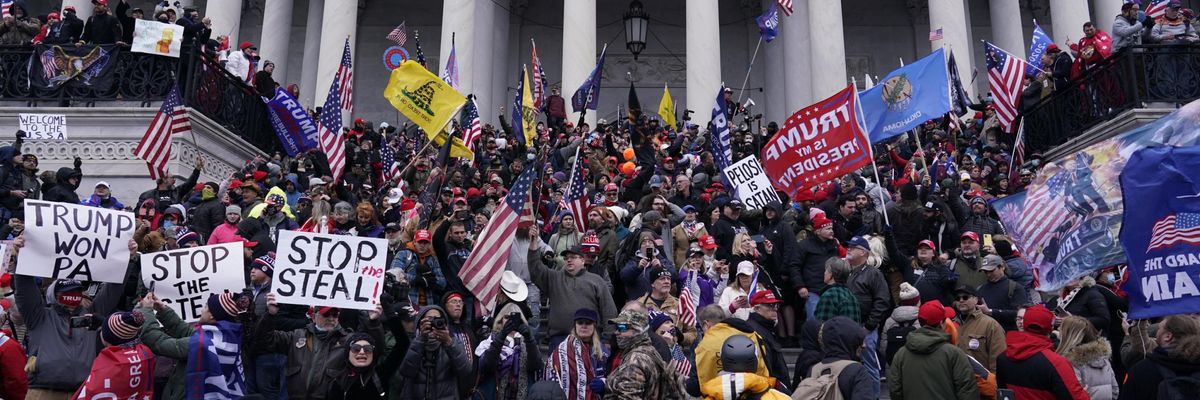
Right-wing insurrectionists, fueled by then-President Donald Trump’s relentless lies about voter fraud, violently rioted at the U.S. Capitol in Washington, D.C., in an attempt to prevent lawmakers from certifying the 2020 presidential election results in a joint session of the 117th Congress on January 6, 2021.
(Photo: Kent Nishimura/Los Angeles Times via Getty Images)
The institutional and cultural conditions that led to the insurrection have not abated; if anything, the landscape has only become more permissive.
More than 1,100 people—most of whom are white, employed men between the age of 18 and 50—have been charged by the government in connection with the January 6, 2021, insurrection. Several were reportedly surprised by their legal troubles because they viewed themselves as having acted to save democracy.
One of the men convicted was Stewart Rhodes, the founder and leader of the Oath Keepers, a far-right anti-government militia group. Rhodes was sentenced to 18 years in prison for seditious conspiracy and other charges related to the insurrection, but he has argued that he deserves leniency because his organization operated in service of the public.
It is not just jailed participants who view the attempted coup as an expression of patriotic duty. Nearly half of Republicans viewed it as an act of patriotism, according to a December 2021 poll.
In a 2023 survey, 33% of white Americans agreed that gun ownership is a sign of good citizenship.
The truth is, this feeling is a core part of American identity, and it brings together two ideological strands present in the American experience since its founding: martial republicanism and white male supremacy.
Martial republicanism encompasses the belief that men—and only men—become good citizens by serving their country in war and politics. This ideology is the seed of modern democracy. Many democratic countries today recognize political participation and military service as the rights and obligations of citizenship.
Martial republicanism does not have a specific answer to who exactly may become a virtuous citizen. At the time of the American Revolution, white male supremacy provided that answer. It was white men who could be entrusted with the country’s defense and its political life.
This was inscribed in the United States’ institutions. The Uniform Militia Act of 1792 mandated white men to serve in the state militia. In some states, militia membership enabled men to vote. Because state governments didn’t have the fiscal capacity to pay for defense, the law required these men to own their own firearms and military supplies.
To be sure, the country’s military has changed since. In 1903, militias were federalized and professionalized. But an ideology that valorizes guns and views government institutions with hostility has survived. And when the gun world merged with the Republican party in the 1990s, these ideas received broader attention.
In a 2023 survey, 33% of white Americans agreed that gun ownership is a sign of good citizenship. Alarmingly, 56% responded that the government is so powerful that people need guns to protect themselves from it.
The link between civilian gun ownership and political violence is reinforced by political elites, from former President Donald Trump to Senator Joe Manchin, Democrat of West Virginia. Allusions to armed citizenship and violence have been featured in political ads. Candidates have even appeared armed in Christmas cards.
But it doesn’t stop there.
Ads have featured Manchin shooting through a bill attempting to regulate fossil fuel companies, an armed Eric Greitens (former Republican governor of Missouri) breaking through a suburban house door hunting RINOs (Republicans in Name Only), and Jerone Davison (a Republican congressional candidate from Arizona), a Black man, holding an AR-15 in order to scare away “a dozen angry Democrats in klan hoods” invading his lawn.
To be sure, their proponents say that these ads are purely metaphor, but studies show that violent language can have deadly consequences, and trusted political elites can incite followers to violence.
The wave of threats and violence in politics should not be surprising. The institutional and cultural conditions that led to January 6 have not abated; if anything, the landscape has only become more permissive. Data shows that, from the U.S. President down to school boards, officials are regularly threats and actual violence. Specifically, while the U.S. Capitol Police recorded 3,939 threats against Congress in 2017, that number was 7,501 in 2022, nearly doubling in six years. The threats targeted both parties equally.
Unless political elites and leaders take these warnings seriously, the 2024 election cycle promises more excesses and, possibly, more violence. The country cannot endure a repeat of January 6.
Dear Common Dreams reader, It’s been nearly 30 years since I co-founded Common Dreams with my late wife, Lina Newhouser. We had the radical notion that journalism should serve the public good, not corporate profits. It was clear to us from the outset what it would take to build such a project. No paid advertisements. No corporate sponsors. No millionaire publisher telling us what to think or do. Many people said we wouldn't last a year, but we proved those doubters wrong. Together with a tremendous team of journalists and dedicated staff, we built an independent media outlet free from the constraints of profits and corporate control. Our mission has always been simple: To inform. To inspire. To ignite change for the common good. Building Common Dreams was not easy. Our survival was never guaranteed. When you take on the most powerful forces—Wall Street greed, fossil fuel industry destruction, Big Tech lobbyists, and uber-rich oligarchs who have spent billions upon billions rigging the economy and democracy in their favor—the only bulwark you have is supporters who believe in your work. But here’s the urgent message from me today. It's never been this bad out there. And it's never been this hard to keep us going. At the very moment Common Dreams is most needed, the threats we face are intensifying. We need your support now more than ever. We don't accept corporate advertising and never will. We don't have a paywall because we don't think people should be blocked from critical news based on their ability to pay. Everything we do is funded by the donations of readers like you. When everyone does the little they can afford, we are strong. But if that support retreats or dries up, so do we. Will you donate now to make sure Common Dreams not only survives but thrives? —Craig Brown, Co-founder |
More than 1,100 people—most of whom are white, employed men between the age of 18 and 50—have been charged by the government in connection with the January 6, 2021, insurrection. Several were reportedly surprised by their legal troubles because they viewed themselves as having acted to save democracy.
One of the men convicted was Stewart Rhodes, the founder and leader of the Oath Keepers, a far-right anti-government militia group. Rhodes was sentenced to 18 years in prison for seditious conspiracy and other charges related to the insurrection, but he has argued that he deserves leniency because his organization operated in service of the public.
It is not just jailed participants who view the attempted coup as an expression of patriotic duty. Nearly half of Republicans viewed it as an act of patriotism, according to a December 2021 poll.
In a 2023 survey, 33% of white Americans agreed that gun ownership is a sign of good citizenship.
The truth is, this feeling is a core part of American identity, and it brings together two ideological strands present in the American experience since its founding: martial republicanism and white male supremacy.
Martial republicanism encompasses the belief that men—and only men—become good citizens by serving their country in war and politics. This ideology is the seed of modern democracy. Many democratic countries today recognize political participation and military service as the rights and obligations of citizenship.
Martial republicanism does not have a specific answer to who exactly may become a virtuous citizen. At the time of the American Revolution, white male supremacy provided that answer. It was white men who could be entrusted with the country’s defense and its political life.
This was inscribed in the United States’ institutions. The Uniform Militia Act of 1792 mandated white men to serve in the state militia. In some states, militia membership enabled men to vote. Because state governments didn’t have the fiscal capacity to pay for defense, the law required these men to own their own firearms and military supplies.
To be sure, the country’s military has changed since. In 1903, militias were federalized and professionalized. But an ideology that valorizes guns and views government institutions with hostility has survived. And when the gun world merged with the Republican party in the 1990s, these ideas received broader attention.
In a 2023 survey, 33% of white Americans agreed that gun ownership is a sign of good citizenship. Alarmingly, 56% responded that the government is so powerful that people need guns to protect themselves from it.
The link between civilian gun ownership and political violence is reinforced by political elites, from former President Donald Trump to Senator Joe Manchin, Democrat of West Virginia. Allusions to armed citizenship and violence have been featured in political ads. Candidates have even appeared armed in Christmas cards.
But it doesn’t stop there.
Ads have featured Manchin shooting through a bill attempting to regulate fossil fuel companies, an armed Eric Greitens (former Republican governor of Missouri) breaking through a suburban house door hunting RINOs (Republicans in Name Only), and Jerone Davison (a Republican congressional candidate from Arizona), a Black man, holding an AR-15 in order to scare away “a dozen angry Democrats in klan hoods” invading his lawn.
To be sure, their proponents say that these ads are purely metaphor, but studies show that violent language can have deadly consequences, and trusted political elites can incite followers to violence.
The wave of threats and violence in politics should not be surprising. The institutional and cultural conditions that led to January 6 have not abated; if anything, the landscape has only become more permissive. Data shows that, from the U.S. President down to school boards, officials are regularly threats and actual violence. Specifically, while the U.S. Capitol Police recorded 3,939 threats against Congress in 2017, that number was 7,501 in 2022, nearly doubling in six years. The threats targeted both parties equally.
Unless political elites and leaders take these warnings seriously, the 2024 election cycle promises more excesses and, possibly, more violence. The country cannot endure a repeat of January 6.
More than 1,100 people—most of whom are white, employed men between the age of 18 and 50—have been charged by the government in connection with the January 6, 2021, insurrection. Several were reportedly surprised by their legal troubles because they viewed themselves as having acted to save democracy.
One of the men convicted was Stewart Rhodes, the founder and leader of the Oath Keepers, a far-right anti-government militia group. Rhodes was sentenced to 18 years in prison for seditious conspiracy and other charges related to the insurrection, but he has argued that he deserves leniency because his organization operated in service of the public.
It is not just jailed participants who view the attempted coup as an expression of patriotic duty. Nearly half of Republicans viewed it as an act of patriotism, according to a December 2021 poll.
In a 2023 survey, 33% of white Americans agreed that gun ownership is a sign of good citizenship.
The truth is, this feeling is a core part of American identity, and it brings together two ideological strands present in the American experience since its founding: martial republicanism and white male supremacy.
Martial republicanism encompasses the belief that men—and only men—become good citizens by serving their country in war and politics. This ideology is the seed of modern democracy. Many democratic countries today recognize political participation and military service as the rights and obligations of citizenship.
Martial republicanism does not have a specific answer to who exactly may become a virtuous citizen. At the time of the American Revolution, white male supremacy provided that answer. It was white men who could be entrusted with the country’s defense and its political life.
This was inscribed in the United States’ institutions. The Uniform Militia Act of 1792 mandated white men to serve in the state militia. In some states, militia membership enabled men to vote. Because state governments didn’t have the fiscal capacity to pay for defense, the law required these men to own their own firearms and military supplies.
To be sure, the country’s military has changed since. In 1903, militias were federalized and professionalized. But an ideology that valorizes guns and views government institutions with hostility has survived. And when the gun world merged with the Republican party in the 1990s, these ideas received broader attention.
In a 2023 survey, 33% of white Americans agreed that gun ownership is a sign of good citizenship. Alarmingly, 56% responded that the government is so powerful that people need guns to protect themselves from it.
The link between civilian gun ownership and political violence is reinforced by political elites, from former President Donald Trump to Senator Joe Manchin, Democrat of West Virginia. Allusions to armed citizenship and violence have been featured in political ads. Candidates have even appeared armed in Christmas cards.
But it doesn’t stop there.
Ads have featured Manchin shooting through a bill attempting to regulate fossil fuel companies, an armed Eric Greitens (former Republican governor of Missouri) breaking through a suburban house door hunting RINOs (Republicans in Name Only), and Jerone Davison (a Republican congressional candidate from Arizona), a Black man, holding an AR-15 in order to scare away “a dozen angry Democrats in klan hoods” invading his lawn.
To be sure, their proponents say that these ads are purely metaphor, but studies show that violent language can have deadly consequences, and trusted political elites can incite followers to violence.
The wave of threats and violence in politics should not be surprising. The institutional and cultural conditions that led to January 6 have not abated; if anything, the landscape has only become more permissive. Data shows that, from the U.S. President down to school boards, officials are regularly threats and actual violence. Specifically, while the U.S. Capitol Police recorded 3,939 threats against Congress in 2017, that number was 7,501 in 2022, nearly doubling in six years. The threats targeted both parties equally.
Unless political elites and leaders take these warnings seriously, the 2024 election cycle promises more excesses and, possibly, more violence. The country cannot endure a repeat of January 6.