SUBSCRIBE TO OUR FREE NEWSLETTER
Daily news & progressive opinion—funded by the people, not the corporations—delivered straight to your inbox.
5
#000000
#FFFFFF
To donate by check, phone, or other method, see our More Ways to Give page.


Daily news & progressive opinion—funded by the people, not the corporations—delivered straight to your inbox.

Ja-Rei Wang, jwang@ucsusa.org, 202-331-6943
The city of Boulder and two counties in Colorado are suing ExxonMobil and Suncor Energy, Canada's largest oil company, to hold them responsible for climate change-related damage to their communities. In the lawsuit filed today in Boulder district court, the plaintiffs--Boulder, Boulder County and San Miguel County--are seeking compensation for damage and adaptation costs resulting from extreme weather events linked to global warming.
New York City and eight coastal California cities and counties have filed similar lawsuits against ExxonMobil and other fossil fuel companies, but the Colorado lawsuit is the first by an inland municipality or county and covers a wider range of climate impacts, including droughts, wildfires, heat waves and flash floods. The complaint notes that more frequent and severe climate-related impacts will threaten Colorado infrastructure as well as its $5-billion winter sports industry and $41-billion agricultural sector.
Below is a statement by Ken Kimmell, president of the Union of Concerned Scientists.
"Communities in Colorado and across the country are already doing what they can to curb their carbon emissions and are spending millions of dollars to adapt to a wide array of harms caused by global warming. Those costs will only multiply over the next few decades, and taxpayers shouldn't be forced to foot the bill that the fossil fuel industry has knowingly run up over the last 40 years. Affected communities can cite ample scientific evidence showing that ExxonMobil and other fossil fuel companies have played an outsized role in making the problem worse.
"The federal government has abdicated leadership on the central challenge of our time, allowing the fossil fuel industry to continue to emit carbon pollution with no controls in place. It is not surprising that communities damaged by climate change are now seeking redress in state courts."
The Union of Concerned Scientists is the leading science-based nonprofit working for a healthy environment and a safer world. UCS combines independent scientific research and citizen action to develop innovative, practical solutions and to secure responsible changes in government policy, corporate practices, and consumer choices.
"Abandoning children to meet deportation targets is immoral. This must stop. These children deserve legal representation."
Thousands of unaccompanied immigrant children could lose their lawyers beginning Friday as federally funded contracts supporting them are set to expire, prompting advocates to warn that the move will leave vulnerable minors to face deportation proceedings frightened and alone.
Since 2003, the US Department of Health and Human Services (HHS) has funded a nationwide network of around 100 advocacy groups that have offered legal services to unaccompanied minors who arrived in the United States without their parents or legal guardians, as well as children already in immigration custody.
The Trump administration's move to withhold over $65 million in congressionally appropriated funding starting late last year forced dozens of nonprofit advocacy groups to trim operations, refuse new clients, or end vital programs altogether. There is no apparent plan for continuing representation for roughly 20,000 children currently receiving legal assistance as they navigate the US immigration courts and deportation process.
"This is a five-alarm fire," Sen. Jeff Merkley said Thursday on social media. "It’s wrong under every moral code."
Shaina Aber, executive director of Acacia Center for Justice—one of the nonprofits that received funding through the program—told El País' Patricia Clarembaux on Thursday, "We don’t know what’s going to happen on August 1 because the government has not informed us of the transition plan for the 20,000 children who have representation under this contract."
“It will really depend on whether the attorneys have alternative funding that allows them to continue," she added.
A child cannot be expected to navigate immigration court alone, yet that is exactly what will happen starting this Saturday if the Trump administration succeeds in dismantling these legal services.Tell Congress to honor its promise to protect unaccompanied children: tinyurl.com/protect-kids
[image or embed]
— Acacia Center for Justice (@acaciajustice.org) July 29, 2026 at 2:51 PM
HHS told El País that its Office of Refugee Resettlement—which is responsible for looking after immigrant minors—“remains fully compliant with legal and regulatory obligations and does not act in any way that could dissuade a child from seeking appropriate legal relief.”
However, as Acacia Center noted, "without legal representation, fewer than 1% of immigrant children are granted immigration relief. Without access to counsel, tens of thousands of vulnerable children could be forced to navigate life-changing legal proceedings with fewer protections, fewer advocates, and less time."
"HHS must honor its commitment and fulfill its obligation to pay for legal services already provided to prevent unaccompanied children from being stripped of their lawyers and deported without due process," the group argued.
Critics also point to President Donald Trump's record of mistreating unauthorized immigrants, especially children, over the course of his two terms. During his first term (2017–21), "zero tolerance" policies, including family separation and expanded use of what many observers call concentration camps, left thousands of children traumatized. Detention in overcrowded and often squalid facilities reportedly plagued by abuse has harmed many children since Trump's return to the White House last year.
Katie, a member of the group Women of Welcome and sponsor of immigrant children, responded to the imminent HHS funding cutoff last week, saying, “I have worked with immigrants in my professional life and have a lot of immigrant friends, but seeing the journey through the eyes of these kids was very new."
"The little girl I am adopting has been through a lot of trauma, and I may never know what she has gone through," Katie added. "She is resilient and funny, but she is 6, and she shouldn’t have to fight this system alone. This experience has not only deepened my faith, but I have learned more and more about how important the work of advocacy and loving people is. For these children, it is difficult to fight a system that isn’t built to protect them.”
Anna Devereaux, senior managing attorney at the Michigan Immigrant Rights Center, said that “children are children, regardless of their nationality, and our law and our values require us to act in their best interest."
"But the government’s failure to provide long-term funding has made it challenging to sustain a legal program for children," she added. "If this funding ends now, the future for these children is uncertain.”
Aber said: “These children are not leverage in a political negotiation. They are human beings—many of whom fled violence, trafficking, and abuse—who have a legally and morally recognized right to have their cases heard with a lawyer by their side."
"Abandoning children to meet deportation targets is immoral," she asserted. "This must stop. These children deserve legal representation."
Yair Lapid, the opposition leader some Democrats believe will rescue Israel from extremism, said the nation should expand its territory to match "the Bible's borders" earlier this year.
Faced with mounting pressure from constituents to stop providing military support to Israel's genocidal wars, some Democrats in Congress who've long expressed unwavering support for the country are hoping that its elections this fall could provide a reset.
On Wednesday, a clique of Democrats met with former Israeli Prime Minister Yair Lapid, a leader of the opposition coalition aiming to oust Prime Minister Benjamin Netanyahu, whose far-right government's unapologetic pursuit of ethnic cleansing against Palestinians and push toward indefinite occupation of southern Lebanon have made support among liberals increasingly untenable.
Lapid has described the ascendancy of his coalition as an opportunity for Democrats who'd recently voted against measures to provide Israel with weapons aid to wipe the slate clean and restore the status quo of ironclad bipartisan support that Israel had enjoyed for decades.
At the meeting, arranged by the staunch Israel supporter Sen. Jacky Rosen (D-Nev.), Lapid said he urged the Democrats in the room, which included Sens. Michael Bennet (Colo.), Richard Blumenthal (Conn.), Maggie Hassan (NH), Cory Booker (NJ), Brian Schatz (Hawaii), Alex Padilla (Calif.), John Hickenlooper (Colo.) and Catherine Cortez Masto (Nev.), according to The Jerusalem Post, "not to give up on Israel and to show solidarity in the face of its challenges."
Lapid is often portrayed in the Western press as a more "moderate" alternative to Netanyahu and his coalition of religious nationalist and ultra-Orthodox parties. Lapid is comparatively secular and has criticized Netanyahu's assaults on institutions like the courts, while showing himself more open to aligning with Israel's marginalized Arab parties.
But on the questions that have led Israel to lose favor with American voters—those of Israel's aggressive warmaking—Lapid has expressed views that seem hardly less extreme than those of the current government, including the idea that Israel should continue to expand its borders across the Middle East in accordance with biblical texts.
The idea that Israel should wage wars of conquest against its neighbors was once confined to the fringes, but has become mainstream in recent years with the support of far-right figures in Netanyahu's government, like Finance Minister Bezalel Smotrich and Security Minister Itamar Ben-Gvir, who've pushed for Israel to expand its illegal settlements in the West Bank and begin moving settlers into Gaza and Lebanon after they're depopulated of their inhabitants.
In February, Lapid was asked during a press conference if he agreed with a statement by US Ambassador to Israel Mike Huckabee that the state had a religious right to seize all the land between the Nile and the Euphrates Rivers.
Per Middle East Eye, he responded as follows:
"I support anything that will allow the Jews a large, broad, strong land and a safe haven for us, our children and our children's children. That I support," he told a Kipa News reporter.
When asked "How broad?" Lapid responded: "As broad as possible."
He added that there were practical "considerations of security and policy and time," but said Israeli territory could expand as far as Iraq.
"Zionism is based on the Bible, our mandate over the land of Israel is biblical, the biblical borders of Israel are very clear," he said. "I believe our ownership deed over the land of Israel is the Bible, therefore the borders are the Bible's borders."
Rania Khalek, a journalist and commentator at BreakThrough News, warned that by viewing Lapid as a palatable alternative to Netanyahu, Democrats were aligning themselves with "violent colonial religious fanaticism... despite the fact that their base overwhelmingly despises this Greater Israel settler project."
Remarking on his comments endorsing the idea of Israeli expansion into Iraq, she marveled that "Yair Lapid is supposedly the liberal opposition to Netanyahu. Yet he sounds just like Ben-Gvir here."
Lapid has been nominally critical of Netanyahu's policy toward Gaza, but largely only from a tactical perspective rather than a humanitarian one.
He defended Israel against criticism as it imposed a "complete siege" that cut off food, water, and electricity from the strip in October 2023, and claimed most killed in Gaza were "terrorists"; supported legislation aimed at crippling the main United Nations aid agency for Palestinians, and endorsed President Donald Trump's idea of permanently removing the residents of Gaza.
Lapid has also been a strong proponent of war with Iran, praising Trump and Netanyahu's strikes in late February as a "just war against evil" and calling for the nation's leadership to be "obliterated." During a speech earlier this week, he endorsed the idea of striking Iran's energy infrastructure, calling it "the right thing to do in the long term."
While serving as prime minister in 2022, Lapid signaled rhetorical support for a two-state solution with the Palestinians, a marked difference from Netanyahu, who has long been adamantly against it. However, the man likely to become prime minister if Lapid's coalition wins, former premier Naftali Bennett, has long opposed a Palestinian state, recently calling it a "huge mistake."
"Today’s decision reaffirms that immigrants who contribute to our communities and have lived here for years deserve dignity, not detention," said US Rep. Pramila Jayapal.
Two separate federal courts on Thursday rejected Trump administration's justification for its mass detention of immigrants.
First, a three-judge panel on the 9th Circuit Court of Appeals ruled 2-1 that the administration had misconstrued the 1996 Immigration and Nationality Act (INA) as mandating detention without bond for all undocumented immigrants in the US.
The court found that the INA's mandatory detention policy only applied to undocumented immigrants who had been apprehended shortly after crossing the border and not to undocumented immigrants who have lived in the US for years after entering the country illegally.
Judge Daniel Bress, an appointee of President Donald Trump, wrote for the majority that the administration's interpretation of the INA would constitute "a major change to the immigration laws by subjecting millions" of undocumented immigrants already living in the US to mandatory detention.
"We accordingly do not think that Congress in 1996 made such a large-scale change to our established system of immigration detention in the way that the government now contends," Bress added.
Shortly after the decision, a three-judge panel on the 7th Circuit Court of Appeals similarly rejected the Trump administration's mass detention policy, ruling 2-1 that the government's interpretation of the law "rests upon the illogical use of both legal fiction and ordinary meaning" to determine whether someone who has long lived in the US is "seeking admission" to the US.
Aaron Reichlin-Melnick, senior fellow at the American Immigration Council, noted that six federal appeals courts so far have ruled against the administration's mass detention policy, while only two have ruled in favor. Decisions on the policy are also pending in three other federal appeals courts.
While predicting that the legal fight over interpretation of the INA is likely headed to the US Supreme Court, Reichlin-Melnick nonetheless said that the rulings were "great news."
Rep. Pramila Jayapal (D-Wash.) hailed the 9th Circuit's ruling against the Trump administration as a "big win."
"While this will likely be litigated further," Jayapal wrote in a social media post, "today’s decision reaffirms that immigrants who contribute to our communities and have lived here for years deserve dignity, not detention."
"Listen to the American people. Vote to end this war," said Sen. Chuck Schumer. "We’re going to keep forcing Republicans to vote until we do.”
The vast majority of US Senate Republicans were joined by Democratic Sen. John Fetterman on Thursday in voting against a war powers resolution to block the Trump administration from continuing to attack Iran without congressional approval, as new polling showed nearly two-thirds of Americans think the war is not worth fighting.
For the second time in as many weeks and the 13th time this year, Senate Democrats called on Republicans to limit President Donald Trump's authority to take military action, pointing to rising anger over the assault on Iran, which has killed at least 18 US service members and more than 3,400 Iranians, as well as thousands more across the region, mostly in Lebanon, as Iran has retaliated in the unprovoked US-Israeli conflict.
“Are Senate Republicans listening? The country is clamoring for you to end this war,” Senate Minority Leader Chuck Schumer (D-NY) said. “I urge and plead with my Republican colleagues: Listen to the American people. Vote to end this war. We’re going to keep forcing Republicans to vote until we do.”
The Associated Press-NORC Research Center poll released Thursday showed that 64% of Americans disapprove of the continuation of the war, including 37% of Republicans. Seventy percent of respondents said the Trump administration should prioritize a permanent ceasefire with Iran after a memorandum of understanding to end the war collapsed in early July and Trump relaunched attacks on the Middle Eastern country.
Seventy-two percent of respondents also said it was "extremely" or "very" important to them to ensure gas and oil prices are reduced after the war. Iran's closure of the Strait of Hormuz has sent the price of gas soaring—adding to Americans' concerns over the rising cost of essentials.
Three Republicans—Sens. Susan Collins (Maine), Lisa Murkowski (Alaska), and Rand Paul (Ky.)—joined Democrats in supporting the war powers resolution, with a final vote of 50-49. But even Republicans who supported allowing Trump to continue the war he started in February, despite the fact that the War Powers Act of 1973 only gives him 60-90 days to end a conflict he has started, addressed the cost-of-living crisis the war is worsening.
“The rising gas prices are a real concern to everybody,” Sen. Mike Rounds (R-SD) said.
Sen. Kirsten Gillibrand (D-NY) said on the Senate floor Thursday that while Trump is "pouring billions of tax dollars into an open ended war in Iran, this reckless war is driving up monthly bills and making everyday life harder for working families. "
.@SenGillibrand (D-NY) urges for passage of Iran War Powers Resolution, ahead of the vote: "This reckless war is driving up monthly bills and making everyday life harder for working families... Under the constitution, we have the power to end the war today — let's use it!" pic.twitter.com/zhLNOzNioZ
— CSPAN (@cspan) July 30, 2026
The resolution failed hours after Iranian media reported that one of the strikes by US Central Command Wednesday night had killed a family of three, including a 2-year-old child.
Under a new policy the administration is defending in court, low-income people with cancer, HIV, Parkinson's, and other life-threatening illnesses must prove they're too sick to work or risk losing their health insurance.
A federal judge on Thursday denied a request by more than two dozen Democratic states to halt a Trump administration policy announced last month that would require Medicaid recipients with terminal diseases to prove they are too sick to work in order to be exempt from new work requirements that go into effect this coming January.
While introducing over $1 trillion in tax cuts for the wealthiest 1% of Americans, last year's massive GOP tax and budget bill also imposed new 80-hour-per-month work requirements that states must implement for Medicaid expansion recipients, who receive government-subsidized insurance coverage at or below 138% of the poverty line.
The law specified that those who are “medically frail or otherwise have special medical needs” are excluded from the work requirement, and specifically listed people with a “serious or complex medical condition.” But it remained unclear what exact conditions met these criteria.
Earlier this month, the Centers for Medicare and Medicaid Services (CMS) introduced a new rule stating that even if a person receives a terminal diagnosis for a disease like cancer, HIV/AIDS, or Parkinson's, that is still not enough for them to be exempt from the work requirements.
Beginning on January 1, 2028, it says they must also demonstrate to states that their condition “significantly impairs” their ability to meet the work requirement.
Democratic attorneys general in 25 states and the District of Columbia filed a preliminary injunction over the rule late last month, arguing that CMS had rewritten the law to introduce a vague and needlessly restrictive new hurdle that vulnerable people will face in obtaining desperately needed care.
“This is one of those cases where it’s really hard to overstate how dire the consequences could be,” North Carolina’s Democratic attorney general, Jeff Jackson, told Politico. “You’re going to have 50 states doing 50 different things, and we’re all going to have to create a whole new bureaucracy... You are talking about a lot more paperwork, more evaluations, more doctor visits, and a lot more work for doctors themselves.”
The Democratic AGs argued that implementation of the work requirements should be paused because they lacked the staff or capacity to meet the timeline set by CMS, which requires states to communicate to enrollees how they'll be affected by the changes by the end of August.
US District Judge Richard Stearns on Thursday denied their initial request to immediately halt the implementation of the requirements while the lawsuit proceeds, but also did not rule on the lawsuit's merits, which are scheduled to be decided before the requirements go into effect on January 1.
Several medical associations, including the American Medical Association, the American College of Physicians, and the American Academy of Pediatrics, have come out against the rule, arguing that it would have dire consequences for people who suffer from severe illness.
"One of the most significant factors in whether someone survives a cancer diagnosis is whether they have health insurance coverage," Lisa Lacasse, president of the American Cancer Society Cancer Action Network, explained in June.
"The new restrictions link the definition of medical frailty to a person’s ability to work," she continued. "This would mean cancer patients and survivors who are suffering from debilitating side effects of the disease or treatment would have to officially prove they can’t work, in a process that is likely to be difficult and take a long time."
The nonpartisan Congressional Budget Office has projected that over the coming decade, changes to healthcare policy introduced by Republicans would increase the number of uninsured Americans by about 11.8 million.
Around 5.7 million of them are projected to be Medicaid recipients who either do not meet the 80-hour work requirement or are otherwise eligible but tripped up by one of the newly imposed paperwork hurdles.
Taya Graham and Stephen Janis argued earlier this week in a piece for The Real News Network that eligible people losing coverage is not an unfortunate side effect of the law, but a goal of the Republicans who passed it, who sought a way to thin the ranks of those who qualify for Medicaid without having to take the politically unpopular step of actually clawing back benefits.
They wrote that what has happened to recipients of the Supplemental Nutrition Assistance Program (SNAP) illustrates how burdensome these new requirements may become.
As The New York Times reported earlier this month, in Arizona, 440,000 people have already been dropped from SNAP after it enacted a formidable regime of paperwork for low-income recipients to prove eligibility, including requiring some people with panhandling income to obtain documentation from donors who drop them a buck on the street.
"If this is what people receiving SNAP benefits have been subjected to," Graham and Janis wrote, "imagine what’s going to happen to people who will need to navigate the new [Medicaid] requirements while struggling with a debilitating or terminal illness."
Medical issues are a leading cause of bankruptcy in the US. According to one study, over 4 in 10 cancer patients over 50 had depleted all their assets within two years of diagnosis.
Melanie D’Arrigo, a campaigner for single-payer healthcare in New York, said that President Donald Trump "cut cancer research, cut healthcare,” and with new Medicaid restrictions, “wants to make sure Americans continue to work as they go broke battling cancer.”
"He has spent his career proving that there is no legal principle he will not bend and no institution he will not compromise in service of Donald Trump."
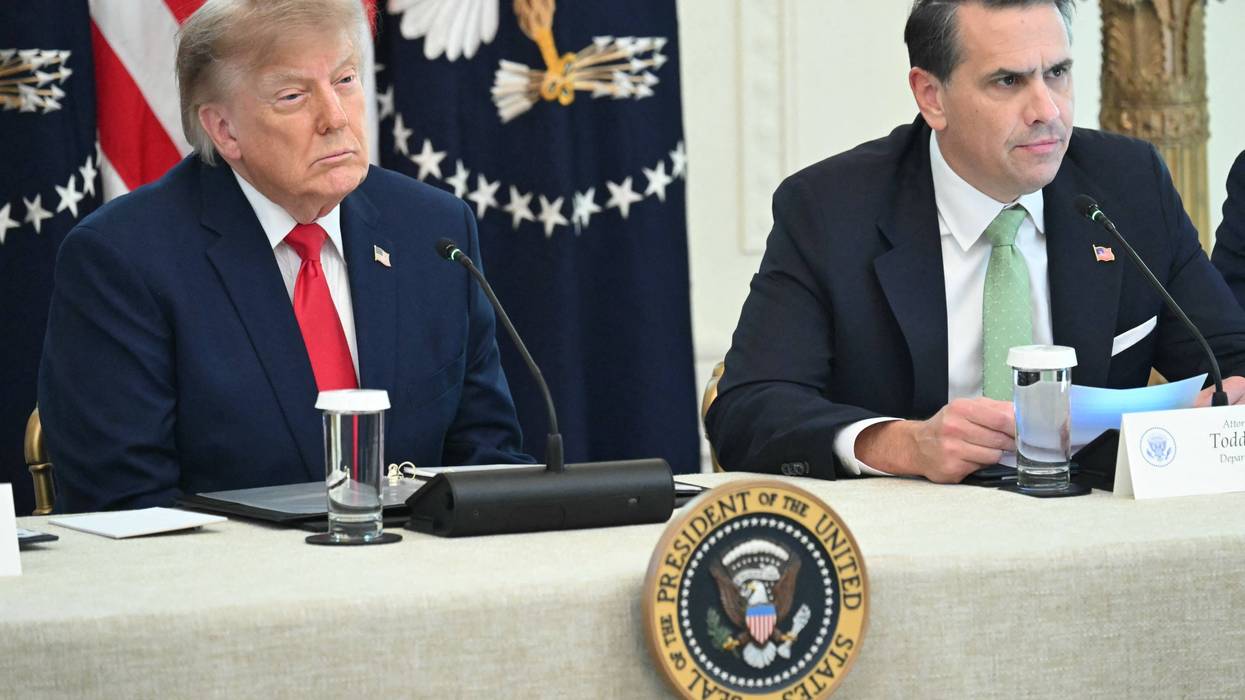
President Donald Trump on Thursday said he would consider withdrawing his nomination of Todd Blanche to be US attorney general if two Republican senators refused to vote for his confirmation.
However, Trump indicated in a social media post that this would only be a temporary retreat, as he vowed to renominate Blanch, who had previously served as the president's personal attorney, after Sens. Thom Tillis (R-NC) and John Cornyn (R-Texas) are out of office when their terms at the start of next year.
Cornyn and Tillis said they would not vote to support Blanche unless he assured them that the DOJ under his leadership would not reconstitute the widely criticized $1.8 billion slush fund created for allies of the president who were supposedly hurt by the "weaponization" of the department under former President Joe Biden.
The Republican senators also want limits on Internal Revenue Service audit protections for Trump and his family, which were proposed as part of a deal to settle the president’s $10 billion lawsuit against the IRS.
In a Thursday interview with NOTUS reporter Igor Bobic, Tillis expressed bewilderment at Trump's refusal to rule out restarting the slush fund, which he said was damaging the Republican Party's chances of holding onto Congress in the 2026 midterms.
"It makes no sense to me," Tillis said. "This is not popular. The president's not winning on this issue. It is killing some of our candidates because they can't explain it. And now it looks like they weren't being honest when they said it was inoperative."
Trump critics urged the Senate to permanently bury Blanche's aspirations of becoming attorney general. (Blanche currently serves as acting head of the Justice Department.)
The social media account for Democrats on the House Judiciary Committee called on the US Senate to "reject this dangerous nomination for good and demand an attorney general who serves the Constitution and the American people, not Donald Trump and the Epstein class."
"Todd Blanche sealed his fate by refusing to disavow Trump’s $1.8 billion slush fund for cop-beating MAGA foot soldiers," the House Judiciary Democrats noted, "or retract his family-sized super pardon for the Trumps and all their businesses."
Joel Payne, chief communications officer for MoveOn Political Action, said that Blanche's nomination deserved to be killed "because his record is corrupt and indefensible."
"He has spent his career proving that there is no legal principle he will not bend and no institution he will not compromise in service of Donald Trump," Payne said. "His blind loyalty, willingness to use the justice system to protect the president, and role in a sweetheart settlement benefiting Trump make him completely unfit to serve as attorney general."
Lisa Gilbert, co-president of Public Citizen, labeled Blanche "unequivocally unfit to serve" as attorney general, as he "has enabled corruption at the highest level of government by not only permitting, but actively encouraging lawlessness, conflicts of interest, and the prioritization of the interests of the president over the interests of the American people."
"In postponing the vote, it is clear that Blanche’s nomination is hanging by a thread," Gilbert added. "Trump should concede defeat and revoke Blanche’s nomination immediately. His personal fixer must not helm the DOJ."
According to conservative legal analyst Ed Whelan, it's likely that Trump could allow Blanche to continue running the DOJ indefinitely in an acting capacity given that the US Senate already confirmed him to be deputy AG.
"It's not at all clear that the time limit under the Federal Vacancies Reform Act applies to a Deputy AG who is serving as Acting AG," Whelan wrote in a social media post. "And in any event, Blanche in his capacity as Deputy AG has virtually all of the powers of the AG. So the reality is that whether or not Blanche is confirmed as AG, he can continue to run DOJ indefinitely."
“The Indian government must immediately stop authorizing exports of weapons, ammunition, and parts to Israel."
Continued weapons exports to Israel could make India, members of its far-right government, and the country's arms firms complicit in the ongoing genocide of Palestinians in Gaza, an investigation published Thursday by Amnesty International warned.
Amnesty's report, Made in India: The Supply of Weapons and Ammunition to Israel, documents sustained exports of military components and materials to Israel by the Bharatiya Janata Party (BJP)-led government of Indian Prime Minister Narendra Modi, despite mounting international legal warnings that states must halt arms transfers where there is a substantial risk they could facilitate genocide or other grave violations of international law.
“Our research reveals India’s continuing support to the Israeli military and defense sector despite the genocide in Gaza, which has been broadcast worldwide on an almost daily basis for years,” Amnesty International secretary general Agnès Callamard said in a statement introducing the report.
The investigation analyzed shipment-level trade data between India and Israel to reveal how Indian arms, ammunition, and other military components have been exported to large Israeli companies that supply the Israel Defense Forces (IDF) as it wages a US-backed war that Amnesty and many other rights groups, national governments, and experts—including a United Nations commission of inquiry—contend is a genocide.
Amnesty researchers found that the 2,596 shipments of weapons, ammunition, parts, and components sent from India to Israel since the Hamas-led attack of October 7, 2023 include 390,516 small arms parts for military-grade weapons, 564,970 parts of explosive ordnance like drone warheads and artillery shell casings, and 298 components for military vehicles.
"While the Israeli military was inflicting widespread death, destruction and suffering on Palestinians in Gaza, Indian companies continued to profit by supplying components and munitions destined for Israel’s defense sector," Callamard said.
While nowhere near the scale and scope of the tens of billions of dollars in armed aid the US has sent Israel since October 2023 under the Biden and Trump administrations—or even what other countries like Germany, Italy, the United Kingdom, and France export—India's military shipments to Israel have still exposed New Delhi to charges of complicity in the death or injury of more than 250,000 Palestinians, most of them civilians; the physical annihilation of Gaza; and the forced displacement and engineered starvation of millions of its people by Israel.
"India manufactures and supplies arms transferred to Israel through its ownership and control over key supplier companies," Callamard said. "Not only has India failed to regulate arms exports to Israel by private companies in line with international law and standards; it has also deepened its defense partnership with Israel."
“In light of the International Court of Justice’s provisional measures orders recognizing a plausible risk of genocide against Palestinians in Gaza, the Indian authorities cannot credibly argue that they did not know that continuing to authorize and facilitate arms transfers to Israel carries a substantial risk of contributing to serious violations of international law," she added.
The ICJ is currently weighing a genocide case filed by South Africa against Israel, and has issued a series of provisional orders to prevent genocidal acts that Israel is accused of ignoring.
While India formally recognized Israel in 1950, for decades New Delhi maintained limited relations, partly due to its support for the Palestinian cause, leadership in the Non-Aligned Movement, and domestic political considerations. Full diplomatic relations weren't established until 1992.
Since then—and especially since the rise of Modi and the Hindu nationalist BJP—bilateral ties have expanded rapidly. Israel has become one of India's largest arms suppliers, selling radar systems, drones, missiles, surveillance equipment, and air defense technology. Joint military research and production have increased, as have public security, intelligence sharing, and other efforts against what both countries call terrorism committed by people resisting Israel's illegal occupation in Palestine and Indian repression in the parts of Jammu and Kashmir that New Delhi controls.
Modi and Netanyahu—who is wanted by the International Criminal Court in The Hague for alleged crimes against humanity and war crimes in Gaza—have also forged close personal relations. Both leaders are right-wing nationalists who utilize religious supremacism to exclude or marginalize Muslims, and both have been accused of increasing authoritarianism, just like their common ally, US President Donald Trump. Protests against Israel's Gaza onslaught have been violently suppressed in both countries.
Prominent left-wing Indians have long condemned their government's ties with Israel.
“At a time when the ceasefire is being used as an excuse to bomb and vaporize Palestinians and occupy Gaza, the Indian government is choosing to stand with genocidal Israel and its imperialist masters like America and is working overtime to benefit the corporations from the occupation of Palestine," Indian People in Solidarity With Palestine and the India chapter of the Boycott, Divestment, and Sanctions (BDS) movement said earlier this year in a joint statement coinciding with a Modi's visit to Israel.
Famed Indian author Arundhati Roy warned two years ago that if India did not stop arming Israel, “it will forever be complicit in aiding and abetting a genocide that is being telecast live for the world to watch.”
In her statement Tuesday, Callamard said that “the Indian government must immediately stop authorizing exports of weapons, ammunition, and parts to Israel."
"It must also ensure that companies operating under its jurisdiction do not contribute to crimes under international law," she added. "All companies have a responsibility to respect human rights throughout their global operations, which includes taking proactive and robust measures early on to ensure that their products are not involved in serious violations of international law."
"We have got to end the absurdity of the Pentagon being the only major federal agency that has never passed an independent audit."
Bipartisan legislation reintroduced Thursday by Sens. Bernie Sanders and Chuck Grassley would impose budgetary penalties on the US Department of Defense for failing to pass a complete and independent audit.
If enacted, the Audit the Pentagon Act would withhold 2% of the budget of any Defense Department office that fails to achieve a clean audit, and the funds would be returned to the US Treasury.
The Pentagon has failed eight consecutive audits without any consequences, as lawmakers from both parties continue to approve massive budget increases each year. For fiscal year 2027, the Trump administration is seeking $1.5 trillion in total military spending as it wages war against Iran with no end in sight.
“The Pentagon has been plagued by a massive amount of waste, fraud and financial mismanagement for decades,” Sanders (I-Vt.) said in a statement on Thursday. “Year after year, the Pentagon fails an audit, and year after year, Congress hands it another blank check."
"At a moment when the administration has dragged us into an unconstitutional war with Iran and is demanding the largest military budget in our history to pay for it, the Pentagon still cannot tell us where trillions of dollars have gone," Sanders added. "We have got to end the absurdity of the Pentagon being the only major federal agency that has never passed an independent audit.”
The Audit the Pentagon Act has 10 Senate co-sponsors so far: Ron Wyden (D-Ore.), Chris Van Hollen (D-Md.), Elizabeth Warren (D-Mass.), Cory Booker (D-NJ), Tina Smith (D-Minn.), Ed Markey (D-Mass.), Mike Lee (R-Utah), Jeff Merkley (D-Ore.), Rand Paul (R-Ky.), and Chris Murphy (D-Conn.).
The latest version of the bill, which was first introduced in 2021, comes as the Trump administration is seeking tens of billions of dollars in funding for the Iran war, which Congress never authorized. Experts have warned for months that the Pentagon is not being transparent about the war's financial cost, which is likely to be far higher than the department's official estimate of $37.5 billion.
“You have the largest agency in terms of discretionary spending for eight years in a row unable to explain and defend the funding that they have, and we have seen enormous examples of waste and fraud,” Sanders told NBC News in an interview. “Tell us where that money is going, period.”
In a press release, Sanders' office highlighted several examples of what it described as "waste and fraud" at the Pentagon:
Earlier this month, a version of the Audit the Pentagon Act was attached to the House's National Defense Authorization Act (NDAA). The Senate Democratic caucus blocked the upper chamber's version of the NDAA earlier this month over President Donald Trump's illegal Iran war.
"Justin would be one of Congress' strongest voices protecting communities from Big Oil's pollution and climate disasters, while championing a just transition to affordable renewable energy."
A week away from Tennessee's Democratic primary, a coalition of national advocacy groups endorsed Justin Pearson, who is running to represent the state's 9th Congressional District in the US House of Representatives.
"Tennesseans deserve a champion who will stand up to corporate polluters and fight to ensure every community has a voice in shaping its future," said Brett Hartl, national political director at the Center for Biological Diversity Action Fund. "Justin Pearson understands that strong environmental protections depend on a healthy democracy where people, not powerful special interests, hold the power to protect their communities and natural heritage."
In addition to Hartl's group, Climate Hawks Vote, Food & Water Action, Friends of the Earth Action, GrayPAC, Jane Fonda Climate PAC, Oil Change Action, and US Mobilizing for Urgent Sustainable Transformation all endorsed Pearson, who currently represents the 86th District in the Tennessee House of Representatives.
Friends of the Earth Action president Erich Pica argued that "in Congress, Justin Pearson will serve Tennessee's 9th Congressional District with integrity, devotion, and hope, at a time when this country needs all three."
"He will fight to build the green economy, securing not only jobs but also a livable world for our children and grandchildren," Pica continued. "He will work to ensure that everyone has access to healthcare, affordable housing, and clean air and clean water. He will lead on the climate crisis while others barely talk about it."
Pearson previously garnered national attention in April 2023 when he and state Rep. Justin Jones (D-52) were expelled from the GOP-controlled Tennessee House for protesting against gun violence; both ultimately won back their seats.
Since Pearson launched his campaign for Congress, demanding not only stricter gun laws but also a higher minimum wage, climate justice, affordable housing, Medicare for All, protections for immigrants, and an end to spending taxpayer dollars on war, he has picked up support from progressive organizations and leaders, including Sen. Bernie Sanders (I-Vt.) and Democratic Reps. Maxwell Frost (Fla.), Ro Khanna (Calif.), Summer Lee (Pa.), Alexandria Ocasio-Cortez (NY), Ayanna Pressley (Mass.), Delia Ramirez (Ill.), and Rashida Tlaib (Mich.).
Sanders and Ocasio-Cortez introduced the Artificial Intelligence Data Center Moratorium Act in March, and earlier this month, Pearson joined AOC, Lee, and Pressley in southwest Memphis, near a data center owned by billionaire Elon Musk's SpaceXAI and used by Anthropic. As with other communities across the country that are home to such facilities, locals are concerned about air pollution and water use.
"Justin Pearson is the kind of leader that is sorely needed in Washington. He is a genuine champion for working families, for civil rights, and for environmental justice," Thomas Meyer, deputy political director at Food & Water Action, said Thursday. "Justin's principled stand against corporate polluters, from oil and gas pipelines to Elon Musk's data center, shows that he isn't afraid to take on difficult and important fights."
💥 We’re proud to endorse Justin Pearson, a data center fighter + voting rights champ running for Congress in TN. As an organizer + state rep, Justin fought to protect his community from polluting fossil fuel projects, including an X/AI data center. Now, he's ready to take that fight to Congress.
[image or embed]
— Oil Change Action (@oilchangeaction.org) July 30, 2026 at 11:00 AM
The fight for the seat Pearson hopes to hold has been a key factor in Democrats' efforts to reclaim control of Congress and Republicans' attempts to keep their slim majorities, including by redrawing political maps to favor the GOP, at the command of President Donald Trump.
After the US Supreme Court's right-wing supermajority issued an April ruling that further gutted the Voting Rights Act, Tennessee Republicans "rushed to be the first to shamelessly capitalize on it," targeting the state's only majority-Black district, where Pearson is running. Despite a swiftly filed legal challenge, a three-judge panel recently allowed the rigged map to stand.
Climate Hawks Vote political director RL Miller declared Thursday that "the way we fight back against Republican gerrymandering of states like Tennessee is by electing voting rights champions."
"The way we fight back against polluters is by electing environmental justice champions," Miller said. "Justin Pearson stands for everything that matters in American politics right now, and Climate Hawks Vote is thrilled to endorse him."
In addition to highlighting his fight against the recent map rigging, Allie Rosenbluth, campaign manager at Oil Change Action, stressed that Pearson does not accept fossil fuel money or contributions from corporate political action committees.
"We are proud to endorse Justin Pearson, who has spent his career fighting for racial, economic, and environmental justice," she said. "He doesn't back down in the face of entrenched interests' efforts to suppress working people's political power, like Republicans' racist redrawing of his district. If elected, Justin would be one of Congress' strongest voices protecting communities from Big Oil’s pollution and climate disasters, while championing a just transition to affordable renewable energy."
"Hong’s answers suggest a willingness to stand up to the federal government even when the odds look slim," wrote journalist Ken Klippenstein.
In a recent interview, Wisconsin state lawmaker Francesca Hong—the front-runner in the Wisconsin Democratic gubernatorial primary race, according to numerous polls—shared plans to counter President Donald Trump's attacks on left-wing organizers that journalist Ken Klippenstein said he had "not seen from any other candidate" running for public office.
Klippenstein, a resident of Wisconsin, sent a questionnaire on national security to the top three candidates running in the primary scheduled for August 11—Hong, a democratic socialist; former state Lt. Gov. Mandela Barnes; and Milwaukee County Executive David Crowley, who has emerged as the Democratic establishment's pick with an endorsement from Gov. Tony Evers.
Hong indicated in her response last week that should she win the primary and the November general election against GOP US Rep. Tom Tiffany, she "may be the first" governor in the US to curb the power of the state's Joint Terrorism Task Force (JTTF), which like other FBI-led task forces across the country has been directed by President Donald Trump to "coordinate and supervise" a national strategy to "investigate and disrupt networks, entities, and organizations that foment political violence so that law enforcement can intervene in criminal conspiracies before they result in violent political acts."
Hong said she would use her authority over state police forces as governor "to cease any cooperation with a federal joint operation task force that is designed to target American citizens exercising their civil liberties.”
Trump's directive came last year in the form of National Security Presidential Memorandum 7 (NSPM-7), which was issued in the weeks following the assassination of right-wing activist Charlie Kirk. Trump declared immediately after the killing—before any investigation had taken place—that the "radical left" was to blame, and swiftly took steps to crack down on left-wing organizers, despite extensive evidence that a majority of political violence in the US is perpetrated by people on the far right.
The president signed an executive order declaring that "antifa"—which is not an organization—was a domestic terrorist group, and included in NSPM-7 a list of viewpoints held by left-wing organizers he also viewed as "domestic terrorists," including anti-capitalism; anti-Christianity; extremism on migration, race, and gender; and hostility toward those who hold traditional American views on family, religion, and morality.
Under NSPM-7, local law enforcement agencies participate with JTTFs that were established in every state after the September 11, 2001 attacks.
Less than a year after the memo was signed, NSPM-7 has "already produced results," said Klippenstein. The document underpinned the convictions of a group of activists who demonstrated against US Immigration and Customs Enforcement (ICE) at Prairieland Detention Center in Alvarado, Texas. The activists were sentenced last month to 30-100 years in prison, with the shortest sentence going to Daniel “Des” Rolando Sanchez Estrada for moving a box that contained leftist zines to avoid incriminating his wife. Sanchez Estrada was found guilty of “corruptly concealing a document or record” under NSPM-7.
A US attorney in Minnesota also cited the directive by name when 15 anti-ICE protesters were convicted, and Klippenstein argued in January that an ICE agent's fatal shooting of protester Renee Good had "NSPM-7 written all over it,” with then-Homeland Security Secretary Kristi Noem accusing Good of "domestic terrorism."
Earlier this month, Secretary of State Marco Rubio said that under NSPM-7, the administration had “designated four violent far-left extremist groups as foreign terrorist organizations, and there will be more designations soon.”
But in Wisconsin, Hong suggested she would discontinue the memorandum of understanding (MOU) that commits local police departments to work with the JTTF.
“These MOUs are a loophole to essentially federalize local police forces," she told Klippenstein last week in response to the questionnaire. "I do not wish to see Wisconsin become a patchwork of communities where people are unsure if they are safe depending on which side of the county line they may find themselves.”
Klippenstein credited Barnes with also responding to the questionnaire with "skepticism" of the MOUs, saying that as governor, he would "carefully review MOUs to ensure that any federal-state law enforcement cooperation is aimed squarely at keeping Wisconsinites safe, not supporting Trump’s dangerous, unconstitutional attacks on Americans whose only crime is disagreeing with him.” Barnes announced on Thursday that he was dropping out of the race, saying, "It’s become very clear who our nominee is going to be.”
Crowley did not respond to Klippenstein's questions.
Hong and Barnes also said they would not support Trump's use of Wisconsin National Guard troops in the US-Israeli war on Iran, with Hong saying she would "refuse to comply with any request from this administration that perpetuates war and genocide around the world to the extent I can."
Hong said she would file a legal challenge to stop such a deployment, and Barnes said he would also consider a lawsuit.
"Hong’s answers suggest a willingness to stand up to the federal government even when the odds look slim," wrote Klippenstein. "That stands out at a time when so many see the Democratic Party as pre-folded lawn chairs allergic to conflict. The sense I get from talking to her supporters is that this willingness to throw a punch is a big part of her appeal."
Barnes was an early favorite in the race, while Lt. Gov. Sara Rodriguez was seen as the candidate preferred by the Democratic establishment. Crowley dropped out of the race and endorsed Rodriguez in early July, but restarted his bid after a campaign finance controversy pushed Rodriguez to drop out.
Hong has been consistently leading in polls tracked by The New York Times since February, with the latest survey from Marquette University Law School, released on Thursday, showing her with a 25-point lead.
This article has been updated to note that Mandela Barnes dropped out of gubernatorial race on Thursday.