SUBSCRIBE TO OUR FREE NEWSLETTER
Daily news & progressive opinion—funded by the people, not the corporations—delivered straight to your inbox.
5
#000000
#FFFFFF
To donate by check, phone, or other method, see our More Ways to Give page.


Daily news & progressive opinion—funded by the people, not the corporations—delivered straight to your inbox.
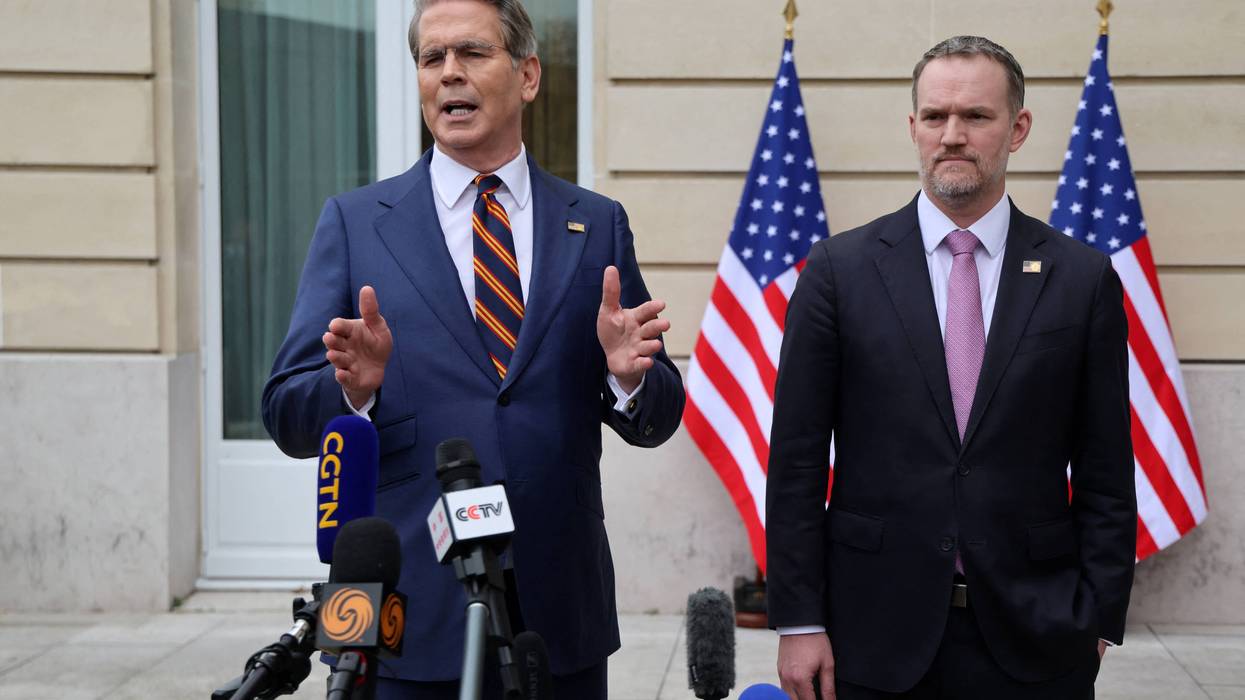
Today, Rep. Adam Schiff (D-CA), a senior Member of the Intelligence Committee, offered an amendment to the annual Defense appropriations which would prohibit the use of funds pursuant to the Authorization for Use of Military Force (AUMF) on December 31, 2014 - effectively sunsetting the law. By the end of 2014, the last American combat troops will rotate out of Afghanistan and the responsibility for that nation's security will have passed to the Afghan people. This amendment closely mirrors Schiff's bipartisan legislation which would sunset the Authorization for Use of Military Force (AUMF) by the end of 2014, and calls on the Administration and Congress to work together to determine what new authority, if any, is necessary to protect the country after that time.
Following the September 11 attacks, the Congress passed the Authorization for Use of Military Force to provide the President with authorization to use "force against those nations, organizations, or persons he determines planned, authorized, committed, or aided the terrorist attacks that occurred on September 11, 2001, or harbored such organizations or persons, in order to prevent any future acts of international terrorism against the United States by such nations, organizations or persons."
On the House Floor today, Schiff stated, "New Year's Day 2015 should not only bring a new relationship between the United States and Afghanistan. It should also mark the end of the conflict that was begun in our skies on that September morning and which was formalized days later when Congress passed the AUMF. The 2001 AUMF was never intended to authorize a war without end, and it now poorly defines those who pose a threat to our country. That authority, and the funding that goes along with it should expire concurrent with the end of our combat role in Afghanistan."
Since the AUMF passed, the U.S. has invaded Afghanistan, toppling the Taliban and routing the core of Al Qaeda. The authorization has also been used to support targeted strikes against Al Qaeda's operatives in other countries, and used as a basis to detain terrorists at the facility at Guantanamo Bay. The country now faces threats from individuals, entities and organizations that may affiliate with al Qaeda, or share its ideology and its determination to attack Americans, but which may not have even been in existence on September 11, 2001.
In his recent speech at the National Defense University, President Obama specifically called on Congress to work with him. "I look forward to engaging Congress and the American people in efforts to refine, and ultimately repeal, the AUMF's mandate," Obama said. "And I will not sign laws designed to expand this mandate further. Our systematic effort to dismantle terrorist organizations must continue. But this war, like all wars, must end."
Schiff added in his speech today, "The Constitution invests in Congress the power to declare war and the responsibility for appropriating funds to pay for it. It is our most awesome responsibility and is central to our military efforts overseas. We owe it to the men and women we send into combat to properly define and authorize their mission, and my amendment will effectively give Congress the next 16 months to do so."
Schiff's bipartisan legislation, which is co-sponsored by Rep. Tom Rooney (R-FL), can be found here.
Rep. Adam Bennett Schiff is an American lawyer, author, and politician who has served as a U.S. representative since 2001. A member of the Democratic Party, he has represented California's 28th congressional district since 2013.
"There is absolutely no basis for what the Department of Education is doing, and it is unimaginably cruel," said a leader at the National Women's Law Center.
Continuing the assault on transgender people that President Donald Trump launched as soon as he returned to power last year, the US Department of Education's Office for Civil Rights rescinded portions of settlements intended to protect trans students at five school districts and one college.
The department framed the move as "freeing schools" from the Biden and Obama administrations' "illegal and burdensome enforcement of Title IX of the Education Amendments of 1972," a landmark civil rights law that bars sex-based discrimination in schools that receive federal funding.
According to The Associated Press, "One of the school systems, Delaware Valley School District in rural eastern Pennsylvania, received notice of the change from the Trump administration in February and has since voted to roll back its antidiscrimination protections for transgender students."
The administration also rescinded provisions of resolution agreements with Cape Henlopen School District in Delaware and Fife School District in Washington, as well as California's La Mesa-Spring Valley School District, Sacramento City Unified, and Taft College.
This is a cruel step by the Trump administration that will make our schools less safe and welcoming for all.Trans kids deserve what every student deserves — a school that supports their freedom to thrive.
[image or embed]
— ACLU (@aclu.org) April 6, 2026 at 6:05 PM
"The Trump administration has opened at least 40 civil rights investigations into educational institutions that provide protections for transgender students," and filed lawsuits in California and Minnesota, The New York Times reported. However, "Education Department officials said there was no precedent for the federal government terminating previously negotiated civil rights settlements with schools. Civil rights lawyers who worked under Democratic and Republican administrations said they were unaware of previous examples of such a move."
Advocates for trans people sharply condemned the rollback, which came on the heels of last week's International Transgender Day of Visibility.
"This sends a chilling alarm that trans students really are a target of this administration," Shelby Chestnut, executive director of the California-based Transgender Law Center, told the Times. "It's extremely concerning. Students should be safe to go to school and get an education."
Shiwali Patel, senior director of education justice at the National Women's Law Center, said in a statement that "there is absolutely no basis for what the Department of Education is doing, and it is unimaginably cruel. Title IX exists to ensure that students are protected from discrimination and treated with dignity so that they can learn and thrive in our schools. It's always been about that. It's what students, families, lawmakers, and advocates fought for when Title IX was passed decades ago. But the Trump administration's Department of Education has spent its limited resources to strip Title IX of that very purpose."
"Real complaints of discrimination and sexual assault are going unanswered by the Department of Education while conservative lawmakers continue to escalate their attacks on a small minority of students," Patel noted. "Parents, teachers, and students need the department to focus on addressing real harms on campuses instead of rolling back policies that keep all students safe."
"We should all be alarmed at the Trump administration's cruel escalation of their anti-trans agenda," she added. "When they push laws that explicitly target trans people or attempt to use scientifically inaccurate language to define sex, they are also inevitably targeting all women and girls. They want to control what we do, how we look, and how we act until we are pushed out of public life. But we are not going anywhere."
“We only accept an end of the war with guarantees that we won’t be attacked again," said one senior Iranian official.
As President Donald Trump escalated his threats to commit war crimes in Iran if its government does not reopen the Strait of Hormuz, Iranian officials on Monday rejected what they called an inadequate ceasefire proposal and insisted on a guarantee that the US and Israel will not only stop their attacks, but also refrain from future aggression.
“We only accept an end of the war with guarantees that we won’t be attacked again," Mojtaba Ferdousi Pour, head of Iran’s diplomatic mission in Cairo, told The Associated Press, affirming his government's rejection of a 45-day truce proposed by regional mediators led by Pakistan and including Egypt and Turkey.
Trump said Monday that he said he might order attacks on all Iranian power plants and bridges if the country's government does not open the Strait of Hormuz—through which around 20 million daily barrels of oil and a large share of the world's liquefied natural gas passed before the war—by 8:00 pm Eastern time Tuesday.
“The entire country can be taken out in one night, and that night might be tomorrow night,” Trump said.
This, after the president on Sunday told Iran to “open the Fuckin’ Strait, you crazy bastards, or you’ll be living in Hell."
Trump—who recently threatened to bomb Iran "back to the Stone Ages"—said Sunday that he is unconcerned about committing war crimes in Iran, absurdly telling reporters that “the time the Iranian people are most unhappy... is when those bombs stop.”
Pour stressed that Iran can't trust Trump, who Iranian officials and others have accused of using nuclear negotiations as a cover to impose demands and buy time to prepare for more war.
Just hours before Trump announced his decision to bomb Iran in February, Omani Foreign Minister Badr bin Hamad Al Busaidi, the mediator of talks between the US and Iranian governments, said that a "peace deal is within our reach."
Iran's government was willing to make unprecedented concessions regarding its nuclear program up until the US and Israel began bombing the country on February 28. Every US administration since that of former President George W. Bush—including Trump's—has concluded that Iran is not seeking to develop nuclear weapons.
The US and Israel also launched attacks on Iran in the summer of 2025 amid ongoing negotiations with Tehran.
A senior Iranian official speaking to Drop Site News Monday on condition of anonymity said that “it is our assessment that the Trump administration, owing to legal constraints within the United States concerning the prosecution of the war as well as the need to maintain control over financial markets, requires a short-term pause in the conflict."
“Our assessment indicates that this proposal has been drafted solely on the basis of the mediators’ perception of the minimum demands of the parties for halting the war,” the official continued.
“Tehran does not consider a temporary ceasefire to be a logical course of action, inasmuch as the window for the United States’ exit from the conflict has already been delineated," they added. "Should the requisite political will exist, the parties are in a position to establish a permanent ceasefire and thereafter concentrate their efforts on diplomacy.”
The standoff comes as Iranian officials said US and Israeli strikes killed at least 34 people, including 6 children, since Monday morning. Recent US-Israeli targets have included Sharif University of Technology in Tehran, a major petrochemical plant in Asaluyeh, and the B1 bridge in Karaj.
Around 2,000 Iranians have been killed over 37 days of intense US-Israeli bombardment, according to Iranian officials and humanitarian groups. This figure includes over 200 children, more than 100 of whom were killed in the February 28 US cruise missile attack on the Shajareh Tayyebeh girls’ elementary school in Minab.
At least 13 US service members have been killed and hundreds more wounded by Iranian counterattacks, which have also killed at least 14 Israelis and more than two dozen people in Gulf Arab nations.
More than 1,400 people have also been killed by Israeli attacks on Lebanon, where over 1 million others have been displaced. Eleven Israeli soldiers have been killed in Lebanon.
All this is happening amid the backdrop of Israel's ongoing war on Gaza, which has left more than 250,000 Palestinians dead or wounded since the October 7, 2023 Hamas-led attack. Israel is facing a genocide case currently before the International Court of Justice, while the International Criminal Court is seeking the arrest of Israeli Prime Minister Benjamin Netanyahu and former Defense Minister Yoav Gallant for alleged crimes against humanity and war crimes in Gaza.
Eight Palestinians were reportedly killed and a number of others wounded on Monday in an Israeli airstrike east of the Maghazi refugee camp in central Gaza.
"Any actions that violate US and international law regarding the conduct of war must be thoroughly investigated and appropriate accountability pursued," said the head of NIAC.
As President Donald Trump's Tuesday night deadline for Iran to reopen the Strait of Hormuz or face more war crimes approached, the National Iranian American Council on Monday urged Congress to investigate the Republican leader's remarks as well as the US-Israeli destruction of Iran's civilian infrastructure that has already occurred.
"The US-Israel war on Iran increasingly appears aimed not at defeating a military adversary but instead at breaking the nation of Iran," said NIAC president Jamal Abdi in a statement. "The past days have seen repeated US-Israeli attacks on civilian targets in Iran, including Sharif University of Technology in Tehran, one of the world's preeminent universities; a major petrochemical plant in Asaluyeh; and the B1 bridge in Karaj, Iran."
Since the US and Israel launched the war—which has not been authorized by Congress—on February 28, they have struck at least tens of thousands of civilian sites, including energy infrastructure, homes, hospitals, and schools. While surrounded by children at a White House event on Monday, Trump attempted to defend his threat to consider "blowing everything up" in Iran if the government doesn't reopen the key shipping route by 8:00 pm Eastern time Tuesday.
Abdi argued that "as Americans, we should be outraged that our government and Israel's have so blurred the lines between civilian and military targets and are openly threatening to engage in war crimes that have little to no military value while inflicting disproportionate civilian harm."
"NIAC calls on the US Congress to thoroughly investigate the targeting and threatening of civilian sites in Iran, including by utilizing all tools at Congress' disposal including subpoena power to secure documentary evidence and testimony from relevant officials," he said. "Any actions that violate US and international law regarding the conduct of war must be thoroughly investigated and appropriate accountability pursued. We cannot allow such brazen disregard for civilian life to be normalized."
So far, nearly all congressional Republicans—who have majorities in both chambers—and a short list of Democrats have blocked attempts to end Trump's illegal assault on Iran via war powers resolutions, even though the US Constitution explicitly empowers only Congress to declare war. Similar measures for Trump's military misadventures elsewhere have also failed.
Still, Abdi said that "NIAC also reiterates that Congress must pass a war powers resolution directing the president to remove US forces from Iran as soon as possible, including by ending the congressional recess early. Moreover, NIAC calls on the United Nations and other international institutions to intervene and put a stop to these advertised crimes before they take place."
United Nations figures—including Secretary-General António Guterres, High Commissioner for Human Rights Volker Türk, and special rapporteurs—have repeatedly called for an end to the regional war, which critics argue violates the UN Charter. However, as one of the five permanent members of the Security Council, the US has veto power, which hamstrings the body's ability to respond.
Iran has responded to the barrage by bombing Israel and various Gulf states, while Israeli forces have renewed attacks on Lebanon and again restricted the flow of humanitarian aid into the Gaza Strip, where they are accused of engaging in genocide. At least 13 US service members and thousands of people across the Middle East have been killed.
"President Trump can and should halt all bombing of Iran immediately, which would do far more to bring the war to a close than his reckless threats to attack more power plants, bridges, and civilian infrastructure," said Abdi. "The United States should pursue a permanent negotiated end to the war and must be prepared to use its leverage by putting sanctions relief on the table."
"While proposed mediations like a reported 45-day ceasefire proposal promulgated by Pakistan would not be without some merit," he continued, "they remain disconnected from the realities of the war and the past experience of Iran being attacked twice by the US and Israel amid negotiations."
"Iran is extremely unlikely to surrender its own leverage just to allow the US and Israel with time and space to attack once again," he added. "This deficit of trust amid war is difficult to overcome, but it must if this war is to end before more civilians are harmed."
Citing a senior Iranian official, Drop Site News reported Monday that "Tehran rejects any agreement for a temporary ceasefire to end the war" and "would only accept an agreement that leads to a permanent end to the fighting."