

SUBSCRIBE TO OUR FREE NEWSLETTER
Daily news & progressive opinion—funded by the people, not the corporations—delivered straight to your inbox.
5
#000000
#FFFFFF
To donate by check, phone, or other method, see our More Ways to Give page.
Daily news & progressive opinion—funded by the people, not the corporations—delivered straight to your inbox.

Jenny Harbine, Earthjustice, 406-586-9699
Today the US Senate released a Continuing Resolution to fund federal government operations for the remainder of the fiscal year that calls for delisting of wolves in Montana and Idaho. The bill directs the Secretary of the Interior to reissue a wolf delisting rule first issued in 2009 that removed Endangered Species Act protection from wolves in Idaho, Montana, eastern Oregon, eastern Washington, and northern Utah. The rule retained federal protections for wolves in Wyoming, which has thus far refused to produce a wolf management plan that the US Fish and Wildlife Service deems adequate. A federal court in Montana struck down the 2009 delisting rule, finding that it violated the Endangered Species Act. The wolf delisting language in the budget bill states that, once reinstated, the delisting rule will not be subject to judicial review.
Idaho and Montana are eager to commence wolf hunting, which will be permitted if the Senate's budget bill passes.
The following is a statement from Earthjustice attorney Jenny Harbine:
"Congress adopted the Endangered Species Act to protect species from social intolerance and shifting political winds. This bill reverses nearly four decades of Congressional wisdom by subjecting wolves to these very threats. What species will be targeted next?
Wolves are an indispensible part of the northern Rockies landscape. Congressional delisting will allow the northern Rockies wolf population to be hunted down to unsustainable levels."
Earthjustice is a non-profit public interest law firm dedicated to protecting the magnificent places, natural resources, and wildlife of this earth, and to defending the right of all people to a healthy environment. We bring about far-reaching change by enforcing and strengthening environmental laws on behalf of hundreds of organizations, coalitions and communities.
800-584-6460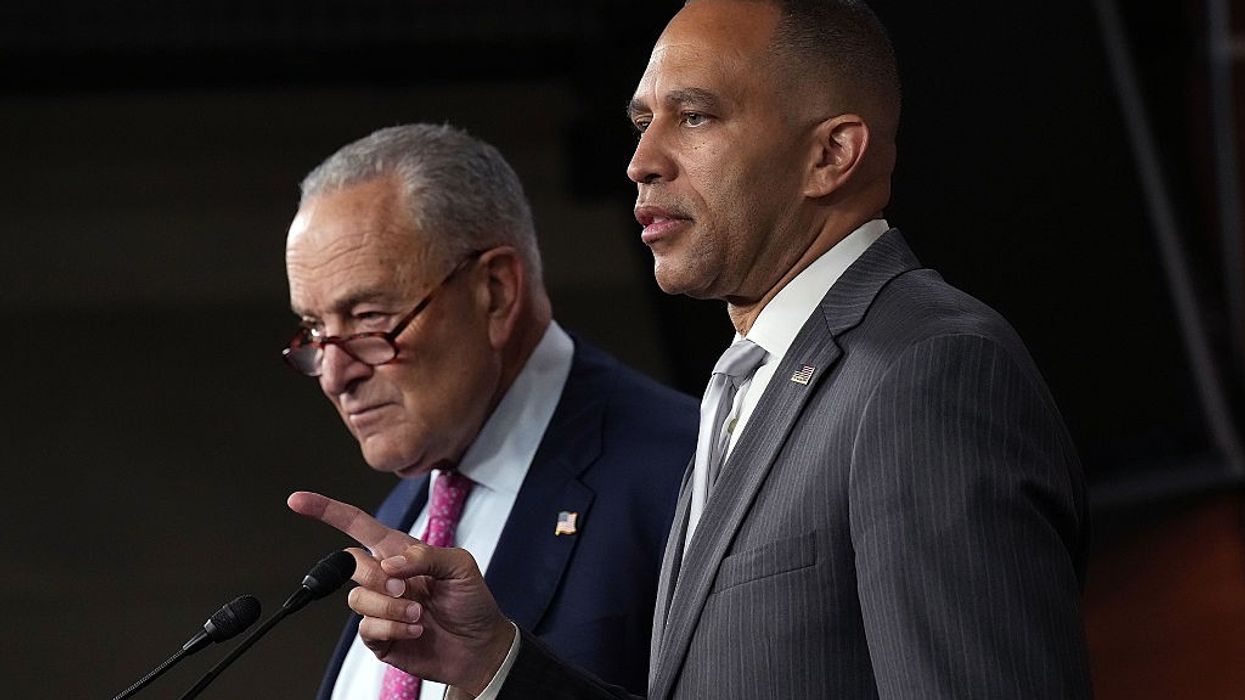
"A two-week ceasefire is insufficient," argued House Minority Leader Hakeem Jeffries. "We need a permanent end to Donald Trump’s reckless war of choice."
After accusations of cowardly delays, Democratic leaders in the US Congress moved Wednesday toward a vote on yet another war powers resolution aimed at stopping President Donald Trump from waging more unauthorized war on Iran as the tenuous day-old Mideast ceasefire unravels.
Senate Minority Leader Chuck Schumer (D-NY) announced Wednesday that Democrats will force a vote on a war powers resolution when upper chamber lawmakers reconvene next week.
"Congress must reassert its authority, especially at this dangerous moment," Schumer said during a press conference at his New York office. "No president, Democrat or Republican, should take this country to war alone. Not now. Not ever."
Meanwhile, House Minority Leader Hakeem Jeffries (D-NY) reiterated remarks made during a Tuesday evening interview with CNN's Anderson Cooper, in which he said he's demanding House Speaker Mike Johnson (R-La.) "immediately reconvene the House back into session" so lawmakers can vote on the war powers resolution.
"A two-week ceasefire is insufficient," Jeffries said. "We need a permanent end to Donald Trump’s reckless war of choice."
"Assuming it doesn’t happen this week, we’ll go back into session next week and we will present a war powers resolution as soon as it becomes available to us to do so as a matter of privilege on the House floor," he continued. "All we need are a handful of Republicans to join us."
"The American people strongly oppose this reckless war of choice and know that we should not be spending billions of dollars to drop bombs in Iran while Republicans and Donald Trump are unwilling to spend a dime to actually make life more affordable for the American people," Jeffries added.
The GOP-controlled House and Senate have rejected attempts to pass war powers resolutions, with Johnson denying that the US is even at war—a dubious argument used in as far back as the Korean War in order to skirt the constitutional requirement for congressional assent.
Jeffries also announced Wednesday that House Judiciary Committee Ranking Member Jamie Raskin (D-Md.) has scheduled a Friday meeting online regarding “Trump administration accountability and the 25th Amendment," which allows for the dismissal of a president who is incapacitated, unable, or unwilling to perform their duties.
More than 80 Democratic lawmakers are urging members of Trump's Cabinet to invoke the measure and remove him from office for his genocidal threats against Iran.
Schumer's announcement came on the heels of a day that began with Trump's genocidal threat to wipe out Iran's civilization and ended with an agreement for the US and Israel to grant broad concessions to Tehran—including a two-week pause in hostilities—in exchange for the reopening of the Strait of Hormuz.
“All of this happens when one man, especially a man acting as unhinged as Donald Trump, has unchecked power to wage war,” Schumer said. “He backs himself into a corner with dangerous, escalating rhetoric.”
“The entire world holds its breath, wondering what's next going to come out of his mouth,” Schumer said of Trump. “And can he ever find a way out? A commander-in-chief who is truly in control would never have gotten into this colossal mess to begin with.”
There have been several unsuccessful attempts to pass an Iran war powers resolution, including a bipartisan House effort led by Reps. Ko Khanna (D-Calif.) and Thomas Massie (R-Ky.), and another spearheaded by Sens. Tim Kaine (D-Va.) and Rand Paul (R-Ky.) in the upper chamber. A handful of House Republicans supported the Khanna-Massie resolution, while Sen. John Fetterman (D-Pa.) broke ranks to vote against the Kaine-Paul measure.
“Republicans will once again have the opportunity to join Democrats and end this reckless war of choice," Schumer added. "The public must demand that Republicans join with us to approve the War Powers Act."
The renewed push for a war powers vote comes as the shaky Iran ceasefire is being heavily tested both by Israel's devastating attacks on Lebanon—which have reportedly killed or wounded more than 1,300 people over the past 24 hours—and Iran's refusal to allow ships to pass through the Strait of Hormuz.
Schumer said Wednesday that “this is one of the very worst military and foreign policy actions that the United States has ever taken."
“The war made us worse in terms of control of the Strait of Hormuz,” he argued, alluding to the ceasefire provision allowing Iranian control over the vital waterway and a $2 million-per-ship toll. "The war made us worse in terms of the strength of the Iranian regime. The war made us worse in terms of high gas prices... And the war made us worse because American credibility is down the drain.”
The War Powers Resolution of 1973—also known as the War Powers Act—was enacted during the Nixon administration toward the end of the US war on Vietnam, Cambodia, and Laos. The law empowers Congress to check the president’s war-making authority by requiring the president to report any military action to Congress within 48 hours. It also mandates that lawmakers approve any troop deployments lasting longer than 60 days.
In addition to Iran, members of Congress have tried—and failed—to pass multiple war powers resolutions limiting Trump's attacks on Venezuela, whose president was kidnapped during a brief US invasion in January.

One climate reporter warned their windfalls "will go toward political campaigns and lobbying organizations dedicated to fighting climate regulation, blocking clean energy policy, and fueling authoritarianism."
After pouring money into President Donald Trump's successful campaign to take back the White House, US fossil fuel industry executives cashed in on his and Israel's war on Iran with record-setting stock sales, according to a VerityData analysis reported on Wednesday by The Wall Street Journal.
"Much of the selling for the first quarter began before the US and Israel began bombing Iran on February 28," and some "were prearranged under plans that allow executives to sell stock automatically at specific times or share prices without making in-the-moment decisions that could leave them open to allegations of improper trading," the newspaper acknowledged.
However, as share prices for the industry skyrocketed—Iran responded to the US-Israeli assault by shutting down the Strait of Hormuz, a key trade route for fossil fuels—executives at Chevron, ConocoPhillips, Diamondback Energy, and other oil and gas companies collectively sold $1.4 billion in stock.
"At nearly a dozen companies, the number of executives selling in the quarter reached or surpassed 10-year records, and in some cases set all-time records," the Journal detailed. "The sales hit a 15-year peak, with nearly six executives selling for every one that bought shares in the first quarter—well over double the usual ratio."
"CEOs stood out as big sellers in many cases," the newspaper highlighted, noting that "Chevron chief executive Mike Wirth sold some $104 million worth of shares between January and March. ConocoPhillips's Ryan Lance netted about $54.3 million in share sales in March alone. Lorenzo Simonelli, CEO of oil field services company Baker Hughes, sold about $33 million worth of stock that same month."
VerityData's head of research, Ben Silverman, said that "it speaks to the opportunistic behavior of everyone involved—it could be opportunistic set months earlier, it could be opportunistic in the moment... There was a breathlessness to the selling, and the message they sent was to cash in now because the ride won't last forever."
Who's profiting from ridiculous and unnecessary wars? Big Oil CEOs, to name one obvious group. @emorwee.bsky.social heated.world/p/chevrons-c...
[image or embed]
— Ross Macfarlane (@rossmacfarlane.bsky.social) April 8, 2026 at 5:04 PM
In her Heated newsletter, climate journalist Emily Atkin pointed out that "this isn't the first time a small group of extraordinarily wealthy oil CEOs used a war to make themselves richer. In the weeks after President Joe Biden said that he was 'convinced' Russia would invade Ukraine in 2022, Big Oil CEOs sold almost $99 million worth of shares, according to an analysis by Friends of the Earth and BailoutWatch."
According to Atkin:
What really makes this story remarkable is not simply that oil executives got rich from a war. It's how perfectly legal and normal it all is, and what that legality reveals about who wins and who loses when America goes to war.
When America goes to war, the costs are distributed broadly, onto every American who drives a car or heats a home. The benefits are distributed narrowly, flowing to a small group of men whose compensation is designed to capture exactly this kind of windfall.
And the cash windfall these oil executives make from the war won't go primarily toward yachts and private jets (they already have those). It will go toward political campaigns and lobbying organizations dedicated to fighting climate regulation, blocking clean energy policy, and fueling authoritarianism.
The Journal reporting came on the heels of Trump and Iran agreeing to a fragile two-week ceasefire negotiated by Pakistan late Tuesday. While Israel is supposedly on board, it escalated attacks on Lebanon on Wednesday.
As a Pakistani official publicly reiterated that Lebanon is still part of the deal and Iran threatened to back out altogether, Janet Abou-Elias, a researcher with the Democratizing Foreign Policy program at the Quincy Institute for Responsible Statecraft, told Common Dreams that Israel's assault "appeared to be a direct attempt to blow up the ceasefire, and it worked."
Meanwhile, although oil prices dropped after the ceasefire announcement, "'fossilflation'—or inflation caused by volatile and rising prices of oil and gas—is still likely to continue," the global climate group 350.org warned on Wednesday.
"Even if the Strait of Hormuz reopens and the ceasefire holds, oil and gas prices will stay above pre-war levels, and consumers will pay," said Andreas Sieber, 350.org's head of political strategy. "Volatility remains high, and supply will stay tight due to infrastructure damage and inventory rebuilding."
The group said last week that war-related spikes in oil and gas prices "have already cost consumers and businesses an additional $104.2-$111.6 billion" globally, and an analysis from Democratic members of the congressional Joint Economic Committee found that Americans spent an extra $8.4 billion at the fuel pump during the first month of Trump's war.
Throughout the conflict, 350.org and other green groups have advocated for a windfall profits tax targeting oil and gas giants, as well as renewed calls for a swift and just international transition away from climate-wrecking fossil fuels.

A foreign policy expert told Common Dreams that Israel’s unprecedented attack on Lebanon, backed by the US, “appeared to be a direct attempt to blow up the ceasefire, and it worked.”
A Pakistani official said Wednesday that despite Israel’s unprecedented attack on Lebanon, it is still part of the ceasefire agreement that Pakistan's prime minister helped to mediate the previous day, even as Israel and the US insist otherwise.
Pakistani Prime Minister Shehbaz Sharif, who played a key role in brokering the deal announced on Tuesday, said that "Iran and the United States of America, along with their allies, have agreed to an immediate ceasefire everywhere, including Lebanon and elsewhere, EFFECTIVE IMMEDIATELY.”
But within hours of the agreement, Israel launched what it said was its largest military operation against Lebanon yet, which killed at least 254 people and wounded 1,165 others, according to the Lebanese Health Ministry. The Israel Defense Forces acknowledged that the assault included attacks on many civilian areas.
Contrary to the mediators, Israeli Prime Minister Benjamin Netanyahu declared that the ceasefire "does not include Lebanon.” White House Press Secretary Karoline Leavitt followed suit, confirming that the US's position was also that “Lebanon is not part of the ceasefire,” adding that “that has been relayed to all parties involved."
But Pakistan's ambassador to the US, Rizwan Saeed Sheikh, said on Wednesday afternoon that this was not the agreement the parties reached on Tuesday.
He told CNN anchor Becky Anderson that the deal announced by his prime minister, which included Lebanon, "could not have been more authentic" to what the two parties agreed to, and that it was still the prime minister's understanding that Lebanon was included.
He added that this was another instance in which a ceasefire "could be disrupted" by Israel's actions. He also noted that "there have been instances in the past where ceasefires have been disrupted," a possible reference to Israel's routine violations of its previous ceasefire with Lebanon and the current one with Gaza, and its repeated assassinations of Iranian negotiators as they've sat down for talks with the US.
The US-Iran ceasefire is less than 24 hours old, but Israel's attack on Wednesday has already thrown it into peril. Iran responded to the attacks on Wednesday by once again closing the Strait of Hormuz after briefly reopening the critical waterway in accordance with the deal. Iran is also reportedly considering withdrawing from the ceasefire altogether and resuming strikes against Israel.
President Donald Trump has appeared eager to declare victory and move on from the war, which has further tanked his already plummeting support at home and sparked a global economic crisis.
But Janet Abou-Elias, a researcher with the Democratizing Foreign Policy program at the Quincy Institute for Responsible Statecraft, told Common Dreams that Israel's goals are very different.
She explained that Israel was largely sidelined from the talks that culminated in Tuesday's ceasefire and that within Israel's internal politics, the agreement is being portrayed as "catastrophic."
She noted that Yair Lapid, the leader of the opposition to Netanyahu's government, has portrayed it as “the worst political failure in our history,” and accused the prime minister of failing to achieve his goals.
"What we’ve seen since looks like Israel acting to undermine a diplomatic process over which it had lost influence," Abou-Elias said.
She said that Israel's attack on Lebanon on Wednesday, which it has referred to as Operation Eternal Darkness, "appeared to be a direct attempt to blow up the ceasefire, and it worked."
According to the Human Rights Activists News Agency, a US-based human rights monitor for Iran, at least 1,701 civilians have been killed in US-Israeli attacks against Iran since the war was launched on February 28.
After Wednesday's bombardment, Lebanon's Health Ministry reported that the death toll in the country was now up to at least 1,739 since the war began on March 2.
"At this point, any durable end to this conflict, even a temporary one, requires Washington to rein in Israel," Abou-Elias said. "Trump has the leverage to do it. What’s unclear is whether he has the political will to use it."