SUBSCRIBE TO OUR FREE NEWSLETTER
Daily news & progressive opinion—funded by the people, not the corporations—delivered straight to your inbox.
5
#000000
#FFFFFF
To donate by check, phone, or other method, see our More Ways to Give page.


Daily news & progressive opinion—funded by the people, not the corporations—delivered straight to your inbox.

Suzanne Struglinski, NRDC, 202-289-2387, sstruglinski@nrdc.org
In the five years since the historic Senator Paul Simon Water for the Poor Act became law, the United States has made limited progress in helping the 2.6 billion people worldwide who do not have adequate sanitation resources, the Natural Resources Defense Council, WaterAid, CARE and 11 other organizations said in a report released today.
A lack of strategic planning; inadequate political prioritization of safe water, sanitation and hygiene issues; and limited programming capacity at the United States Agency of International Development (USAID) and the State Department are just some of the reasons the government has fallen behind on the implementation of the law, the groups say.
"The United States government has a long way to go to meet its obligations to the needs of people around the world without access to safe sanitation, said Heather Allen, International Program advocate at the Natural Resources Defense Council. " With two in five people worldwide lacking access to a safe place to go the bathroom, on World Toilet Day we must commit to redouble our efforts to solve the global sanitation crisis."
In the report, "U.S. Implementation of the Senator Paul Simon Water for the Poor Act: Small Steps for a Crisis that Calls for Great Strides,"advocates outline what the Obama administration needs to do to address the global sanitation crisis and why it needs to happen immediately.
In addition to the report's recommendations for the administration, Congress passing the Water for the World Act can help build the capacity within the government to implement the Water for the Poor Act, passed in 2005, and would set a target for reaching 100 million people worldwide with safe water and sanitation.
"Threats from the global freshwater crisis grow each day, from increasing water shortages here at home to the billion people worldwide already living on the brink," said Rep. Earl Blumenauer (D-Ore.), who introduced the Water for the Poor Act and is a sponsor of the Water for the World Act. "The United States must act swiftly to confront this stunning poverty and insecurity."
"The Water for the World Act addresses the shortfalls in the implementation of our current aid programs that were identified by NRDC and others. It will enable the U.S. government to vastly improve the effectiveness by which we confront this challenge and we will save more lives," Blumenauer said.
Approximately 4,000 children under 5 years old in the developing world die each day from diarrheal diseases related to unsafe water and a lack of adequate sanitation. Diarrhea caused by unsafe water and sanitation kills more children under 5 every year than HIV/AIDS, malaria, and measles combined.
"Disease and death caused by unsafe drinking water and sanitation disproportionately affect poor children in poor countries," said Dr. David Winder, CEO WaterAid, America. "However, the bulk of U.S. assistance for water and sanitation is going to a handful of politically strategic countries whose populations have relatively good access to these basic services. For the U.S. government to have the greatest impact on saving lives and alleviating suffering, it must improve the level of resources that are directed specifically to poor countries."
The report, which has support from Action Against Hunger, AMREF, Catholic Relief Services, Global Water Challenge, H20 for Life, International Housing Coalition. Millennium Water Alliance, PATH, PSI (Population Services International), Water for People and Water.org, was one of many events recognizing World Toilet Day on Nov. 19, 2010. https://www.worldtoilet.org/
The organizations want the administration to take action now to save countless lives.
"In order to ensure that the U.S. government and U.S. taxpayers are getting the most possible out of this investment, it is crucial that the administration release a real strategy by which its efforts can be judged," said Peter Lochery, director of the Water Team at CARE. "Having a comprehensive strategy is the only way we are going to know that the most effective and sustainable approaches are being used that will result in the biggest positive impact for poor people around the world."
NRDC works to safeguard the earth--its people, its plants and animals, and the natural systems on which all life depends. We combine the power of more than three million members and online activists with the expertise of some 700 scientists, lawyers, and policy advocates across the globe to ensure the rights of all people to the air, the water, and the wild.
(212) 727-2700"May we honor him not only in sorrow, but in how bravely we continue with open hearts, steady steps, and the music leading us home," said the iconic musician's daughter. "Hang it up and see what tomorrow brings."
Bob Weir, one of the founding members of the Grateful Dead, has died after a storied career as guitarist and singer for one of the most iconic American rock bands of the last century.
"It is with profound sadness that we share the passing of Bobby Weir," read a message from Weir's daughter, Chloe Weir, posted to social media on Saturday evening. "We send him off the way he sent so many of us on our way: with a farewell that isn’t an ending, but a blessing. A reward for a life worth livin'."
Weir—along with Jerry Garcia, Phil Lesh, Ron "Pigpen" McKernan, and Bill Kreutzmann—formed the Grateful Dead in the Bay Area of California in 1965. Weir was only a teenager at the time, the youngest member of the band.
With the addition of Mickey Hart shortly after, and many others over the years, the band has toured the country in a variety of iterations ever since.
In a longer post about her father's passing, Chloe Weir wrote:
He transitioned peacefully, surrounded by loved ones, after courageously beating cancer as only Bobby could. Unfortunately, he succumbed to underlying lung issues.
For over sixty years, Bobby took to the road. A guitarist, vocalist, storyteller, and founding member of the Grateful Dead. Bobby will forever be a guiding force whose unique artistry reshaped American music. His work did more than fill rooms with music; it was warm sunlight that filled the soul, building a community, a language, and a feeling of family that generations of fans carry with them. Every chord he played, every word he sang was an integral part of the stories he wove. There was an invitation: to feel, to question, to wander, and to belong.
Bobby’s final months reflected the same spirit that defined his life. Diagnosed in July, he began treatment only weeks before returning to his hometown stage for a three-night celebration of 60 years of music at Golden Gate Park. Those performances, emotional, soulful, and full of light, were not farewells, but gifts. Another act of resilience. An artist choosing, even then, to keep going by his own design. As we remember Bobby, it’s hard not to feel the echo of the way he lived. A man driftin’ and dreamin’, never worrying if the road would lead him home. A child of countless trees. A child of boundless seas.
There is no final curtain here, not really. Only the sense of someone setting off again. He often spoke of a three-hundred-year legacy, determined to ensure the songbook would endure long after him. May that dream live on through future generations of Dead Heads. And so we send him off the way he sent so many of us on our way: with a farewell that isn’t an ending, but a blessing. A reward for a life worth livin’.
His loving family, Natascha, Monet, and Chloe, request privacy during this difficult time and offer their gratitude for the outpouring of love, support, and remembrance. May we honor him not only in sorrow, but in how bravely we continue with open hearts, steady steps, and the music leading us home. Hang it up and see what tomorrow brings.
Across the world, as the news spread, people impacted by Weir's artisrtry, social activism, and the music he produced with the Dead and other bands—including Kingfish, RatDog, and various other adventures—shared their love, celebrated his life, and expressed their grief over his passing.
"I’m writing this with tears streaming down my face," wrote music journalist Vic Vela. "I sang Bobby’s songs on road trips, in the shower, while house cleaning, and, of course, at Dead shows. He provided the soundtrack of my life and his music was there for me through good times and bad. The Grateful Dead are my Everything and you started it all, Bobby. Go be with your brothers now, sir. Go be with Jerry and Phil and Pigpen— Heaven’s Heart of Gold Band. Fare thee well, Bobby We love you."
- YouTube youtu.be
"So incredibly saddened by the passing of Bob Weir," said Kyle Hollingsworth, keyboardist for the String Cheese Incident, one of the countless rock bands over the decades heavily influenced by the innovative and improvisational style of music created by the Grateful Dead. "I spent many of my formative years dancing and watching from the audience. What a blessing to have had a moment with him. May his love light shine on. Rest in peace, Bobby."
"The dancing bears are still," declared Martha Quinn, a former VJ on MTV. "Founding Grateful Dead member Bob Weir passed away. He & the Dead were in a class unto themselves, fans saw them 100x times. Deadheads became a global family. May Bob be jamming with Jerry & Phil. They will survive, in our hearts and minds. My condolences to his loved ones, who number many."
"Not to get political, but it's a real indication of how flawed our healthcare system is," says the candidate for US Senate in Maine who supports Medicare for All.
Graham Platner and his wife, Amy Gertner, announced on Saturday that they are "leaving for a little while" in order to receive in vitro fertilization (IVF) treatments in the social democratic country of Norway, the necessity of which the Democratic Mainer running to unseat Republican Senator Susan Collins this year is a direct indictment of a "flawed" US healthcare system.
Platner, running against Maine Gov. Janet Mills and other candidates in a primary race to win the chance to challenge Collins, explains in a video how his and Amy's effort to get pregnant with their first child has corresponded with—but also predates—his Senate bid.
"Amy and I's life has taken an incredible turn," says Platner, filmed sitting with his wife in their home in Maine, as the video begins.
"We have been all over the state of Maine, from Ogunquit to Madawasca, from Rumford to Callis, holding well over 30 town halls" over recent months, he explains. "But in the background, we've also been trying to do something else, something we've been trying to do for a couple of years, and that has been to start a family."
"One round here in the States is $25,000. One round in Norway is $5,500 bucks. Even when you add on plane tickets, it's incomparable." —Graham Platner, candidate for US Senate
Watch:
Due to 'Astronomical' Cost in US, @grahamformaine and Wife, Amy Platner, Heading to Norway for Affordable IVF Treatment | "Not to get political, but it's a real indication of how flawed our healthcare system is," says US Senate candidate who supports Medicare for All. pic.twitter.com/036d4dig3I
— Common Dreams (@commondreams) January 10, 2026
Throughout his campaign for Senate, Platner, a military veteran who has benefited from the VA health system, has consistently called out the social injustice and economic backwardness of the nation's dominant for-profit healthcare system. Backing Medicare for All, Platner has said a single-payer system—with no co-pays, profit motives from giant insurers, and free medical care at point of service—is "the answer," a profoundly better way to manage the health needs of Americans, especially working people.
"I don't think we should live in a system where only the wealthy can afford healthcare," Platner said at a campaign event last year.
In December, just before the New Year, he said, "I will fight for Medicare for All in the Senate. Until we win it, I’ll back every bill that expands Medicare and Medicaid, cuts prescription drug costs, and puts the healthcare needs of the working class first."
In Saturday's announcement about their infertility journey and where it's headed next, the couple explain that they first looked at the VA to see if that would be a viable pathway to make the IVF process—which can cost $25,000 per round of treatment—more affordable.
Unfortunately, they found out, as Amy explains, that because "the infertility was something that was part of my body" and less so of Graham's, the VA system would not cover the treatments.
"We're going to have to have a conversation in the Senate, by the way," Graham said of that dynamic. "It takes two people. If you wanna have a kid, it's not a one-person job."

But while the VA's denial may have been the "end of the road," feared Amy, her doctor told her about other patients who have sought treatment abroad, where IVF treatments can be a fraction of the cost—a familiar pattern when it comes to what people in other countries pay for care, treatments, and prescription drugs compared to the United States.
Given Amy's assertion that she wanted to have a baby of her own "ever since I knew that it was something the female body was capable of doing," the idea of going to Norway arrived as a lifeline.
"To watch the woman that I love, who I want to start a family with, go through this experience of infertility," says Graham in the video. "I can see how it impacts her. I have so much respect and so much ... I'm so impressed at how you've been able to handle it."
Ultimately, it was the affordability dynamic, they explain, that led them to take the idea of going abroad seriously.
"One round here in the States is $25,000. One round in Norway is 5,500 bucks," Graham explains. "Even when you add on plane tickets, it's incomparable."
"Not to get political," he continues, "but it's a real indication of how flawed our healthcare system is. For us, the Senate campaign is a way of making sure that other people do not have to go through the exact same things that we've been through, where we can help build power in order to go get things that working people in this country need, like a universal healthcare system that provides fertility support."
Graham and Amy first spoke about their trip with local journalist Jesse Ellison with the Midcoast Villager for a story published on Thursday. In their conversation with the local paper, they both spoke of how the deeply personal struggle of trying to get pregnant is not at all divorced from the very real reasons that they both decided to back Graham's run for Senate.
From Ellison's reporting:
“It’s less about the VA and more about the fact that IVF is unaffordable for regular working-class people in this country,” Platner told me. “The concept of insurance companies not covering infertility treatment is why we need universal health care. Our story of infertility is just another example among many stories, we know we aren’t the only people struggling with this.” And so the two of them decided to talk about this choice publicly, too. Because if flying to Norway, spending two weeks in an Airbnb, and paying out-of-pocket for health care makes more financial sense than getting care here in America, well, that says something in and of itself.
For her part, Amys says, "I really wanted to share the story with any of you who have experienced infertility. I don't know if I have all of the answers or if sharing this story makes you feel like you're part of a community of infertility, but I hope that this can offer you some hope."
"There is no other justifiable way to describe what is taking place in Minneapolis at this moment," said the Minnesota Democrat.
Amidst national outrage this week over the killing by Minneapolis resident Renee Nicole Good by a federal agent, members of Minnesota's congressional delegation on Saturday were blocked from full access to a federal immigration detention center in the city—but at least one lawmaker among them warns something much more sinister is now taking place in the state.
"I was just denied access to the ICE processing center at the Whipple Building," Rep. Ilhan Omar (D-Minn.), who represents the state's 5th District. "Members of Congress have a legal right and constitutional responsibility to conduct oversight where people are being detained. The public deserves to know what is taking place in ICE facilities."
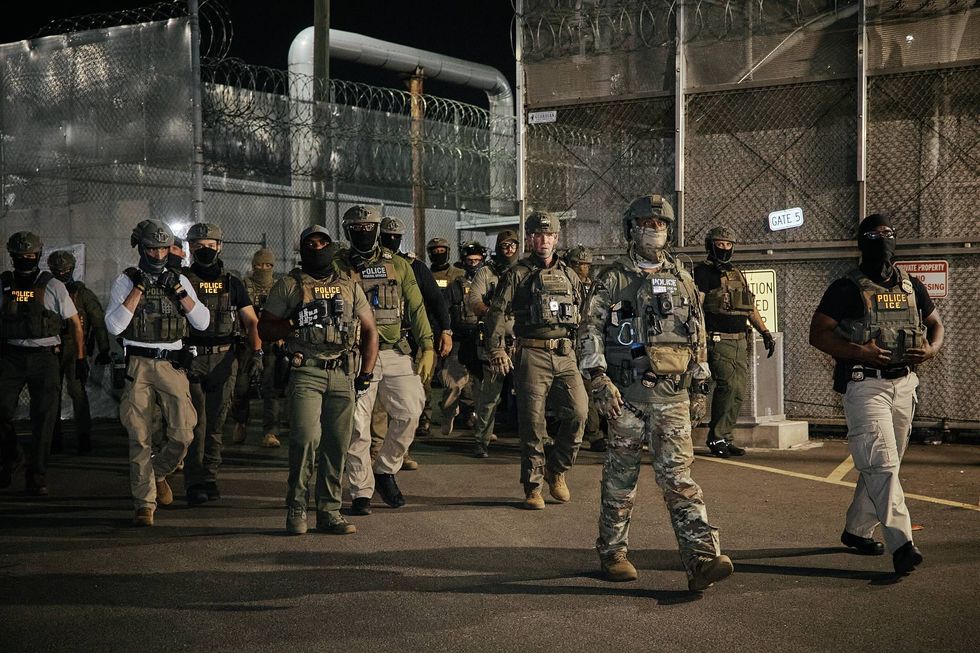
Omar shared a video of herself, along with Reps. Angie Craig and Kelly Morrison, outside the facility as large numbers of masked federal agents in protective gear blocked the driveway entrance.
Happening NOW: US Reps Ilhan Omar and Angie Craig are attempting to enter Whipple Fed Building- met with federal agents on other side. @wcco pic.twitter.com/3eIWxiLaW7
— Adam Duxter (@AdamDuxter) January 10, 2026
In a telephone interview with MSNOW, Omar later explained that she and her colleagues arrived at the facility Saturday morning in order to conduct oversight activities. While Omar said they were initially allowed to enter the building, they were shortly after told they "had to wait until higher-ups were able to come speak with us."
It seemed to Omar, she said, that the order to halt their visit "maybe came from Washington to deny us the proper access that we needed to complete those oversight duties that we are obligated as members of Congress."
Calling it a clear violation of their oversight authority, Omar and Craig explained to reporters what happened after they were denied further access to the facility:
"This is beyond the pale." Democratic Congresswomen Rep. Ilhan Omar and Rep. Annie Craig had their access to a federal detention facility revoked while touring the building. pic.twitter.com/KthvotCREX
— USA TODAY (@USATODAY) January 10, 2026
Congresswoman Craig also spoke to MSNOW's Ali Velshi:
Rep. Angie Craig: "We were told because this facility is being funding by the 'Big Beautiful Bill,' not the congressional appropriations act, that we would not be allowed to enter the facility. That's complete nonsense ... I informed them they were violating the law. They said… pic.twitter.com/vCOqgldB2Q
— Aaron Rupar (@atrupar) January 10, 2026
Noting the size and scale of the presence of armed federal agents now deployed in her state, Omar suggested in her interview with MSNOW that the recent Immigration and Custom Enforcement (ICE) operations being conducted serve no purpose other than to harass and terrorize local communities. That militarized presence has only grown since Trump ordered more agents to the city following Wednesday's killing of Good and the protests that have erupted as a result.
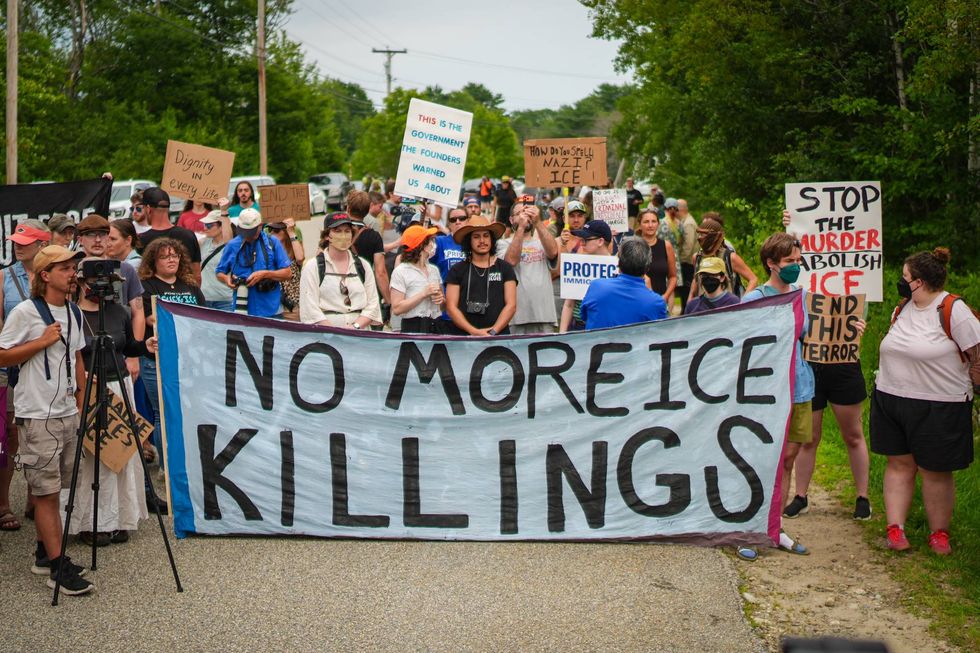
" Protest is as American as apple pie," said Omar. "People come out to register their opposition to what they do not like or want to accept. It is important for people to be able to do that in a democracy."
"What we are seeing right now, not only from the surge of 2,000 federal agents—now we have another 1,000 apparently coming in—it is essentially trying to create this kind of environment where people feel intimidated, threatened, and terrorized. And I think the ultimate goal of [Homeland Security Security Secretary] Kristi Noem and President Trump is to agitate people enough where they are able to invoke the Insurrection Act to declare martial law."
"There is," she continued, "no other justifiable way to describe what is taking place in Minneapolis at this moment. There is no justifiable reason why this number of agents is here in our state."