SUBSCRIBE TO OUR FREE NEWSLETTER
Daily news & progressive opinion—funded by the people, not the corporations—delivered straight to your inbox.
5
#000000
#FFFFFF
To donate by check, phone, or other method, see our More Ways to Give page.
Daily news & progressive opinion—funded by the people, not the corporations—delivered straight to your inbox.
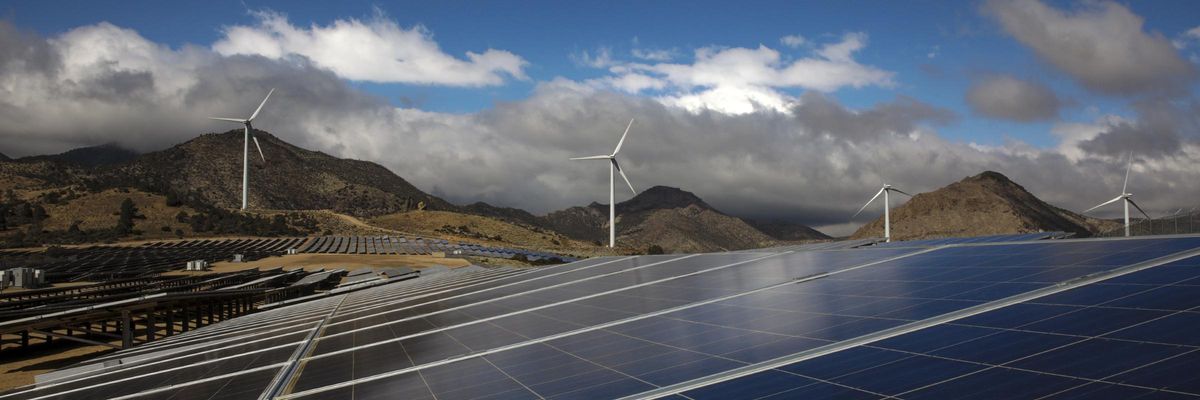
A wind farm and solar power plant are pictured on March 23, 2021 in Kern County, California.
"As we begin 2023, it seems very likely that renewables will provide nearly a quarter—if not more—of the nation's electricity during the coming year," said Ken Bossong of the SUN DAY Campaign.
A new analysis of federal data shows that wind and solar alone could generate more electricity in the United States than nuclear and coal over the coming year, critical progress toward reducing the country's reliance on dirty energy.
The SUN DAY Campaign, a nonprofit that promotes sustainable energy development, highlighted a recently released U.S. Energy Information Administration (EIA) review finding that renewable sources as a whole—including solar, wind, biomass, and others—provided 22.6% of U.S. electricity over the first 10 months of 2022, a pace set to beat the agency's projection for the full year.
"Taken together, during the first ten months of 2022, renewable energy sources comfortably out-produced both coal and nuclear power by 16.62% and 27.39% respectively," the SUN DAY Campaign noted Tuesday. "However, natural gas continues to dominate with a 39.4% share of total generation."
The new EIA figures show that electricity output from solar alone jumped by more than 26% in the first 10 months of last year. In just October, the SUN DAY Campaign observed, "solar's output was 31.68% greater than a year earlier, a rate of growth that strongly eclipsed that of every other energy source."
Ken Bossong, the campaign's executive director, said that "as we begin 2023, it seems very likely that renewables will provide nearly a quarter—if not more—of the nation's electricity during the coming year."
"And it is entirely possible that the combination of just wind and solar will outpace nuclear power and maybe even that of coal during the next twelve months," Bossong added.
"It is entirely possible that the combination of just wind and solar will outpace nuclear power and maybe even that of coal during the next twelve months."
The encouraging data comes amid the broader context of U.S. failures to sufficiently accelerate renewable energy production and phase out fossil fuel use, which is helping push greenhouse gas emissions to record-shattering levels globally.
Gas production, a major contributor to highly potent methane pollution, likely broke an annual record in the U.S. last year, according to the latest federal data. One recent analysis found that the U.S. is currently pursuing more new oil pipeline capacity by length than any other country.
The Climate Action Tracker (CAT), a site created by a group of scientists to analyze nations' emissions targets and progress, rates the U.S. as "insufficient" overall, arguing the country's "climate policies and action in 2030 need substantial improvements to be consistent with the 1.5°C temperature limit."
On the positive side, CAT welcomes the recent passage of the Inflation Reduction Act (IRA), a law that's set to boost the U.S. build-out of renewable energy infrastructure.
"However, while the largest share of the IRA is directed to clean technologies, it also includes several concessions for the fossil fuel industry such as requiring minimum acreages of public lands for drilling leases," CAT notes. "These concessions contradict President Biden's promise on his first day in office to ban new oil and gas drilling on federal lands."
Dear Common Dreams reader, It’s been nearly 30 years since I co-founded Common Dreams with my late wife, Lina Newhouser. We had the radical notion that journalism should serve the public good, not corporate profits. It was clear to us from the outset what it would take to build such a project. No paid advertisements. No corporate sponsors. No millionaire publisher telling us what to think or do. Many people said we wouldn't last a year, but we proved those doubters wrong. Together with a tremendous team of journalists and dedicated staff, we built an independent media outlet free from the constraints of profits and corporate control. Our mission has always been simple: To inform. To inspire. To ignite change for the common good. Building Common Dreams was not easy. Our survival was never guaranteed. When you take on the most powerful forces—Wall Street greed, fossil fuel industry destruction, Big Tech lobbyists, and uber-rich oligarchs who have spent billions upon billions rigging the economy and democracy in their favor—the only bulwark you have is supporters who believe in your work. But here’s the urgent message from me today. It's never been this bad out there. And it's never been this hard to keep us going. At the very moment Common Dreams is most needed, the threats we face are intensifying. We need your support now more than ever. We don't accept corporate advertising and never will. We don't have a paywall because we don't think people should be blocked from critical news based on their ability to pay. Everything we do is funded by the donations of readers like you. When everyone does the little they can afford, we are strong. But if that support retreats or dries up, so do we. Will you donate now to make sure Common Dreams not only survives but thrives? —Craig Brown, Co-founder |
A new analysis of federal data shows that wind and solar alone could generate more electricity in the United States than nuclear and coal over the coming year, critical progress toward reducing the country's reliance on dirty energy.
The SUN DAY Campaign, a nonprofit that promotes sustainable energy development, highlighted a recently released U.S. Energy Information Administration (EIA) review finding that renewable sources as a whole—including solar, wind, biomass, and others—provided 22.6% of U.S. electricity over the first 10 months of 2022, a pace set to beat the agency's projection for the full year.
"Taken together, during the first ten months of 2022, renewable energy sources comfortably out-produced both coal and nuclear power by 16.62% and 27.39% respectively," the SUN DAY Campaign noted Tuesday. "However, natural gas continues to dominate with a 39.4% share of total generation."
The new EIA figures show that electricity output from solar alone jumped by more than 26% in the first 10 months of last year. In just October, the SUN DAY Campaign observed, "solar's output was 31.68% greater than a year earlier, a rate of growth that strongly eclipsed that of every other energy source."
Ken Bossong, the campaign's executive director, said that "as we begin 2023, it seems very likely that renewables will provide nearly a quarter—if not more—of the nation's electricity during the coming year."
"And it is entirely possible that the combination of just wind and solar will outpace nuclear power and maybe even that of coal during the next twelve months," Bossong added.
"It is entirely possible that the combination of just wind and solar will outpace nuclear power and maybe even that of coal during the next twelve months."
The encouraging data comes amid the broader context of U.S. failures to sufficiently accelerate renewable energy production and phase out fossil fuel use, which is helping push greenhouse gas emissions to record-shattering levels globally.
Gas production, a major contributor to highly potent methane pollution, likely broke an annual record in the U.S. last year, according to the latest federal data. One recent analysis found that the U.S. is currently pursuing more new oil pipeline capacity by length than any other country.
The Climate Action Tracker (CAT), a site created by a group of scientists to analyze nations' emissions targets and progress, rates the U.S. as "insufficient" overall, arguing the country's "climate policies and action in 2030 need substantial improvements to be consistent with the 1.5°C temperature limit."
On the positive side, CAT welcomes the recent passage of the Inflation Reduction Act (IRA), a law that's set to boost the U.S. build-out of renewable energy infrastructure.
"However, while the largest share of the IRA is directed to clean technologies, it also includes several concessions for the fossil fuel industry such as requiring minimum acreages of public lands for drilling leases," CAT notes. "These concessions contradict President Biden's promise on his first day in office to ban new oil and gas drilling on federal lands."
A new analysis of federal data shows that wind and solar alone could generate more electricity in the United States than nuclear and coal over the coming year, critical progress toward reducing the country's reliance on dirty energy.
The SUN DAY Campaign, a nonprofit that promotes sustainable energy development, highlighted a recently released U.S. Energy Information Administration (EIA) review finding that renewable sources as a whole—including solar, wind, biomass, and others—provided 22.6% of U.S. electricity over the first 10 months of 2022, a pace set to beat the agency's projection for the full year.
"Taken together, during the first ten months of 2022, renewable energy sources comfortably out-produced both coal and nuclear power by 16.62% and 27.39% respectively," the SUN DAY Campaign noted Tuesday. "However, natural gas continues to dominate with a 39.4% share of total generation."
The new EIA figures show that electricity output from solar alone jumped by more than 26% in the first 10 months of last year. In just October, the SUN DAY Campaign observed, "solar's output was 31.68% greater than a year earlier, a rate of growth that strongly eclipsed that of every other energy source."
Ken Bossong, the campaign's executive director, said that "as we begin 2023, it seems very likely that renewables will provide nearly a quarter—if not more—of the nation's electricity during the coming year."
"And it is entirely possible that the combination of just wind and solar will outpace nuclear power and maybe even that of coal during the next twelve months," Bossong added.
"It is entirely possible that the combination of just wind and solar will outpace nuclear power and maybe even that of coal during the next twelve months."
The encouraging data comes amid the broader context of U.S. failures to sufficiently accelerate renewable energy production and phase out fossil fuel use, which is helping push greenhouse gas emissions to record-shattering levels globally.
Gas production, a major contributor to highly potent methane pollution, likely broke an annual record in the U.S. last year, according to the latest federal data. One recent analysis found that the U.S. is currently pursuing more new oil pipeline capacity by length than any other country.
The Climate Action Tracker (CAT), a site created by a group of scientists to analyze nations' emissions targets and progress, rates the U.S. as "insufficient" overall, arguing the country's "climate policies and action in 2030 need substantial improvements to be consistent with the 1.5°C temperature limit."
On the positive side, CAT welcomes the recent passage of the Inflation Reduction Act (IRA), a law that's set to boost the U.S. build-out of renewable energy infrastructure.
"However, while the largest share of the IRA is directed to clean technologies, it also includes several concessions for the fossil fuel industry such as requiring minimum acreages of public lands for drilling leases," CAT notes. "These concessions contradict President Biden's promise on his first day in office to ban new oil and gas drilling on federal lands."