
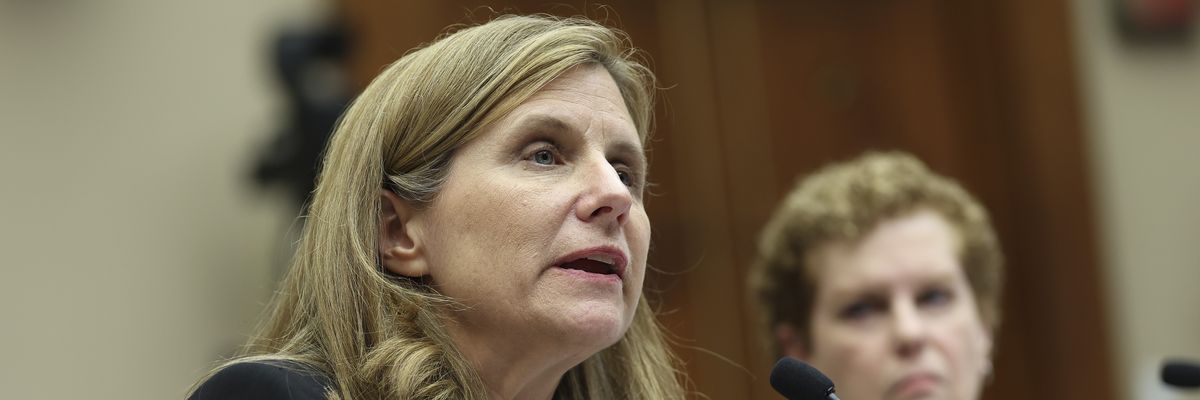
Liz Magill, president of University of Pennsylvania, testifies before the House Education and Workforce Committee on December 5, 2023 in Washington, DC.
'Horrifying Precedent': Penn President Resigns Amid Right-Wing Campus Speech Uproar
"She was coerced into resigning for defending her students’ right to political free speech," said one critic.
Professors at the University of Pennsylvania on Saturday were joined by rights advocates in condemning the attacks that forced university president Liz Magill to resign days after she testified before the U.S. Congress.
Magill had angered lawmakers from both parties by refusing to say students should be punished for hypothetically "calling for the genocide of Jews."
Magill announced her resignation Saturday after the university lost a $100 million donation from hedge fund manager Ross Stevens, a Penn alum, due to last Tuesday's hearing at the House Education and Workforce Committee.
At the hearing, Rep. Elise Stefanik (R-N.Y.) demanded to know whether hypothetical calls for committing a genocide against Jewish people would violate the policies of Penn, Harvard, and the Massachusetts Institute of Technology. Stefanik also conflated calls for "intifada"—an uprising against oppression which is not necessarily violent or aimed at eliminating any group of people—with demands for a genocide against Jewish people. Committee members did not point to examples of students actually calling for genocide.
Magill, along with the presidents of the other two elite institutions, told the committee that such speech, if "directed and severe, pervasive," would qualify as harassment and would be disciplined as such, but suggested that in accordance with the U.S. Constitution, Penn does not generally discipline people for speech alone.
Magill's testimony represented Penn's official rules governing free speech, which state that "universities can invest their efforts and resources in educating their members and in creating spaces and contexts for productive dialogue, but they cannot legitimately punish members—students, staff, and faculty—who choose not to participate in those, or who profess bigoted and other hateful views."
But powerful donors including Stevens and former Utah Gov. Jon Huntsman, another Penn graduate, demanded Magill's ouster and said they would end their financial support until the president resigned.
The Penn chapter of the American Association of University Professors (AAUP) said that "Penn faculty and students who have expressed concern for Palestinian civilians and criticized the war in Gaza," had been targeted by "distortions and attacks" that have done nothing to actually address "the scourge of antisemitism—a real and grave problem."
"Instead, they have threatened the ability of faculty and students to research, teach, study, and publicly discuss the history, politics, and cultures of Israel and Palestine," said the group. "These attacks strike at the heart of the mission of an educational institution: to foster open, critical, and rigorous research and teaching that can produce knowledge for the public good in a democratic society."
The AAUP said the next university president must "defend the principles of shared governance and academic freedom, which protect the educational mission of the university."
"And they must correct what has become a dangerous myth suggesting that the defense of academic freedom and open expression is in any way contradictory to the fight against antisemitism," the group added.
The attacks on Magill from Congress—including a letter signed last week by 74 members of both parties who demanded her resignation—followed calls in September from the school's Board of Trustees for Magill to distance Penn from a literature festival that celebrated Palestinian writers.
The Board of Advisors at Wharton, Penn's business school, also wrote to Magill on Thursday asking for her resignation and notifying her of resolutions they had unanimously proposed, including one saying students and faculty would not "engage in hate speech, whether veiled or explicit."
Jonathan Friedman, director of free expression and education programs at PEN America, said the "vague" resolutions threaten "to ban wide swaths of speech."
Writer and rights advocate Leah McElrath said Magill's resignation set "a horrifying precedent" and was indicative of a larger effort in the U.S. to suppress political speech that is critical of the Israeli government and and to "expand the definition of antisemitism to include anti-Zionism."
"The story here is not solely about Liz Magill," said Alex Kane, senior staff reporter for Jewish Currents. "The main story is a McCarthyist atmosphere consuming college campuses over calls for Palestinian liberation. Magill tepidly defended free speech for Palestine advocates, then made a big PR misstep and fell into a right-wing trap."
Since October 7, colleges including Columbia University and Brandeis University have suspended their campus chapters of Students for Justice in Palestine, which has held protests against Israel's U.S.-backed war in Gaza. About 18,000 Palestinians—including more than 6,600 children—have now been killed and 49,500 have been wounded as the Israel Defense Forces have claimed they are targeting Hamas and making efforts to protect civilians.
Peter Beinart, editor-at-large for Jewish Currents, said the ongoing controversy over antisemitism on college campuses—now the subject of an official House investigation—is meant to distract from the massacre of civilians in Gaza.
"Forcing [the] resignation of [a] university president for failing to condemn non-existent 'calls for genocide' of Jews," said Sarah Leah Whitson, executive director of Democracy for the Arab World Now, "all while an actual U.S.-supported genocide of Palestinians [is] underway—is ALL about silencing criticism of Israel."
Note: This article has been corrected to better reflect the comments of the AAUP at University of Pennsylvania.
We are at a crossroads
This country and this world are at a monumental crossroads. In a few short weeks, US voters will have an opportunity to beat back the forces of fascism and confront the billionaires who are rigging the economy, our media system, and our democracy, making it increasingly impossible for ordinary people to get by. We’re not just talking about the election. We’re talking about what must be done once these fascist elements are vanquished from power. We need a bolder set of solutions than what either major party has so far been willing to offer and a working-class movement ready to fight like hell for it. Trump didn't emerge from nowhere. The conditions that fueled MAGA authoritarianism were created by decades of radical neoliberal economic policies and a corrupt political system dominated by corporate interests. They slashed taxes on the super-rich, promising that the benefits would trickle down. They said giveaways to the corporate titans would make life more affordable for the rest of us. It was all bullshit. And when a bitter, betrayed populace searches for someone to blame, right-wing demagogues have little trouble finding scapegoats. People know when they're being lied to, but you won't hear any of this from the corporate media. Only independent journalism—powered and funded by people who believe in building a better world—can deliver truly trustworthy daily news. Our Fall Campaign is underway, and we need your help. To power our newsroom through the rest of the year, we need to raise $125,000 by midnight on October 31. So if you share our vision, please contribute whatever you can to sustain our work. |
Professors at the University of Pennsylvania on Saturday were joined by rights advocates in condemning the attacks that forced university president Liz Magill to resign days after she testified before the U.S. Congress.
Magill had angered lawmakers from both parties by refusing to say students should be punished for hypothetically "calling for the genocide of Jews."
Magill announced her resignation Saturday after the university lost a $100 million donation from hedge fund manager Ross Stevens, a Penn alum, due to last Tuesday's hearing at the House Education and Workforce Committee.
At the hearing, Rep. Elise Stefanik (R-N.Y.) demanded to know whether hypothetical calls for committing a genocide against Jewish people would violate the policies of Penn, Harvard, and the Massachusetts Institute of Technology. Stefanik also conflated calls for "intifada"—an uprising against oppression which is not necessarily violent or aimed at eliminating any group of people—with demands for a genocide against Jewish people. Committee members did not point to examples of students actually calling for genocide.
Magill, along with the presidents of the other two elite institutions, told the committee that such speech, if "directed and severe, pervasive," would qualify as harassment and would be disciplined as such, but suggested that in accordance with the U.S. Constitution, Penn does not generally discipline people for speech alone.
Magill's testimony represented Penn's official rules governing free speech, which state that "universities can invest their efforts and resources in educating their members and in creating spaces and contexts for productive dialogue, but they cannot legitimately punish members—students, staff, and faculty—who choose not to participate in those, or who profess bigoted and other hateful views."
But powerful donors including Stevens and former Utah Gov. Jon Huntsman, another Penn graduate, demanded Magill's ouster and said they would end their financial support until the president resigned.
The Penn chapter of the American Association of University Professors (AAUP) said that "Penn faculty and students who have expressed concern for Palestinian civilians and criticized the war in Gaza," had been targeted by "distortions and attacks" that have done nothing to actually address "the scourge of antisemitism—a real and grave problem."
"Instead, they have threatened the ability of faculty and students to research, teach, study, and publicly discuss the history, politics, and cultures of Israel and Palestine," said the group. "These attacks strike at the heart of the mission of an educational institution: to foster open, critical, and rigorous research and teaching that can produce knowledge for the public good in a democratic society."
The AAUP said the next university president must "defend the principles of shared governance and academic freedom, which protect the educational mission of the university."
"And they must correct what has become a dangerous myth suggesting that the defense of academic freedom and open expression is in any way contradictory to the fight against antisemitism," the group added.
The attacks on Magill from Congress—including a letter signed last week by 74 members of both parties who demanded her resignation—followed calls in September from the school's Board of Trustees for Magill to distance Penn from a literature festival that celebrated Palestinian writers.
The Board of Advisors at Wharton, Penn's business school, also wrote to Magill on Thursday asking for her resignation and notifying her of resolutions they had unanimously proposed, including one saying students and faculty would not "engage in hate speech, whether veiled or explicit."
Jonathan Friedman, director of free expression and education programs at PEN America, said the "vague" resolutions threaten "to ban wide swaths of speech."
Writer and rights advocate Leah McElrath said Magill's resignation set "a horrifying precedent" and was indicative of a larger effort in the U.S. to suppress political speech that is critical of the Israeli government and and to "expand the definition of antisemitism to include anti-Zionism."
"The story here is not solely about Liz Magill," said Alex Kane, senior staff reporter for Jewish Currents. "The main story is a McCarthyist atmosphere consuming college campuses over calls for Palestinian liberation. Magill tepidly defended free speech for Palestine advocates, then made a big PR misstep and fell into a right-wing trap."
Since October 7, colleges including Columbia University and Brandeis University have suspended their campus chapters of Students for Justice in Palestine, which has held protests against Israel's U.S.-backed war in Gaza. About 18,000 Palestinians—including more than 6,600 children—have now been killed and 49,500 have been wounded as the Israel Defense Forces have claimed they are targeting Hamas and making efforts to protect civilians.
Peter Beinart, editor-at-large for Jewish Currents, said the ongoing controversy over antisemitism on college campuses—now the subject of an official House investigation—is meant to distract from the massacre of civilians in Gaza.
"Forcing [the] resignation of [a] university president for failing to condemn non-existent 'calls for genocide' of Jews," said Sarah Leah Whitson, executive director of Democracy for the Arab World Now, "all while an actual U.S.-supported genocide of Palestinians [is] underway—is ALL about silencing criticism of Israel."
Note: This article has been corrected to better reflect the comments of the AAUP at University of Pennsylvania.
- University of Florida Pro-Palestine Group Sues DeSantis Over Deactivation ›
- In 'Disgraceful' Assault on Free Speech, DeSantis Bans Pro-Palestinian Student Group ›
- Students Demanding Protection for Pro-Palestinian Activism Arrested at House Hearing on Campus Speech ›
- Opinion | Stop Bullying US Students Calling for Justice for Palestine | Common Dreams ›
- Opinion | Israel’s War on Gaza Has Become a ‘Stress Test’ for Academic Freedom | Common Dreams ›
- Ex-Harvard Hillel Leader: 'Stop Weaponizing Antisemitism' ›
- Opinion | An Open Letter to Elise Stefanik: This Is Genocide and You Should Resign | Common Dreams ›
- NYCLU to Sue If Columbia Won't Reinstate Pro-Palestinian Campus Groups ›
- 'Shameful': Columbia Greenlights Police Crackdown on Anti-War Encampment | Common Dreams ›
- Opinion | House GOP Plays Politics With Campus Antisemitism While Enabling Islamophobia | Common Dreams ›
- Texas State Troopers in Riot Gear Crack Down on UT Students' Gaza Protest | Common Dreams ›
- Opinion | Columbia’s President Sold Out Students and Faculty to Far-Right McCarthyism | Common Dreams ›
- Opinion | The Older Generation of Politicians Can’t Stop the American Intifada | Common Dreams ›
- Opinion | These University Presidents Aren’t Leaders—They’re Lackeys | Common Dreams ›
- Jewish Organizers Slam GOP Antisemitism Hearing as 'Offensive and Dangerous' | Common Dreams ›
- Opinion | Speaking Freely in the Age of Trump | Common Dreams ›
- Opinion | In the Attack on Pro-Palestinian Campus Speech, More Than Jobs Are at Stake | Common Dreams ›
- Opinion | The Joint Attack on Campus Protesters Threatens America’s Core Values | Common Dreams ›
- Univ. of Washington Removes Mideast Center Director Who Criticized US-Israeli War on Iran | Common Dreams ›
Professors at the University of Pennsylvania on Saturday were joined by rights advocates in condemning the attacks that forced university president Liz Magill to resign days after she testified before the U.S. Congress.
Magill had angered lawmakers from both parties by refusing to say students should be punished for hypothetically "calling for the genocide of Jews."
Magill announced her resignation Saturday after the university lost a $100 million donation from hedge fund manager Ross Stevens, a Penn alum, due to last Tuesday's hearing at the House Education and Workforce Committee.
At the hearing, Rep. Elise Stefanik (R-N.Y.) demanded to know whether hypothetical calls for committing a genocide against Jewish people would violate the policies of Penn, Harvard, and the Massachusetts Institute of Technology. Stefanik also conflated calls for "intifada"—an uprising against oppression which is not necessarily violent or aimed at eliminating any group of people—with demands for a genocide against Jewish people. Committee members did not point to examples of students actually calling for genocide.
Magill, along with the presidents of the other two elite institutions, told the committee that such speech, if "directed and severe, pervasive," would qualify as harassment and would be disciplined as such, but suggested that in accordance with the U.S. Constitution, Penn does not generally discipline people for speech alone.
Magill's testimony represented Penn's official rules governing free speech, which state that "universities can invest their efforts and resources in educating their members and in creating spaces and contexts for productive dialogue, but they cannot legitimately punish members—students, staff, and faculty—who choose not to participate in those, or who profess bigoted and other hateful views."
But powerful donors including Stevens and former Utah Gov. Jon Huntsman, another Penn graduate, demanded Magill's ouster and said they would end their financial support until the president resigned.
The Penn chapter of the American Association of University Professors (AAUP) said that "Penn faculty and students who have expressed concern for Palestinian civilians and criticized the war in Gaza," had been targeted by "distortions and attacks" that have done nothing to actually address "the scourge of antisemitism—a real and grave problem."
"Instead, they have threatened the ability of faculty and students to research, teach, study, and publicly discuss the history, politics, and cultures of Israel and Palestine," said the group. "These attacks strike at the heart of the mission of an educational institution: to foster open, critical, and rigorous research and teaching that can produce knowledge for the public good in a democratic society."
The AAUP said the next university president must "defend the principles of shared governance and academic freedom, which protect the educational mission of the university."
"And they must correct what has become a dangerous myth suggesting that the defense of academic freedom and open expression is in any way contradictory to the fight against antisemitism," the group added.
The attacks on Magill from Congress—including a letter signed last week by 74 members of both parties who demanded her resignation—followed calls in September from the school's Board of Trustees for Magill to distance Penn from a literature festival that celebrated Palestinian writers.
The Board of Advisors at Wharton, Penn's business school, also wrote to Magill on Thursday asking for her resignation and notifying her of resolutions they had unanimously proposed, including one saying students and faculty would not "engage in hate speech, whether veiled or explicit."
Jonathan Friedman, director of free expression and education programs at PEN America, said the "vague" resolutions threaten "to ban wide swaths of speech."
Writer and rights advocate Leah McElrath said Magill's resignation set "a horrifying precedent" and was indicative of a larger effort in the U.S. to suppress political speech that is critical of the Israeli government and and to "expand the definition of antisemitism to include anti-Zionism."
"The story here is not solely about Liz Magill," said Alex Kane, senior staff reporter for Jewish Currents. "The main story is a McCarthyist atmosphere consuming college campuses over calls for Palestinian liberation. Magill tepidly defended free speech for Palestine advocates, then made a big PR misstep and fell into a right-wing trap."
Since October 7, colleges including Columbia University and Brandeis University have suspended their campus chapters of Students for Justice in Palestine, which has held protests against Israel's U.S.-backed war in Gaza. About 18,000 Palestinians—including more than 6,600 children—have now been killed and 49,500 have been wounded as the Israel Defense Forces have claimed they are targeting Hamas and making efforts to protect civilians.
Peter Beinart, editor-at-large for Jewish Currents, said the ongoing controversy over antisemitism on college campuses—now the subject of an official House investigation—is meant to distract from the massacre of civilians in Gaza.
"Forcing [the] resignation of [a] university president for failing to condemn non-existent 'calls for genocide' of Jews," said Sarah Leah Whitson, executive director of Democracy for the Arab World Now, "all while an actual U.S.-supported genocide of Palestinians [is] underway—is ALL about silencing criticism of Israel."
Note: This article has been corrected to better reflect the comments of the AAUP at University of Pennsylvania.
- University of Florida Pro-Palestine Group Sues DeSantis Over Deactivation ›
- In 'Disgraceful' Assault on Free Speech, DeSantis Bans Pro-Palestinian Student Group ›
- Students Demanding Protection for Pro-Palestinian Activism Arrested at House Hearing on Campus Speech ›
- Opinion | Stop Bullying US Students Calling for Justice for Palestine | Common Dreams ›
- Opinion | Israel’s War on Gaza Has Become a ‘Stress Test’ for Academic Freedom | Common Dreams ›
- Ex-Harvard Hillel Leader: 'Stop Weaponizing Antisemitism' ›
- Opinion | An Open Letter to Elise Stefanik: This Is Genocide and You Should Resign | Common Dreams ›
- NYCLU to Sue If Columbia Won't Reinstate Pro-Palestinian Campus Groups ›
- 'Shameful': Columbia Greenlights Police Crackdown on Anti-War Encampment | Common Dreams ›
- Opinion | House GOP Plays Politics With Campus Antisemitism While Enabling Islamophobia | Common Dreams ›
- Texas State Troopers in Riot Gear Crack Down on UT Students' Gaza Protest | Common Dreams ›
- Opinion | Columbia’s President Sold Out Students and Faculty to Far-Right McCarthyism | Common Dreams ›
- Opinion | The Older Generation of Politicians Can’t Stop the American Intifada | Common Dreams ›
- Opinion | These University Presidents Aren’t Leaders—They’re Lackeys | Common Dreams ›
- Jewish Organizers Slam GOP Antisemitism Hearing as 'Offensive and Dangerous' | Common Dreams ›
- Opinion | Speaking Freely in the Age of Trump | Common Dreams ›
- Opinion | In the Attack on Pro-Palestinian Campus Speech, More Than Jobs Are at Stake | Common Dreams ›
- Opinion | The Joint Attack on Campus Protesters Threatens America’s Core Values | Common Dreams ›
- Univ. of Washington Removes Mideast Center Director Who Criticized US-Israeli War on Iran | Common Dreams ›