SUBSCRIBE TO OUR FREE NEWSLETTER
Daily news & progressive opinion—funded by the people, not the corporations—delivered straight to your inbox.
5
#000000
#FFFFFF
To donate by check, phone, or other method, see our More Ways to Give page.
Daily news & progressive opinion—funded by the people, not the corporations—delivered straight to your inbox.
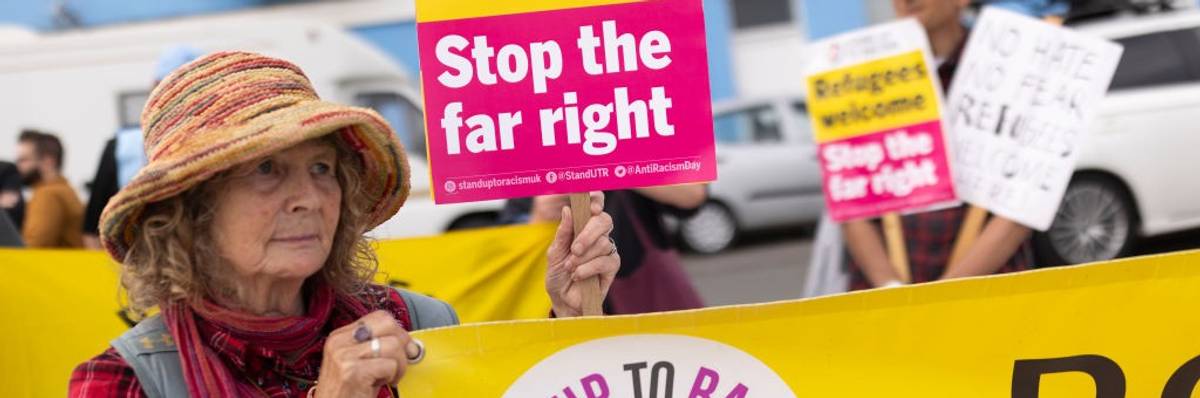
Immigrant rights advocates demonstrate in Portland, England on July 18, 2023.
"This bill sets a worrying precedent for dismantling asylum-related obligations that other countries, including in Europe, may be tempted to follow," said the U.N. human rights chief.
A pair of United Nations commissioners on Tuesday accused the United Kingdom of violating its international human rights and refugee law obligations after the country's Conservative Party-led Parliament approved legislation cracking down on asylum-seekers.
Tories passed the so-called Illegal Migration Bill, the centerpiece of right-wing U.K. Prime Minister Rishi Sunak's pledge to "stop the boats" crossing the English Channel, on Monday night. It is set to become law once King Charles III gives his "royal assent," which a monarch hasn't used to block a bill in 315 years.
After that formality, the measure "will have profound consequences for people in need of international protection," U.N. High Commissioner for Human Rights Volker Türk and U.N. High Commissioner for Refugees Filippo Grandi warned in a joint statement.
As the U.N. Human Rights Office explained:
The bill extinguishes access to asylum in the U.K. for anyone who arrives irregularly, having passed through a country—however briefly—where they did not face persecution. It bars them from presenting refugee protection or other human rights claims, no matter how compelling their circumstances. In addition, it requires their removal to another country, with no guarantee that they will necessarily be able to access protection there. It creates sweeping new detention powers, with limited judicial oversight.
"For decades, the U.K. has provided refuge to those in need, in line with its international obligations—a tradition of which it has been rightly proud," said Grandi. "This new legislation significantly erodes the legal framework that has protected so many, exposing refugees to grave risks in breach of international law."
According to the U.N. Human Rights Office, the legislation "denies access to protection in the U.K. for anyone falling within its scope—including unaccompanied and separated children—regardless of whether they are at risk of persecution, may have suffered human rights violations, or whether they are survivors of human trafficking or modern-day slavery and may have other well-founded claims under international human rights and humanitarian law."
In Türk's words, "Carrying out removals under these circumstances is contrary to prohibitions of refoulement and collective expulsions, rights to due process, to family and private life, and the principle of best interests of children concerned."
"In addition to raising very serious legal concerns from the international perspective," Türk continued, "this bill sets a worrying precedent for dismantling asylum-related obligations that other countries, including in Europe, may be tempted to follow, with a potentially adverse effect on the international refugee and human rights protection system as a whole."
Last month, the U.K. Court of Appeal ruled that the Tories' widely condemned plan to deport asylum-seekers to Rwanda is unlawful because the African nation cannot be classified as a "safe third country."
Sunak and U.K. Home Secretary Suella Braverman have vowed to challenge the ruling in the U.K. Supreme Court. The courtroom battle over the legality of the so-called U.K.-Rwanda Asylum Partnership Arrangement could have implications for the fate of the broader Illegal Migration Bill. It also underscores how the newly approved legislation threatens to leave asylum-seekers in limbo.
The U.N. Human Rights Office warned Tuesday that "in the absence of viable removal arrangements with third countries, or without adequate operational capacity to remove large numbers of asylum-seekers, thousands can be expected to remain in the U.K. indefinitely in precarious legal situations."
"The legislation will exacerbate the already vulnerable situation of people who arrive irregularly in the U.K., drastically limiting the enjoyment of their human rights, and putting them at risk of detention and destitution," the office added. "As a result, their rights to health, an adequate standard of living, and to work are at risk, exposing them to the risk of exploitation and abuse."
According to the Financial Times:
The end of the legislative debate between the Commons and the Lords came as the Bibby Stockholm barge docked in Dorset where it is expected to house up to 500 migrants, with the first arrivals expected this month.
Ministers' plans to house asylum-seekers in the 93-meter-long vessel have faced intense backlash from local people and council members, who said the proposal was cruel and would place undue strain on the community.
Türk noted that "the U.K. has long had a commitment to upholding international human rights and refugee law."
"Such steadfast commitment is needed today more than ever," said Türk. "I urge the U.K. government to renew this commitment to human rights by reversing this law and ensuring that the rights of all migrants, refugees, and asylum-seekers are respected, protected, and fulfilled, without discrimination."
"This should include efforts to guarantee expeditious and fair processing of asylum and human rights claims, improve reception conditions, and increase the availability and accessibility of safe pathways for regular migration," added the U.N. human rights chief.
Dear Common Dreams reader, It’s been nearly 30 years since I co-founded Common Dreams with my late wife, Lina Newhouser. We had the radical notion that journalism should serve the public good, not corporate profits. It was clear to us from the outset what it would take to build such a project. No paid advertisements. No corporate sponsors. No millionaire publisher telling us what to think or do. Many people said we wouldn't last a year, but we proved those doubters wrong. Together with a tremendous team of journalists and dedicated staff, we built an independent media outlet free from the constraints of profits and corporate control. Our mission has always been simple: To inform. To inspire. To ignite change for the common good. Building Common Dreams was not easy. Our survival was never guaranteed. When you take on the most powerful forces—Wall Street greed, fossil fuel industry destruction, Big Tech lobbyists, and uber-rich oligarchs who have spent billions upon billions rigging the economy and democracy in their favor—the only bulwark you have is supporters who believe in your work. But here’s the urgent message from me today. It's never been this bad out there. And it's never been this hard to keep us going. At the very moment Common Dreams is most needed, the threats we face are intensifying. We need your support now more than ever. We don't accept corporate advertising and never will. We don't have a paywall because we don't think people should be blocked from critical news based on their ability to pay. Everything we do is funded by the donations of readers like you. When everyone does the little they can afford, we are strong. But if that support retreats or dries up, so do we. Will you donate now to make sure Common Dreams not only survives but thrives? —Craig Brown, Co-founder |
A pair of United Nations commissioners on Tuesday accused the United Kingdom of violating its international human rights and refugee law obligations after the country's Conservative Party-led Parliament approved legislation cracking down on asylum-seekers.
Tories passed the so-called Illegal Migration Bill, the centerpiece of right-wing U.K. Prime Minister Rishi Sunak's pledge to "stop the boats" crossing the English Channel, on Monday night. It is set to become law once King Charles III gives his "royal assent," which a monarch hasn't used to block a bill in 315 years.
After that formality, the measure "will have profound consequences for people in need of international protection," U.N. High Commissioner for Human Rights Volker Türk and U.N. High Commissioner for Refugees Filippo Grandi warned in a joint statement.
As the U.N. Human Rights Office explained:
The bill extinguishes access to asylum in the U.K. for anyone who arrives irregularly, having passed through a country—however briefly—where they did not face persecution. It bars them from presenting refugee protection or other human rights claims, no matter how compelling their circumstances. In addition, it requires their removal to another country, with no guarantee that they will necessarily be able to access protection there. It creates sweeping new detention powers, with limited judicial oversight.
"For decades, the U.K. has provided refuge to those in need, in line with its international obligations—a tradition of which it has been rightly proud," said Grandi. "This new legislation significantly erodes the legal framework that has protected so many, exposing refugees to grave risks in breach of international law."
According to the U.N. Human Rights Office, the legislation "denies access to protection in the U.K. for anyone falling within its scope—including unaccompanied and separated children—regardless of whether they are at risk of persecution, may have suffered human rights violations, or whether they are survivors of human trafficking or modern-day slavery and may have other well-founded claims under international human rights and humanitarian law."
In Türk's words, "Carrying out removals under these circumstances is contrary to prohibitions of refoulement and collective expulsions, rights to due process, to family and private life, and the principle of best interests of children concerned."
"In addition to raising very serious legal concerns from the international perspective," Türk continued, "this bill sets a worrying precedent for dismantling asylum-related obligations that other countries, including in Europe, may be tempted to follow, with a potentially adverse effect on the international refugee and human rights protection system as a whole."
Last month, the U.K. Court of Appeal ruled that the Tories' widely condemned plan to deport asylum-seekers to Rwanda is unlawful because the African nation cannot be classified as a "safe third country."
Sunak and U.K. Home Secretary Suella Braverman have vowed to challenge the ruling in the U.K. Supreme Court. The courtroom battle over the legality of the so-called U.K.-Rwanda Asylum Partnership Arrangement could have implications for the fate of the broader Illegal Migration Bill. It also underscores how the newly approved legislation threatens to leave asylum-seekers in limbo.
The U.N. Human Rights Office warned Tuesday that "in the absence of viable removal arrangements with third countries, or without adequate operational capacity to remove large numbers of asylum-seekers, thousands can be expected to remain in the U.K. indefinitely in precarious legal situations."
"The legislation will exacerbate the already vulnerable situation of people who arrive irregularly in the U.K., drastically limiting the enjoyment of their human rights, and putting them at risk of detention and destitution," the office added. "As a result, their rights to health, an adequate standard of living, and to work are at risk, exposing them to the risk of exploitation and abuse."
According to the Financial Times:
The end of the legislative debate between the Commons and the Lords came as the Bibby Stockholm barge docked in Dorset where it is expected to house up to 500 migrants, with the first arrivals expected this month.
Ministers' plans to house asylum-seekers in the 93-meter-long vessel have faced intense backlash from local people and council members, who said the proposal was cruel and would place undue strain on the community.
Türk noted that "the U.K. has long had a commitment to upholding international human rights and refugee law."
"Such steadfast commitment is needed today more than ever," said Türk. "I urge the U.K. government to renew this commitment to human rights by reversing this law and ensuring that the rights of all migrants, refugees, and asylum-seekers are respected, protected, and fulfilled, without discrimination."
"This should include efforts to guarantee expeditious and fair processing of asylum and human rights claims, improve reception conditions, and increase the availability and accessibility of safe pathways for regular migration," added the U.N. human rights chief.
A pair of United Nations commissioners on Tuesday accused the United Kingdom of violating its international human rights and refugee law obligations after the country's Conservative Party-led Parliament approved legislation cracking down on asylum-seekers.
Tories passed the so-called Illegal Migration Bill, the centerpiece of right-wing U.K. Prime Minister Rishi Sunak's pledge to "stop the boats" crossing the English Channel, on Monday night. It is set to become law once King Charles III gives his "royal assent," which a monarch hasn't used to block a bill in 315 years.
After that formality, the measure "will have profound consequences for people in need of international protection," U.N. High Commissioner for Human Rights Volker Türk and U.N. High Commissioner for Refugees Filippo Grandi warned in a joint statement.
As the U.N. Human Rights Office explained:
The bill extinguishes access to asylum in the U.K. for anyone who arrives irregularly, having passed through a country—however briefly—where they did not face persecution. It bars them from presenting refugee protection or other human rights claims, no matter how compelling their circumstances. In addition, it requires their removal to another country, with no guarantee that they will necessarily be able to access protection there. It creates sweeping new detention powers, with limited judicial oversight.
"For decades, the U.K. has provided refuge to those in need, in line with its international obligations—a tradition of which it has been rightly proud," said Grandi. "This new legislation significantly erodes the legal framework that has protected so many, exposing refugees to grave risks in breach of international law."
According to the U.N. Human Rights Office, the legislation "denies access to protection in the U.K. for anyone falling within its scope—including unaccompanied and separated children—regardless of whether they are at risk of persecution, may have suffered human rights violations, or whether they are survivors of human trafficking or modern-day slavery and may have other well-founded claims under international human rights and humanitarian law."
In Türk's words, "Carrying out removals under these circumstances is contrary to prohibitions of refoulement and collective expulsions, rights to due process, to family and private life, and the principle of best interests of children concerned."
"In addition to raising very serious legal concerns from the international perspective," Türk continued, "this bill sets a worrying precedent for dismantling asylum-related obligations that other countries, including in Europe, may be tempted to follow, with a potentially adverse effect on the international refugee and human rights protection system as a whole."
Last month, the U.K. Court of Appeal ruled that the Tories' widely condemned plan to deport asylum-seekers to Rwanda is unlawful because the African nation cannot be classified as a "safe third country."
Sunak and U.K. Home Secretary Suella Braverman have vowed to challenge the ruling in the U.K. Supreme Court. The courtroom battle over the legality of the so-called U.K.-Rwanda Asylum Partnership Arrangement could have implications for the fate of the broader Illegal Migration Bill. It also underscores how the newly approved legislation threatens to leave asylum-seekers in limbo.
The U.N. Human Rights Office warned Tuesday that "in the absence of viable removal arrangements with third countries, or without adequate operational capacity to remove large numbers of asylum-seekers, thousands can be expected to remain in the U.K. indefinitely in precarious legal situations."
"The legislation will exacerbate the already vulnerable situation of people who arrive irregularly in the U.K., drastically limiting the enjoyment of their human rights, and putting them at risk of detention and destitution," the office added. "As a result, their rights to health, an adequate standard of living, and to work are at risk, exposing them to the risk of exploitation and abuse."
According to the Financial Times:
The end of the legislative debate between the Commons and the Lords came as the Bibby Stockholm barge docked in Dorset where it is expected to house up to 500 migrants, with the first arrivals expected this month.
Ministers' plans to house asylum-seekers in the 93-meter-long vessel have faced intense backlash from local people and council members, who said the proposal was cruel and would place undue strain on the community.
Türk noted that "the U.K. has long had a commitment to upholding international human rights and refugee law."
"Such steadfast commitment is needed today more than ever," said Türk. "I urge the U.K. government to renew this commitment to human rights by reversing this law and ensuring that the rights of all migrants, refugees, and asylum-seekers are respected, protected, and fulfilled, without discrimination."
"This should include efforts to guarantee expeditious and fair processing of asylum and human rights claims, improve reception conditions, and increase the availability and accessibility of safe pathways for regular migration," added the U.N. human rights chief.