

SUBSCRIBE TO OUR FREE NEWSLETTER
Daily news & progressive opinion—funded by the people, not the corporations—delivered straight to your inbox.
5
#000000
#FFFFFF
To donate by check, phone, or other method, see our More Ways to Give page.
Daily news & progressive opinion—funded by the people, not the corporations—delivered straight to your inbox.
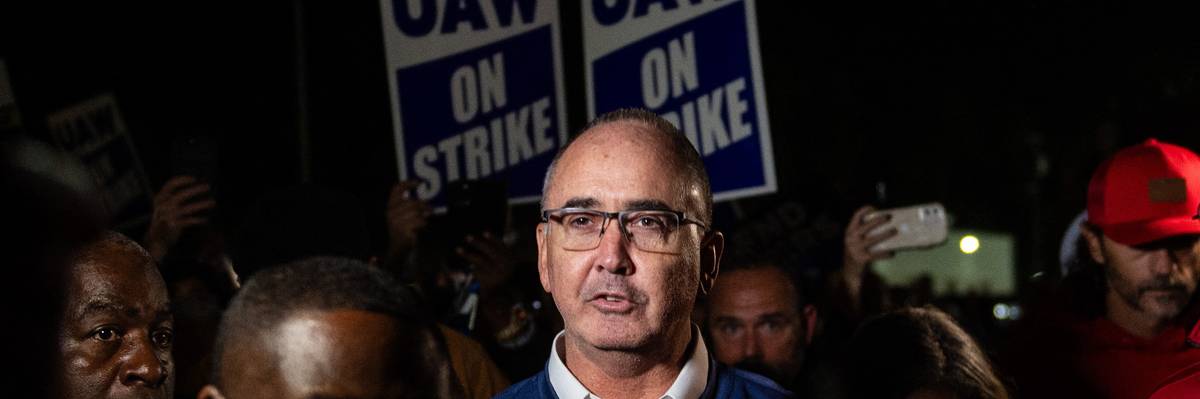
United Auto Workers president Shawn Fain speaks with members of the media across the street from the Ford Assembly Plant in Wayne, Michigan on September 15, 2023.
"The CEOs gave themselves 40% pay increases in the last four years alone," United Auto Workers president Shawn Fain said from the picket line. "And they want to call us greedy."
Forty percent.
It's a figure that United Auto Workers president Shawn Fain cited repeatedly in the run-up to the union's historic strike against the Big Three U.S. car manufacturers as he called attention to the exorbitant compensation of the companies' top executives.
Over the past four years, the CEOs of General Motors, Ford, and Stellantis have seen their total pay jump by 40% while the wages of the companies' ordinary employees have risen by just 6%. The Economic Policy Institute observed earlier this week that autoworker wages across the U.S. have fallen by 19.3% since 2008.
Last year, the CEOs of the Big Three automakers received staggering pay packages, fueling workers' ongoing push for better wages and benefits. Ford's Jim Farley took home around $21 million, Stellantis' Carlos Tavares pocketed nearly $25 million, and General Motors' Mary Barra—the highest-paid of the group—brought in roughly $29 million.
Barra has received more than $200 million in compensation since becoming GM's CEO in 2014.
"We've went backwards in the last 16 years—backwards—while the CEOs gave themselves 40% pay increases in the last four years alone," Fain said from a picket line in Michigan early Friday. "And they want to call us greedy."
"UAW members see the CEO pay disparity as a measurement of how they are undervalued."
The contrast between CEO and worker pay at the large, profitable automakers is striking.
The shareholder advocacy nonprofit As You Sow, which tracks CEO-to-worker pay gaps at U.S. companies, noted Friday that Ford's chief executive made 281 times as much as the company's median worker last year.
The gap was even larger at General Motors, where Barra was paid 362 times more than the automaker's median employee in 2022.
In a CNN interview on Friday, Barra insisted it is fair that General Motors is only offering its workers a 20% pay increase over the course of a four-year contract after she got a 34% compensation boost over the past four years.
Rosanna Landis Weaver, director of wage justice and executive compensation at As You Sow, said in a statement Friday that "as a consequence of out-of-control executive compensation, shareholders are now faced with striking workers at a critical juncture as these companies transition to EV production."
"UAW members see the CEO pay disparity as a measurement of how they are undervalued," said Weaver. "Skyrocketing CEO pay is linked to worker dissatisfaction and lower profits, making excessive pay a distinct material risk that shareholders must take seriously."
Progressive lawmakers who have expressed solidarity with the UAW's fight for a fair contract have also condemned runaway executive compensation and declining worker wages.
"The Big Three auto companies have already raked in $20 billion in profits this year. Their CEOs make millions. They can afford to pay their employees a living wage," Rep. Jamaal Bowman (D-N.Y.) wrote on social media Friday. "I'm standing with UAW as they start their strike. We got you!"
In an appearance on MSNBC Thursday night, Sen. Bernie Sanders (I-Vt.) noted that "over the last 20 years, real wages for automobile workers have gone down by 30% when you account for inflation" as CEO pay has risen.
"I really applaud the courage of Shawn Fain and the workers at the UAW for standing up and saying: 'You know what? Enough is enough,'" Sanders added. "No one thinks that three people on top should own more wealth than the bottom half of American society. That CEOs are making 400 times more than their workers—that's not what this country is supposed to be about. That's what the UAW is telling the American people, and I think there's massive support for what they're trying to do."
According to the Economic Policy Institute, CEO compensation at the top publicly traded companies in the U.S. grew by 1,460% between 1978 and 2021 while typical worker pay grew by just 18.1%.
Robert Reich, the former U.S. labor secretary, argued in a blog post Thursday that the combination of "humongous executive pay packages," massive automaker profits, low wages for hourly employees, and tiered pay systems that harm newer workers have increased "the likelihood of a long strike."
"CEO pay at the Big Three is out of sight," Reich noted. "Overall, CEO pay rose 40% over the last four years. And that's not counting all the other executive salaries under the CEOs that have been ratcheted upward as CEO pay has gone through the roof."
Dear Common Dreams reader, It’s been nearly 30 years since I co-founded Common Dreams with my late wife, Lina Newhouser. We had the radical notion that journalism should serve the public good, not corporate profits. It was clear to us from the outset what it would take to build such a project. No paid advertisements. No corporate sponsors. No millionaire publisher telling us what to think or do. Many people said we wouldn't last a year, but we proved those doubters wrong. Together with a tremendous team of journalists and dedicated staff, we built an independent media outlet free from the constraints of profits and corporate control. Our mission has always been simple: To inform. To inspire. To ignite change for the common good. Building Common Dreams was not easy. Our survival was never guaranteed. When you take on the most powerful forces—Wall Street greed, fossil fuel industry destruction, Big Tech lobbyists, and uber-rich oligarchs who have spent billions upon billions rigging the economy and democracy in their favor—the only bulwark you have is supporters who believe in your work. But here’s the urgent message from me today. It's never been this bad out there. And it's never been this hard to keep us going. At the very moment Common Dreams is most needed, the threats we face are intensifying. We need your support now more than ever. We don't accept corporate advertising and never will. We don't have a paywall because we don't think people should be blocked from critical news based on their ability to pay. Everything we do is funded by the donations of readers like you. When everyone does the little they can afford, we are strong. But if that support retreats or dries up, so do we. Will you donate now to make sure Common Dreams not only survives but thrives? —Craig Brown, Co-founder |
Forty percent.
It's a figure that United Auto Workers president Shawn Fain cited repeatedly in the run-up to the union's historic strike against the Big Three U.S. car manufacturers as he called attention to the exorbitant compensation of the companies' top executives.
Over the past four years, the CEOs of General Motors, Ford, and Stellantis have seen their total pay jump by 40% while the wages of the companies' ordinary employees have risen by just 6%. The Economic Policy Institute observed earlier this week that autoworker wages across the U.S. have fallen by 19.3% since 2008.
Last year, the CEOs of the Big Three automakers received staggering pay packages, fueling workers' ongoing push for better wages and benefits. Ford's Jim Farley took home around $21 million, Stellantis' Carlos Tavares pocketed nearly $25 million, and General Motors' Mary Barra—the highest-paid of the group—brought in roughly $29 million.
Barra has received more than $200 million in compensation since becoming GM's CEO in 2014.
"We've went backwards in the last 16 years—backwards—while the CEOs gave themselves 40% pay increases in the last four years alone," Fain said from a picket line in Michigan early Friday. "And they want to call us greedy."
"UAW members see the CEO pay disparity as a measurement of how they are undervalued."
The contrast between CEO and worker pay at the large, profitable automakers is striking.
The shareholder advocacy nonprofit As You Sow, which tracks CEO-to-worker pay gaps at U.S. companies, noted Friday that Ford's chief executive made 281 times as much as the company's median worker last year.
The gap was even larger at General Motors, where Barra was paid 362 times more than the automaker's median employee in 2022.
In a CNN interview on Friday, Barra insisted it is fair that General Motors is only offering its workers a 20% pay increase over the course of a four-year contract after she got a 34% compensation boost over the past four years.
Rosanna Landis Weaver, director of wage justice and executive compensation at As You Sow, said in a statement Friday that "as a consequence of out-of-control executive compensation, shareholders are now faced with striking workers at a critical juncture as these companies transition to EV production."
"UAW members see the CEO pay disparity as a measurement of how they are undervalued," said Weaver. "Skyrocketing CEO pay is linked to worker dissatisfaction and lower profits, making excessive pay a distinct material risk that shareholders must take seriously."
Progressive lawmakers who have expressed solidarity with the UAW's fight for a fair contract have also condemned runaway executive compensation and declining worker wages.
"The Big Three auto companies have already raked in $20 billion in profits this year. Their CEOs make millions. They can afford to pay their employees a living wage," Rep. Jamaal Bowman (D-N.Y.) wrote on social media Friday. "I'm standing with UAW as they start their strike. We got you!"
In an appearance on MSNBC Thursday night, Sen. Bernie Sanders (I-Vt.) noted that "over the last 20 years, real wages for automobile workers have gone down by 30% when you account for inflation" as CEO pay has risen.
"I really applaud the courage of Shawn Fain and the workers at the UAW for standing up and saying: 'You know what? Enough is enough,'" Sanders added. "No one thinks that three people on top should own more wealth than the bottom half of American society. That CEOs are making 400 times more than their workers—that's not what this country is supposed to be about. That's what the UAW is telling the American people, and I think there's massive support for what they're trying to do."
According to the Economic Policy Institute, CEO compensation at the top publicly traded companies in the U.S. grew by 1,460% between 1978 and 2021 while typical worker pay grew by just 18.1%.
Robert Reich, the former U.S. labor secretary, argued in a blog post Thursday that the combination of "humongous executive pay packages," massive automaker profits, low wages for hourly employees, and tiered pay systems that harm newer workers have increased "the likelihood of a long strike."
"CEO pay at the Big Three is out of sight," Reich noted. "Overall, CEO pay rose 40% over the last four years. And that's not counting all the other executive salaries under the CEOs that have been ratcheted upward as CEO pay has gone through the roof."
Forty percent.
It's a figure that United Auto Workers president Shawn Fain cited repeatedly in the run-up to the union's historic strike against the Big Three U.S. car manufacturers as he called attention to the exorbitant compensation of the companies' top executives.
Over the past four years, the CEOs of General Motors, Ford, and Stellantis have seen their total pay jump by 40% while the wages of the companies' ordinary employees have risen by just 6%. The Economic Policy Institute observed earlier this week that autoworker wages across the U.S. have fallen by 19.3% since 2008.
Last year, the CEOs of the Big Three automakers received staggering pay packages, fueling workers' ongoing push for better wages and benefits. Ford's Jim Farley took home around $21 million, Stellantis' Carlos Tavares pocketed nearly $25 million, and General Motors' Mary Barra—the highest-paid of the group—brought in roughly $29 million.
Barra has received more than $200 million in compensation since becoming GM's CEO in 2014.
"We've went backwards in the last 16 years—backwards—while the CEOs gave themselves 40% pay increases in the last four years alone," Fain said from a picket line in Michigan early Friday. "And they want to call us greedy."
"UAW members see the CEO pay disparity as a measurement of how they are undervalued."
The contrast between CEO and worker pay at the large, profitable automakers is striking.
The shareholder advocacy nonprofit As You Sow, which tracks CEO-to-worker pay gaps at U.S. companies, noted Friday that Ford's chief executive made 281 times as much as the company's median worker last year.
The gap was even larger at General Motors, where Barra was paid 362 times more than the automaker's median employee in 2022.
In a CNN interview on Friday, Barra insisted it is fair that General Motors is only offering its workers a 20% pay increase over the course of a four-year contract after she got a 34% compensation boost over the past four years.
Rosanna Landis Weaver, director of wage justice and executive compensation at As You Sow, said in a statement Friday that "as a consequence of out-of-control executive compensation, shareholders are now faced with striking workers at a critical juncture as these companies transition to EV production."
"UAW members see the CEO pay disparity as a measurement of how they are undervalued," said Weaver. "Skyrocketing CEO pay is linked to worker dissatisfaction and lower profits, making excessive pay a distinct material risk that shareholders must take seriously."
Progressive lawmakers who have expressed solidarity with the UAW's fight for a fair contract have also condemned runaway executive compensation and declining worker wages.
"The Big Three auto companies have already raked in $20 billion in profits this year. Their CEOs make millions. They can afford to pay their employees a living wage," Rep. Jamaal Bowman (D-N.Y.) wrote on social media Friday. "I'm standing with UAW as they start their strike. We got you!"
In an appearance on MSNBC Thursday night, Sen. Bernie Sanders (I-Vt.) noted that "over the last 20 years, real wages for automobile workers have gone down by 30% when you account for inflation" as CEO pay has risen.
"I really applaud the courage of Shawn Fain and the workers at the UAW for standing up and saying: 'You know what? Enough is enough,'" Sanders added. "No one thinks that three people on top should own more wealth than the bottom half of American society. That CEOs are making 400 times more than their workers—that's not what this country is supposed to be about. That's what the UAW is telling the American people, and I think there's massive support for what they're trying to do."
According to the Economic Policy Institute, CEO compensation at the top publicly traded companies in the U.S. grew by 1,460% between 1978 and 2021 while typical worker pay grew by just 18.1%.
Robert Reich, the former U.S. labor secretary, argued in a blog post Thursday that the combination of "humongous executive pay packages," massive automaker profits, low wages for hourly employees, and tiered pay systems that harm newer workers have increased "the likelihood of a long strike."
"CEO pay at the Big Three is out of sight," Reich noted. "Overall, CEO pay rose 40% over the last four years. And that's not counting all the other executive salaries under the CEOs that have been ratcheted upward as CEO pay has gone through the roof."

