SUBSCRIBE TO OUR FREE NEWSLETTER
Daily news & progressive opinion—funded by the people, not the corporations—delivered straight to your inbox.
5
#000000
#FFFFFF
To donate by check, phone, or other method, see our More Ways to Give page.
Daily news & progressive opinion—funded by the people, not the corporations—delivered straight to your inbox.
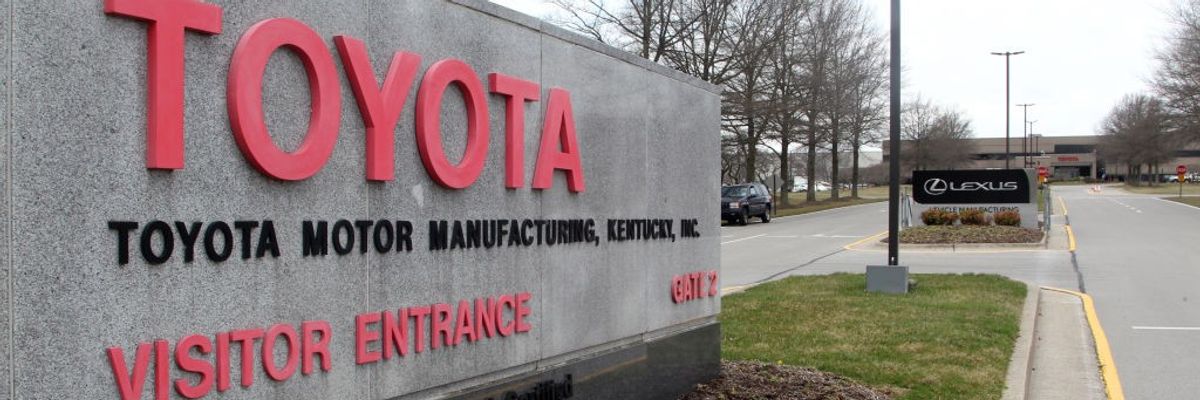
A photo shows the Toyota Motor Manufacturing plant on March 14, 2019, in Georgetown, Kentucky.
"They did it now because the company knows we're coming for them," UAW president Shawn Fain said in response to the news.
Days after the United Auto Workers announced tentative deals with the Big Three carmakers, Toyota confirmed this week that it would offer raises to its nonunion U.S. factory workers.
The Japanese automaker said Wednesday that hourly manufacturers at the top of the pay scale would see a 9% raise beginning January 1, Reuters reported. UAW president Shawn Fain, who is attempting to use the union's victory to bolster the wider labor movement, said that the timing of Toyota's announcement was no coincidence.
"Toyota isn't giving out raises out of the goodness of their heart," he said in a video statement shared by More Perfect Union on Friday. "Toyota is the largest and most profitable auto company in the world. They could have just as easily raised wages a month ago or a year ago. They did it now because the company knows we're coming for them."
In the deals struck with Ford, Stellantis, and General Motors, the UAW secured a 25% pay raise over the life of the contracts. The tentative agreements brought an end to a historic six-week strike, as members return to work while they vote on whether or not to ratify the deals.
The UAW has negotiated for the three contracts to expire on April 30, 2028, a slightly longer lifespan than usual, according to Labor Notes. In a speech Sunday, Fain said part of the reason for the longer contracts was to give the labor movement time to build toward a potential strike on May Day 2028. Fain also said the UAW planned to spend the next four-and-a-half years organizing workers at nonunion plants owned by companies including Tesla, Volkswagen, Mercedes, BMW, Honda, Nissan, and Toyota.
"When we return to the bargaining table in 2028, it won't just be with the Big Three. It will be the Big Five or Big Six," Fain said.
"UAW. That stands for, 'You are welcome.'"
On Monday, a Toyota employee at a plant in Alabama told Labor Notes that management had called workers into an emergency meeting offering to raise top pay to $32 an hour and to scale up workers to that level in four years instead of eight. Another employee at a Kentucky plant said the top rate for production workers there had been raised by $2.94 to $34.80 and skilled trades workers saw a $3.70 boost to $43.20.
Toyota confirmed it was offering raises to news outlets Wednesday. It also said it was halving the time needed to reach top pay across the board and expanding paid time off.
"We value our employees and their contributions, and we show it by offering robust compensation packages that we continually review to ensure that we remain competitive within the automotive industry," Chris Reynolds, Toyota Motor North America's executive vice president, said in a statement reported by Reuters.
Toyota's actions are in keeping with findings that a strong union movement benefits nonunion workers as well. During the 1950s, when union membership peaked at one-third of U.S. workers, income inequality was at its lowest since the Great Depression spike, according to figures shared by the Department of the Treasury. By 2022, only 10% of U.S. workers were in a union, and the top 1% took home almost 20% of total income. If private sector union membership increases by just 1%, nonunion workers see a 0.3% wage increase.
"Even though you're not yet members of our union, that pay raise Toyota's giving you is the UAW bump," Fain addressed Toyota workers in his statement. "UAW. That stands for, 'You are welcome.'"
"You are welcome to join our Stand Up movement," he continued. "If this is what Toyota gives you when the Big Three stand up and fight, imagine what you could accomplish if you join the UAW and stand up and fight for yourselves."
Dear Common Dreams reader, It’s been nearly 30 years since I co-founded Common Dreams with my late wife, Lina Newhouser. We had the radical notion that journalism should serve the public good, not corporate profits. It was clear to us from the outset what it would take to build such a project. No paid advertisements. No corporate sponsors. No millionaire publisher telling us what to think or do. Many people said we wouldn't last a year, but we proved those doubters wrong. Together with a tremendous team of journalists and dedicated staff, we built an independent media outlet free from the constraints of profits and corporate control. Our mission has always been simple: To inform. To inspire. To ignite change for the common good. Building Common Dreams was not easy. Our survival was never guaranteed. When you take on the most powerful forces—Wall Street greed, fossil fuel industry destruction, Big Tech lobbyists, and uber-rich oligarchs who have spent billions upon billions rigging the economy and democracy in their favor—the only bulwark you have is supporters who believe in your work. But here’s the urgent message from me today. It's never been this bad out there. And it's never been this hard to keep us going. At the very moment Common Dreams is most needed, the threats we face are intensifying. We need your support now more than ever. We don't accept corporate advertising and never will. We don't have a paywall because we don't think people should be blocked from critical news based on their ability to pay. Everything we do is funded by the donations of readers like you. When everyone does the little they can afford, we are strong. But if that support retreats or dries up, so do we. Will you donate now to make sure Common Dreams not only survives but thrives? —Craig Brown, Co-founder |
Days after the United Auto Workers announced tentative deals with the Big Three carmakers, Toyota confirmed this week that it would offer raises to its nonunion U.S. factory workers.
The Japanese automaker said Wednesday that hourly manufacturers at the top of the pay scale would see a 9% raise beginning January 1, Reuters reported. UAW president Shawn Fain, who is attempting to use the union's victory to bolster the wider labor movement, said that the timing of Toyota's announcement was no coincidence.
"Toyota isn't giving out raises out of the goodness of their heart," he said in a video statement shared by More Perfect Union on Friday. "Toyota is the largest and most profitable auto company in the world. They could have just as easily raised wages a month ago or a year ago. They did it now because the company knows we're coming for them."
In the deals struck with Ford, Stellantis, and General Motors, the UAW secured a 25% pay raise over the life of the contracts. The tentative agreements brought an end to a historic six-week strike, as members return to work while they vote on whether or not to ratify the deals.
The UAW has negotiated for the three contracts to expire on April 30, 2028, a slightly longer lifespan than usual, according to Labor Notes. In a speech Sunday, Fain said part of the reason for the longer contracts was to give the labor movement time to build toward a potential strike on May Day 2028. Fain also said the UAW planned to spend the next four-and-a-half years organizing workers at nonunion plants owned by companies including Tesla, Volkswagen, Mercedes, BMW, Honda, Nissan, and Toyota.
"When we return to the bargaining table in 2028, it won't just be with the Big Three. It will be the Big Five or Big Six," Fain said.
"UAW. That stands for, 'You are welcome.'"
On Monday, a Toyota employee at a plant in Alabama told Labor Notes that management had called workers into an emergency meeting offering to raise top pay to $32 an hour and to scale up workers to that level in four years instead of eight. Another employee at a Kentucky plant said the top rate for production workers there had been raised by $2.94 to $34.80 and skilled trades workers saw a $3.70 boost to $43.20.
Toyota confirmed it was offering raises to news outlets Wednesday. It also said it was halving the time needed to reach top pay across the board and expanding paid time off.
"We value our employees and their contributions, and we show it by offering robust compensation packages that we continually review to ensure that we remain competitive within the automotive industry," Chris Reynolds, Toyota Motor North America's executive vice president, said in a statement reported by Reuters.
Toyota's actions are in keeping with findings that a strong union movement benefits nonunion workers as well. During the 1950s, when union membership peaked at one-third of U.S. workers, income inequality was at its lowest since the Great Depression spike, according to figures shared by the Department of the Treasury. By 2022, only 10% of U.S. workers were in a union, and the top 1% took home almost 20% of total income. If private sector union membership increases by just 1%, nonunion workers see a 0.3% wage increase.
"Even though you're not yet members of our union, that pay raise Toyota's giving you is the UAW bump," Fain addressed Toyota workers in his statement. "UAW. That stands for, 'You are welcome.'"
"You are welcome to join our Stand Up movement," he continued. "If this is what Toyota gives you when the Big Three stand up and fight, imagine what you could accomplish if you join the UAW and stand up and fight for yourselves."
Days after the United Auto Workers announced tentative deals with the Big Three carmakers, Toyota confirmed this week that it would offer raises to its nonunion U.S. factory workers.
The Japanese automaker said Wednesday that hourly manufacturers at the top of the pay scale would see a 9% raise beginning January 1, Reuters reported. UAW president Shawn Fain, who is attempting to use the union's victory to bolster the wider labor movement, said that the timing of Toyota's announcement was no coincidence.
"Toyota isn't giving out raises out of the goodness of their heart," he said in a video statement shared by More Perfect Union on Friday. "Toyota is the largest and most profitable auto company in the world. They could have just as easily raised wages a month ago or a year ago. They did it now because the company knows we're coming for them."
In the deals struck with Ford, Stellantis, and General Motors, the UAW secured a 25% pay raise over the life of the contracts. The tentative agreements brought an end to a historic six-week strike, as members return to work while they vote on whether or not to ratify the deals.
The UAW has negotiated for the three contracts to expire on April 30, 2028, a slightly longer lifespan than usual, according to Labor Notes. In a speech Sunday, Fain said part of the reason for the longer contracts was to give the labor movement time to build toward a potential strike on May Day 2028. Fain also said the UAW planned to spend the next four-and-a-half years organizing workers at nonunion plants owned by companies including Tesla, Volkswagen, Mercedes, BMW, Honda, Nissan, and Toyota.
"When we return to the bargaining table in 2028, it won't just be with the Big Three. It will be the Big Five or Big Six," Fain said.
"UAW. That stands for, 'You are welcome.'"
On Monday, a Toyota employee at a plant in Alabama told Labor Notes that management had called workers into an emergency meeting offering to raise top pay to $32 an hour and to scale up workers to that level in four years instead of eight. Another employee at a Kentucky plant said the top rate for production workers there had been raised by $2.94 to $34.80 and skilled trades workers saw a $3.70 boost to $43.20.
Toyota confirmed it was offering raises to news outlets Wednesday. It also said it was halving the time needed to reach top pay across the board and expanding paid time off.
"We value our employees and their contributions, and we show it by offering robust compensation packages that we continually review to ensure that we remain competitive within the automotive industry," Chris Reynolds, Toyota Motor North America's executive vice president, said in a statement reported by Reuters.
Toyota's actions are in keeping with findings that a strong union movement benefits nonunion workers as well. During the 1950s, when union membership peaked at one-third of U.S. workers, income inequality was at its lowest since the Great Depression spike, according to figures shared by the Department of the Treasury. By 2022, only 10% of U.S. workers were in a union, and the top 1% took home almost 20% of total income. If private sector union membership increases by just 1%, nonunion workers see a 0.3% wage increase.
"Even though you're not yet members of our union, that pay raise Toyota's giving you is the UAW bump," Fain addressed Toyota workers in his statement. "UAW. That stands for, 'You are welcome.'"
"You are welcome to join our Stand Up movement," he continued. "If this is what Toyota gives you when the Big Three stand up and fight, imagine what you could accomplish if you join the UAW and stand up and fight for yourselves."