SUBSCRIBE TO OUR FREE NEWSLETTER
Daily news & progressive opinion—funded by the people, not the corporations—delivered straight to your inbox.
5
#000000
#FFFFFF
To donate by check, phone, or other method, see our More Ways to Give page.
Daily news & progressive opinion—funded by the people, not the corporations—delivered straight to your inbox.
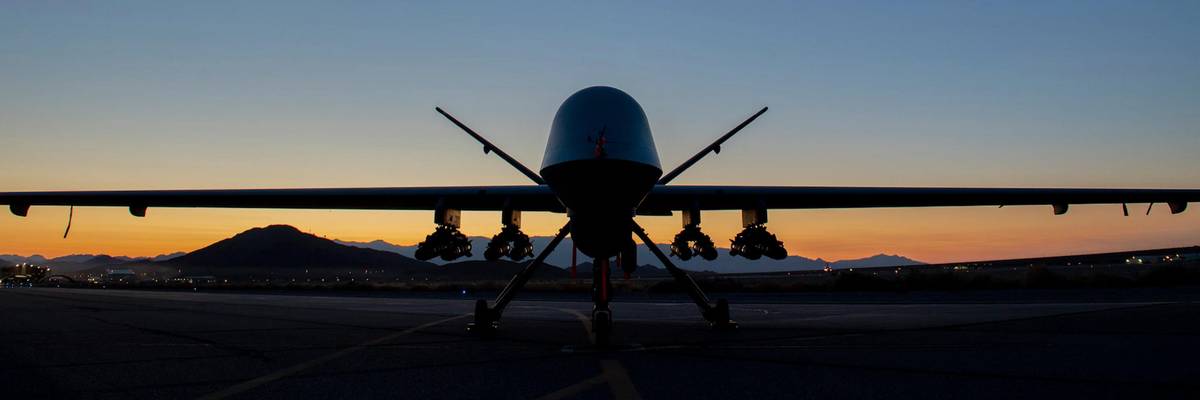
A U.S. Air Force MQ-9 Reaper drone sits on the tarmac of Creech Air Force Base in Nevada at dusk.
"The U.S. is failing to fulfill its commitments in responding appropriately to civilian harm," said one advocate.
Two dozen Somali and international human rights groups on Monday asked the Pentagon to "take immediate steps to address the requests of families whose loved ones were killed or injured by U.S. airstrikes in Somalia"—people who often say they're being ignored by American officials.
In a letter to U.S. Defense Secretary Lloyd Austin, the groups cite recent Intercept reporting that "illustrates how in multiple cases of civilian harm in Somalia confirmed by the U.S. government, civilian victims, survivors, and their families have yet to receive answers, acknowledgment, and amends despite their sustained efforts to reach authorities over several years."
The letter highlights victims including Luul Dahir Mohamed, a 22-year-old Somali woman who was killed along with her 4-year-old daughter Mariam Shilow Muse in an April 2018 U.S. drone strike in El Buur. Luul's brother Abubakar Dahir Mohamed said that despite confirming their deaths and admitting they were civilians, the U.S. military has yet to provide the family with a "substantive reply."
"Since the strike, our family has been broken apart. It has been more than five years since it happened, but we have not been able to move on," Abubakar Dahir Mohamed wrote in an opinion piece published last week by The Continent. "Even as we have contacted [the U.S. government] in every way we know how, we have never been able to even start a process of getting justice. The U.S. has never even acknowledged our existence."
The groups' letter asserts that "the U.S. response thus far stands in stark contrast to this administration's stated priorities of mitigating, responding to, and learning from civilian harm."
Declaring that "the protection of civilians is a strategic priority as well as a moral imperative," the Pentagon last year
published its Civilian Harm Mitigation and Response Action Plan (CHMR-AP), which includes stated commitments to improving commanders' understanding of civilian environments, developing standardized incident reporting and data management processes, and enhancing the military's ability to assess and respond when noncombatants are harmed by U.S. attacks.
"In light of these commitments, it is unfathomable that Abubakar and his family have for so long struggled to receive acknowledgment or amends from the United States," the new letter contends. "We urge the Department of Defense to urgently make long-overdue amends in consultation with Abubakar's family and their representatives, including condolence payments and an explanation for why their demands appear to have been ignored until now."
The letter notes that "the Department of Defense has at its disposal $3 million of annual funding provided by the U.S. Congress to make ex gratia payments to civilian victims and survivors of U.S. operations."
However, the signers "know of no cases in which those funds have been used in Somalia, despite the fact that in numerous cases confirmed by the United States, the identities of civilian victims and survivors are known and their contact information has been made available through their own reporting or through civil society representatives."
Living up to the Pentagon's commitment "requires responding to the inquiries of civilians seeking answers and making amends for the life-altering harm they and their families have experienced," the letter asserts. "We urge [U.S. Africa Command] and the Department of Defense to do so immediately."
International groups joining Somali signatories to the letter include Airwars, Amnesty International USA, Center for Civilians in Conflict, the Columbia Law School Human Rights Institute, and Human Rights Watch.
According to Airwars, a U.K.-based monitoring group, hundreds of Somalis—including some civilians—have been killed by U.S. airstrikes this year alone as the Biden administration quietly continues the so-called War on Terror launched in the wake of the September 11, 2001 attacks on the United States.
Airwars said in 2021 that as many as 48,000 civilians in over half a dozen countries have been killed by U.S. airstrikes since 9/11, while the Costs of War Project at Brown University's Watson Institute for International & Public Affairs estimates that more than 430,000 noncombatants have been killed by all sides during the war.
Dear Common Dreams reader, It’s been nearly 30 years since I co-founded Common Dreams with my late wife, Lina Newhouser. We had the radical notion that journalism should serve the public good, not corporate profits. It was clear to us from the outset what it would take to build such a project. No paid advertisements. No corporate sponsors. No millionaire publisher telling us what to think or do. Many people said we wouldn't last a year, but we proved those doubters wrong. Together with a tremendous team of journalists and dedicated staff, we built an independent media outlet free from the constraints of profits and corporate control. Our mission has always been simple: To inform. To inspire. To ignite change for the common good. Building Common Dreams was not easy. Our survival was never guaranteed. When you take on the most powerful forces—Wall Street greed, fossil fuel industry destruction, Big Tech lobbyists, and uber-rich oligarchs who have spent billions upon billions rigging the economy and democracy in their favor—the only bulwark you have is supporters who believe in your work. But here’s the urgent message from me today. It's never been this bad out there. And it's never been this hard to keep us going. At the very moment Common Dreams is most needed, the threats we face are intensifying. We need your support now more than ever. We don't accept corporate advertising and never will. We don't have a paywall because we don't think people should be blocked from critical news based on their ability to pay. Everything we do is funded by the donations of readers like you. When everyone does the little they can afford, we are strong. But if that support retreats or dries up, so do we. Will you donate now to make sure Common Dreams not only survives but thrives? —Craig Brown, Co-founder |
Two dozen Somali and international human rights groups on Monday asked the Pentagon to "take immediate steps to address the requests of families whose loved ones were killed or injured by U.S. airstrikes in Somalia"—people who often say they're being ignored by American officials.
In a letter to U.S. Defense Secretary Lloyd Austin, the groups cite recent Intercept reporting that "illustrates how in multiple cases of civilian harm in Somalia confirmed by the U.S. government, civilian victims, survivors, and their families have yet to receive answers, acknowledgment, and amends despite their sustained efforts to reach authorities over several years."
The letter highlights victims including Luul Dahir Mohamed, a 22-year-old Somali woman who was killed along with her 4-year-old daughter Mariam Shilow Muse in an April 2018 U.S. drone strike in El Buur. Luul's brother Abubakar Dahir Mohamed said that despite confirming their deaths and admitting they were civilians, the U.S. military has yet to provide the family with a "substantive reply."
"Since the strike, our family has been broken apart. It has been more than five years since it happened, but we have not been able to move on," Abubakar Dahir Mohamed wrote in an opinion piece published last week by The Continent. "Even as we have contacted [the U.S. government] in every way we know how, we have never been able to even start a process of getting justice. The U.S. has never even acknowledged our existence."
The groups' letter asserts that "the U.S. response thus far stands in stark contrast to this administration's stated priorities of mitigating, responding to, and learning from civilian harm."
Declaring that "the protection of civilians is a strategic priority as well as a moral imperative," the Pentagon last year
published its Civilian Harm Mitigation and Response Action Plan (CHMR-AP), which includes stated commitments to improving commanders' understanding of civilian environments, developing standardized incident reporting and data management processes, and enhancing the military's ability to assess and respond when noncombatants are harmed by U.S. attacks.
"In light of these commitments, it is unfathomable that Abubakar and his family have for so long struggled to receive acknowledgment or amends from the United States," the new letter contends. "We urge the Department of Defense to urgently make long-overdue amends in consultation with Abubakar's family and their representatives, including condolence payments and an explanation for why their demands appear to have been ignored until now."
The letter notes that "the Department of Defense has at its disposal $3 million of annual funding provided by the U.S. Congress to make ex gratia payments to civilian victims and survivors of U.S. operations."
However, the signers "know of no cases in which those funds have been used in Somalia, despite the fact that in numerous cases confirmed by the United States, the identities of civilian victims and survivors are known and their contact information has been made available through their own reporting or through civil society representatives."
Living up to the Pentagon's commitment "requires responding to the inquiries of civilians seeking answers and making amends for the life-altering harm they and their families have experienced," the letter asserts. "We urge [U.S. Africa Command] and the Department of Defense to do so immediately."
International groups joining Somali signatories to the letter include Airwars, Amnesty International USA, Center for Civilians in Conflict, the Columbia Law School Human Rights Institute, and Human Rights Watch.
According to Airwars, a U.K.-based monitoring group, hundreds of Somalis—including some civilians—have been killed by U.S. airstrikes this year alone as the Biden administration quietly continues the so-called War on Terror launched in the wake of the September 11, 2001 attacks on the United States.
Airwars said in 2021 that as many as 48,000 civilians in over half a dozen countries have been killed by U.S. airstrikes since 9/11, while the Costs of War Project at Brown University's Watson Institute for International & Public Affairs estimates that more than 430,000 noncombatants have been killed by all sides during the war.
Two dozen Somali and international human rights groups on Monday asked the Pentagon to "take immediate steps to address the requests of families whose loved ones were killed or injured by U.S. airstrikes in Somalia"—people who often say they're being ignored by American officials.
In a letter to U.S. Defense Secretary Lloyd Austin, the groups cite recent Intercept reporting that "illustrates how in multiple cases of civilian harm in Somalia confirmed by the U.S. government, civilian victims, survivors, and their families have yet to receive answers, acknowledgment, and amends despite their sustained efforts to reach authorities over several years."
The letter highlights victims including Luul Dahir Mohamed, a 22-year-old Somali woman who was killed along with her 4-year-old daughter Mariam Shilow Muse in an April 2018 U.S. drone strike in El Buur. Luul's brother Abubakar Dahir Mohamed said that despite confirming their deaths and admitting they were civilians, the U.S. military has yet to provide the family with a "substantive reply."
"Since the strike, our family has been broken apart. It has been more than five years since it happened, but we have not been able to move on," Abubakar Dahir Mohamed wrote in an opinion piece published last week by The Continent. "Even as we have contacted [the U.S. government] in every way we know how, we have never been able to even start a process of getting justice. The U.S. has never even acknowledged our existence."
The groups' letter asserts that "the U.S. response thus far stands in stark contrast to this administration's stated priorities of mitigating, responding to, and learning from civilian harm."
Declaring that "the protection of civilians is a strategic priority as well as a moral imperative," the Pentagon last year
published its Civilian Harm Mitigation and Response Action Plan (CHMR-AP), which includes stated commitments to improving commanders' understanding of civilian environments, developing standardized incident reporting and data management processes, and enhancing the military's ability to assess and respond when noncombatants are harmed by U.S. attacks.
"In light of these commitments, it is unfathomable that Abubakar and his family have for so long struggled to receive acknowledgment or amends from the United States," the new letter contends. "We urge the Department of Defense to urgently make long-overdue amends in consultation with Abubakar's family and their representatives, including condolence payments and an explanation for why their demands appear to have been ignored until now."
The letter notes that "the Department of Defense has at its disposal $3 million of annual funding provided by the U.S. Congress to make ex gratia payments to civilian victims and survivors of U.S. operations."
However, the signers "know of no cases in which those funds have been used in Somalia, despite the fact that in numerous cases confirmed by the United States, the identities of civilian victims and survivors are known and their contact information has been made available through their own reporting or through civil society representatives."
Living up to the Pentagon's commitment "requires responding to the inquiries of civilians seeking answers and making amends for the life-altering harm they and their families have experienced," the letter asserts. "We urge [U.S. Africa Command] and the Department of Defense to do so immediately."
International groups joining Somali signatories to the letter include Airwars, Amnesty International USA, Center for Civilians in Conflict, the Columbia Law School Human Rights Institute, and Human Rights Watch.
According to Airwars, a U.K.-based monitoring group, hundreds of Somalis—including some civilians—have been killed by U.S. airstrikes this year alone as the Biden administration quietly continues the so-called War on Terror launched in the wake of the September 11, 2001 attacks on the United States.
Airwars said in 2021 that as many as 48,000 civilians in over half a dozen countries have been killed by U.S. airstrikes since 9/11, while the Costs of War Project at Brown University's Watson Institute for International & Public Affairs estimates that more than 430,000 noncombatants have been killed by all sides during the war.