SUBSCRIBE TO OUR FREE NEWSLETTER
Daily news & progressive opinion—funded by the people, not the corporations—delivered straight to your inbox.
5
#000000
#FFFFFF
To donate by check, phone, or other method, see our More Ways to Give page.
Daily news & progressive opinion—funded by the people, not the corporations—delivered straight to your inbox.
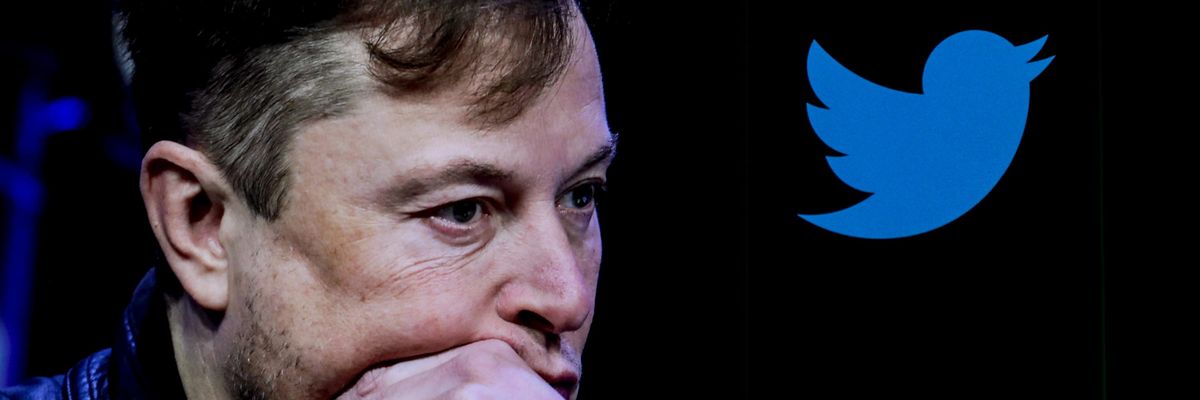
In this photo illustration, an image of Elon Musk is displayed on a computer screen and the logo of Twitter on a mobile phone on October 6, 2022.
Critics expressed concern about the social media giant serving as "a major new forum for massive amounts of money to be spent to influence politics."
As advertisers depart Twitter in the wake of Elon Musk's recent takeover, the billionaire owner continues to shake up the social media platform, which on Tuesday relaxed a ban on political and issue-based advertising put in place for over three years.
When then-CEO Jack Dorsey announced the ban in October 2019, he explained that "this isn't about free expression. This is about paying for reach. And paying to increase the reach of political speech has significant ramifications that today's democratic infrastructure may not be prepared to handle."
The Twitter Safety account revealed the policy change in a pair of tweets late Tuesday:
We believe that cause-based advertising can facilitate public conversation around important topics. Today, we're relaxing our ads policy for cause-based ads in the U.S. We also plan to expand the political advertising we permit in the coming weeks.
Moving forward, we will align our advertising policy with that of TV and other media outlets. As with all policy changes, we will first ensure that our approach to reviewing and approving content protects people on Twitter. We'll share more details as this work progresses.
Politico noted that "advertisers have fled the platform in droves after Elon Musk's takeover last October, which was followed by a spike in hate speech and the reinstatement of several previously banned right-wing accounts. The move also puts Twitter in alignment with several of the other major social media companies, such as Meta's Facebook and Google's YouTube, which both allow paid political content. One notable exception is ByteDance's TikTok, which still has a ban on political advertising."
Some digital media experts noted issues with the 2019 ban. For example, Fight for the Future director Evan Greer on Wednesday pointed to what climate journalist Emily Atkin called "Twitter's Big Oil ad loophole" in her February 2021 reporting.
As Ars Technica reported Wednesday:
That 2019 ban included exceptions for some cause-based advertising, where advertisers were permitted to conduct some microtargeting of Twitter users based on limited geographic location information, keywords, and interests. Notably, advertisers were not allowed to target audiences based on political affiliation like "conservative" or "liberal." Under these prior rules, Twitter-certified cause-based advertisers approved to promote content created to "educate, raise awareness, and/or call for people to take action in connection with civic engagement, economic growth, environmental stewardship, or social equity."
In 2019, the Electronic Frontier Foundation said that Twitter limiting cause-based advertising wasn't a good policy because the microtargeting exception applies to "an almost impossibly broad range of advertisements adjacent to the banned campaign content." The EFF said this policy had "the potential to worsen the problem it is trying to solve," suggesting that smaller social media platforms that "let users choose the moderation approaches that work for them" do more to empower their users to "protect themselves from manipulative advertising."
Meanwhile, some critics expressed concern about the impacts of the new policy on U.S. democracy.
"A major new forum for massive amounts of money to be spent to influence politics. Awesome!" Citizens for Responsibility and Ethics in Washington president Noah Bookbinder sardonically tweeted with a facepalm emoji.
Tim Karr, senior director of strategy and communications at Free Press, said he was skeptical that Musk would pair the ban reversal with the sort of fact-checking "that would actually 'facilitate' healthy public discourse," given the new owner's "obsession with spreading [disinformation] and conspiracy theories."
Republican digital strategist Eric Wilson told The Washington Post that while there would be a "learning curve" for campaigns that choose to now advertise on Twitter, "obviously it's good to have more options" and he expects that political candidates will take advantage of the advertising opportunity as long as journalists continue to use the platform.
"We know voters are not as active on Twitter as they are on places like Facebook and Instagram," Wilson said, referring to Meta's social media platforms. "But it remains important for shaping political narratives."
While advertising was Twitter's primary revenue source pre-Musk, it's not clear that the policy change will notably benefit the company from a financial standpoint. Before the ban, political ad spending for the U.S. 2018 midterm cycle was less than $3 million. Twitter's total revenue was $3 billion in 2018 and in 2021 it topped $5 billion, $4.51 billion of which came from ads.
A few weeks after Musk bought the company in October, Media Matters for America revealed that 50 of its 100 top advertisers—which collectively "accounted for nearly $2 billion in spending on the platform since 2020, and over $750 million in advertising in 2022 alone"—had "announced or seemingly stopped advertising on Twitter."
This post has been updated to clarify Twitter's 2021 revenue figures.
Dear Common Dreams reader, It’s been nearly 30 years since I co-founded Common Dreams with my late wife, Lina Newhouser. We had the radical notion that journalism should serve the public good, not corporate profits. It was clear to us from the outset what it would take to build such a project. No paid advertisements. No corporate sponsors. No millionaire publisher telling us what to think or do. Many people said we wouldn't last a year, but we proved those doubters wrong. Together with a tremendous team of journalists and dedicated staff, we built an independent media outlet free from the constraints of profits and corporate control. Our mission has always been simple: To inform. To inspire. To ignite change for the common good. Building Common Dreams was not easy. Our survival was never guaranteed. When you take on the most powerful forces—Wall Street greed, fossil fuel industry destruction, Big Tech lobbyists, and uber-rich oligarchs who have spent billions upon billions rigging the economy and democracy in their favor—the only bulwark you have is supporters who believe in your work. But here’s the urgent message from me today. It's never been this bad out there. And it's never been this hard to keep us going. At the very moment Common Dreams is most needed, the threats we face are intensifying. We need your support now more than ever. We don't accept corporate advertising and never will. We don't have a paywall because we don't think people should be blocked from critical news based on their ability to pay. Everything we do is funded by the donations of readers like you. When everyone does the little they can afford, we are strong. But if that support retreats or dries up, so do we. Will you donate now to make sure Common Dreams not only survives but thrives? —Craig Brown, Co-founder |
As advertisers depart Twitter in the wake of Elon Musk's recent takeover, the billionaire owner continues to shake up the social media platform, which on Tuesday relaxed a ban on political and issue-based advertising put in place for over three years.
When then-CEO Jack Dorsey announced the ban in October 2019, he explained that "this isn't about free expression. This is about paying for reach. And paying to increase the reach of political speech has significant ramifications that today's democratic infrastructure may not be prepared to handle."
The Twitter Safety account revealed the policy change in a pair of tweets late Tuesday:
We believe that cause-based advertising can facilitate public conversation around important topics. Today, we're relaxing our ads policy for cause-based ads in the U.S. We also plan to expand the political advertising we permit in the coming weeks.
Moving forward, we will align our advertising policy with that of TV and other media outlets. As with all policy changes, we will first ensure that our approach to reviewing and approving content protects people on Twitter. We'll share more details as this work progresses.
Politico noted that "advertisers have fled the platform in droves after Elon Musk's takeover last October, which was followed by a spike in hate speech and the reinstatement of several previously banned right-wing accounts. The move also puts Twitter in alignment with several of the other major social media companies, such as Meta's Facebook and Google's YouTube, which both allow paid political content. One notable exception is ByteDance's TikTok, which still has a ban on political advertising."
Some digital media experts noted issues with the 2019 ban. For example, Fight for the Future director Evan Greer on Wednesday pointed to what climate journalist Emily Atkin called "Twitter's Big Oil ad loophole" in her February 2021 reporting.
As Ars Technica reported Wednesday:
That 2019 ban included exceptions for some cause-based advertising, where advertisers were permitted to conduct some microtargeting of Twitter users based on limited geographic location information, keywords, and interests. Notably, advertisers were not allowed to target audiences based on political affiliation like "conservative" or "liberal." Under these prior rules, Twitter-certified cause-based advertisers approved to promote content created to "educate, raise awareness, and/or call for people to take action in connection with civic engagement, economic growth, environmental stewardship, or social equity."
In 2019, the Electronic Frontier Foundation said that Twitter limiting cause-based advertising wasn't a good policy because the microtargeting exception applies to "an almost impossibly broad range of advertisements adjacent to the banned campaign content." The EFF said this policy had "the potential to worsen the problem it is trying to solve," suggesting that smaller social media platforms that "let users choose the moderation approaches that work for them" do more to empower their users to "protect themselves from manipulative advertising."
Meanwhile, some critics expressed concern about the impacts of the new policy on U.S. democracy.
"A major new forum for massive amounts of money to be spent to influence politics. Awesome!" Citizens for Responsibility and Ethics in Washington president Noah Bookbinder sardonically tweeted with a facepalm emoji.
Tim Karr, senior director of strategy and communications at Free Press, said he was skeptical that Musk would pair the ban reversal with the sort of fact-checking "that would actually 'facilitate' healthy public discourse," given the new owner's "obsession with spreading [disinformation] and conspiracy theories."
Republican digital strategist Eric Wilson told The Washington Post that while there would be a "learning curve" for campaigns that choose to now advertise on Twitter, "obviously it's good to have more options" and he expects that political candidates will take advantage of the advertising opportunity as long as journalists continue to use the platform.
"We know voters are not as active on Twitter as they are on places like Facebook and Instagram," Wilson said, referring to Meta's social media platforms. "But it remains important for shaping political narratives."
While advertising was Twitter's primary revenue source pre-Musk, it's not clear that the policy change will notably benefit the company from a financial standpoint. Before the ban, political ad spending for the U.S. 2018 midterm cycle was less than $3 million. Twitter's total revenue was $3 billion in 2018 and in 2021 it topped $5 billion, $4.51 billion of which came from ads.
A few weeks after Musk bought the company in October, Media Matters for America revealed that 50 of its 100 top advertisers—which collectively "accounted for nearly $2 billion in spending on the platform since 2020, and over $750 million in advertising in 2022 alone"—had "announced or seemingly stopped advertising on Twitter."
This post has been updated to clarify Twitter's 2021 revenue figures.
As advertisers depart Twitter in the wake of Elon Musk's recent takeover, the billionaire owner continues to shake up the social media platform, which on Tuesday relaxed a ban on political and issue-based advertising put in place for over three years.
When then-CEO Jack Dorsey announced the ban in October 2019, he explained that "this isn't about free expression. This is about paying for reach. And paying to increase the reach of political speech has significant ramifications that today's democratic infrastructure may not be prepared to handle."
The Twitter Safety account revealed the policy change in a pair of tweets late Tuesday:
We believe that cause-based advertising can facilitate public conversation around important topics. Today, we're relaxing our ads policy for cause-based ads in the U.S. We also plan to expand the political advertising we permit in the coming weeks.
Moving forward, we will align our advertising policy with that of TV and other media outlets. As with all policy changes, we will first ensure that our approach to reviewing and approving content protects people on Twitter. We'll share more details as this work progresses.
Politico noted that "advertisers have fled the platform in droves after Elon Musk's takeover last October, which was followed by a spike in hate speech and the reinstatement of several previously banned right-wing accounts. The move also puts Twitter in alignment with several of the other major social media companies, such as Meta's Facebook and Google's YouTube, which both allow paid political content. One notable exception is ByteDance's TikTok, which still has a ban on political advertising."
Some digital media experts noted issues with the 2019 ban. For example, Fight for the Future director Evan Greer on Wednesday pointed to what climate journalist Emily Atkin called "Twitter's Big Oil ad loophole" in her February 2021 reporting.
As Ars Technica reported Wednesday:
That 2019 ban included exceptions for some cause-based advertising, where advertisers were permitted to conduct some microtargeting of Twitter users based on limited geographic location information, keywords, and interests. Notably, advertisers were not allowed to target audiences based on political affiliation like "conservative" or "liberal." Under these prior rules, Twitter-certified cause-based advertisers approved to promote content created to "educate, raise awareness, and/or call for people to take action in connection with civic engagement, economic growth, environmental stewardship, or social equity."
In 2019, the Electronic Frontier Foundation said that Twitter limiting cause-based advertising wasn't a good policy because the microtargeting exception applies to "an almost impossibly broad range of advertisements adjacent to the banned campaign content." The EFF said this policy had "the potential to worsen the problem it is trying to solve," suggesting that smaller social media platforms that "let users choose the moderation approaches that work for them" do more to empower their users to "protect themselves from manipulative advertising."
Meanwhile, some critics expressed concern about the impacts of the new policy on U.S. democracy.
"A major new forum for massive amounts of money to be spent to influence politics. Awesome!" Citizens for Responsibility and Ethics in Washington president Noah Bookbinder sardonically tweeted with a facepalm emoji.
Tim Karr, senior director of strategy and communications at Free Press, said he was skeptical that Musk would pair the ban reversal with the sort of fact-checking "that would actually 'facilitate' healthy public discourse," given the new owner's "obsession with spreading [disinformation] and conspiracy theories."
Republican digital strategist Eric Wilson told The Washington Post that while there would be a "learning curve" for campaigns that choose to now advertise on Twitter, "obviously it's good to have more options" and he expects that political candidates will take advantage of the advertising opportunity as long as journalists continue to use the platform.
"We know voters are not as active on Twitter as they are on places like Facebook and Instagram," Wilson said, referring to Meta's social media platforms. "But it remains important for shaping political narratives."
While advertising was Twitter's primary revenue source pre-Musk, it's not clear that the policy change will notably benefit the company from a financial standpoint. Before the ban, political ad spending for the U.S. 2018 midterm cycle was less than $3 million. Twitter's total revenue was $3 billion in 2018 and in 2021 it topped $5 billion, $4.51 billion of which came from ads.
A few weeks after Musk bought the company in October, Media Matters for America revealed that 50 of its 100 top advertisers—which collectively "accounted for nearly $2 billion in spending on the platform since 2020, and over $750 million in advertising in 2022 alone"—had "announced or seemingly stopped advertising on Twitter."
This post has been updated to clarify Twitter's 2021 revenue figures.