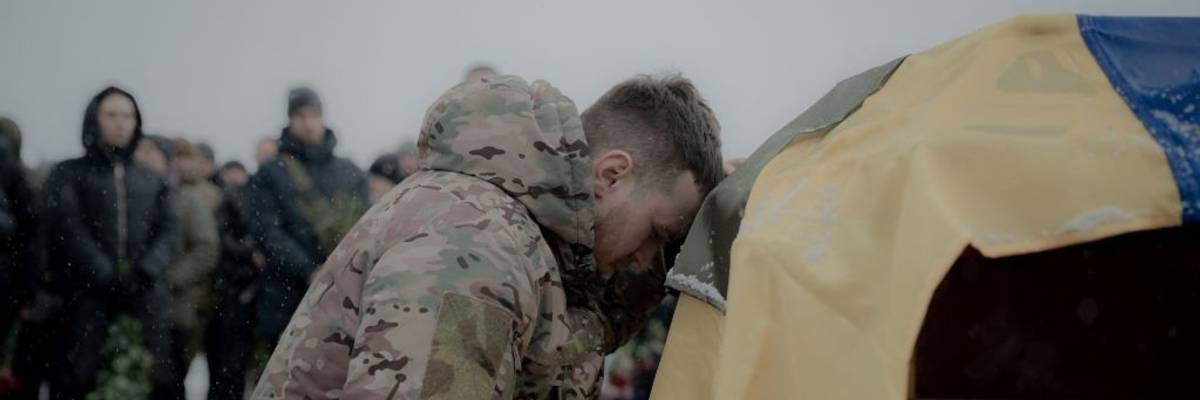
A comrade mourns next to the coffin of Anton Spitsyn, a Ukrainian serviceman and co-founder of the special purpose unit of "Gostri Kartuzy" (Peaky Blinders) who was killed fighting Russian troops, during funeral in Kharkiv on February 5, 2025.
After Calls, Trump Claims Putin and Zelenskyy Want to 'Make Peace' in Ukraine
His comments came after the defense secretary made clear the Trump administration opposes NATO membership for Ukraine and thinks that returning to the country's "pre-2014 borders is an unrealistic objective."
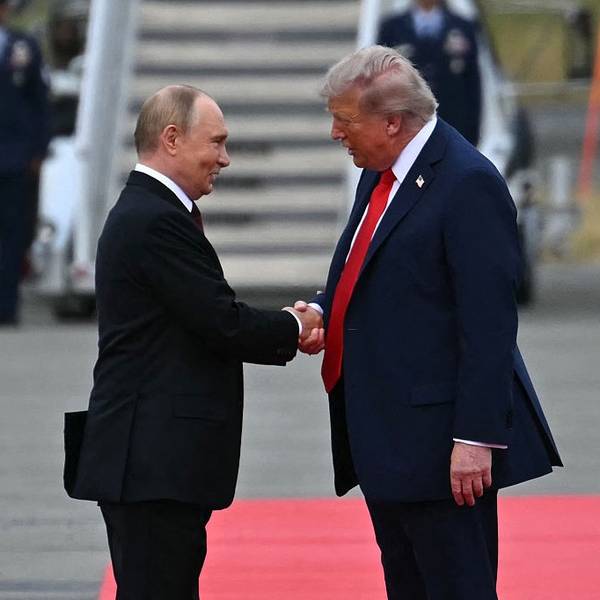
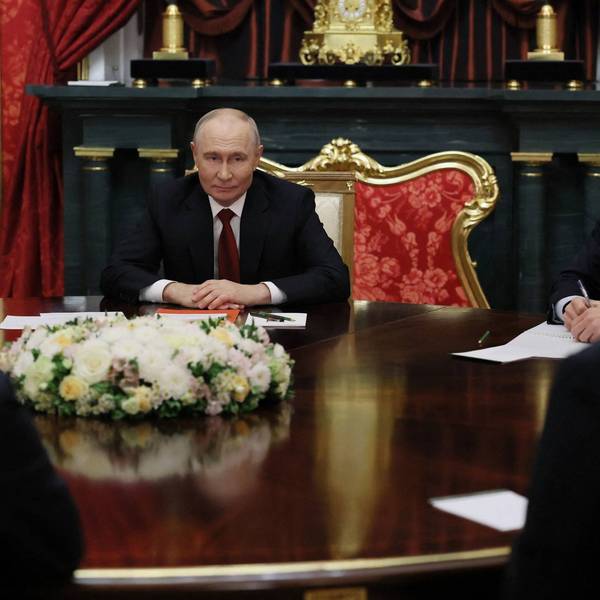
After phone calls with Russia and Ukraine's leaders on Wednesday, U.S. President Donald Trump claimed on social media that settlement talks will begin immediately, nearly three years into the Kremlin's invasion of the neighboring nation.
Trump said on his Truth Social platform that during the "lengthy and highly productive phone call" with Russian President Vladimir Putin, the pair discussed a wide range of issues and agreed that "we want to stop the millions of deaths taking place in the War with Russia/Ukraine." (Although the estimates for civilian and troop deaths since February 2022 vary, they aren't in the millions.)
"We agreed to work together, very closely, including visiting each other's Nations. We have also agreed to have our respective teams start negotiations immediately," wrote the U.S. president in his post. "I have asked Secretary of State Marco Rubio, Director of the CIA John Ratcliffe, National Security Adviser Michael Waltz, and Ambassador and Special Envoy Steve Witkoff, to lead the negotiations which, I feel strongly, will be successful."
"I want to thank President Putin for his time and effort with respect to this call, and for the release, yesterday, of Marc Fogel," Trump added, referring to an American teacher whose imprisonment in Russia was widely seen as "essentially a hostage-taking situation."
Later, Trump told reporters that he expects his first meeting with Putin to happen in Saudi Arabia, "not in the too distant future."
As of September, the U.S. Congress had appropriated or made available nearly $183 billion to help Ukraine respond to the 2022 Russian invasion. This week Trump said Ukraine should reward the United States with $500 billion worth of precious minerals in exchange for its military support.
After a subsequent call with Ukrainian President Volodymyr Zelenskyy on Wednesday, Trump posted: "The conversation went very well. He, like President Putin, wants to make PEACE. We discussed a variety of topics having to do with the War, but mostly, the meeting that is being set up on Friday in Munich, where Vice President JD Vance and Secretary of State Marco Rubio will lead the Delegation. I am hopeful that the results of that meeting will be positive. It is time to stop this ridiculous War, where there has been massive, and totally unnecessary, DEATH and DESTRUCTION. God bless the people of Russia and Ukraine!"
Vance and Rubio will travel to Germany for the Munich Security Conference, which is scheduled to begin on Friday. Ahead of that summit, the Ukraine Defense Contact Group on Wednesday held a meeting at NATO headquarters in Brussels, where U.S. Defense Secretary Pete Hegseth delivered headline-making opening remarks.
The U.S. president "intends to end this war by diplomacy and bringing both Russia and Ukraine to the table," said Hegseth. "We want, like you, a sovereign and prosperous Ukraine. But we must start by recognizing that returning to Ukraine's pre-2014 borders is an unrealistic objective. Chasing this illusionary goal will only prolong the war and cause more suffering."
"The United States does not believe that NATO membership for Ukraine is a realistic outcome of a negotiated settlement. Instead, any security guarantee must be backed by capable European and non-European troops," he continued. "To be clear, as part of any security guarantee, there will not be U.S. troops deployed to Ukraine."
Anatol Lieven, director of the Quincy Institute for Responsible Statecraft's Eurasia Program, explained that "in practice, Hegseth's statement also rules out European troops for Ukraine. Russia has made clear that it will accept only troops from genuinely neutral countries as peacekeepers, and European leaders have stated that they would only deploy their own troops if given a cast-iron assurance by the U.S. that America would come to their aid if attacked—an assurance that Hegseth has just ruled out."
Lieven also wrote:
In his statement to the other NATO defense ministers, Hegseth repeatedly stressed the words "realistic" and "realistically." Realistically, it was obvious for years before the Ukraine War that NATO countries would never fight to defend Ukraine; and on the eve of the invasion, the Biden administration and every other NATO government refused to give Ukraine a timetable for membership. Yet at the same time, they preserved the public illusion that Ukraine would one day join NATO, and they refused to negotiate a treaty of neutrality with Moscow.
Since the failure of the Ukrainian counter-offensive in 2023, 16 months ago, it has been obvious that Ukraine could not regain its lost territories, but Western officials went on committing themselves publicly to this outcome and rejecting territorial compromise. Something in the region of a quarter of a million human beings have now died so that Western establishments could continue to propagate these illusions. It is time to let them go, and we should be grateful to Hegseth for saying so.
Progressive critics of the U.S. policy in Ukraine have long argued that Trump's predecessor, former President Joe Biden, was not leveling with the American people when it came to the likely outcomes in Ukraine and that his failure to foster the conditions for peace talks or a negotiated settlement meant the fighting would drag on without end.
Trump's supposed quest for securing peace in Russia and Ukraine contrasts with his unpopular imperialistic ambitions in other cases—he's recently
proposed U.S. takeovers of Canada, Greenland, the Gaza Strip, and the Panama Canal.
We are at a crossroads
This country and this world are at a monumental crossroads. In a few short weeks, US voters will have an opportunity to beat back the forces of fascism and confront the billionaires who are rigging the economy, our media system, and our democracy, making it increasingly impossible for ordinary people to get by. We’re not just talking about the election. We’re talking about what must be done once these fascist elements are vanquished from power. We need a bolder set of solutions than what either major party has so far been willing to offer and a working-class movement ready to fight like hell for it. Trump didn't emerge from nowhere. The conditions that fueled MAGA authoritarianism were created by decades of radical neoliberal economic policies and a corrupt political system dominated by corporate interests. They slashed taxes on the super-rich, promising that the benefits would trickle down. They said giveaways to the corporate titans would make life more affordable for the rest of us. It was all bullshit. And when a bitter, betrayed populace searches for someone to blame, right-wing demagogues have little trouble finding scapegoats. People know when they're being lied to, but you won't hear any of this from the corporate media. Only independent journalism—powered and funded by people who believe in building a better world—can deliver truly trustworthy daily news. Our Fall Campaign is underway, and we need your help. To power our newsroom through the rest of the year, we need to raise $125,000 by midnight on October 31. So if you share our vision, please contribute whatever you can to sustain our work. |
After phone calls with Russia and Ukraine's leaders on Wednesday, U.S. President Donald Trump claimed on social media that settlement talks will begin immediately, nearly three years into the Kremlin's invasion of the neighboring nation.
Trump said on his Truth Social platform that during the "lengthy and highly productive phone call" with Russian President Vladimir Putin, the pair discussed a wide range of issues and agreed that "we want to stop the millions of deaths taking place in the War with Russia/Ukraine." (Although the estimates for civilian and troop deaths since February 2022 vary, they aren't in the millions.)
"We agreed to work together, very closely, including visiting each other's Nations. We have also agreed to have our respective teams start negotiations immediately," wrote the U.S. president in his post. "I have asked Secretary of State Marco Rubio, Director of the CIA John Ratcliffe, National Security Adviser Michael Waltz, and Ambassador and Special Envoy Steve Witkoff, to lead the negotiations which, I feel strongly, will be successful."
"I want to thank President Putin for his time and effort with respect to this call, and for the release, yesterday, of Marc Fogel," Trump added, referring to an American teacher whose imprisonment in Russia was widely seen as "essentially a hostage-taking situation."
Later, Trump told reporters that he expects his first meeting with Putin to happen in Saudi Arabia, "not in the too distant future."
As of September, the U.S. Congress had appropriated or made available nearly $183 billion to help Ukraine respond to the 2022 Russian invasion. This week Trump said Ukraine should reward the United States with $500 billion worth of precious minerals in exchange for its military support.
After a subsequent call with Ukrainian President Volodymyr Zelenskyy on Wednesday, Trump posted: "The conversation went very well. He, like President Putin, wants to make PEACE. We discussed a variety of topics having to do with the War, but mostly, the meeting that is being set up on Friday in Munich, where Vice President JD Vance and Secretary of State Marco Rubio will lead the Delegation. I am hopeful that the results of that meeting will be positive. It is time to stop this ridiculous War, where there has been massive, and totally unnecessary, DEATH and DESTRUCTION. God bless the people of Russia and Ukraine!"
Vance and Rubio will travel to Germany for the Munich Security Conference, which is scheduled to begin on Friday. Ahead of that summit, the Ukraine Defense Contact Group on Wednesday held a meeting at NATO headquarters in Brussels, where U.S. Defense Secretary Pete Hegseth delivered headline-making opening remarks.
The U.S. president "intends to end this war by diplomacy and bringing both Russia and Ukraine to the table," said Hegseth. "We want, like you, a sovereign and prosperous Ukraine. But we must start by recognizing that returning to Ukraine's pre-2014 borders is an unrealistic objective. Chasing this illusionary goal will only prolong the war and cause more suffering."
"The United States does not believe that NATO membership for Ukraine is a realistic outcome of a negotiated settlement. Instead, any security guarantee must be backed by capable European and non-European troops," he continued. "To be clear, as part of any security guarantee, there will not be U.S. troops deployed to Ukraine."
Anatol Lieven, director of the Quincy Institute for Responsible Statecraft's Eurasia Program, explained that "in practice, Hegseth's statement also rules out European troops for Ukraine. Russia has made clear that it will accept only troops from genuinely neutral countries as peacekeepers, and European leaders have stated that they would only deploy their own troops if given a cast-iron assurance by the U.S. that America would come to their aid if attacked—an assurance that Hegseth has just ruled out."
Lieven also wrote:
In his statement to the other NATO defense ministers, Hegseth repeatedly stressed the words "realistic" and "realistically." Realistically, it was obvious for years before the Ukraine War that NATO countries would never fight to defend Ukraine; and on the eve of the invasion, the Biden administration and every other NATO government refused to give Ukraine a timetable for membership. Yet at the same time, they preserved the public illusion that Ukraine would one day join NATO, and they refused to negotiate a treaty of neutrality with Moscow.
Since the failure of the Ukrainian counter-offensive in 2023, 16 months ago, it has been obvious that Ukraine could not regain its lost territories, but Western officials went on committing themselves publicly to this outcome and rejecting territorial compromise. Something in the region of a quarter of a million human beings have now died so that Western establishments could continue to propagate these illusions. It is time to let them go, and we should be grateful to Hegseth for saying so.
Progressive critics of the U.S. policy in Ukraine have long argued that Trump's predecessor, former President Joe Biden, was not leveling with the American people when it came to the likely outcomes in Ukraine and that his failure to foster the conditions for peace talks or a negotiated settlement meant the fighting would drag on without end.
Trump's supposed quest for securing peace in Russia and Ukraine contrasts with his unpopular imperialistic ambitions in other cases—he's recently
proposed U.S. takeovers of Canada, Greenland, the Gaza Strip, and the Panama Canal.
- NATO and the Origins of the Ukraine Crisis ›
- No Matter How Long the Ukraine War Lasts, Weapons Makers Plan to Cash In ›
- 'Outrageous': Sanders Rips Trump for Praising Putin's Invasion of Ukraine ›
- Why Europe Is Unlikely to Replace Trump’s US as Ukraine’s Chief Backer ›
- Opinion | Giving Peace a Chance in Ukraine Is Good. Why Not Gaza Too? | Common Dreams ›
- 'Thuggery From Trump and Vance': World Reacts to Oval Office Meltdown With Zelenskyy | Common Dreams ›
- Opinion | If We Want Peace in Ukraine: What Now? | Common Dreams ›
- Opinion | Putin’s Useful Idiots Ambush Democracy | Common Dreams ›
- Opinion | By Supporting Putin’s Land Grab, Trump Is At Least Being Consistent | Common Dreams ›
After phone calls with Russia and Ukraine's leaders on Wednesday, U.S. President Donald Trump claimed on social media that settlement talks will begin immediately, nearly three years into the Kremlin's invasion of the neighboring nation.
Trump said on his Truth Social platform that during the "lengthy and highly productive phone call" with Russian President Vladimir Putin, the pair discussed a wide range of issues and agreed that "we want to stop the millions of deaths taking place in the War with Russia/Ukraine." (Although the estimates for civilian and troop deaths since February 2022 vary, they aren't in the millions.)
"We agreed to work together, very closely, including visiting each other's Nations. We have also agreed to have our respective teams start negotiations immediately," wrote the U.S. president in his post. "I have asked Secretary of State Marco Rubio, Director of the CIA John Ratcliffe, National Security Adviser Michael Waltz, and Ambassador and Special Envoy Steve Witkoff, to lead the negotiations which, I feel strongly, will be successful."
"I want to thank President Putin for his time and effort with respect to this call, and for the release, yesterday, of Marc Fogel," Trump added, referring to an American teacher whose imprisonment in Russia was widely seen as "essentially a hostage-taking situation."
Later, Trump told reporters that he expects his first meeting with Putin to happen in Saudi Arabia, "not in the too distant future."
As of September, the U.S. Congress had appropriated or made available nearly $183 billion to help Ukraine respond to the 2022 Russian invasion. This week Trump said Ukraine should reward the United States with $500 billion worth of precious minerals in exchange for its military support.
After a subsequent call with Ukrainian President Volodymyr Zelenskyy on Wednesday, Trump posted: "The conversation went very well. He, like President Putin, wants to make PEACE. We discussed a variety of topics having to do with the War, but mostly, the meeting that is being set up on Friday in Munich, where Vice President JD Vance and Secretary of State Marco Rubio will lead the Delegation. I am hopeful that the results of that meeting will be positive. It is time to stop this ridiculous War, where there has been massive, and totally unnecessary, DEATH and DESTRUCTION. God bless the people of Russia and Ukraine!"
Vance and Rubio will travel to Germany for the Munich Security Conference, which is scheduled to begin on Friday. Ahead of that summit, the Ukraine Defense Contact Group on Wednesday held a meeting at NATO headquarters in Brussels, where U.S. Defense Secretary Pete Hegseth delivered headline-making opening remarks.
The U.S. president "intends to end this war by diplomacy and bringing both Russia and Ukraine to the table," said Hegseth. "We want, like you, a sovereign and prosperous Ukraine. But we must start by recognizing that returning to Ukraine's pre-2014 borders is an unrealistic objective. Chasing this illusionary goal will only prolong the war and cause more suffering."
"The United States does not believe that NATO membership for Ukraine is a realistic outcome of a negotiated settlement. Instead, any security guarantee must be backed by capable European and non-European troops," he continued. "To be clear, as part of any security guarantee, there will not be U.S. troops deployed to Ukraine."
Anatol Lieven, director of the Quincy Institute for Responsible Statecraft's Eurasia Program, explained that "in practice, Hegseth's statement also rules out European troops for Ukraine. Russia has made clear that it will accept only troops from genuinely neutral countries as peacekeepers, and European leaders have stated that they would only deploy their own troops if given a cast-iron assurance by the U.S. that America would come to their aid if attacked—an assurance that Hegseth has just ruled out."
Lieven also wrote:
In his statement to the other NATO defense ministers, Hegseth repeatedly stressed the words "realistic" and "realistically." Realistically, it was obvious for years before the Ukraine War that NATO countries would never fight to defend Ukraine; and on the eve of the invasion, the Biden administration and every other NATO government refused to give Ukraine a timetable for membership. Yet at the same time, they preserved the public illusion that Ukraine would one day join NATO, and they refused to negotiate a treaty of neutrality with Moscow.
Since the failure of the Ukrainian counter-offensive in 2023, 16 months ago, it has been obvious that Ukraine could not regain its lost territories, but Western officials went on committing themselves publicly to this outcome and rejecting territorial compromise. Something in the region of a quarter of a million human beings have now died so that Western establishments could continue to propagate these illusions. It is time to let them go, and we should be grateful to Hegseth for saying so.
Progressive critics of the U.S. policy in Ukraine have long argued that Trump's predecessor, former President Joe Biden, was not leveling with the American people when it came to the likely outcomes in Ukraine and that his failure to foster the conditions for peace talks or a negotiated settlement meant the fighting would drag on without end.
Trump's supposed quest for securing peace in Russia and Ukraine contrasts with his unpopular imperialistic ambitions in other cases—he's recently
proposed U.S. takeovers of Canada, Greenland, the Gaza Strip, and the Panama Canal.
- NATO and the Origins of the Ukraine Crisis ›
- No Matter How Long the Ukraine War Lasts, Weapons Makers Plan to Cash In ›
- 'Outrageous': Sanders Rips Trump for Praising Putin's Invasion of Ukraine ›
- Why Europe Is Unlikely to Replace Trump’s US as Ukraine’s Chief Backer ›
- Opinion | Giving Peace a Chance in Ukraine Is Good. Why Not Gaza Too? | Common Dreams ›
- 'Thuggery From Trump and Vance': World Reacts to Oval Office Meltdown With Zelenskyy | Common Dreams ›
- Opinion | If We Want Peace in Ukraine: What Now? | Common Dreams ›
- Opinion | Putin’s Useful Idiots Ambush Democracy | Common Dreams ›
- Opinion | By Supporting Putin’s Land Grab, Trump Is At Least Being Consistent | Common Dreams ›