SUBSCRIBE TO OUR FREE NEWSLETTER
Daily news & progressive opinion—funded by the people, not the corporations—delivered straight to your inbox.
5
#000000
#FFFFFF
To donate by check, phone, or other method, see our More Ways to Give page.
Daily news & progressive opinion—funded by the people, not the corporations—delivered straight to your inbox.
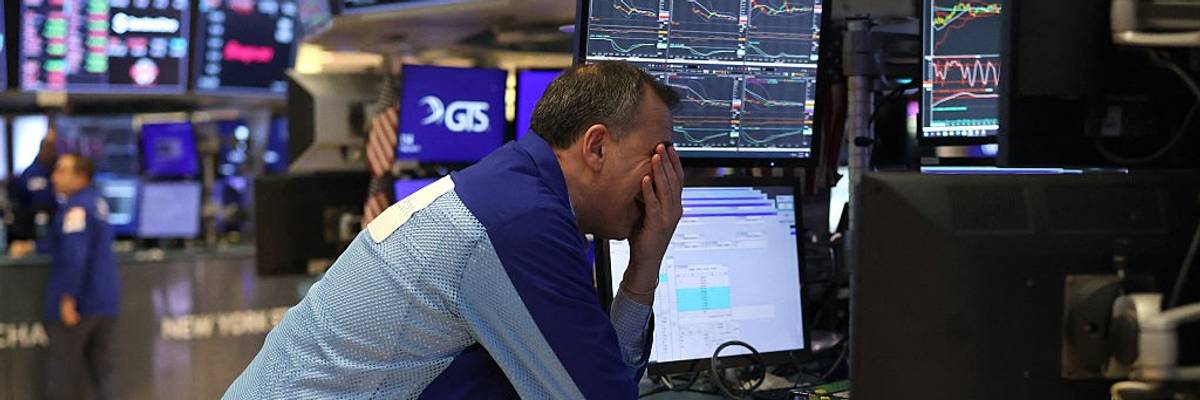
Traders work on the floor of the New York Stock Exchange in New York City, on April 4, 2025.
"The president single-handedly wiped out Americans' retirement savings overnight and subjected businesses to intense whiplash with his increasingly erratic and chaotic policies that continue to drive consumer and business uncertainty."
Alarm over U.S. President Donald Trump's tariffs continues to grow, with stocks plummeting and JPMorgan warning that "the risk of recession in the global economy this year is raised to 60%, up from 40%."
After China announced new 34% tariffs on all American goods beginning next week, The Associated Press reported Friday that "the S&P 500 was down 4.8% in afternoon trading, after earlier dropping more than 5%, following its worst day since Covid wrecked the global economy in 2020. The Dow Jones Industrial Average was down 1,719 points, or 4.3%, as of 1:08 p.m. Eastern time, and the Nasdaq composite was 4.9% lower."
Noting the state of Wall Street this week, Groundwork Collaborative executive director Lindsay Owens declared in a Friday statement that "Trump has officially brought the economy to its knees."
"The president single-handedly wiped out Americans' retirement savings overnight and subjected businesses to intense whiplash with his increasingly erratic and chaotic policies that continue to drive consumer and business uncertainty," she said. "To call this an economic downturn is an understatement; Trump is marching us straight into a depression."
Political and economic observers have been publicly wondering for weeks if Trump is intentionally crashing the economy. Further fueling those fears, he ramped up his trade war on Wednesday by announcing a minimum 10% tariff for imports, with higher levies for dozens of countries. Although he claimed those steeper duties are "reciprocal," his math "horrified" economists and has been called "crazy."
Responding in a Thursday note titled, There Will Be Blood, head of global economic research Bruce Kasman and other experts at JPMorgan wrote that "if sustained, this year's ~22%-point tariff increase would be the largest U.S. tax hike since 1968."
"The effect of this tax hike is likely to be magnified—through retaliation, a slide in U.S. business sentiment, and supply chain disruptions," states the note, which came before China's announcement.
As Bloomberg reported:
Several Wall Street firms on Thursday warned of a U.S. recession, with some making it their base case, after... Trump announced major levies on goods imported from countries around the world. Other economists, including those at JPMorgan, said the hit could be big, though they are taking a wait-and-see approach before revising their projections.
The announcement rocked global financial markets, and the S&P 500 suffered its worst day since 2020. Trump, speaking on Air Force One on Thursday afternoon, said he was open to reducing tariffs if trading partners were able to offer something "phenomenal."
"We are not making immediate changes to our forecasts and want to see the initial implementation and negotiation process that takes hold," the JPMorgan note says. "However, we view the full implementation of announced policies as a substantial macroeconomic shock not currently incorporated in our forecasts. We thus emphasize that these policies, if sustained, would likely push the U.S. and possibly global economy into recession this year."
The team also pointed out that the United States is in potential danger no matter how other countries are ultimately impacted, calling a "scenario where rest of world muddles through a U.S. recession possible but less likely than global downturn."
As Common Dreams reported last week, in anticipation of Trump's tariff announcement, Goldman Sachs published a research note projecting that the odds of a recession in the next year are 35%, up from 20%.
Other financial industry research firms that have recently warned of a possible recession include Barclays, BofA Global Research, Deutsche Bank, RBC Capital Markets, and UBS Global Wealth Management, according to Reuters.
"This is a game-changer, not only for the U.S. economy, but for the global economy. Many countries will likely end up in a recession," Olu Sonola, head of U.S. economic research at Fitch Ratings, said in a late Wednesday note about the levies. "You can throw most forecasts out the door, if this tariff rate stays on for an extended period of time."
Experts have made similar comments to the press in the wake of the president's Rose Garden remarks on Wednesday. Time on Friday shared some from Brian Bethune, a Boston College economics professor:
"[Consumers] are not even going to the grocery store and paying more for vegetables because there's none available from Mexico, or going to Whole Foods, for example, and finding the big sections of fresh fruit are being shut down. They haven't really felt the full impact [yet], and they're already saying something isn't right," Bethune says.
However, while some economists... are more cautious in their discussion about a possible recession, Bethune says it's "inevitable." The question, he says, is just how long until it happens and for how long will it occur? He sees Trump's admission of there being " some pain" on the horizon as only proof of the inevitability.
"At least they [the Trump administration] are not pretending that it's not disruptive, but they're basically soft-selling it, reflecting their ignorance about the way business operates," Bethune claims.
Also on Friday, the Bureau of Labor Statistics released the latest U.S. jobs data. Although the unemployment rate rose from 4.1% to 4.2% in March, the economy added 228,000 jobs, which was better than expected.
However, economists warn of what lies ahead. As University of Michigan economics professor Betsey Stevenson put it, "Today's jobs report is like looking at your vacation photos after you had a horrible car crash on the way home."
Dear Common Dreams reader, It’s been nearly 30 years since I co-founded Common Dreams with my late wife, Lina Newhouser. We had the radical notion that journalism should serve the public good, not corporate profits. It was clear to us from the outset what it would take to build such a project. No paid advertisements. No corporate sponsors. No millionaire publisher telling us what to think or do. Many people said we wouldn't last a year, but we proved those doubters wrong. Together with a tremendous team of journalists and dedicated staff, we built an independent media outlet free from the constraints of profits and corporate control. Our mission has always been simple: To inform. To inspire. To ignite change for the common good. Building Common Dreams was not easy. Our survival was never guaranteed. When you take on the most powerful forces—Wall Street greed, fossil fuel industry destruction, Big Tech lobbyists, and uber-rich oligarchs who have spent billions upon billions rigging the economy and democracy in their favor—the only bulwark you have is supporters who believe in your work. But here’s the urgent message from me today. It's never been this bad out there. And it's never been this hard to keep us going. At the very moment Common Dreams is most needed, the threats we face are intensifying. We need your support now more than ever. We don't accept corporate advertising and never will. We don't have a paywall because we don't think people should be blocked from critical news based on their ability to pay. Everything we do is funded by the donations of readers like you. When everyone does the little they can afford, we are strong. But if that support retreats or dries up, so do we. Will you donate now to make sure Common Dreams not only survives but thrives? —Craig Brown, Co-founder |
Alarm over U.S. President Donald Trump's tariffs continues to grow, with stocks plummeting and JPMorgan warning that "the risk of recession in the global economy this year is raised to 60%, up from 40%."
After China announced new 34% tariffs on all American goods beginning next week, The Associated Press reported Friday that "the S&P 500 was down 4.8% in afternoon trading, after earlier dropping more than 5%, following its worst day since Covid wrecked the global economy in 2020. The Dow Jones Industrial Average was down 1,719 points, or 4.3%, as of 1:08 p.m. Eastern time, and the Nasdaq composite was 4.9% lower."
Noting the state of Wall Street this week, Groundwork Collaborative executive director Lindsay Owens declared in a Friday statement that "Trump has officially brought the economy to its knees."
"The president single-handedly wiped out Americans' retirement savings overnight and subjected businesses to intense whiplash with his increasingly erratic and chaotic policies that continue to drive consumer and business uncertainty," she said. "To call this an economic downturn is an understatement; Trump is marching us straight into a depression."
Political and economic observers have been publicly wondering for weeks if Trump is intentionally crashing the economy. Further fueling those fears, he ramped up his trade war on Wednesday by announcing a minimum 10% tariff for imports, with higher levies for dozens of countries. Although he claimed those steeper duties are "reciprocal," his math "horrified" economists and has been called "crazy."
Responding in a Thursday note titled, There Will Be Blood, head of global economic research Bruce Kasman and other experts at JPMorgan wrote that "if sustained, this year's ~22%-point tariff increase would be the largest U.S. tax hike since 1968."
"The effect of this tax hike is likely to be magnified—through retaliation, a slide in U.S. business sentiment, and supply chain disruptions," states the note, which came before China's announcement.
As Bloomberg reported:
Several Wall Street firms on Thursday warned of a U.S. recession, with some making it their base case, after... Trump announced major levies on goods imported from countries around the world. Other economists, including those at JPMorgan, said the hit could be big, though they are taking a wait-and-see approach before revising their projections.
The announcement rocked global financial markets, and the S&P 500 suffered its worst day since 2020. Trump, speaking on Air Force One on Thursday afternoon, said he was open to reducing tariffs if trading partners were able to offer something "phenomenal."
"We are not making immediate changes to our forecasts and want to see the initial implementation and negotiation process that takes hold," the JPMorgan note says. "However, we view the full implementation of announced policies as a substantial macroeconomic shock not currently incorporated in our forecasts. We thus emphasize that these policies, if sustained, would likely push the U.S. and possibly global economy into recession this year."
The team also pointed out that the United States is in potential danger no matter how other countries are ultimately impacted, calling a "scenario where rest of world muddles through a U.S. recession possible but less likely than global downturn."
As Common Dreams reported last week, in anticipation of Trump's tariff announcement, Goldman Sachs published a research note projecting that the odds of a recession in the next year are 35%, up from 20%.
Other financial industry research firms that have recently warned of a possible recession include Barclays, BofA Global Research, Deutsche Bank, RBC Capital Markets, and UBS Global Wealth Management, according to Reuters.
"This is a game-changer, not only for the U.S. economy, but for the global economy. Many countries will likely end up in a recession," Olu Sonola, head of U.S. economic research at Fitch Ratings, said in a late Wednesday note about the levies. "You can throw most forecasts out the door, if this tariff rate stays on for an extended period of time."
Experts have made similar comments to the press in the wake of the president's Rose Garden remarks on Wednesday. Time on Friday shared some from Brian Bethune, a Boston College economics professor:
"[Consumers] are not even going to the grocery store and paying more for vegetables because there's none available from Mexico, or going to Whole Foods, for example, and finding the big sections of fresh fruit are being shut down. They haven't really felt the full impact [yet], and they're already saying something isn't right," Bethune says.
However, while some economists... are more cautious in their discussion about a possible recession, Bethune says it's "inevitable." The question, he says, is just how long until it happens and for how long will it occur? He sees Trump's admission of there being " some pain" on the horizon as only proof of the inevitability.
"At least they [the Trump administration] are not pretending that it's not disruptive, but they're basically soft-selling it, reflecting their ignorance about the way business operates," Bethune claims.
Also on Friday, the Bureau of Labor Statistics released the latest U.S. jobs data. Although the unemployment rate rose from 4.1% to 4.2% in March, the economy added 228,000 jobs, which was better than expected.
However, economists warn of what lies ahead. As University of Michigan economics professor Betsey Stevenson put it, "Today's jobs report is like looking at your vacation photos after you had a horrible car crash on the way home."
Alarm over U.S. President Donald Trump's tariffs continues to grow, with stocks plummeting and JPMorgan warning that "the risk of recession in the global economy this year is raised to 60%, up from 40%."
After China announced new 34% tariffs on all American goods beginning next week, The Associated Press reported Friday that "the S&P 500 was down 4.8% in afternoon trading, after earlier dropping more than 5%, following its worst day since Covid wrecked the global economy in 2020. The Dow Jones Industrial Average was down 1,719 points, or 4.3%, as of 1:08 p.m. Eastern time, and the Nasdaq composite was 4.9% lower."
Noting the state of Wall Street this week, Groundwork Collaborative executive director Lindsay Owens declared in a Friday statement that "Trump has officially brought the economy to its knees."
"The president single-handedly wiped out Americans' retirement savings overnight and subjected businesses to intense whiplash with his increasingly erratic and chaotic policies that continue to drive consumer and business uncertainty," she said. "To call this an economic downturn is an understatement; Trump is marching us straight into a depression."
Political and economic observers have been publicly wondering for weeks if Trump is intentionally crashing the economy. Further fueling those fears, he ramped up his trade war on Wednesday by announcing a minimum 10% tariff for imports, with higher levies for dozens of countries. Although he claimed those steeper duties are "reciprocal," his math "horrified" economists and has been called "crazy."
Responding in a Thursday note titled, There Will Be Blood, head of global economic research Bruce Kasman and other experts at JPMorgan wrote that "if sustained, this year's ~22%-point tariff increase would be the largest U.S. tax hike since 1968."
"The effect of this tax hike is likely to be magnified—through retaliation, a slide in U.S. business sentiment, and supply chain disruptions," states the note, which came before China's announcement.
As Bloomberg reported:
Several Wall Street firms on Thursday warned of a U.S. recession, with some making it their base case, after... Trump announced major levies on goods imported from countries around the world. Other economists, including those at JPMorgan, said the hit could be big, though they are taking a wait-and-see approach before revising their projections.
The announcement rocked global financial markets, and the S&P 500 suffered its worst day since 2020. Trump, speaking on Air Force One on Thursday afternoon, said he was open to reducing tariffs if trading partners were able to offer something "phenomenal."
"We are not making immediate changes to our forecasts and want to see the initial implementation and negotiation process that takes hold," the JPMorgan note says. "However, we view the full implementation of announced policies as a substantial macroeconomic shock not currently incorporated in our forecasts. We thus emphasize that these policies, if sustained, would likely push the U.S. and possibly global economy into recession this year."
The team also pointed out that the United States is in potential danger no matter how other countries are ultimately impacted, calling a "scenario where rest of world muddles through a U.S. recession possible but less likely than global downturn."
As Common Dreams reported last week, in anticipation of Trump's tariff announcement, Goldman Sachs published a research note projecting that the odds of a recession in the next year are 35%, up from 20%.
Other financial industry research firms that have recently warned of a possible recession include Barclays, BofA Global Research, Deutsche Bank, RBC Capital Markets, and UBS Global Wealth Management, according to Reuters.
"This is a game-changer, not only for the U.S. economy, but for the global economy. Many countries will likely end up in a recession," Olu Sonola, head of U.S. economic research at Fitch Ratings, said in a late Wednesday note about the levies. "You can throw most forecasts out the door, if this tariff rate stays on for an extended period of time."
Experts have made similar comments to the press in the wake of the president's Rose Garden remarks on Wednesday. Time on Friday shared some from Brian Bethune, a Boston College economics professor:
"[Consumers] are not even going to the grocery store and paying more for vegetables because there's none available from Mexico, or going to Whole Foods, for example, and finding the big sections of fresh fruit are being shut down. They haven't really felt the full impact [yet], and they're already saying something isn't right," Bethune says.
However, while some economists... are more cautious in their discussion about a possible recession, Bethune says it's "inevitable." The question, he says, is just how long until it happens and for how long will it occur? He sees Trump's admission of there being " some pain" on the horizon as only proof of the inevitability.
"At least they [the Trump administration] are not pretending that it's not disruptive, but they're basically soft-selling it, reflecting their ignorance about the way business operates," Bethune claims.
Also on Friday, the Bureau of Labor Statistics released the latest U.S. jobs data. Although the unemployment rate rose from 4.1% to 4.2% in March, the economy added 228,000 jobs, which was better than expected.
However, economists warn of what lies ahead. As University of Michigan economics professor Betsey Stevenson put it, "Today's jobs report is like looking at your vacation photos after you had a horrible car crash on the way home."