SUBSCRIBE TO OUR FREE NEWSLETTER
Daily news & progressive opinion—funded by the people, not the corporations—delivered straight to your inbox.
5
#000000
#FFFFFF
To donate by check, phone, or other method, see our More Ways to Give page.
Daily news & progressive opinion—funded by the people, not the corporations—delivered straight to your inbox.
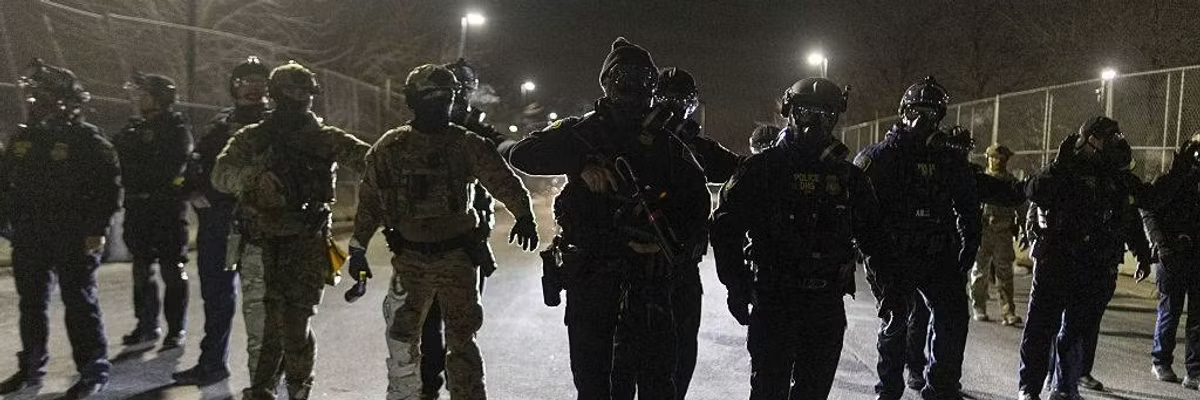
Federal immigration officers confront protesters outside Bishop Henry Whipple Federal Building in Minneapolis, Minnesota, on January 15, 2026.
"If we keep having these crises, one of them is going to get really ugly."
Experts are warning that the Trump administration's ongoing crackdown in Minnesota could quickly get out of hand and could even result in a second US civil war.
Claire Finkelstein, a professor at the University of Pennsylvania Carey Law School, wrote in a Wednesday column published by the Guardian that she and her colleagues at the Center for Ethics and the Rule of Law (CERL) conducted a tabletop exercise in October 2024 that simulated potential outcomes if a US president were to carry out law enforcement operations similar to the ones being conducted by the Trump administration with US Immigration and Customs Enforcement (ICE) officers in Minnesota.
"In that exercise, a president carried out a highly unpopular law-enforcement operation in Philadelphia and attempted to federalize the Pennsylvania’s National Guard," Finkelstein explained. "When the governor resisted and the guard remained loyal to the state, the president deployed active-duty troops, resulting in an armed conflict between state and federal forces."
Finkelstein noted that such a scenario is alarmingly close to what's currently going on in Minnesota, where Gov. Tim Walz has placed his state's National Guard on standby and President Donald Trump has threatened to invoke the Insurrection Act, which would give him broad powers to deploy the military on US soil.
The simulation also projected that the judiciary would be of little help to any state that found itself in the president's crosshairs.
"We concluded that in a fast-moving emergency of this magnitude, courts would probably be unable or unwilling to intervene in time, leaving state officials without meaningful judicial relief," Finkelstein explained. "State officials might file emergency motions to enjoin the use of federal troops, but judges would either fail to respond quickly enough or decline to rule on what they view as a 'political question,' leaving the conflict unresolved."
Steve Saideman, a political scientist at Carleton University in Ottawa, Canada, argued that the situation now is even more dire than the one Finkelstein and her colleagues imagined in their simulation.
In a post on Bluesky, Saideman argued that the US is "hours or days away from civil war."
"This might sound extreme," he acknowledged, "but if Walz has the Minnesota National Guard blocking ICE operations, the usual response of the federal government to governors using National Guard against feds is to call out the Army... What happens if the Army confronts Minnesota National Guard? We have no idea. But one real possibility is: bam."
Saideman added that, given the nonstop chaos of Trump's presidency, it's only a matter of time before it eventually boils over into real civil conflict.
"If we keep having these crises, one of them is going to get really ugly," he said. "Crises under Trump are street cars—there is always another one coming along. We have gotten lucky thus far, but if a citizen shoots at ICE or if the Minnesota National Guard tussles with ICE, things may escalate very quickly."
In a New York Times column published on Monday, Lydia Polgreen argued it was no longer a stretch to equate what is going on in Minnesota with a war being waged by the federal government against one of its own states.
"It might not yet be a civil war, but what the White House has called Operation Metro Surge is definitely not just—or even primarily—an immigration enforcement operation," wrote Polgreen. "It is an occupation designed to punish and terrorize anyone who dares defy this incursion and, by extension, Trump’s power to wield limitless force against any enemy he wishes."
Dear Common Dreams reader, It’s been nearly 30 years since I co-founded Common Dreams with my late wife, Lina Newhouser. We had the radical notion that journalism should serve the public good, not corporate profits. It was clear to us from the outset what it would take to build such a project. No paid advertisements. No corporate sponsors. No millionaire publisher telling us what to think or do. Many people said we wouldn't last a year, but we proved those doubters wrong. Together with a tremendous team of journalists and dedicated staff, we built an independent media outlet free from the constraints of profits and corporate control. Our mission has always been simple: To inform. To inspire. To ignite change for the common good. Building Common Dreams was not easy. Our survival was never guaranteed. When you take on the most powerful forces—Wall Street greed, fossil fuel industry destruction, Big Tech lobbyists, and uber-rich oligarchs who have spent billions upon billions rigging the economy and democracy in their favor—the only bulwark you have is supporters who believe in your work. But here’s the urgent message from me today. It's never been this bad out there. And it's never been this hard to keep us going. At the very moment Common Dreams is most needed, the threats we face are intensifying. We need your support now more than ever. We don't accept corporate advertising and never will. We don't have a paywall because we don't think people should be blocked from critical news based on their ability to pay. Everything we do is funded by the donations of readers like you. When everyone does the little they can afford, we are strong. But if that support retreats or dries up, so do we. Will you donate now to make sure Common Dreams not only survives but thrives? —Craig Brown, Co-founder |
Experts are warning that the Trump administration's ongoing crackdown in Minnesota could quickly get out of hand and could even result in a second US civil war.
Claire Finkelstein, a professor at the University of Pennsylvania Carey Law School, wrote in a Wednesday column published by the Guardian that she and her colleagues at the Center for Ethics and the Rule of Law (CERL) conducted a tabletop exercise in October 2024 that simulated potential outcomes if a US president were to carry out law enforcement operations similar to the ones being conducted by the Trump administration with US Immigration and Customs Enforcement (ICE) officers in Minnesota.
"In that exercise, a president carried out a highly unpopular law-enforcement operation in Philadelphia and attempted to federalize the Pennsylvania’s National Guard," Finkelstein explained. "When the governor resisted and the guard remained loyal to the state, the president deployed active-duty troops, resulting in an armed conflict between state and federal forces."
Finkelstein noted that such a scenario is alarmingly close to what's currently going on in Minnesota, where Gov. Tim Walz has placed his state's National Guard on standby and President Donald Trump has threatened to invoke the Insurrection Act, which would give him broad powers to deploy the military on US soil.
The simulation also projected that the judiciary would be of little help to any state that found itself in the president's crosshairs.
"We concluded that in a fast-moving emergency of this magnitude, courts would probably be unable or unwilling to intervene in time, leaving state officials without meaningful judicial relief," Finkelstein explained. "State officials might file emergency motions to enjoin the use of federal troops, but judges would either fail to respond quickly enough or decline to rule on what they view as a 'political question,' leaving the conflict unresolved."
Steve Saideman, a political scientist at Carleton University in Ottawa, Canada, argued that the situation now is even more dire than the one Finkelstein and her colleagues imagined in their simulation.
In a post on Bluesky, Saideman argued that the US is "hours or days away from civil war."
"This might sound extreme," he acknowledged, "but if Walz has the Minnesota National Guard blocking ICE operations, the usual response of the federal government to governors using National Guard against feds is to call out the Army... What happens if the Army confronts Minnesota National Guard? We have no idea. But one real possibility is: bam."
Saideman added that, given the nonstop chaos of Trump's presidency, it's only a matter of time before it eventually boils over into real civil conflict.
"If we keep having these crises, one of them is going to get really ugly," he said. "Crises under Trump are street cars—there is always another one coming along. We have gotten lucky thus far, but if a citizen shoots at ICE or if the Minnesota National Guard tussles with ICE, things may escalate very quickly."
In a New York Times column published on Monday, Lydia Polgreen argued it was no longer a stretch to equate what is going on in Minnesota with a war being waged by the federal government against one of its own states.
"It might not yet be a civil war, but what the White House has called Operation Metro Surge is definitely not just—or even primarily—an immigration enforcement operation," wrote Polgreen. "It is an occupation designed to punish and terrorize anyone who dares defy this incursion and, by extension, Trump’s power to wield limitless force against any enemy he wishes."
Experts are warning that the Trump administration's ongoing crackdown in Minnesota could quickly get out of hand and could even result in a second US civil war.
Claire Finkelstein, a professor at the University of Pennsylvania Carey Law School, wrote in a Wednesday column published by the Guardian that she and her colleagues at the Center for Ethics and the Rule of Law (CERL) conducted a tabletop exercise in October 2024 that simulated potential outcomes if a US president were to carry out law enforcement operations similar to the ones being conducted by the Trump administration with US Immigration and Customs Enforcement (ICE) officers in Minnesota.
"In that exercise, a president carried out a highly unpopular law-enforcement operation in Philadelphia and attempted to federalize the Pennsylvania’s National Guard," Finkelstein explained. "When the governor resisted and the guard remained loyal to the state, the president deployed active-duty troops, resulting in an armed conflict between state and federal forces."
Finkelstein noted that such a scenario is alarmingly close to what's currently going on in Minnesota, where Gov. Tim Walz has placed his state's National Guard on standby and President Donald Trump has threatened to invoke the Insurrection Act, which would give him broad powers to deploy the military on US soil.
The simulation also projected that the judiciary would be of little help to any state that found itself in the president's crosshairs.
"We concluded that in a fast-moving emergency of this magnitude, courts would probably be unable or unwilling to intervene in time, leaving state officials without meaningful judicial relief," Finkelstein explained. "State officials might file emergency motions to enjoin the use of federal troops, but judges would either fail to respond quickly enough or decline to rule on what they view as a 'political question,' leaving the conflict unresolved."
Steve Saideman, a political scientist at Carleton University in Ottawa, Canada, argued that the situation now is even more dire than the one Finkelstein and her colleagues imagined in their simulation.
In a post on Bluesky, Saideman argued that the US is "hours or days away from civil war."
"This might sound extreme," he acknowledged, "but if Walz has the Minnesota National Guard blocking ICE operations, the usual response of the federal government to governors using National Guard against feds is to call out the Army... What happens if the Army confronts Minnesota National Guard? We have no idea. But one real possibility is: bam."
Saideman added that, given the nonstop chaos of Trump's presidency, it's only a matter of time before it eventually boils over into real civil conflict.
"If we keep having these crises, one of them is going to get really ugly," he said. "Crises under Trump are street cars—there is always another one coming along. We have gotten lucky thus far, but if a citizen shoots at ICE or if the Minnesota National Guard tussles with ICE, things may escalate very quickly."
In a New York Times column published on Monday, Lydia Polgreen argued it was no longer a stretch to equate what is going on in Minnesota with a war being waged by the federal government against one of its own states.
"It might not yet be a civil war, but what the White House has called Operation Metro Surge is definitely not just—or even primarily—an immigration enforcement operation," wrote Polgreen. "It is an occupation designed to punish and terrorize anyone who dares defy this incursion and, by extension, Trump’s power to wield limitless force against any enemy he wishes."