5
#000000
#FFFFFF
To donate by check, phone, or other method, see our More Ways to Give page.
Daily news & progressive opinion—funded by the people, not the corporations—delivered straight to your inbox.
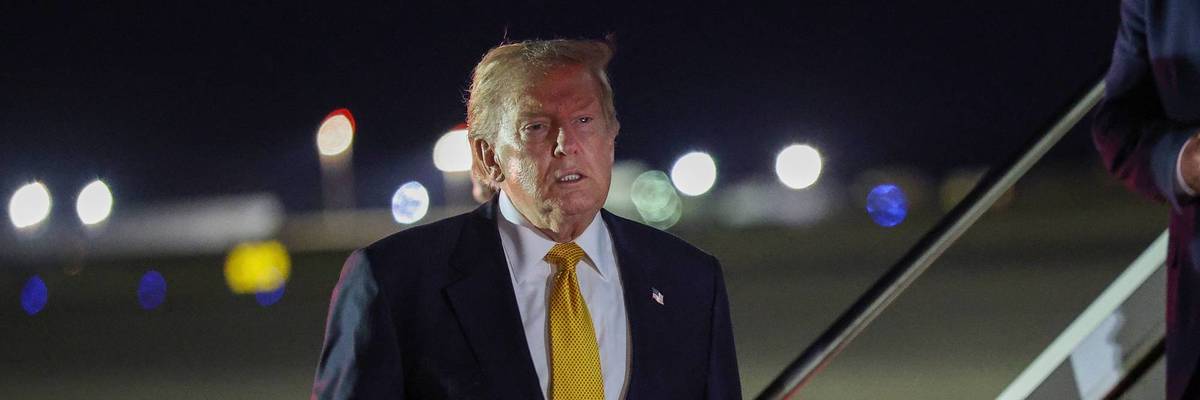
US President Donald Trump steps off Air Force One to board the new Qatari-gifted Boeing plane en route to the United States after participating in the NATO Summit at Royal Air Force Mildenhall on July 8, 2026, in Mildenhall, England.
Trump claimed to have "59% approval" while not a single pollster even has him above water. Meanwhile, oil prices are shooting back up after he restarted the war in Iran.
It is once again Opposite Day for President Donald Trump, who claimed in a late-night social media post that his approval rating is high and oil prices are dropping, neither of which is actually true.
"59 percent Approval Rating. Prices coming down along with the lowering of oil and gas. Thank you! President DJT," Trump wrote Sunday night on Truth Social.
Trump did not specify what poll had him at 59% approval, presumably because it does not exist. Not a single one of the polls tracked by The New York Times or RealClearPolling's aggregators shows Trump even breaking even with the public.
The Times average as of Monday morning has his approval rating at 39%, with 58% disapproval—on par with the worst metrics of his second term. RCP’s average is only slightly more merciful, showing the president’s approval at just under 40% and his disapproval at 57%.
Even the GOP-friendly pollster Rasmussen shows him with just 44% approval and 54% disapproval—generous outlier numbers for the president.
It is, of course, possible that Trump was referring to some heavily massaged poll that only he has seen, though he has a long history of inflating his popularity while claiming that polls showing otherwise are "fake news."
The price of oil, on the other hand, is something that can't be faked, though it didn't stop Trump from trying.
This weekend, Trump launched a new series of attacks against Iran, after declaring earlier in the week that the peace framework signed last month was “over” and saying negotiations were a “waste of time.”
Iran responded by announcing late Saturday night that it would seal off the Strait of Hormuz to most traffic, once again choking off a main route for global oil and gas transport.
Asked about the closure on Sunday, Trump told reporters, "I don't want to talk about it."
His post seems to reveal a further commitment to denying reality. Contrary to his claim about the "lowering of oil and gas," US gas prices on Monday averaged $3.87 per gallon, up from $3.80 a week earlier.
Meanwhile, the price of Brent crude has shot up by more than 9% over the past week, from $72 per barrel last Monday to nearly $79 as of this writing. At the time of Trump’s tweet, oil prices had already climbed by about 4% and continued to increase into Monday morning.
Prices are down from the war's height in the springtime, when gas surpassed $4.50 per gallon and a barrel of oil cost more than $110. But crude prices are still 9% higher than prewar, while gas is up about 31%, with companies capitalizing on the war to pad their profit margins at the expense of consumers and businesses.
Dear Common Dreams reader, It’s been nearly 30 years since I co-founded Common Dreams with my late wife, Lina Newhouser. We had the radical notion that journalism should serve the public good, not corporate profits. It was clear to us from the outset what it would take to build such a project. No paid advertisements. No corporate sponsors. No millionaire publisher telling us what to think or do. Many people said we wouldn't last a year, but we proved those doubters wrong. Together with a tremendous team of journalists and dedicated staff, we built an independent media outlet free from the constraints of profits and corporate control. Our mission has always been simple: To inform. To inspire. To ignite change for the common good. Building Common Dreams was not easy. Our survival was never guaranteed. When you take on the most powerful forces—Wall Street greed, fossil fuel industry destruction, Big Tech lobbyists, and uber-rich oligarchs who have spent billions upon billions rigging the economy and democracy in their favor—the only bulwark you have is supporters who believe in your work. But here’s the urgent message from me today. It's never been this bad out there. And it's never been this hard to keep us going. At the very moment Common Dreams is most needed, the threats we face are intensifying. We need your support now more than ever. We don't accept corporate advertising and never will. We don't have a paywall because we don't think people should be blocked from critical news based on their ability to pay. Everything we do is funded by the donations of readers like you. When everyone does the little they can afford, we are strong. But if that support retreats or dries up, so do we. Will you donate now to make sure Common Dreams not only survives but thrives? —Craig Brown, Co-founder |
It is once again Opposite Day for President Donald Trump, who claimed in a late-night social media post that his approval rating is high and oil prices are dropping, neither of which is actually true.
"59 percent Approval Rating. Prices coming down along with the lowering of oil and gas. Thank you! President DJT," Trump wrote Sunday night on Truth Social.
Trump did not specify what poll had him at 59% approval, presumably because it does not exist. Not a single one of the polls tracked by The New York Times or RealClearPolling's aggregators shows Trump even breaking even with the public.
The Times average as of Monday morning has his approval rating at 39%, with 58% disapproval—on par with the worst metrics of his second term. RCP’s average is only slightly more merciful, showing the president’s approval at just under 40% and his disapproval at 57%.
Even the GOP-friendly pollster Rasmussen shows him with just 44% approval and 54% disapproval—generous outlier numbers for the president.
It is, of course, possible that Trump was referring to some heavily massaged poll that only he has seen, though he has a long history of inflating his popularity while claiming that polls showing otherwise are "fake news."
The price of oil, on the other hand, is something that can't be faked, though it didn't stop Trump from trying.
This weekend, Trump launched a new series of attacks against Iran, after declaring earlier in the week that the peace framework signed last month was “over” and saying negotiations were a “waste of time.”
Iran responded by announcing late Saturday night that it would seal off the Strait of Hormuz to most traffic, once again choking off a main route for global oil and gas transport.
Asked about the closure on Sunday, Trump told reporters, "I don't want to talk about it."
His post seems to reveal a further commitment to denying reality. Contrary to his claim about the "lowering of oil and gas," US gas prices on Monday averaged $3.87 per gallon, up from $3.80 a week earlier.
Meanwhile, the price of Brent crude has shot up by more than 9% over the past week, from $72 per barrel last Monday to nearly $79 as of this writing. At the time of Trump’s tweet, oil prices had already climbed by about 4% and continued to increase into Monday morning.
Prices are down from the war's height in the springtime, when gas surpassed $4.50 per gallon and a barrel of oil cost more than $110. But crude prices are still 9% higher than prewar, while gas is up about 31%, with companies capitalizing on the war to pad their profit margins at the expense of consumers and businesses.
It is once again Opposite Day for President Donald Trump, who claimed in a late-night social media post that his approval rating is high and oil prices are dropping, neither of which is actually true.
"59 percent Approval Rating. Prices coming down along with the lowering of oil and gas. Thank you! President DJT," Trump wrote Sunday night on Truth Social.
Trump did not specify what poll had him at 59% approval, presumably because it does not exist. Not a single one of the polls tracked by The New York Times or RealClearPolling's aggregators shows Trump even breaking even with the public.
The Times average as of Monday morning has his approval rating at 39%, with 58% disapproval—on par with the worst metrics of his second term. RCP’s average is only slightly more merciful, showing the president’s approval at just under 40% and his disapproval at 57%.
Even the GOP-friendly pollster Rasmussen shows him with just 44% approval and 54% disapproval—generous outlier numbers for the president.
It is, of course, possible that Trump was referring to some heavily massaged poll that only he has seen, though he has a long history of inflating his popularity while claiming that polls showing otherwise are "fake news."
The price of oil, on the other hand, is something that can't be faked, though it didn't stop Trump from trying.
This weekend, Trump launched a new series of attacks against Iran, after declaring earlier in the week that the peace framework signed last month was “over” and saying negotiations were a “waste of time.”
Iran responded by announcing late Saturday night that it would seal off the Strait of Hormuz to most traffic, once again choking off a main route for global oil and gas transport.
Asked about the closure on Sunday, Trump told reporters, "I don't want to talk about it."
His post seems to reveal a further commitment to denying reality. Contrary to his claim about the "lowering of oil and gas," US gas prices on Monday averaged $3.87 per gallon, up from $3.80 a week earlier.
Meanwhile, the price of Brent crude has shot up by more than 9% over the past week, from $72 per barrel last Monday to nearly $79 as of this writing. At the time of Trump’s tweet, oil prices had already climbed by about 4% and continued to increase into Monday morning.
Prices are down from the war's height in the springtime, when gas surpassed $4.50 per gallon and a barrel of oil cost more than $110. But crude prices are still 9% higher than prewar, while gas is up about 31%, with companies capitalizing on the war to pad their profit margins at the expense of consumers and businesses.