SUBSCRIBE TO OUR FREE NEWSLETTER
Daily news & progressive opinion—funded by the people, not the corporations—delivered straight to your inbox.
5
#000000
#FFFFFF
To donate by check, phone, or other method, see our More Ways to Give page.
Daily news & progressive opinion—funded by the people, not the corporations—delivered straight to your inbox.
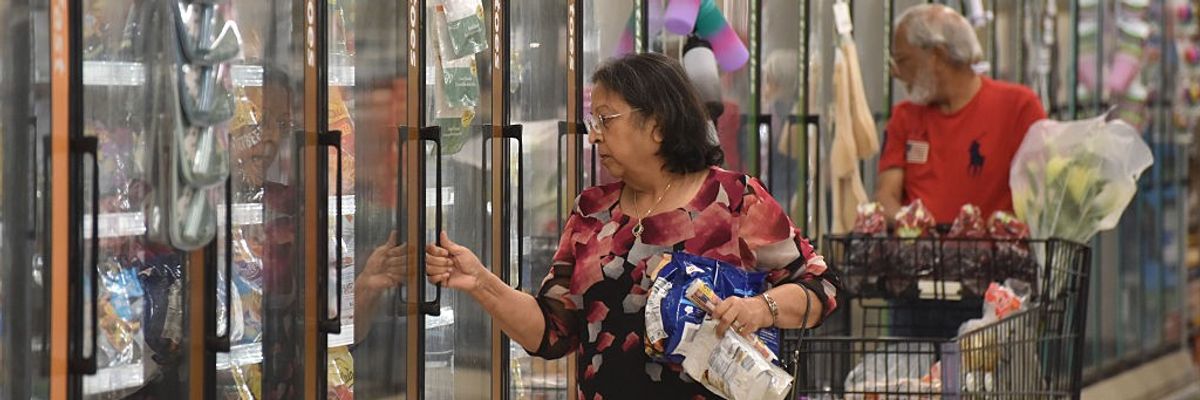
People shop at a supermarket on July 18, 2025 in Rockville, Maryland.
"In contrast with the president's assertion of bustling job creation," said The Century Foundation's Andrew Stettner, "Americans can't get off of unemployment benefits in an economy that has stopped adding jobs outside of healthcare."
The flow of abysmal U.S. economic data continued Thursday with the release of figures showing that the number of Americans collecting unemployment benefits has reached its highest level in nearly four years, heightening concerns that the Trump administration is pushing the country toward a period of "stagflation."
"Today's unemployment report, coupled with last week's jobs data, suggests that we're fast stumbling into stagflation, with fledgling jobs growth and rising prices," Andrew Stettner, unemployment insurance expert at The Century Foundation, said in a statement following the new Labor Department numbers.
The department said that 1.97 million Americans were receiving unemployment benefits during the week ending July 26, an increase of 38,000 compared to the previous week.
"In contrast with the president's assertion of bustling job creation," said Stettner, "Americans can't get off of unemployment benefits in an economy that has stopped adding jobs outside of healthcare."
The government figures were released a day after private data showed that employment in the U.S. services sector fell last month as prices rose. Meanwhile, U.S. manufacturing activity contracted in July at the fastest pace in nine months, even as President Donald Trump claimed his erratic tariff regime would revive the sector.
"Private data confirms the government numbers, and firing the head of BLS can't change that," said Rep. Gwen Moore (D-Wis.), referring to Trump's decision to terminate Bureau of Labor Statistics Commissioner Erika McEntarfer in the wake of last week's terrible U.S. jobs report—calling into question the reliability of future federal data.
" Republicans are killing jobs and feeding inflation," Moore added. "Trump is making stagflation great again."
"Trump's economy of uncertainty is leading to widespread anxiety, with more than 3 in 4 Americans saying they are concerned about a possible recession."
The recent data—combined with surveys showing American consumers are increasingly struggling with the rising prices of groceries and other necessities—appears to vindicate warnings from economists and other analysts that the U.S. economy is in growing trouble under Trump's erratic stewardship.
"The risk of stagflation has risen meaningfully," Olu Sonola, an economist at Fitch Ratings, wrote in a client note. "Inflation is drifting further from target, private sector economic growth has slowed materially, and the labor market has just sounded a warning bell."
Rachel West and Laura Valle Gutierrez of The Century Foundation wrote earlier this week that "Trump's economy of uncertainty is leading to widespread anxiety, with more than 3 in 4 Americans saying they are concerned about a possible recession."
"And Trump's budget law, which slashes healthcare and food assistance for everyday Americans to pay for more than $4 trillion in tax cuts for the wealthy and corporations, compounds Americans' uncertainty and fear about what the future brings," they added.
Dear Common Dreams reader, It’s been nearly 30 years since I co-founded Common Dreams with my late wife, Lina Newhouser. We had the radical notion that journalism should serve the public good, not corporate profits. It was clear to us from the outset what it would take to build such a project. No paid advertisements. No corporate sponsors. No millionaire publisher telling us what to think or do. Many people said we wouldn't last a year, but we proved those doubters wrong. Together with a tremendous team of journalists and dedicated staff, we built an independent media outlet free from the constraints of profits and corporate control. Our mission has always been simple: To inform. To inspire. To ignite change for the common good. Building Common Dreams was not easy. Our survival was never guaranteed. When you take on the most powerful forces—Wall Street greed, fossil fuel industry destruction, Big Tech lobbyists, and uber-rich oligarchs who have spent billions upon billions rigging the economy and democracy in their favor—the only bulwark you have is supporters who believe in your work. But here’s the urgent message from me today. It's never been this bad out there. And it's never been this hard to keep us going. At the very moment Common Dreams is most needed, the threats we face are intensifying. We need your support now more than ever. We don't accept corporate advertising and never will. We don't have a paywall because we don't think people should be blocked from critical news based on their ability to pay. Everything we do is funded by the donations of readers like you. When everyone does the little they can afford, we are strong. But if that support retreats or dries up, so do we. Will you donate now to make sure Common Dreams not only survives but thrives? —Craig Brown, Co-founder |
The flow of abysmal U.S. economic data continued Thursday with the release of figures showing that the number of Americans collecting unemployment benefits has reached its highest level in nearly four years, heightening concerns that the Trump administration is pushing the country toward a period of "stagflation."
"Today's unemployment report, coupled with last week's jobs data, suggests that we're fast stumbling into stagflation, with fledgling jobs growth and rising prices," Andrew Stettner, unemployment insurance expert at The Century Foundation, said in a statement following the new Labor Department numbers.
The department said that 1.97 million Americans were receiving unemployment benefits during the week ending July 26, an increase of 38,000 compared to the previous week.
"In contrast with the president's assertion of bustling job creation," said Stettner, "Americans can't get off of unemployment benefits in an economy that has stopped adding jobs outside of healthcare."
The government figures were released a day after private data showed that employment in the U.S. services sector fell last month as prices rose. Meanwhile, U.S. manufacturing activity contracted in July at the fastest pace in nine months, even as President Donald Trump claimed his erratic tariff regime would revive the sector.
"Private data confirms the government numbers, and firing the head of BLS can't change that," said Rep. Gwen Moore (D-Wis.), referring to Trump's decision to terminate Bureau of Labor Statistics Commissioner Erika McEntarfer in the wake of last week's terrible U.S. jobs report—calling into question the reliability of future federal data.
" Republicans are killing jobs and feeding inflation," Moore added. "Trump is making stagflation great again."
"Trump's economy of uncertainty is leading to widespread anxiety, with more than 3 in 4 Americans saying they are concerned about a possible recession."
The recent data—combined with surveys showing American consumers are increasingly struggling with the rising prices of groceries and other necessities—appears to vindicate warnings from economists and other analysts that the U.S. economy is in growing trouble under Trump's erratic stewardship.
"The risk of stagflation has risen meaningfully," Olu Sonola, an economist at Fitch Ratings, wrote in a client note. "Inflation is drifting further from target, private sector economic growth has slowed materially, and the labor market has just sounded a warning bell."
Rachel West and Laura Valle Gutierrez of The Century Foundation wrote earlier this week that "Trump's economy of uncertainty is leading to widespread anxiety, with more than 3 in 4 Americans saying they are concerned about a possible recession."
"And Trump's budget law, which slashes healthcare and food assistance for everyday Americans to pay for more than $4 trillion in tax cuts for the wealthy and corporations, compounds Americans' uncertainty and fear about what the future brings," they added.
The flow of abysmal U.S. economic data continued Thursday with the release of figures showing that the number of Americans collecting unemployment benefits has reached its highest level in nearly four years, heightening concerns that the Trump administration is pushing the country toward a period of "stagflation."
"Today's unemployment report, coupled with last week's jobs data, suggests that we're fast stumbling into stagflation, with fledgling jobs growth and rising prices," Andrew Stettner, unemployment insurance expert at The Century Foundation, said in a statement following the new Labor Department numbers.
The department said that 1.97 million Americans were receiving unemployment benefits during the week ending July 26, an increase of 38,000 compared to the previous week.
"In contrast with the president's assertion of bustling job creation," said Stettner, "Americans can't get off of unemployment benefits in an economy that has stopped adding jobs outside of healthcare."
The government figures were released a day after private data showed that employment in the U.S. services sector fell last month as prices rose. Meanwhile, U.S. manufacturing activity contracted in July at the fastest pace in nine months, even as President Donald Trump claimed his erratic tariff regime would revive the sector.
"Private data confirms the government numbers, and firing the head of BLS can't change that," said Rep. Gwen Moore (D-Wis.), referring to Trump's decision to terminate Bureau of Labor Statistics Commissioner Erika McEntarfer in the wake of last week's terrible U.S. jobs report—calling into question the reliability of future federal data.
" Republicans are killing jobs and feeding inflation," Moore added. "Trump is making stagflation great again."
"Trump's economy of uncertainty is leading to widespread anxiety, with more than 3 in 4 Americans saying they are concerned about a possible recession."
The recent data—combined with surveys showing American consumers are increasingly struggling with the rising prices of groceries and other necessities—appears to vindicate warnings from economists and other analysts that the U.S. economy is in growing trouble under Trump's erratic stewardship.
"The risk of stagflation has risen meaningfully," Olu Sonola, an economist at Fitch Ratings, wrote in a client note. "Inflation is drifting further from target, private sector economic growth has slowed materially, and the labor market has just sounded a warning bell."
Rachel West and Laura Valle Gutierrez of The Century Foundation wrote earlier this week that "Trump's economy of uncertainty is leading to widespread anxiety, with more than 3 in 4 Americans saying they are concerned about a possible recession."
"And Trump's budget law, which slashes healthcare and food assistance for everyday Americans to pay for more than $4 trillion in tax cuts for the wealthy and corporations, compounds Americans' uncertainty and fear about what the future brings," they added.