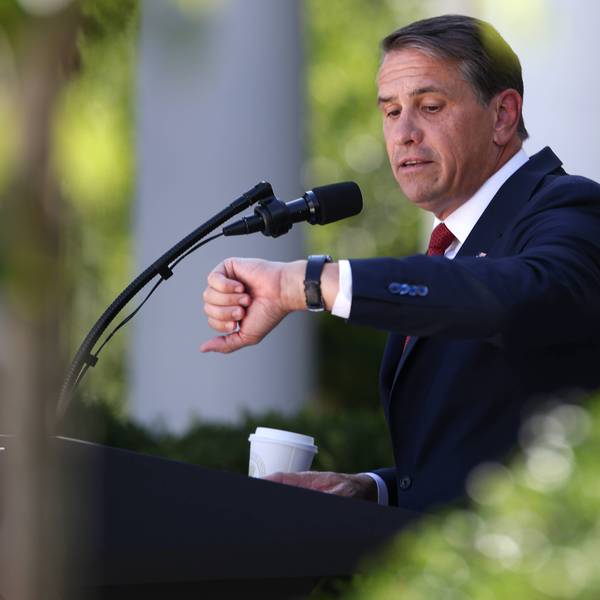

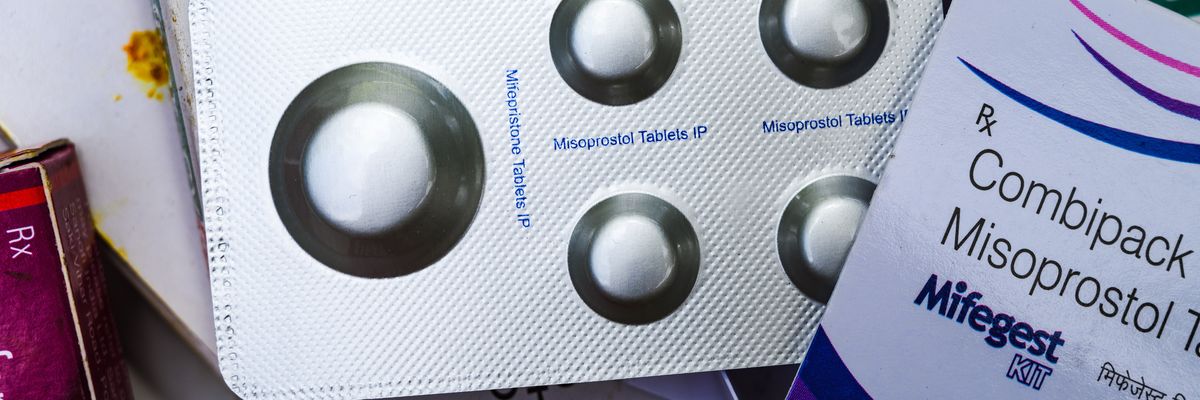
Mifepristone and misoprostol, which are used in medication abortions, are seen at a pharmacy in Tehatta, West Bengal, India on August 18, 2023.
Texas House Passes Attack on Mailed Abortion Pills That 'Will Fuel Fear' Nationwide
"Texas: Land of the free! Also Texas: We want you to surveil your neighbor, see if they've missed their period, snoop through their trash and mail, and sue whoever sent them medication abortion."
Republicans in the Texas House of Representatives on Thursday night advanced another anti-abortion bounty hunter bill, this one taking aim at medications mailed from states that support reproductive freedom so Texans can choose to end pregnancies.
House Bill 7 passed 82-48 along party lines during Texas' second special legislative session of the year. The proposal from state Rep. Jeff Leach (R-67) still needs approval from the Senate—which previously passed similar legislation—before it heads to the desk of Republican Gov. Greg Abbott. He has signed various attacks on reproductive rights, including Senate Bill 8, a 2021 state law that entices vigilantes with $10,000 bounties to enforce a six-week abortion ban.
Like S.B. 8, the new bill relies on lawsuits filed by private citizens. H.B. 7 would empower them to sue out-of-state healthcare providers, medication manufacturers, and anyone who mails or otherwise provides abortion pills to someone in the state for up to $100,000 in damages per violation—even if no abortion occurs. Under pressure from some anti-choice groups, Republicans added language allowing vigilantes to keep only $10,000; the rest would go to a charity they choose.
"It's designed to trap Texans into forced pregnancy," Shellie Hayes-McMahon, executive director of Planned Parenthood Texas Votes, told the Houston Chronicle. "Instead of fixing the crisis they (Texas lawmakers) manufactured, they're doubling down to punish anyone who dares to help a Texan. This bill is not about safety, it's about control."
Republicans in the Texas House have introduced another way to try to harm patients, providers, and manufacturers in the state. HB 7 would allow anyone to sue a manufacturer, distributor, or provider of medication abortion—even without proof of care being provided.
[image or embed]
— Reproductive Freedom for All (@reproductivefreedomforall.org) August 29, 2025 at 10:34 AM
The bill is part of a broader effort to stop the flow of abortion medications—mifepristone and misoprostol—into states that have ramped up restrictions in the wake of the U.S. Supreme Court's right-wing supermajority reversing Roe v. Wade in 2022.
As GOP lawmakers have worked to further restrict reproductive freedom, Democrat-controlled states have enacted "shield laws" to protect doctors and patients. Laws enabling telehealth abortions are key targets for Republican officials and far-right activists—including "anti-abortion legal terrorist" Jonathan Mitchell, the chief architect of S.B. 8 who's now representing a Texas man in a wrongful death case against a California doctor accused of providing pills that his girlfriend used to end her pregnancy.
The New York Times reported that "supporters hope and opponents fear" H.B. 7 "will serve as a model for other states to limit medication abortion by promoting a rash of lawsuits against medical providers, pharmaceutical companies, and companies such as FedEx or UPS that may ship the drugs."
Supporters and opponents also anticipate court battles over the bill itself. "Texas is sort of the tip of the spear," Marc Hearron, the associate director of litigation at the Center for Reproductive Rights, told the Times. "It's setting up a clash."
H.B. 7 is "pushing up against the limits of how much a state can control," Hearron added. "Each state can have its own laws, but throughout our history, we have been able to travel across the country, send things across the country."
Texas: Land of the free! Also Texas: We want you to surveil your neighbor, see if they've missed their period, snoop through their trash and mail, and sue whoever sent them medication abortion. https://bit.ly/4lM2sXF
[image or embed]
— Center for Reproductive Rights (@reprorights.org) August 28, 2025 at 4:45 PM
After Thursday's vote, Blair Wallace, policy and advocacy strategist on reproductive freedom at the ACLU of Texas, warned in a statement that "H.B. 7 exports Texas' extreme abortion ban far beyond state borders."
"It will fuel fear among manufacturers and providers nationwide, while encouraging neighbors to police one another's reproductive lives, further isolating pregnant Texans, and punishing the people who care for them," she said. "We believe in a Texas where people have the freedom to make decisions about our own bodies and futures."
We are at a crossroads
This country and this world are at a monumental crossroads. In a few short weeks, US voters will have an opportunity to beat back the forces of fascism and confront the billionaires who are rigging the economy, our media system, and our democracy, making it increasingly impossible for ordinary people to get by. We’re not just talking about the election. We’re talking about what must be done once these fascist elements are vanquished from power. We need a bolder set of solutions than what either major party has so far been willing to offer and a working-class movement ready to fight like hell for it. Trump didn't emerge from nowhere. The conditions that fueled MAGA authoritarianism were created by decades of radical neoliberal economic policies and a corrupt political system dominated by corporate interests. They slashed taxes on the super-rich, promising that the benefits would trickle down. They said giveaways to the corporate titans would make life more affordable for the rest of us. It was all bullshit. And when a bitter, betrayed populace searches for someone to blame, right-wing demagogues have little trouble finding scapegoats. People know when they're being lied to, but you won't hear any of this from the corporate media. Only independent journalism—powered and funded by people who believe in building a better world—can deliver truly trustworthy daily news. Our Fall Campaign is underway, and we need your help. To power our newsroom through the rest of the year, we need to raise $125,000 by midnight on October 31. So if you share our vision, please contribute whatever you can to sustain our work. |
Republicans in the Texas House of Representatives on Thursday night advanced another anti-abortion bounty hunter bill, this one taking aim at medications mailed from states that support reproductive freedom so Texans can choose to end pregnancies.
House Bill 7 passed 82-48 along party lines during Texas' second special legislative session of the year. The proposal from state Rep. Jeff Leach (R-67) still needs approval from the Senate—which previously passed similar legislation—before it heads to the desk of Republican Gov. Greg Abbott. He has signed various attacks on reproductive rights, including Senate Bill 8, a 2021 state law that entices vigilantes with $10,000 bounties to enforce a six-week abortion ban.
Like S.B. 8, the new bill relies on lawsuits filed by private citizens. H.B. 7 would empower them to sue out-of-state healthcare providers, medication manufacturers, and anyone who mails or otherwise provides abortion pills to someone in the state for up to $100,000 in damages per violation—even if no abortion occurs. Under pressure from some anti-choice groups, Republicans added language allowing vigilantes to keep only $10,000; the rest would go to a charity they choose.
"It's designed to trap Texans into forced pregnancy," Shellie Hayes-McMahon, executive director of Planned Parenthood Texas Votes, told the Houston Chronicle. "Instead of fixing the crisis they (Texas lawmakers) manufactured, they're doubling down to punish anyone who dares to help a Texan. This bill is not about safety, it's about control."
Republicans in the Texas House have introduced another way to try to harm patients, providers, and manufacturers in the state. HB 7 would allow anyone to sue a manufacturer, distributor, or provider of medication abortion—even without proof of care being provided.
[image or embed]
— Reproductive Freedom for All (@reproductivefreedomforall.org) August 29, 2025 at 10:34 AM
The bill is part of a broader effort to stop the flow of abortion medications—mifepristone and misoprostol—into states that have ramped up restrictions in the wake of the U.S. Supreme Court's right-wing supermajority reversing Roe v. Wade in 2022.
As GOP lawmakers have worked to further restrict reproductive freedom, Democrat-controlled states have enacted "shield laws" to protect doctors and patients. Laws enabling telehealth abortions are key targets for Republican officials and far-right activists—including "anti-abortion legal terrorist" Jonathan Mitchell, the chief architect of S.B. 8 who's now representing a Texas man in a wrongful death case against a California doctor accused of providing pills that his girlfriend used to end her pregnancy.
The New York Times reported that "supporters hope and opponents fear" H.B. 7 "will serve as a model for other states to limit medication abortion by promoting a rash of lawsuits against medical providers, pharmaceutical companies, and companies such as FedEx or UPS that may ship the drugs."
Supporters and opponents also anticipate court battles over the bill itself. "Texas is sort of the tip of the spear," Marc Hearron, the associate director of litigation at the Center for Reproductive Rights, told the Times. "It's setting up a clash."
H.B. 7 is "pushing up against the limits of how much a state can control," Hearron added. "Each state can have its own laws, but throughout our history, we have been able to travel across the country, send things across the country."
Texas: Land of the free! Also Texas: We want you to surveil your neighbor, see if they've missed their period, snoop through their trash and mail, and sue whoever sent them medication abortion. https://bit.ly/4lM2sXF
[image or embed]
— Center for Reproductive Rights (@reprorights.org) August 28, 2025 at 4:45 PM
After Thursday's vote, Blair Wallace, policy and advocacy strategist on reproductive freedom at the ACLU of Texas, warned in a statement that "H.B. 7 exports Texas' extreme abortion ban far beyond state borders."
"It will fuel fear among manufacturers and providers nationwide, while encouraging neighbors to police one another's reproductive lives, further isolating pregnant Texans, and punishing the people who care for them," she said. "We believe in a Texas where people have the freedom to make decisions about our own bodies and futures."
- Alarm as 'Legal Terrorist' Helps Texan Sue Dr. Over Girlfriend's Abortion Pills ›
- NARAL Pro-Choice America Denounces Texas Gov. Abbott for Signing Bill Attacking Medication Abortion Care ›
- 'MAGA Abortion Bans Kill Women': Pregnant Texas Teen Dead After Care Denied ›
- Attacks on Shield Laws Ramp Up as NY Doctor Fined $100,000 for Providing Abortion in Texas ›
- Third Death Tied to Texas Abortion Ban as 'Stigma and Fear' Disrupt Miscarriage Care ›