SUBSCRIBE TO OUR FREE NEWSLETTER
Daily news & progressive opinion—funded by the people, not the corporations—delivered straight to your inbox.
5
#000000
#FFFFFF
To donate by check, phone, or other method, see our More Ways to Give page.
Daily news & progressive opinion—funded by the people, not the corporations—delivered straight to your inbox.
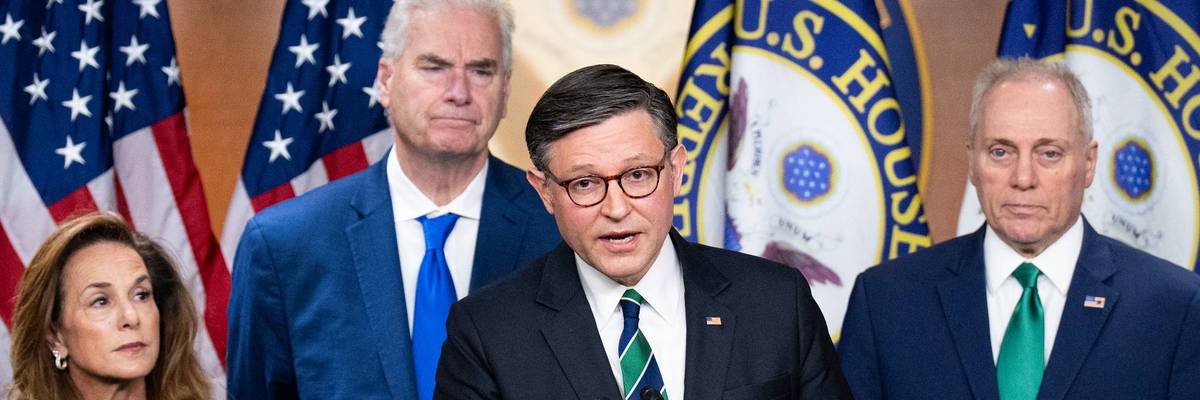
Speaker of the House Mike Johnson (R-La.) speaks during the House Republican Conference news conference in the US Capitol on Tuesday, March 17, 2026.
"By our reckoning, wage growth has steadily lost ground relative to the pace of inflation since the middle of last year," said one economist.
Congressional Republicans had been hoping their political standing would improve this spring when American voters received larger refunds thanks to changes in US tax law made under the One Big Beautiful Bill Act.
However, The Financial Times reported on Tuesday that much of the projected fiscal stimulus from the larger refunds has already been swallowed up by the rise in gas and energy prices caused by President Donald Trump's illegal war with Iran, and the financial situation could grow even worse in the coming months.
Gregory Daco, chief economist at EY Parthenon, told The Financial Times that "the tax refunds have been largely erased by the increase in Middle East price pressures," and warned that "the longer the conflict lasts, the more we move to an adverse scenario where inflation proves more persistent and erodes consumer spending growth."
Nathan Sheets, global chief economist at Citigroup, told The Financial Times that the Iran war has only accelerated problems for US consumers who were already facing high pressures from the cost of living.
"By our reckoning, wage growth has steadily lost ground relative to the pace of inflation since the middle of last year," Sheets said. "First President Trump’s tariffs and, more recently, Iran-related pressures on oil and commodity prices have pushed up prices relative to wages."
US retailers have been expecting the positive impact of the tax refunds to dwindle, with Target CFO Jim Lee telling The Financial Times that they "will be fading over the rest of the year" as Americans are using larger shares of their incomes to pay for basics such as food and energy.
Lee's concerns were echoed by Walmart CFO John David Rainey, who told CNBC last week that while tax refunds have been helping Americans buffer the costs associated with the Iran war, that financial cushion is shrinking by the day.
“I think higher tax returns muted some of the pressure related to higher fuel prices," said Rainey, "and as we’re in a period of time right now where those tax refunds are largely not coming in, I think consumers are going to feel more of that pressure from higher fuel prices."
Walmart's stock price on has fallen sharply over the last week despite strong quarterly earnings, as investors express concerns that low-income consumers are feeling squeezed financially.
As reported by The New York Times, Walmart noted in its most recent earnings call that "sales continued to be driven by its low-price private label goods and higher-income households trading down to stretch their budgets," suggesting that consumers are under increasing distress.
Dear Common Dreams reader, It’s been nearly 30 years since I co-founded Common Dreams with my late wife, Lina Newhouser. We had the radical notion that journalism should serve the public good, not corporate profits. It was clear to us from the outset what it would take to build such a project. No paid advertisements. No corporate sponsors. No millionaire publisher telling us what to think or do. Many people said we wouldn't last a year, but we proved those doubters wrong. Together with a tremendous team of journalists and dedicated staff, we built an independent media outlet free from the constraints of profits and corporate control. Our mission has always been simple: To inform. To inspire. To ignite change for the common good. Building Common Dreams was not easy. Our survival was never guaranteed. When you take on the most powerful forces—Wall Street greed, fossil fuel industry destruction, Big Tech lobbyists, and uber-rich oligarchs who have spent billions upon billions rigging the economy and democracy in their favor—the only bulwark you have is supporters who believe in your work. But here’s the urgent message from me today. It's never been this bad out there. And it's never been this hard to keep us going. At the very moment Common Dreams is most needed, the threats we face are intensifying. We need your support now more than ever. We don't accept corporate advertising and never will. We don't have a paywall because we don't think people should be blocked from critical news based on their ability to pay. Everything we do is funded by the donations of readers like you. When everyone does the little they can afford, we are strong. But if that support retreats or dries up, so do we. Will you donate now to make sure Common Dreams not only survives but thrives? —Craig Brown, Co-founder |
Congressional Republicans had been hoping their political standing would improve this spring when American voters received larger refunds thanks to changes in US tax law made under the One Big Beautiful Bill Act.
However, The Financial Times reported on Tuesday that much of the projected fiscal stimulus from the larger refunds has already been swallowed up by the rise in gas and energy prices caused by President Donald Trump's illegal war with Iran, and the financial situation could grow even worse in the coming months.
Gregory Daco, chief economist at EY Parthenon, told The Financial Times that "the tax refunds have been largely erased by the increase in Middle East price pressures," and warned that "the longer the conflict lasts, the more we move to an adverse scenario where inflation proves more persistent and erodes consumer spending growth."
Nathan Sheets, global chief economist at Citigroup, told The Financial Times that the Iran war has only accelerated problems for US consumers who were already facing high pressures from the cost of living.
"By our reckoning, wage growth has steadily lost ground relative to the pace of inflation since the middle of last year," Sheets said. "First President Trump’s tariffs and, more recently, Iran-related pressures on oil and commodity prices have pushed up prices relative to wages."
US retailers have been expecting the positive impact of the tax refunds to dwindle, with Target CFO Jim Lee telling The Financial Times that they "will be fading over the rest of the year" as Americans are using larger shares of their incomes to pay for basics such as food and energy.
Lee's concerns were echoed by Walmart CFO John David Rainey, who told CNBC last week that while tax refunds have been helping Americans buffer the costs associated with the Iran war, that financial cushion is shrinking by the day.
“I think higher tax returns muted some of the pressure related to higher fuel prices," said Rainey, "and as we’re in a period of time right now where those tax refunds are largely not coming in, I think consumers are going to feel more of that pressure from higher fuel prices."
Walmart's stock price on has fallen sharply over the last week despite strong quarterly earnings, as investors express concerns that low-income consumers are feeling squeezed financially.
As reported by The New York Times, Walmart noted in its most recent earnings call that "sales continued to be driven by its low-price private label goods and higher-income households trading down to stretch their budgets," suggesting that consumers are under increasing distress.
Congressional Republicans had been hoping their political standing would improve this spring when American voters received larger refunds thanks to changes in US tax law made under the One Big Beautiful Bill Act.
However, The Financial Times reported on Tuesday that much of the projected fiscal stimulus from the larger refunds has already been swallowed up by the rise in gas and energy prices caused by President Donald Trump's illegal war with Iran, and the financial situation could grow even worse in the coming months.
Gregory Daco, chief economist at EY Parthenon, told The Financial Times that "the tax refunds have been largely erased by the increase in Middle East price pressures," and warned that "the longer the conflict lasts, the more we move to an adverse scenario where inflation proves more persistent and erodes consumer spending growth."
Nathan Sheets, global chief economist at Citigroup, told The Financial Times that the Iran war has only accelerated problems for US consumers who were already facing high pressures from the cost of living.
"By our reckoning, wage growth has steadily lost ground relative to the pace of inflation since the middle of last year," Sheets said. "First President Trump’s tariffs and, more recently, Iran-related pressures on oil and commodity prices have pushed up prices relative to wages."
US retailers have been expecting the positive impact of the tax refunds to dwindle, with Target CFO Jim Lee telling The Financial Times that they "will be fading over the rest of the year" as Americans are using larger shares of their incomes to pay for basics such as food and energy.
Lee's concerns were echoed by Walmart CFO John David Rainey, who told CNBC last week that while tax refunds have been helping Americans buffer the costs associated with the Iran war, that financial cushion is shrinking by the day.
“I think higher tax returns muted some of the pressure related to higher fuel prices," said Rainey, "and as we’re in a period of time right now where those tax refunds are largely not coming in, I think consumers are going to feel more of that pressure from higher fuel prices."
Walmart's stock price on has fallen sharply over the last week despite strong quarterly earnings, as investors express concerns that low-income consumers are feeling squeezed financially.
As reported by The New York Times, Walmart noted in its most recent earnings call that "sales continued to be driven by its low-price private label goods and higher-income households trading down to stretch their budgets," suggesting that consumers are under increasing distress.