SUBSCRIBE TO OUR FREE NEWSLETTER
Daily news & progressive opinion—funded by the people, not the corporations—delivered straight to your inbox.
5
#000000
#FFFFFF
To donate by check, phone, or other method, see our More Ways to Give page.
Daily news & progressive opinion—funded by the people, not the corporations—delivered straight to your inbox.
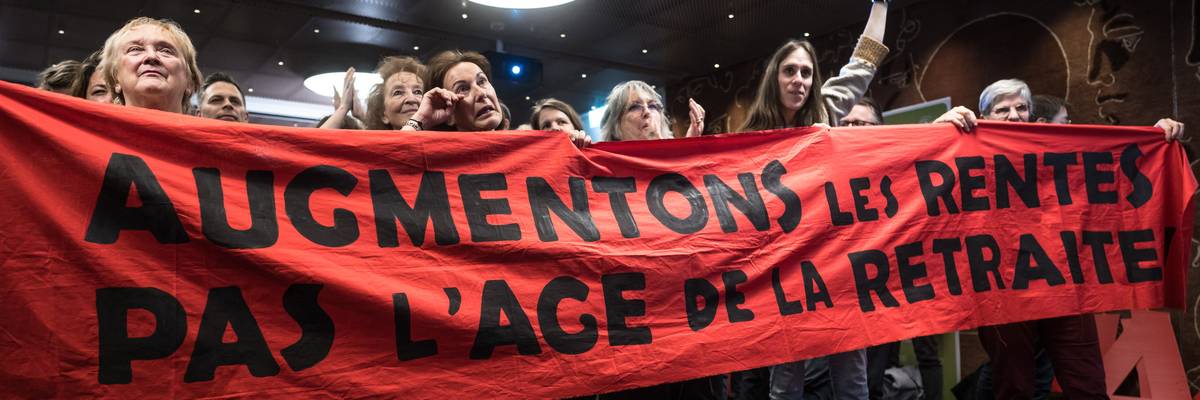
Activists react in Bern, Switzerland, on March 3, 2024 after the results of the vote of a national initiative to boost pension payments.
"It is the people who have the power in Switzerland," one union leader said.
In a move that pensioners rights group Avivo called "a historic victory for retirees," Swiss voters on Sunday voted to boost their pension by one-month's payment.
At the same time, voters rejected a measure to raise the retirement age from 65 to 66. The vote marks the first time in Switzerland's history that its people have voted directly to increase their own benefits, and one expert said the break with the past could be a response to the government bailout of Credit Suisse in 2023.
"Many think that the entrepreneurs and managers have broken the unwritten Swiss social contract: That managers are modest with bonuses and debauchery and the people are modest with social demands," Michael Hermann, who leads the Sotomo poll, told newspaper SonntagsZeitung. "People have been angry for a long time about the behavior of corporations, managers, tax evaders. So you often hear now: 'If they help themselves, then we also want something for us.'"
" Democracy is alive and kicking in Switzerland."
The pension plan measure will see pensioners receive a 13th payment every November, as is already the case for Swiss paychecks, as BBC News explained. Currently, pensioners are paid between $1,393 and $2,760 a month, which many argue is not enough given Switzerland's high cost of living. Zurich tied with Singapore as the most expensive city in the world, according to a November report by the Economic Intelligence Unit.
"I'm retired now and so obviously I would like a bit more," 65-year-old Zurich voter Mery told Reuters. "It should allow me to give a little something to my grandchildren."
The extra payments will start in 2026.
The measure needed both a majority of voters and a majority of cantons to pass, which it secured with 58.24% of voters and 16 out of 26 cantons, according to Le Monde.
The increase was backed by left parties and the Swiss Trade Union Federation and opposed by business interests and the center-right government and parliament, who argued it would be difficult to pay for. This makes the yes vote especially surprising, as historically Swiss voters have not acted against government advice on financial matters. For example, they rejected previous proposals to shorten the work week and increase the number of vacation days.
"Democracy is alive and kicking in Switzerland," said Interior Minister Elisabeth Baume-Schneider.
Lukas Golder of polling firm gfs.bern, reports Reuters, told SRF that the vote was "a huge milestone from a union perspective."
Head of the Swiss Trade Union Federation Pierre-Yves Maillard, told RTS that the vote sent "a wonderful message to all those who have worked hard all of their lives" and proved that "it is the people who have the power in Switzerland," according to Le Monde.
The proposal to raise the retirement age by one year and tie it to life-expectancy was rejected by 74.72% of voters. Turnout for the election was high for a Swiss plebiscite, at more than 58%.
The election comes amid a push to raise the retirement age in other countries. France's Emmanuel Macron faced massive protests when he upped that country's retirement age from 62 to 64.
U.S. Republican presidential candidate Nikki Haley has called for raising the retirement age for workers who are now in their 20s.
"They should plan on their retirement age being increased, yes," Haley said of younger workers during a January 10 debate.
Dear Common Dreams reader, It’s been nearly 30 years since I co-founded Common Dreams with my late wife, Lina Newhouser. We had the radical notion that journalism should serve the public good, not corporate profits. It was clear to us from the outset what it would take to build such a project. No paid advertisements. No corporate sponsors. No millionaire publisher telling us what to think or do. Many people said we wouldn't last a year, but we proved those doubters wrong. Together with a tremendous team of journalists and dedicated staff, we built an independent media outlet free from the constraints of profits and corporate control. Our mission has always been simple: To inform. To inspire. To ignite change for the common good. Building Common Dreams was not easy. Our survival was never guaranteed. When you take on the most powerful forces—Wall Street greed, fossil fuel industry destruction, Big Tech lobbyists, and uber-rich oligarchs who have spent billions upon billions rigging the economy and democracy in their favor—the only bulwark you have is supporters who believe in your work. But here’s the urgent message from me today. It's never been this bad out there. And it's never been this hard to keep us going. At the very moment Common Dreams is most needed, the threats we face are intensifying. We need your support now more than ever. We don't accept corporate advertising and never will. We don't have a paywall because we don't think people should be blocked from critical news based on their ability to pay. Everything we do is funded by the donations of readers like you. When everyone does the little they can afford, we are strong. But if that support retreats or dries up, so do we. Will you donate now to make sure Common Dreams not only survives but thrives? —Craig Brown, Co-founder |
In a move that pensioners rights group Avivo called "a historic victory for retirees," Swiss voters on Sunday voted to boost their pension by one-month's payment.
At the same time, voters rejected a measure to raise the retirement age from 65 to 66. The vote marks the first time in Switzerland's history that its people have voted directly to increase their own benefits, and one expert said the break with the past could be a response to the government bailout of Credit Suisse in 2023.
"Many think that the entrepreneurs and managers have broken the unwritten Swiss social contract: That managers are modest with bonuses and debauchery and the people are modest with social demands," Michael Hermann, who leads the Sotomo poll, told newspaper SonntagsZeitung. "People have been angry for a long time about the behavior of corporations, managers, tax evaders. So you often hear now: 'If they help themselves, then we also want something for us.'"
" Democracy is alive and kicking in Switzerland."
The pension plan measure will see pensioners receive a 13th payment every November, as is already the case for Swiss paychecks, as BBC News explained. Currently, pensioners are paid between $1,393 and $2,760 a month, which many argue is not enough given Switzerland's high cost of living. Zurich tied with Singapore as the most expensive city in the world, according to a November report by the Economic Intelligence Unit.
"I'm retired now and so obviously I would like a bit more," 65-year-old Zurich voter Mery told Reuters. "It should allow me to give a little something to my grandchildren."
The extra payments will start in 2026.
The measure needed both a majority of voters and a majority of cantons to pass, which it secured with 58.24% of voters and 16 out of 26 cantons, according to Le Monde.
The increase was backed by left parties and the Swiss Trade Union Federation and opposed by business interests and the center-right government and parliament, who argued it would be difficult to pay for. This makes the yes vote especially surprising, as historically Swiss voters have not acted against government advice on financial matters. For example, they rejected previous proposals to shorten the work week and increase the number of vacation days.
"Democracy is alive and kicking in Switzerland," said Interior Minister Elisabeth Baume-Schneider.
Lukas Golder of polling firm gfs.bern, reports Reuters, told SRF that the vote was "a huge milestone from a union perspective."
Head of the Swiss Trade Union Federation Pierre-Yves Maillard, told RTS that the vote sent "a wonderful message to all those who have worked hard all of their lives" and proved that "it is the people who have the power in Switzerland," according to Le Monde.
The proposal to raise the retirement age by one year and tie it to life-expectancy was rejected by 74.72% of voters. Turnout for the election was high for a Swiss plebiscite, at more than 58%.
The election comes amid a push to raise the retirement age in other countries. France's Emmanuel Macron faced massive protests when he upped that country's retirement age from 62 to 64.
U.S. Republican presidential candidate Nikki Haley has called for raising the retirement age for workers who are now in their 20s.
"They should plan on their retirement age being increased, yes," Haley said of younger workers during a January 10 debate.
In a move that pensioners rights group Avivo called "a historic victory for retirees," Swiss voters on Sunday voted to boost their pension by one-month's payment.
At the same time, voters rejected a measure to raise the retirement age from 65 to 66. The vote marks the first time in Switzerland's history that its people have voted directly to increase their own benefits, and one expert said the break with the past could be a response to the government bailout of Credit Suisse in 2023.
"Many think that the entrepreneurs and managers have broken the unwritten Swiss social contract: That managers are modest with bonuses and debauchery and the people are modest with social demands," Michael Hermann, who leads the Sotomo poll, told newspaper SonntagsZeitung. "People have been angry for a long time about the behavior of corporations, managers, tax evaders. So you often hear now: 'If they help themselves, then we also want something for us.'"
" Democracy is alive and kicking in Switzerland."
The pension plan measure will see pensioners receive a 13th payment every November, as is already the case for Swiss paychecks, as BBC News explained. Currently, pensioners are paid between $1,393 and $2,760 a month, which many argue is not enough given Switzerland's high cost of living. Zurich tied with Singapore as the most expensive city in the world, according to a November report by the Economic Intelligence Unit.
"I'm retired now and so obviously I would like a bit more," 65-year-old Zurich voter Mery told Reuters. "It should allow me to give a little something to my grandchildren."
The extra payments will start in 2026.
The measure needed both a majority of voters and a majority of cantons to pass, which it secured with 58.24% of voters and 16 out of 26 cantons, according to Le Monde.
The increase was backed by left parties and the Swiss Trade Union Federation and opposed by business interests and the center-right government and parliament, who argued it would be difficult to pay for. This makes the yes vote especially surprising, as historically Swiss voters have not acted against government advice on financial matters. For example, they rejected previous proposals to shorten the work week and increase the number of vacation days.
"Democracy is alive and kicking in Switzerland," said Interior Minister Elisabeth Baume-Schneider.
Lukas Golder of polling firm gfs.bern, reports Reuters, told SRF that the vote was "a huge milestone from a union perspective."
Head of the Swiss Trade Union Federation Pierre-Yves Maillard, told RTS that the vote sent "a wonderful message to all those who have worked hard all of their lives" and proved that "it is the people who have the power in Switzerland," according to Le Monde.
The proposal to raise the retirement age by one year and tie it to life-expectancy was rejected by 74.72% of voters. Turnout for the election was high for a Swiss plebiscite, at more than 58%.
The election comes amid a push to raise the retirement age in other countries. France's Emmanuel Macron faced massive protests when he upped that country's retirement age from 62 to 64.
U.S. Republican presidential candidate Nikki Haley has called for raising the retirement age for workers who are now in their 20s.
"They should plan on their retirement age being increased, yes," Haley said of younger workers during a January 10 debate.