

SUBSCRIBE TO OUR FREE NEWSLETTER
Daily news & progressive opinion—funded by the people, not the corporations—delivered straight to your inbox.
5
#000000
#FFFFFF
To donate by check, phone, or other method, see our More Ways to Give page.
Daily news & progressive opinion—funded by the people, not the corporations—delivered straight to your inbox.
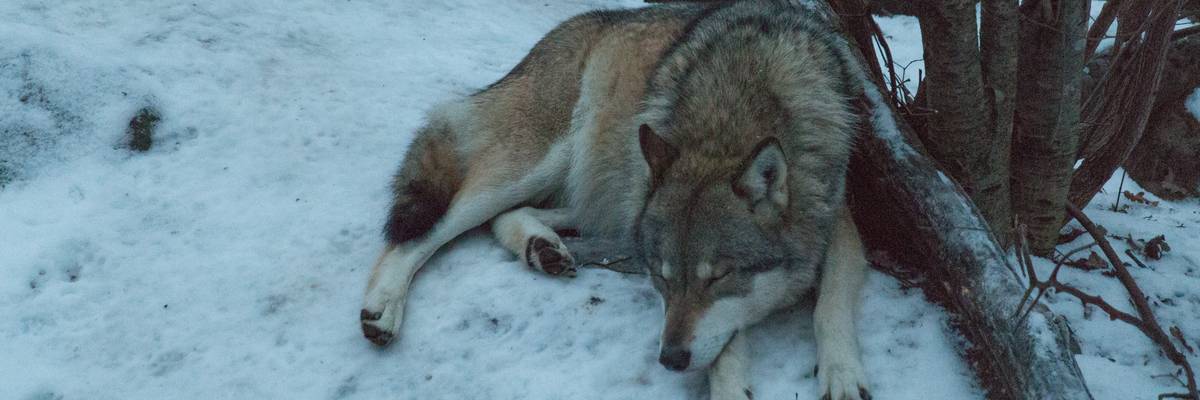
A wolf in Sweden sleeps on the ground in winter time.
"The Swedish government since 2010 has been blatantly disregarding the wolf's special protection status, allowing a yearly licensed quota hunt and thereby breaking E.U. law," one campaigner said.
Sweden is set to start a controversial wolf hunt on Thursday that could see its declining wolf population fall by another 8%.
The country has authorized the killing of 30 of the nation's 375 wolves—or five entire families—in a move that conservationists say is illegal under European Union law. Ultimately, the Swedish government wants to nearly halve the minimum number of wolves for "favorable conservation status" from 300 to 170.
'Imagine... the outcry if this were Sri Lanka killing leopards, or Botswana lions, both much trickier animals to live with," U.K. environmentalist Ben Goldsmith wrote on social media. "Shame, shame on Sweden."
"If Sweden, one of the richest countries in the world with a population of 10.5 million people, can't accept a population of 375 wolves, what hope is there for the planet's biodiversity?"
Under the Council of Europe's Convention on the Conservation of European Wildlife and Natural Habitats, or Bern Convention, countries must preserve the populations of protected species so that they remain above a sustainable level. However, Magnus Orrebrant, the chair of the Swedish Carnivore Association, told The Guardian that E.U. law has not meant much for Sweden's wolves.
"The Swedish government since 2010 has been blatantly disregarding the wolf's special protection status, allowing a yearly licensed quota hunt and thereby breaking E.U. law," Orrebrant said. "We filed a formal complaint to the E.U. commission, leading to an infringement procedure against Sweden, as yet to no avail."
Excessive wolf hunting has been a problem in Sweden for decades, and was part of the reason that the country had no breeding population at all between 1966 and 1983. In addition, increased hunting slashed the population by nearly 20% between 2022 and 2023.
Beyond licensed hunts, Sweden's wolf population also faces pressure from poachers, according to conservation group Revolution Rov, with DNA evidence suggesting that up to 80 wolves are killed illegally each year.
"In many license hunting decisions on wolves in recent years, it has been argued that if legal hunting is allowed, illegal hunting will disappear, but that has not happened at all... Instead, even more wolves have had to die," the group wrote in a petition against 2024's hunt.
The group also wrote that Sweden's wolf population is genetically vulnerable, with many mating pairs being closely related. For the population to remain healthy, it needs an influx of new genes from wolves migrating from Finland or Russia, but these wolves are often killed before they can pair off.
Wildlife advocates outside of Sweden also criticized the 2025 hunt.
"I believe that one of the hallmarks of human progress is learning to coexist with other species that our ancestors once feared," wrote Wildlife Trusts CEO Craig Bennett on social media. "And sadly, it often feels like we still live in the Dark Ages."
Ecologist and conservationist Alan Watson Featherstone wrote: "I really do despair about humanity—we are such a selfish species. If Sweden, one of the richest countries in the world with a population of 10.5 million people, can't accept a population of 375 wolves, what hope is there for the planet's biodiversity?"
However, Sweden is not alone in Europe in its hostility to wolves. The Bern Convention in December accepted an E.U. proposal to lower the wolf's status from "strictly protected" to "protected." The decision followed complaints from farmers that the continent's rebounding wolf population was harming livestock, but conservationists say that allowing the killing of wolves will threaten the species in a vulnerable moment and is not the solution to livestock killings.
"The wolf is still endangered in many parts of Europe, and weakening its protection will only lead to further conflict and threaten its recovery," Ilaria Di Silvestre, regional director of policy at the International Fund for Animal Welfare, told The Associated Press in December.
The Bern Convention's decision, which will go into effect on March 7, will clear the way for the European Commission to alter its habitats directive for wolves to reflect their higher numbers in the mountains and forests of Scandinavia and Western Europe, which will then make it easier to approve more wolf killings.
"We are very critical to the path that the E.U. is now taking, downgrading the protection status of the wolf," Orrebrant told The Guardian. "If the E.U. follows up the latest Bern Convention decision by changing the wolf's protection status in the habitat directive, the result will be very negative not only for the wolves, but for all wildlife in Europe."
Dear Common Dreams reader, It’s been nearly 30 years since I co-founded Common Dreams with my late wife, Lina Newhouser. We had the radical notion that journalism should serve the public good, not corporate profits. It was clear to us from the outset what it would take to build such a project. No paid advertisements. No corporate sponsors. No millionaire publisher telling us what to think or do. Many people said we wouldn't last a year, but we proved those doubters wrong. Together with a tremendous team of journalists and dedicated staff, we built an independent media outlet free from the constraints of profits and corporate control. Our mission has always been simple: To inform. To inspire. To ignite change for the common good. Building Common Dreams was not easy. Our survival was never guaranteed. When you take on the most powerful forces—Wall Street greed, fossil fuel industry destruction, Big Tech lobbyists, and uber-rich oligarchs who have spent billions upon billions rigging the economy and democracy in their favor—the only bulwark you have is supporters who believe in your work. But here’s the urgent message from me today. It's never been this bad out there. And it's never been this hard to keep us going. At the very moment Common Dreams is most needed, the threats we face are intensifying. We need your support now more than ever. We don't accept corporate advertising and never will. We don't have a paywall because we don't think people should be blocked from critical news based on their ability to pay. Everything we do is funded by the donations of readers like you. When everyone does the little they can afford, we are strong. But if that support retreats or dries up, so do we. Will you donate now to make sure Common Dreams not only survives but thrives? —Craig Brown, Co-founder |
Sweden is set to start a controversial wolf hunt on Thursday that could see its declining wolf population fall by another 8%.
The country has authorized the killing of 30 of the nation's 375 wolves—or five entire families—in a move that conservationists say is illegal under European Union law. Ultimately, the Swedish government wants to nearly halve the minimum number of wolves for "favorable conservation status" from 300 to 170.
'Imagine... the outcry if this were Sri Lanka killing leopards, or Botswana lions, both much trickier animals to live with," U.K. environmentalist Ben Goldsmith wrote on social media. "Shame, shame on Sweden."
"If Sweden, one of the richest countries in the world with a population of 10.5 million people, can't accept a population of 375 wolves, what hope is there for the planet's biodiversity?"
Under the Council of Europe's Convention on the Conservation of European Wildlife and Natural Habitats, or Bern Convention, countries must preserve the populations of protected species so that they remain above a sustainable level. However, Magnus Orrebrant, the chair of the Swedish Carnivore Association, told The Guardian that E.U. law has not meant much for Sweden's wolves.
"The Swedish government since 2010 has been blatantly disregarding the wolf's special protection status, allowing a yearly licensed quota hunt and thereby breaking E.U. law," Orrebrant said. "We filed a formal complaint to the E.U. commission, leading to an infringement procedure against Sweden, as yet to no avail."
Excessive wolf hunting has been a problem in Sweden for decades, and was part of the reason that the country had no breeding population at all between 1966 and 1983. In addition, increased hunting slashed the population by nearly 20% between 2022 and 2023.
Beyond licensed hunts, Sweden's wolf population also faces pressure from poachers, according to conservation group Revolution Rov, with DNA evidence suggesting that up to 80 wolves are killed illegally each year.
"In many license hunting decisions on wolves in recent years, it has been argued that if legal hunting is allowed, illegal hunting will disappear, but that has not happened at all... Instead, even more wolves have had to die," the group wrote in a petition against 2024's hunt.
The group also wrote that Sweden's wolf population is genetically vulnerable, with many mating pairs being closely related. For the population to remain healthy, it needs an influx of new genes from wolves migrating from Finland or Russia, but these wolves are often killed before they can pair off.
Wildlife advocates outside of Sweden also criticized the 2025 hunt.
"I believe that one of the hallmarks of human progress is learning to coexist with other species that our ancestors once feared," wrote Wildlife Trusts CEO Craig Bennett on social media. "And sadly, it often feels like we still live in the Dark Ages."
Ecologist and conservationist Alan Watson Featherstone wrote: "I really do despair about humanity—we are such a selfish species. If Sweden, one of the richest countries in the world with a population of 10.5 million people, can't accept a population of 375 wolves, what hope is there for the planet's biodiversity?"
However, Sweden is not alone in Europe in its hostility to wolves. The Bern Convention in December accepted an E.U. proposal to lower the wolf's status from "strictly protected" to "protected." The decision followed complaints from farmers that the continent's rebounding wolf population was harming livestock, but conservationists say that allowing the killing of wolves will threaten the species in a vulnerable moment and is not the solution to livestock killings.
"The wolf is still endangered in many parts of Europe, and weakening its protection will only lead to further conflict and threaten its recovery," Ilaria Di Silvestre, regional director of policy at the International Fund for Animal Welfare, told The Associated Press in December.
The Bern Convention's decision, which will go into effect on March 7, will clear the way for the European Commission to alter its habitats directive for wolves to reflect their higher numbers in the mountains and forests of Scandinavia and Western Europe, which will then make it easier to approve more wolf killings.
"We are very critical to the path that the E.U. is now taking, downgrading the protection status of the wolf," Orrebrant told The Guardian. "If the E.U. follows up the latest Bern Convention decision by changing the wolf's protection status in the habitat directive, the result will be very negative not only for the wolves, but for all wildlife in Europe."
Sweden is set to start a controversial wolf hunt on Thursday that could see its declining wolf population fall by another 8%.
The country has authorized the killing of 30 of the nation's 375 wolves—or five entire families—in a move that conservationists say is illegal under European Union law. Ultimately, the Swedish government wants to nearly halve the minimum number of wolves for "favorable conservation status" from 300 to 170.
'Imagine... the outcry if this were Sri Lanka killing leopards, or Botswana lions, both much trickier animals to live with," U.K. environmentalist Ben Goldsmith wrote on social media. "Shame, shame on Sweden."
"If Sweden, one of the richest countries in the world with a population of 10.5 million people, can't accept a population of 375 wolves, what hope is there for the planet's biodiversity?"
Under the Council of Europe's Convention on the Conservation of European Wildlife and Natural Habitats, or Bern Convention, countries must preserve the populations of protected species so that they remain above a sustainable level. However, Magnus Orrebrant, the chair of the Swedish Carnivore Association, told The Guardian that E.U. law has not meant much for Sweden's wolves.
"The Swedish government since 2010 has been blatantly disregarding the wolf's special protection status, allowing a yearly licensed quota hunt and thereby breaking E.U. law," Orrebrant said. "We filed a formal complaint to the E.U. commission, leading to an infringement procedure against Sweden, as yet to no avail."
Excessive wolf hunting has been a problem in Sweden for decades, and was part of the reason that the country had no breeding population at all between 1966 and 1983. In addition, increased hunting slashed the population by nearly 20% between 2022 and 2023.
Beyond licensed hunts, Sweden's wolf population also faces pressure from poachers, according to conservation group Revolution Rov, with DNA evidence suggesting that up to 80 wolves are killed illegally each year.
"In many license hunting decisions on wolves in recent years, it has been argued that if legal hunting is allowed, illegal hunting will disappear, but that has not happened at all... Instead, even more wolves have had to die," the group wrote in a petition against 2024's hunt.
The group also wrote that Sweden's wolf population is genetically vulnerable, with many mating pairs being closely related. For the population to remain healthy, it needs an influx of new genes from wolves migrating from Finland or Russia, but these wolves are often killed before they can pair off.
Wildlife advocates outside of Sweden also criticized the 2025 hunt.
"I believe that one of the hallmarks of human progress is learning to coexist with other species that our ancestors once feared," wrote Wildlife Trusts CEO Craig Bennett on social media. "And sadly, it often feels like we still live in the Dark Ages."
Ecologist and conservationist Alan Watson Featherstone wrote: "I really do despair about humanity—we are such a selfish species. If Sweden, one of the richest countries in the world with a population of 10.5 million people, can't accept a population of 375 wolves, what hope is there for the planet's biodiversity?"
However, Sweden is not alone in Europe in its hostility to wolves. The Bern Convention in December accepted an E.U. proposal to lower the wolf's status from "strictly protected" to "protected." The decision followed complaints from farmers that the continent's rebounding wolf population was harming livestock, but conservationists say that allowing the killing of wolves will threaten the species in a vulnerable moment and is not the solution to livestock killings.
"The wolf is still endangered in many parts of Europe, and weakening its protection will only lead to further conflict and threaten its recovery," Ilaria Di Silvestre, regional director of policy at the International Fund for Animal Welfare, told The Associated Press in December.
The Bern Convention's decision, which will go into effect on March 7, will clear the way for the European Commission to alter its habitats directive for wolves to reflect their higher numbers in the mountains and forests of Scandinavia and Western Europe, which will then make it easier to approve more wolf killings.
"We are very critical to the path that the E.U. is now taking, downgrading the protection status of the wolf," Orrebrant told The Guardian. "If the E.U. follows up the latest Bern Convention decision by changing the wolf's protection status in the habitat directive, the result will be very negative not only for the wolves, but for all wildlife in Europe."

