SUBSCRIBE TO OUR FREE NEWSLETTER
Daily news & progressive opinion—funded by the people, not the corporations—delivered straight to your inbox.
5
#000000
#FFFFFF
To donate by check, phone, or other method, see our More Ways to Give page.
Daily news & progressive opinion—funded by the people, not the corporations—delivered straight to your inbox.
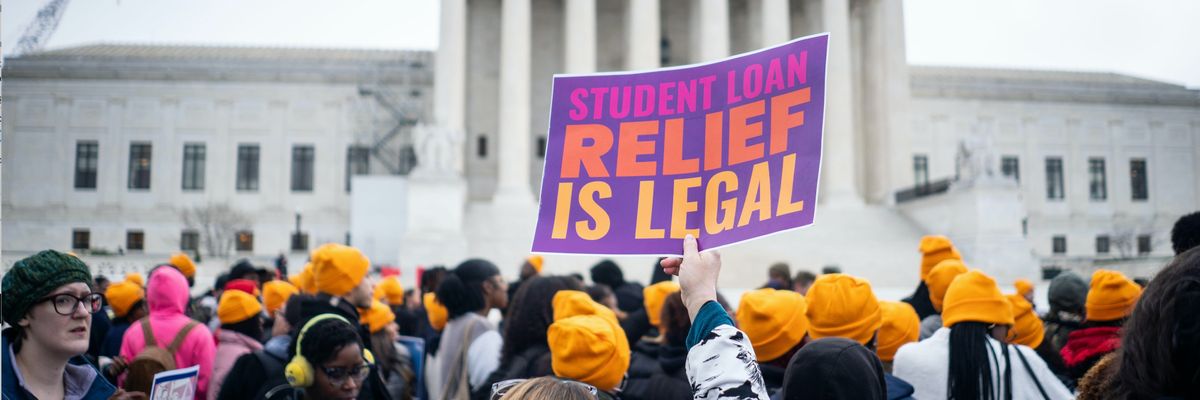
Activists rally outside the U.S. Supreme Court on February 28, 2023 as the justices began hearing oral arguments in a pair of cases on student debt relief.
While Chief Justice John Roberts lamented the proposal's price tag, liberal colleague Elena Kagan said the law allowing the president to "modify or waive" student aid during national emergencies "doesn't get much clearer."
President Joe Biden's plan to forgive more than $400 billion in student loan debt to over 40 million borrowers drew criticism from conservative members of the U.S. Supreme Court on Tuesday as the justices heard oral arguments in a pair of cases that will decide the fate of one of the president's signature policies and impact the financial futures of millions of Americans.
Politico reports members of the high court's right-wing supermajority "repeatedly questioned whether the Education Department had the legal authority it claimed to discharge federal student loan debt to help borrowers recover economically from the national emergency spurred by Covid-19."
Chief Justice John Roberts was particularly hostile, telling U.S. Solicitor-General Elizabeth Prelogar—who was defending the administration's plan—that "we're talking about half a trillion dollars and 43 million Americans."
The Los Angeles Times reports that most of Roberts' conservative colleagues "sounded ready to rule against the administration."
Justice Brett Kavanaugh, for example, expressed skepticism about authorizing the president to a "massive new program" based on an interpretation of the HEROES Act of 2003, which allows the Education Department to "modify or waive" student aid "in connection with a war or other military operation or national emergency."
Conversely, Justice Elana Kagan asserted that Congress "doesn't get much clearer" about the president's authority in the HEROES Act.
“We deal with congressional statutes every day that are really confusing," she said. "This one is not."
Lawyers representing Nebraska—one of the Republican-led states challenging Biden's plan—argued that the administration is using the Covid-19 pandemic as "a pretext for the president to fulfill his campaign promise" to forgive student loan debt.
Proponents of Biden's plan, meanwhile, stressed the importance of student debt relief.
"Addressing the student loan debt crisis puts money back in the pockets of families and communities who need it most," Taifa Smith Butler, president of the progressive advocacy group Dēmos, said in a statement.
"Black and Brown borrowers are disproportionately burdened by student debt, further inhibiting their ability to build wealth and economic power," she continued. "This ongoing crisis undermines the promise of higher education, leaving millions of people to put their dreams and lives on hold because of the crushing pain of student loan debt."
Lamenting that "a handful of ultraconservative officials, backed by special interest groups motivated by greed and dark money, want to bypass the president's authority at the expense of everyday working people," Smith Butler argued that "any action, plan, or agenda not rooted in equity to address the student loan debt crisis undermines America's legitimacy in being a world leader that truly cares about the future of its people."
Borrowers, activists, and U.S. lawmakers rallied on the steps of the U.S. Supreme Court in Washington, D.C. on Monday night and Tuesday morning to voice support for Biden's plan. Members of Congress who spoke included Sens. Bernie Sanders (I-Vt.) and Ed Markey (D-Mass.), Congressional Progressive Caucus Chair Pramila Jayapal (D-Wash.), and Reps. Ilhan Omar (D-Minn.), Maxwell Frost (D-Fla.), and Jamaal Bowman (D-N.Y.).
"This is about justice, this is about freedom, this is about economic security, this is about our future," said Jayapal. "Let's cancel this student debt, let's keep this movement going, and let's bring justice to everyone."
Dear Common Dreams reader, It’s been nearly 30 years since I co-founded Common Dreams with my late wife, Lina Newhouser. We had the radical notion that journalism should serve the public good, not corporate profits. It was clear to us from the outset what it would take to build such a project. No paid advertisements. No corporate sponsors. No millionaire publisher telling us what to think or do. Many people said we wouldn't last a year, but we proved those doubters wrong. Together with a tremendous team of journalists and dedicated staff, we built an independent media outlet free from the constraints of profits and corporate control. Our mission has always been simple: To inform. To inspire. To ignite change for the common good. Building Common Dreams was not easy. Our survival was never guaranteed. When you take on the most powerful forces—Wall Street greed, fossil fuel industry destruction, Big Tech lobbyists, and uber-rich oligarchs who have spent billions upon billions rigging the economy and democracy in their favor—the only bulwark you have is supporters who believe in your work. But here’s the urgent message from me today. It's never been this bad out there. And it's never been this hard to keep us going. At the very moment Common Dreams is most needed, the threats we face are intensifying. We need your support now more than ever. We don't accept corporate advertising and never will. We don't have a paywall because we don't think people should be blocked from critical news based on their ability to pay. Everything we do is funded by the donations of readers like you. When everyone does the little they can afford, we are strong. But if that support retreats or dries up, so do we. Will you donate now to make sure Common Dreams not only survives but thrives? —Craig Brown, Co-founder |
President Joe Biden's plan to forgive more than $400 billion in student loan debt to over 40 million borrowers drew criticism from conservative members of the U.S. Supreme Court on Tuesday as the justices heard oral arguments in a pair of cases that will decide the fate of one of the president's signature policies and impact the financial futures of millions of Americans.
Politico reports members of the high court's right-wing supermajority "repeatedly questioned whether the Education Department had the legal authority it claimed to discharge federal student loan debt to help borrowers recover economically from the national emergency spurred by Covid-19."
Chief Justice John Roberts was particularly hostile, telling U.S. Solicitor-General Elizabeth Prelogar—who was defending the administration's plan—that "we're talking about half a trillion dollars and 43 million Americans."
The Los Angeles Times reports that most of Roberts' conservative colleagues "sounded ready to rule against the administration."
Justice Brett Kavanaugh, for example, expressed skepticism about authorizing the president to a "massive new program" based on an interpretation of the HEROES Act of 2003, which allows the Education Department to "modify or waive" student aid "in connection with a war or other military operation or national emergency."
Conversely, Justice Elana Kagan asserted that Congress "doesn't get much clearer" about the president's authority in the HEROES Act.
“We deal with congressional statutes every day that are really confusing," she said. "This one is not."
Lawyers representing Nebraska—one of the Republican-led states challenging Biden's plan—argued that the administration is using the Covid-19 pandemic as "a pretext for the president to fulfill his campaign promise" to forgive student loan debt.
Proponents of Biden's plan, meanwhile, stressed the importance of student debt relief.
"Addressing the student loan debt crisis puts money back in the pockets of families and communities who need it most," Taifa Smith Butler, president of the progressive advocacy group Dēmos, said in a statement.
"Black and Brown borrowers are disproportionately burdened by student debt, further inhibiting their ability to build wealth and economic power," she continued. "This ongoing crisis undermines the promise of higher education, leaving millions of people to put their dreams and lives on hold because of the crushing pain of student loan debt."
Lamenting that "a handful of ultraconservative officials, backed by special interest groups motivated by greed and dark money, want to bypass the president's authority at the expense of everyday working people," Smith Butler argued that "any action, plan, or agenda not rooted in equity to address the student loan debt crisis undermines America's legitimacy in being a world leader that truly cares about the future of its people."
Borrowers, activists, and U.S. lawmakers rallied on the steps of the U.S. Supreme Court in Washington, D.C. on Monday night and Tuesday morning to voice support for Biden's plan. Members of Congress who spoke included Sens. Bernie Sanders (I-Vt.) and Ed Markey (D-Mass.), Congressional Progressive Caucus Chair Pramila Jayapal (D-Wash.), and Reps. Ilhan Omar (D-Minn.), Maxwell Frost (D-Fla.), and Jamaal Bowman (D-N.Y.).
"This is about justice, this is about freedom, this is about economic security, this is about our future," said Jayapal. "Let's cancel this student debt, let's keep this movement going, and let's bring justice to everyone."
President Joe Biden's plan to forgive more than $400 billion in student loan debt to over 40 million borrowers drew criticism from conservative members of the U.S. Supreme Court on Tuesday as the justices heard oral arguments in a pair of cases that will decide the fate of one of the president's signature policies and impact the financial futures of millions of Americans.
Politico reports members of the high court's right-wing supermajority "repeatedly questioned whether the Education Department had the legal authority it claimed to discharge federal student loan debt to help borrowers recover economically from the national emergency spurred by Covid-19."
Chief Justice John Roberts was particularly hostile, telling U.S. Solicitor-General Elizabeth Prelogar—who was defending the administration's plan—that "we're talking about half a trillion dollars and 43 million Americans."
The Los Angeles Times reports that most of Roberts' conservative colleagues "sounded ready to rule against the administration."
Justice Brett Kavanaugh, for example, expressed skepticism about authorizing the president to a "massive new program" based on an interpretation of the HEROES Act of 2003, which allows the Education Department to "modify or waive" student aid "in connection with a war or other military operation or national emergency."
Conversely, Justice Elana Kagan asserted that Congress "doesn't get much clearer" about the president's authority in the HEROES Act.
“We deal with congressional statutes every day that are really confusing," she said. "This one is not."
Lawyers representing Nebraska—one of the Republican-led states challenging Biden's plan—argued that the administration is using the Covid-19 pandemic as "a pretext for the president to fulfill his campaign promise" to forgive student loan debt.
Proponents of Biden's plan, meanwhile, stressed the importance of student debt relief.
"Addressing the student loan debt crisis puts money back in the pockets of families and communities who need it most," Taifa Smith Butler, president of the progressive advocacy group Dēmos, said in a statement.
"Black and Brown borrowers are disproportionately burdened by student debt, further inhibiting their ability to build wealth and economic power," she continued. "This ongoing crisis undermines the promise of higher education, leaving millions of people to put their dreams and lives on hold because of the crushing pain of student loan debt."
Lamenting that "a handful of ultraconservative officials, backed by special interest groups motivated by greed and dark money, want to bypass the president's authority at the expense of everyday working people," Smith Butler argued that "any action, plan, or agenda not rooted in equity to address the student loan debt crisis undermines America's legitimacy in being a world leader that truly cares about the future of its people."
Borrowers, activists, and U.S. lawmakers rallied on the steps of the U.S. Supreme Court in Washington, D.C. on Monday night and Tuesday morning to voice support for Biden's plan. Members of Congress who spoke included Sens. Bernie Sanders (I-Vt.) and Ed Markey (D-Mass.), Congressional Progressive Caucus Chair Pramila Jayapal (D-Wash.), and Reps. Ilhan Omar (D-Minn.), Maxwell Frost (D-Fla.), and Jamaal Bowman (D-N.Y.).
"This is about justice, this is about freedom, this is about economic security, this is about our future," said Jayapal. "Let's cancel this student debt, let's keep this movement going, and let's bring justice to everyone."