SUBSCRIBE TO OUR FREE NEWSLETTER
Daily news & progressive opinion—funded by the people, not the corporations—delivered straight to your inbox.
5
#000000
#FFFFFF
To donate by check, phone, or other method, see our More Ways to Give page.
Daily news & progressive opinion—funded by the people, not the corporations—delivered straight to your inbox.
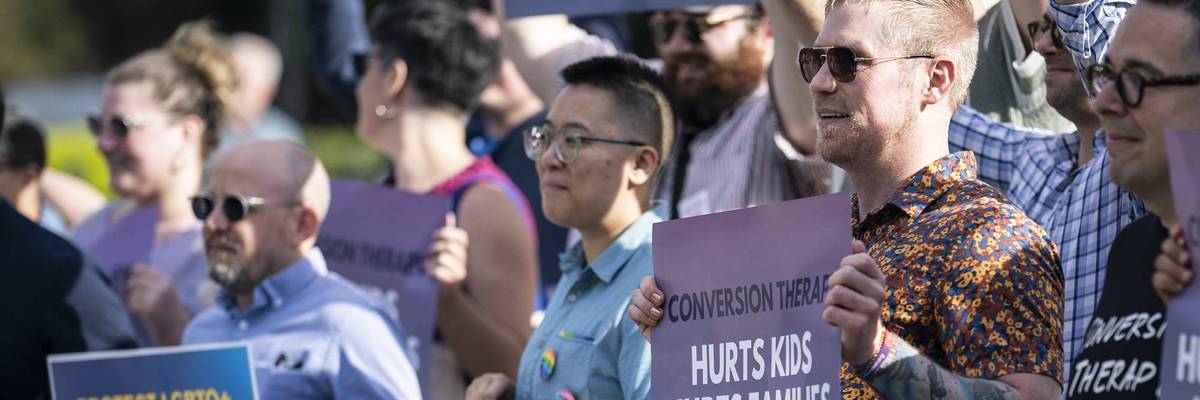
Demonstrators with the Human Rights Campaign stand outside the United States Supreme Court on Capitol Hill on October 7, 2025, in Washington, DC.
Young people are more than twice as likely to attempt suicide if they have been subject to conversion therapy, which LGBTQ+ rights advocates say is "proven to cause lasting psychological harm."
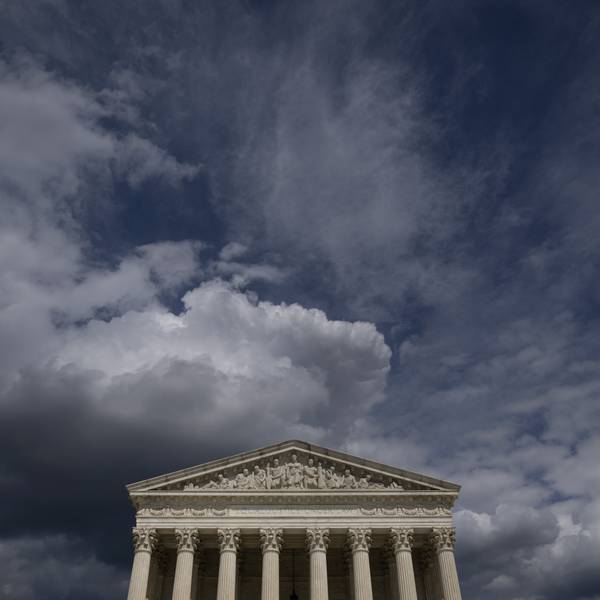
The US Supreme Court on Tuesday struck down Colorado’s ban on “conversion therapy,” drawing warnings from LGBTQ+ groups that the ruling could expose children in dozens of states to the harmful practice.
Colorado's law forbade licensed physicians and mental healthcare providers from attempting to "convert" or change a minor's sexuality, a practice that the American Psychological Association has found to be both ineffective and dangerous, raising rates of depression, anxiety, and suicide in LGBTQ+ youth.
The law defined "conversion therapy" as any treatment that “attempts or purports to change an individual’s sexual orientation or gender identity, including efforts to change behaviors or gender expressions or to eliminate or reduce sexual or romantic attraction or feelings toward individuals of the same sex.”
It allowed exemptions for pastors and religious organizations. It also allowed health professionals to engage in wide-ranging discussions with children about their sexual and gender identities, so long as they did not try to change the child's orientation.
Nevertheless, on Tuesday, the high court sided 8-1 with Kaley Chiles, a Christian counselor who said she wished to offer talk therapy to children who want to reduce same-sex attraction and argued that the ban on this practice was in violation of her First Amendment rights.
Chiles was backed by the Trump administration, as well as the far-right Alliance Defending Freedom, a Christian nationalist legal group with a long history of seeking to outlaw same-sex conduct.
Most famously, the group argued in support of state laws criminalizing homosexuality in the 2003 Lawrence v. Texas case, and it has since gone on to back many other cases attacking birth control access, same-sex marriage, and transgender equality.
In the majority opinion, the conservative Justice Neil Gorsuch wrote that Colorado's law “censors speech based on viewpoint" and therefore must be subject to strict scrutiny—the highest form of judicial review, which the court determined it did not pass.
The lone dissenting justice, Ketanji Brown Jackson, argued that Chiles' treatment was not mere speech, but that it was acting in her capacity "as a licensed healthcare professional," which formed the crux of Colorado's defense of the ban.
She argued that the ruling "opens a dangerous can of worms" and "threatens to impair states’ ability to regulate the provision of medical care in any respect."
"Because the majority plays with fire in this case, I fear that the people of this country will get burned," Jackson said.
Two liberals, Justices Elena Kagan and Sonia Sotomayor, joined the conservatives in striking the law down. However, they argued in a concurring opinion that a full ban on therapy aimed at changing minors' sexuality might be more lawful than the one Colorado passed, which included carveouts for specific circumstances.
Kagan also argued that allowing Colorado to outlaw conversion therapy could backfire and give red states the legal framework to also ban counselors from providing affirmative care to LGBTQ+ minors.
LGBTQ+ rights organizations have roundly condemned the court's decision, which is expected to weaken bans on conversion therapy in the 23 states and the District of Columbia that currently have them.
"Today’s reckless decision means more American kids will suffer," said Kelley Robinson, the president of the Human Rights Campaign. "The Court has weaponized free speech in order to prioritize anti-LGBTQ+ bias over the safety, health, and well-being of children."
A 2024 mental health survey by the Trevor Project, an LGBTQ+ advocacy group, found that 13% of LGBTQ+ young people have been either threatened with or subject to conversion therapy—including about 1 in 6 transgender or nonbinary youth.
Previously, the group published peer-reviewed research in the American Journal of Public Health, showing that young people subject to conversion therapy were more than twice as likely to attempt suicide as their peers.
"These efforts, no matter what proponents call them, no matter what any court says, are still proven to cause lasting psychological harm," said Trevor Project CEO Jaymes Black. "That’s why protections have been enacted in more than 20 states, and are supported by every major medical and mental health association in the country."
Carl Charles, a senior attorney at Lambda Legal who joined more than a dozen survivors of the practice in a friend of the court brief in support of Colorado's law, said, "I know firsthand the long-lasting harms of conversion therapy, having been subjected to it when I was 15 years old."
"This practice did not change my sexual orientation or gender identity," said Charles, a transgender man. "Instead, it destroyed important relationships and created shame and fear that took time and effort to undo. For many survivors, it is a reverberating life-long harm."
"LGBTQ+ youth do not need to be changed," Charles said. "Rather, like all youth, they need to be supported and celebrated for the unique and important people they are becoming."
Colorado's Democratic Gov. Jared Polis has said he will seek to pass new legislation that complies with the Supreme Court's ruling.
"Conversion therapy doesn’t work, can seriously harm youth, and Coloradans should beware before turning over their hard-earned money to a scam," Polis said. "I am evaluating the US Supreme Court ruling and working to figure out how to better protect LGBTQ youth and free speech in Colorado."
In other states whose bans could be undermined by the ruling, efforts have already begun to ensure that providers who cause harm to children still face accountability.
In California, which has a similar ban on conversion therapy to Colorado’s, state Sen. Scott Weiner (D-11) introduced a bill proposing a longer statute of limitations and making it easier for LGBTQ+ individuals to bring malpractice claims against medical professionals who subject them to conversion therapy.
Weiner noted that the Supreme Court's ruling "explicitly states that malpractice claims for conversion therapy are different than bans," since they require a plaintiff to demonstrate injury caused by their treatment.
"You can’t 'convert' someone who’s LGBTQ—full stop—and people who think you can are peddling quackery," Weiner said. "California will always have the community’s back."
The 988 Suicide & Crisis Lifeline can be reached by calling or texting 988, or through chat at 988lifeline.org. The Trevor Project, which serves LGBTQ+ youth, can be reached at 1-866-488-7386, by texting "START" to 678-678, or through chat at TheTrevorProject.org. Both offer 24/7, free, and confidential support.
Dear Common Dreams reader, It’s been nearly 30 years since I co-founded Common Dreams with my late wife, Lina Newhouser. We had the radical notion that journalism should serve the public good, not corporate profits. It was clear to us from the outset what it would take to build such a project. No paid advertisements. No corporate sponsors. No millionaire publisher telling us what to think or do. Many people said we wouldn't last a year, but we proved those doubters wrong. Together with a tremendous team of journalists and dedicated staff, we built an independent media outlet free from the constraints of profits and corporate control. Our mission has always been simple: To inform. To inspire. To ignite change for the common good. Building Common Dreams was not easy. Our survival was never guaranteed. When you take on the most powerful forces—Wall Street greed, fossil fuel industry destruction, Big Tech lobbyists, and uber-rich oligarchs who have spent billions upon billions rigging the economy and democracy in their favor—the only bulwark you have is supporters who believe in your work. But here’s the urgent message from me today. It's never been this bad out there. And it's never been this hard to keep us going. At the very moment Common Dreams is most needed, the threats we face are intensifying. We need your support now more than ever. We don't accept corporate advertising and never will. We don't have a paywall because we don't think people should be blocked from critical news based on their ability to pay. Everything we do is funded by the donations of readers like you. When everyone does the little they can afford, we are strong. But if that support retreats or dries up, so do we. Will you donate now to make sure Common Dreams not only survives but thrives? —Craig Brown, Co-founder |
The US Supreme Court on Tuesday struck down Colorado’s ban on “conversion therapy,” drawing warnings from LGBTQ+ groups that the ruling could expose children in dozens of states to the harmful practice.
Colorado's law forbade licensed physicians and mental healthcare providers from attempting to "convert" or change a minor's sexuality, a practice that the American Psychological Association has found to be both ineffective and dangerous, raising rates of depression, anxiety, and suicide in LGBTQ+ youth.
The law defined "conversion therapy" as any treatment that “attempts or purports to change an individual’s sexual orientation or gender identity, including efforts to change behaviors or gender expressions or to eliminate or reduce sexual or romantic attraction or feelings toward individuals of the same sex.”
It allowed exemptions for pastors and religious organizations. It also allowed health professionals to engage in wide-ranging discussions with children about their sexual and gender identities, so long as they did not try to change the child's orientation.
Nevertheless, on Tuesday, the high court sided 8-1 with Kaley Chiles, a Christian counselor who said she wished to offer talk therapy to children who want to reduce same-sex attraction and argued that the ban on this practice was in violation of her First Amendment rights.
Chiles was backed by the Trump administration, as well as the far-right Alliance Defending Freedom, a Christian nationalist legal group with a long history of seeking to outlaw same-sex conduct.
Most famously, the group argued in support of state laws criminalizing homosexuality in the 2003 Lawrence v. Texas case, and it has since gone on to back many other cases attacking birth control access, same-sex marriage, and transgender equality.
In the majority opinion, the conservative Justice Neil Gorsuch wrote that Colorado's law “censors speech based on viewpoint" and therefore must be subject to strict scrutiny—the highest form of judicial review, which the court determined it did not pass.
The lone dissenting justice, Ketanji Brown Jackson, argued that Chiles' treatment was not mere speech, but that it was acting in her capacity "as a licensed healthcare professional," which formed the crux of Colorado's defense of the ban.
She argued that the ruling "opens a dangerous can of worms" and "threatens to impair states’ ability to regulate the provision of medical care in any respect."
"Because the majority plays with fire in this case, I fear that the people of this country will get burned," Jackson said.
Two liberals, Justices Elena Kagan and Sonia Sotomayor, joined the conservatives in striking the law down. However, they argued in a concurring opinion that a full ban on therapy aimed at changing minors' sexuality might be more lawful than the one Colorado passed, which included carveouts for specific circumstances.
Kagan also argued that allowing Colorado to outlaw conversion therapy could backfire and give red states the legal framework to also ban counselors from providing affirmative care to LGBTQ+ minors.
LGBTQ+ rights organizations have roundly condemned the court's decision, which is expected to weaken bans on conversion therapy in the 23 states and the District of Columbia that currently have them.
"Today’s reckless decision means more American kids will suffer," said Kelley Robinson, the president of the Human Rights Campaign. "The Court has weaponized free speech in order to prioritize anti-LGBTQ+ bias over the safety, health, and well-being of children."
A 2024 mental health survey by the Trevor Project, an LGBTQ+ advocacy group, found that 13% of LGBTQ+ young people have been either threatened with or subject to conversion therapy—including about 1 in 6 transgender or nonbinary youth.
Previously, the group published peer-reviewed research in the American Journal of Public Health, showing that young people subject to conversion therapy were more than twice as likely to attempt suicide as their peers.
"These efforts, no matter what proponents call them, no matter what any court says, are still proven to cause lasting psychological harm," said Trevor Project CEO Jaymes Black. "That’s why protections have been enacted in more than 20 states, and are supported by every major medical and mental health association in the country."
Carl Charles, a senior attorney at Lambda Legal who joined more than a dozen survivors of the practice in a friend of the court brief in support of Colorado's law, said, "I know firsthand the long-lasting harms of conversion therapy, having been subjected to it when I was 15 years old."
"This practice did not change my sexual orientation or gender identity," said Charles, a transgender man. "Instead, it destroyed important relationships and created shame and fear that took time and effort to undo. For many survivors, it is a reverberating life-long harm."
"LGBTQ+ youth do not need to be changed," Charles said. "Rather, like all youth, they need to be supported and celebrated for the unique and important people they are becoming."
Colorado's Democratic Gov. Jared Polis has said he will seek to pass new legislation that complies with the Supreme Court's ruling.
"Conversion therapy doesn’t work, can seriously harm youth, and Coloradans should beware before turning over their hard-earned money to a scam," Polis said. "I am evaluating the US Supreme Court ruling and working to figure out how to better protect LGBTQ youth and free speech in Colorado."
In other states whose bans could be undermined by the ruling, efforts have already begun to ensure that providers who cause harm to children still face accountability.
In California, which has a similar ban on conversion therapy to Colorado’s, state Sen. Scott Weiner (D-11) introduced a bill proposing a longer statute of limitations and making it easier for LGBTQ+ individuals to bring malpractice claims against medical professionals who subject them to conversion therapy.
Weiner noted that the Supreme Court's ruling "explicitly states that malpractice claims for conversion therapy are different than bans," since they require a plaintiff to demonstrate injury caused by their treatment.
"You can’t 'convert' someone who’s LGBTQ—full stop—and people who think you can are peddling quackery," Weiner said. "California will always have the community’s back."
The 988 Suicide & Crisis Lifeline can be reached by calling or texting 988, or through chat at 988lifeline.org. The Trevor Project, which serves LGBTQ+ youth, can be reached at 1-866-488-7386, by texting "START" to 678-678, or through chat at TheTrevorProject.org. Both offer 24/7, free, and confidential support.
The US Supreme Court on Tuesday struck down Colorado’s ban on “conversion therapy,” drawing warnings from LGBTQ+ groups that the ruling could expose children in dozens of states to the harmful practice.
Colorado's law forbade licensed physicians and mental healthcare providers from attempting to "convert" or change a minor's sexuality, a practice that the American Psychological Association has found to be both ineffective and dangerous, raising rates of depression, anxiety, and suicide in LGBTQ+ youth.
The law defined "conversion therapy" as any treatment that “attempts or purports to change an individual’s sexual orientation or gender identity, including efforts to change behaviors or gender expressions or to eliminate or reduce sexual or romantic attraction or feelings toward individuals of the same sex.”
It allowed exemptions for pastors and religious organizations. It also allowed health professionals to engage in wide-ranging discussions with children about their sexual and gender identities, so long as they did not try to change the child's orientation.
Nevertheless, on Tuesday, the high court sided 8-1 with Kaley Chiles, a Christian counselor who said she wished to offer talk therapy to children who want to reduce same-sex attraction and argued that the ban on this practice was in violation of her First Amendment rights.
Chiles was backed by the Trump administration, as well as the far-right Alliance Defending Freedom, a Christian nationalist legal group with a long history of seeking to outlaw same-sex conduct.
Most famously, the group argued in support of state laws criminalizing homosexuality in the 2003 Lawrence v. Texas case, and it has since gone on to back many other cases attacking birth control access, same-sex marriage, and transgender equality.
In the majority opinion, the conservative Justice Neil Gorsuch wrote that Colorado's law “censors speech based on viewpoint" and therefore must be subject to strict scrutiny—the highest form of judicial review, which the court determined it did not pass.
The lone dissenting justice, Ketanji Brown Jackson, argued that Chiles' treatment was not mere speech, but that it was acting in her capacity "as a licensed healthcare professional," which formed the crux of Colorado's defense of the ban.
She argued that the ruling "opens a dangerous can of worms" and "threatens to impair states’ ability to regulate the provision of medical care in any respect."
"Because the majority plays with fire in this case, I fear that the people of this country will get burned," Jackson said.
Two liberals, Justices Elena Kagan and Sonia Sotomayor, joined the conservatives in striking the law down. However, they argued in a concurring opinion that a full ban on therapy aimed at changing minors' sexuality might be more lawful than the one Colorado passed, which included carveouts for specific circumstances.
Kagan also argued that allowing Colorado to outlaw conversion therapy could backfire and give red states the legal framework to also ban counselors from providing affirmative care to LGBTQ+ minors.
LGBTQ+ rights organizations have roundly condemned the court's decision, which is expected to weaken bans on conversion therapy in the 23 states and the District of Columbia that currently have them.
"Today’s reckless decision means more American kids will suffer," said Kelley Robinson, the president of the Human Rights Campaign. "The Court has weaponized free speech in order to prioritize anti-LGBTQ+ bias over the safety, health, and well-being of children."
A 2024 mental health survey by the Trevor Project, an LGBTQ+ advocacy group, found that 13% of LGBTQ+ young people have been either threatened with or subject to conversion therapy—including about 1 in 6 transgender or nonbinary youth.
Previously, the group published peer-reviewed research in the American Journal of Public Health, showing that young people subject to conversion therapy were more than twice as likely to attempt suicide as their peers.
"These efforts, no matter what proponents call them, no matter what any court says, are still proven to cause lasting psychological harm," said Trevor Project CEO Jaymes Black. "That’s why protections have been enacted in more than 20 states, and are supported by every major medical and mental health association in the country."
Carl Charles, a senior attorney at Lambda Legal who joined more than a dozen survivors of the practice in a friend of the court brief in support of Colorado's law, said, "I know firsthand the long-lasting harms of conversion therapy, having been subjected to it when I was 15 years old."
"This practice did not change my sexual orientation or gender identity," said Charles, a transgender man. "Instead, it destroyed important relationships and created shame and fear that took time and effort to undo. For many survivors, it is a reverberating life-long harm."
"LGBTQ+ youth do not need to be changed," Charles said. "Rather, like all youth, they need to be supported and celebrated for the unique and important people they are becoming."
Colorado's Democratic Gov. Jared Polis has said he will seek to pass new legislation that complies with the Supreme Court's ruling.
"Conversion therapy doesn’t work, can seriously harm youth, and Coloradans should beware before turning over their hard-earned money to a scam," Polis said. "I am evaluating the US Supreme Court ruling and working to figure out how to better protect LGBTQ youth and free speech in Colorado."
In other states whose bans could be undermined by the ruling, efforts have already begun to ensure that providers who cause harm to children still face accountability.
In California, which has a similar ban on conversion therapy to Colorado’s, state Sen. Scott Weiner (D-11) introduced a bill proposing a longer statute of limitations and making it easier for LGBTQ+ individuals to bring malpractice claims against medical professionals who subject them to conversion therapy.
Weiner noted that the Supreme Court's ruling "explicitly states that malpractice claims for conversion therapy are different than bans," since they require a plaintiff to demonstrate injury caused by their treatment.
"You can’t 'convert' someone who’s LGBTQ—full stop—and people who think you can are peddling quackery," Weiner said. "California will always have the community’s back."
The 988 Suicide & Crisis Lifeline can be reached by calling or texting 988, or through chat at 988lifeline.org. The Trevor Project, which serves LGBTQ+ youth, can be reached at 1-866-488-7386, by texting "START" to 678-678, or through chat at TheTrevorProject.org. Both offer 24/7, free, and confidential support.